Mothers’ Day: It’s Time to Put Away the Sappy Sentiments and Turn Over a Few Tables in the Temples of Hallmark!

True Mother Julian of NorwichIn a world where rape remains an weapon of war as whole populations are transformed into refugees, in a nation where the number of aboriginal women murdered soars above a thousand, in communities where mothers continue to struggle to feed, cloth, and house their children, there is no time for sappy sentiments on the day established to call for peace.  Peace can only be achieved through justice and justice for mothers requires action by women and men everywhere.

Preachers have several choices when it comes to proclaiming the Gospel on Mothers’ Day.  We can of course ignore the fact that it is Mothers’ Day. After all Mothers’ Day does not appear on the Church calendar of feasts and commemorations. However, Mothers’ Day is reported to be the third highest attendance day; out numbered only by Easter and Christmas! I suspect that a great many offspring choose the day to placate their mothers. So ignoring the event seems like adding insult to injury to those guilt-ridden offspring who hope that their efforts won’t go unnoticed. Sadly, the presence of the Christmas and Easter crowd, all too often tempts the preacher to resort to sentimentality in order to entertain the infrequent worshippers. The history of the creation of Mothers’ Day ought to compel preachers to resist temptation and find the courage not to compromise. 

Most of us think of Mothers’ Day as a kind of conventional holiday that celebrates traditional family values; the kind of traditional values that encourage women who are mothers to keep on keeping on.  But celebrating the traditional motherhood is definitely not what Mothers’ Day was originally intended for.  The very first Mothers’ Day was intended to be a celebration not just of mothers, but rather it was designed to be a call to action by all women. 

One of the first founders of Mother’s Day was Anna Jarvis back in 1858.  Anna Jarvis gathered women of the Appalachian mountains together in what she called mother’s day work clubs. Where women worked together to eliminate poverty.  When the Civil War came about, the mother’s day work clubs created medical camps.  They were places of nonviolence for men from both sides who were wounded in the war. 

At the end of the Civil War, Anna Jarvis organized the Mother’s Day Friendship Day, which was a call for radical peace.  Anna Jarvis brought together the leaders from the north and the south for a time of reconciliation.  Mother’s Day was originally about reconciliation and peace.

Then along came a  woman named, Julia Ward Howe who wrote “The Battle Hymn of the Republic”. Julia Ward Howe called for women to protest the cruelties of war everywhere and to gather together to call for peace.  She called for a national day of peace for all women.  She issued women’s’ declaration, and from the streets women shouted :

“Arise then women of this day, arise all women who have hearts, say firmly our husbands shall not come to us reeking with the carnage for caresses and applause.  Arise women of peace.” 

Anna Jarvis’ daughter also named Anna Jarvis approached President Wilson and petitioned for a national Mother’s Day.  It was Woodrow Wilson who called for the second Sunday of May to be the national Mother’s Day. Shortly thereafter, n anti-suffragette movement spoke out against the women who were calling for peace.  So instead of being a day for women who were active and present in the world, it became a day to celebrate mothers who stayed at home with the children.

Anna Jarvis the founder of Mother’s Day was so angry with Woodrow Wilson that she filed a law suit, that petitioned the courts to put a stop to Mother’s Day because as the court papers insisted, instead of it being run by women, suddenly Mother’s Day was being run by men in an effort to keep them in the house barefoot and pregnant. 

Sadly, the world was not ready for such strong willed women to shout out loud. And so, Anna Jarvis was arrested at a Mother’s Day celebration and she spent the rest of her life in a sanatorium? 

On mothers’ day we would all do well to remember Julia Ward Howe’s Mothers’ Day Proclamation.  Dated 1870 but sadly it is still so very relevant today:

Arise, then, women of this day! Arise, all women who have hearts, whether your baptism be that of water or tears!

Say firmly: “We will not have great questions decided by irrelevant agencies. Our husbands shall not come to us, reeking with carnage, for caresses and applause. Our sons shall not be taken from us to unlearn all that we have taught them of charity, mercy and patience. We women of one country will be too tender of those of another to allow our sons to be trained to injure theirs.”

From the bosom of the devastated earth, a voice goes up with our own. It says, “Disarm, Disarm!” The sword of murder is not the balance of justice. Blood not wipe out dishonor, nor violence indicate possession. As men have often forsaken the plow and the anvil at the summons of war, let women now leave all that may be left of home for a great and earnest day of counsel. Let them meet first, as women, to bewail & commemorate the dead. Let them solemnly take counsel with each other as to the means whereby the great human family can live in peace, each bearing after his own time the sacred impress, not of Caesars but of God.

In the name of womanhood and of humanity, I earnestly ask that a general congress of women without limit of nationality may be appointed and held at some place deemed most convenient and at the earliest period consistent with its objects, to promote the alliance of the different nationalities, the amicable settlement of international questions, the great and general interests of peace.”

To those of you who continue to point out that the Mothers’ Day apostrophe belongs between the r and the s, all I can say is: “Move it!”  Until we can move beyond thoughts about our very own mother to the realization that mothers everywhere are worthy of celebration the vision of peace that this day is designed to call us all toward will remain but a dream. Let this day be about mothers everywhere!!! Moving the apostrophe is but a small reminder that the holiday does not belong to any individual mother but to mothers every where!!! Let peace break out this Mothers’ Day!!!

For additional resources for the celebration of MOTHERS’ DAY click here to listen to a MOTHERS’ DAY sermon click  here

A Way to Understand the Resurrection – Richard Holloway

Peter Callesen's Papercut Resurrection

Peter Callesen’s Papercut Resurrection

Richard Holloway, the former Primate of the Scottish Episcopal Church, interprets the story of the resurrection not as an historical tale, but as our own story. Holloway has written of his longing for a humbled and broken church. His own humility and brokenness shines through this video as Holloway embodies his own longing.

Sacred Downtime: Barbara Brown Taylor

BB TaylorNow that Holy Week has come and gone and we are shouting our Alleluias, perhaps we can begin to turn our minds to the expectation of some sacred downtime. Barbara Brown Taylor is a preacher from whom I have learned so very much. I am currently enjoying the luxury of enjoying her latest book for the first time. Taylor’s earlier books are like old friends that I return to often. So her latest book, Learning to Walk in the Dark holds all the promise of a new treasured friendship. While searching for a video to introduce her new book, Learning to walk in the darkI came upon this video, recorded in the spring of 2009 and only recently posted online, in which Taylor offers a welcome reminder of the contours of downtime.  Looking forward to a few busy weeks, and longing for those lazy, hazy days of summer, Taylor has reminded me to stop and luxuriate in the splendour of springtime. So, rather than speed through Learning to Walk in the Dark, I shall take my time and write about it when we’ve become better friends. In the
meantime enjoy Sacred Downtime…..

Humpty Dumpty, Doubting Thomas, and Resurrection – John 20:19-31 – Easter 2A

humpty dumptyChrist is Risen! Christ is Risen Indeed! Alleluia! Here we are still in the early days of the fifty daylong celebration of Easter and I’m already wondering how long we should keep chanting that Christ is risen! Sometimes, it seems that after the first flush of Easter Sunday’s excitement, our shouting that Christ is Risen sounds a little like we doth protest too much. The crowds of Easter are pretty much gone and churches all over Christendom are trying to keep up the excitement with the remnant of believers who turn up at church more often than Christmas and Easters. Our shouts of Christ is risen seem a little feeble; almost as if we are trying to convince ourselves that the celebrations of last Sunday actually mean something. After all it’s pretty safe to shout that Christ is risen in church. Nobody is going to challenge us in here about what we mean by that. But what if we were shouting that Christ is risen on the street corners or at work? Would we be comfortable telling people what we mean?

Christ is risen! Are we really willing to shout when it comes to declaring our belief in the resurrection? And if we are willing to shout about the resurrection, what is it that we would be shouting about? After all people have been arguing about the resurrection ever since the rumors about the empty tomb first began and after 21 centuries we still can’t agree what happened to Jesus after he died. Over the centuries the word resurrection has taken on so much baggage that it is difficult for many of us to talk about resurrection because we all bring so much to the conversation whenever we try to discuss it. Most of us grew up believing that we needed to believe in physical resurrection in order to belong. So we have learned to accept that resurrection means the physical resuscitation of a corpse. Yet even the stories that we tell in church don’t necessarily insist that Jesus physically rose from the dead.

The Irish novelist who wrote the famous book about his childhood in Ireland called Angela’s Ashes, also wrote a less famous book about his early years as a teacher in the United States. The book was called T’is and even though it didn’t sell quite as well as his first novel, McCourt’s I love it because it lends some keen insights into a teaching and teaching is one of the things I love about being a pastor. McCourt tells a story about Humpty Dumpty that illustrates some of the difficulties we face when we begin a discussion of the resurrection. McCourt tells his class the story of Humpty Dumpty to his class and for a whole class period there’s a heated discussion of “Humpty Dumpty” itself. (I’m using the term “itself” because no where in this English nursery Rhyme does it indicate what gender Humpty Dumpty is) In McCourt’s class Humpty Dumpty’s gender was automatically assumed to be male. But it was the sixties and so nobody argued about Humpty’s gender when McCourt recited the well known rhyme: “Humpty Dumpty sat on the wall, Humpty Dumpty had a great fall; All the kings horses And all the king’s men Couldn’t put Humpty together again.” Then Frank asked his class what is going on in the nursery rhyme and all the hands shot up to say things like: This egg falls off the wall and if you study biology or physics you know that you can never put an egg back together again. I mean it’s common sense really. That’s when Frank asked the question that set the class at odds with him. “Who says it’s an egg? Of course it’s an egg! Everyone knows that! Where does it say that it’s an egg? The class is thinking. They’re searching the text for egg, any mention, any hint of egg. They just won’t give in. There are more hands and indignant assertions of egg. All their lives they knew this rhyme and there was never any doubt that Humpty Dumpty was an egg. They’re comfortable with the idea of egg and why do teachers have to come along and destroy everything with all this analysis. McCourt insists that he’s not destroying. He just wants to know where they got the idea that Humpty Dumpty is an egg. Because the class insists, it’s in all the pictures and whoever drew the first picture must have known the guy who wrote the poem or he’d never have made it an egg. So Frank says, All right. If you’re content with the idea of egg we’ll let it be but I know the future lawyers in this class will never accept egg where there is no evidence of egg. And so by tacit agreement Humpty Dumpty becomes now and always an egg. (I am indebted to Bernard Brandon Scott’s reminder of the story about Humpty Dumpty in  Frank McCourt’s novel “T’is”)

For me the subject of the resurrection of Jesus has a great deal in common with Humpty Dumpty because by some sort of tacit agreement it was decided long ago that the resurrection of Jesus just has to be a physical resuscitation of a corpse; this despite the fact that the earliest writer on the subject of the resurrection, the Apostle Paul denies that the resurrection of Jesus was a physical resuscitation of a corpse. Continue reading

PRACTICING RESURRECTION – a sermon for the 2nd Sunday of Easter

resurrectionFor this sermon I used a video within the sermon to help illustrate resurrection. You can view the video within the written text of the sermon below or listen to the audio version provided. I am indebted to the work of James Rowe Adams for much of the New Testament Scholarship in this sermon.

The Scripture texts were John chapter 20:19-31 and Acts 4:32-35

Audio Version of the Sermon click here

Practicing Resurrection

Christ is Risen! Christ is Risen indeed!  Alleluia! So, Christ is Risen!  So What???What can it possibly mean to you and to me, that a rag-tag bunch of Jesus’ followers gathered together in an upper-room and talked about their experiences of Jesus and decided that not even death could extinguish the life that they experienced in Jesus? What difference does it make to you or to I that Christ is risen? The truth is that it can make absolutely no difference what so ever. Now there are a whole lot of people who will tell you that the important thing about resurrection is that you believe it. Those same folks absolutely love the story of doubting Thomas. And so every year on the second Sunday of Easter we read the story of doubting Thomas as a kind of inoculation against Thomas’ disease.

I sometimes think that the designers of the lectionary were trying to build up our resistance to doubt. Having problems believing in resurrection, well don’t do what Thomas did, don’t doubt, because you’ll be proven wrong. Jesus is alive, the wounds in his hands proved that to Doubting Thomas, so have no doubt about it the resurrection happened!  Believe in the resurrection!

The trouble with believing in stuff is that it belief can make absolutely no difference what so ever. I can believe in justice for all, but unless I’m prepared to seek justice, to be fair, or to resist injustice, it makes absolutely no difference what so ever. You can shout, “Christ is risen!” all you want but unless you are willing to live it, the resurrection means very little at all. In order to live the resurrection you have to begin practicing resurrection. In order to practice something, you have to know what it looks like, what it sounds like, or what it feels like.

I’ve been trying to figure out how to show you what resurrection looks like in the flesh. Then I remembered a video that’s been doing the rounds on the internet, so I want you to watch this modern miracle of resurrection.

WATCH THE VIDEO CLIP FROM:  Alive Inside

Christ is Risen! Christ is Risen indeed!  Alleluia!  Almost 2000 years ago, a bunch of rag-tag Jesus followers were huddled together in fear. Their beloved leader had been brutally executed by the powers that be and they were terrified that they would be next. Paralyzed by their fear, hiding behind a locked door, something happened that gave them the strength to burst forth from their own tomb and change the world. Continue reading

Is God Coming Back to Life? – Easter Sunday sermon – April 20, 2014

time god coversThis sermon is the second of a two parter which began on Good Friday (you can find that sermon here). It is the fruit of conversations that have been going on at Holy Cross Lutheran Church for a number of months. I am indebted to the members of the congregation for their courage, wisdom and curiosity which they so graciously share. I am indebted to Dom Crossan, Jack Spong, Barbara Brown Taylor, Michael Morwood, and Dick Rauscher whose work has inspired and emboldened me in my preaching. You can listen to the sermon below and I have also provided the manuscript (which is never quite the same as what comes out from the pulpit) Shalom. 

On Good Friday we gathered here to grieve the death of God. I began my Good Friday sermon with the Parable of the Mad Man that was written by Frederich Nietzsche back in 1882. The mad man in the parable goes around announcing that God is dead. The parable gained notoriety 1966 when an issue of Time Magazine asked the question: Is God Dead? The question appeared on the cover of the magazine and created quite a stir. It referenced Nietzsche’s parable as the inspiration behind the “God is dead movement” which insisted that “man” has killed God because “man” has evolved beyond our need for gods.

So, on Good Friday my sermon took a long hard look at the god who is indeed dead. In my sermon, I grieved the death of The Father-god, the Sky-god, God the grand puppeteer, who watches over us like a kindly shepherd, and listens to us, and interferes on our behalf, and judges us and longs to welcome us into heaven, but is willing to let us languish in hell if need be.

I pointed out that parables like the parable of the mad man are stories that tell us what we already know and Nietzsche’s Mad Man was right, this god that so many of us have loved and worshipped for so many years is indeed dead; sacrificed on the altars of reality.All that we have learned about the cosmos; all the scientific breakthroughs, our technologies, our philosophies, biblical scholarship and our evolving theologies have killed the personification of god that we once worshipped and adored.

I looked upon the cross and I wept because the death of the personified god is not easy to bear and I miss the Father-god because I really did love him, and he really did save me. For most of my life the personification of God was the only way I had of knowing anything of the Force that lies at the very heart of reality. God is dead; the Father God, the Sky God, the kindly Shepherd that I was counting on to make me lie down in green pastures, is dead. Our science, technology, philosophy, history, and our theologies have killed this personified deity that we both feared and adored.  God is dead and we have killed him.  Continue reading

Giving Up the Theories of Atonement in Order to Move Toward an Evolutionary Understanding of Jesus: a Good Friday sermon

eloi eloi lamaI am indebted to Michael Morewood for the theological insights in his book “It’s Time: Challenges to the Doctrine of the Faith” for helping me to see beyond the idols in my head! This sermon was preached on Good Friday 2013 at Holy Cross Lutheran Church. Additional Good Friday sermons can be found here and here

The account of Jesus’ execution that we have just heard from the Gospel according to John lacks the rawness of the earlier accounts of Jesus death. The author of this account wrote at the turn of the first century, some seventy to eighty years after the Romans executed Jesus. That’s enough time for two, maybe three, or possibly even four generations to have pondered these events. The first account of these events, the Gospel According to Mark was written slightly earlier, sometime after the year 70. Most scholars date it between the years 70 and 85. That’s still 40 to 65 years after the execution; still time for one or two generations to have pondered these events. Perhaps it’s the closer proximity of the Gospel according to Mark that gives it much shaper raw feeling when it is read. Or maybe it’s the decision of translators down through the ages to preserve the intensity of Jesus’ cry from the cross in Aramaic. I don’t know about you, but I cannot begin to contemplate the events of this dreadful day without hearing the echoes of Jesus’ plaintive cry, in his mother tongue: “Eloi, eloi, lama sabachthani?”

“Eloi, eloi, lama sabachthani?” “My God, my God, Why have you forsaken me?” The rawness, the bitterness, the desperation of this horrendous moment, and all the horrendous moments that have transpired before or since are captured in Jesus plea, “My God, My God, Why have you forsaken me?” I have always imagined a dying Jesus gathering up what little strength he has to raise his head to the heavens and cry: “Eloi, eloi, lama sabachthani?” In most of the films depicting the crucifixion that I can remember seeing, Jesus looks up, up toward the heavens to utter this painful cry to God.Jesus’ question has haunted the followers of Jesus for centuries as Christians have struggled to understand how and why Jesus died.This question has left the followers of Jesus tied up in knots for nearly 21 centuries as our ancestors in the faith have struggled to offer up answers to the questions of the faithful. Why did Jesus have to die?

In pulpits all over the planet, preachers are struggling to help their listeners cope with the realities of the violence that murdered the One whom we seek to follow. I have spent most of my life, struggling to understand exactly why Jesus died and what Jesus’ death means for all the generations who have trusted and followed Jesus. I have studied the answers that have been offered by successive generations of Jesus’ followers. I can recite chapter and verse of the various theories that have been offered by the church to explain Jesus’ death as all part of God’s grand plan to reconcile humanity to God. I can tell you about the Apostle Paul, who looked back to the Book of Genesis to try to fathom a reason for it all and settled upon the story of Adam’s disobedience as the source of our sinfulness. I could talk for hours about the theologies that hang on that apple. I know far too much about the fall and original sin and the need for reconciliation. I could recount the various theories of how God went about settling the score; of making us one with God. The theologians called this process of reconciliation with God, atonement and then proceeded to develop all sorts of theories of atonement. Lutheran pastors are required to study them all; all the way from the moral authority and ransom theories to the favorite of the last few centuries aptly named the satisfaction theory. Continue reading

Journeying Toward Resurrection: John Philip Newell


snowdropsA powerful series contemplating resurrection in ever deepening ways in order to explore what a risen christianity might look like in terms of its offering of healing and blessing for the earth. Created by John Philip Newell a poet, pastor and scholar who opens our eyes o a vision beyond doctrines and dogmas that fail to proclaim the wonders of the universe in which we live.  “Christianity will rise again to the extent that we remember the sacredness of everything that has been born in the universe.”

Religionless Christianity: Commemoration of Dietrich Bonhoeffer

Reposted today as the Church commemorates the life and witness of Dietrich Bonhoeffer.

When I was just a teenager, I was introduced to the writings of Dietrich Bonhoeffer by a wise Lutheran Pastor. I remember devouring Bonhoeffer’s “Life Together” and “Letters and Papers from Prison”. To this day, I credit Bonhoeffer for making me a Lutheran.  While a great deal of water has flowed under a good many bridges since I was first enamoured of Lutheran theology, to this day I am grateful to that wise old Lutheran pastor who gave me my first taste of Bonhoeffer.   Of late, there has been much ado about a little phrase that has been extracted from Bonhoeffer’s work: “religionless Christianity”.

(click here for full quotations from Letter and Papers from Prison)

“It is not for us to prophecy the day when men will once more ask God that the world be changed and renewed. But when that day arrives there will be a new language, perhaps quite non-religious. But liberating and redeeming as was Jesus language. It’ll shock people. It’ll shock them by its power. It’ll be the language of a new truth proclaiming God’s peace with men.”  Bonhoeffer: Agent of Grace

Tragically, Bonhoeffer was executed before he had the opportunity to expand on his idea of Christianity beyond religion.  The phrase “religionless Christianity” has intrigued agnostics, atheists, humanists, liberal christians and progressive christians.  Eric Metaxas, author of “Bonhoeffer” dismisses the idea that Bonhoeffer was anything but a serious, orthodox Lutheran pastor right up to the end.

Despite the historical evidence of Bonhoeffer’s religious orthodoxy, the notion of religionless Christianity will not die. Bishop John Shelby Spong is among those who have tried to build on Bonhoeffer’s phrase and his book “Jesus for the Non Religious” has certainly moved the conversation along among progressive christians.  

The dream of religionless christianity has moved well beyond Bonhoeffer as twenty-first century christians wrestle with archaic images of God and move beyond the religious trappings of traditional christianity. The notion of moving beyond religion has always intrigued me. Years ago, while studying Hinduism my professor offered a definition of God from one of the Vedas: “God is beyond the beyond, and beyond that also”.  As I continue to explore the life and teachings of the man none as Jesus of Nazareth it becomes more and more evident that such a definition is compatible with his portrait of God.  Jesus of Nazareth attempted to move his co-religionists beyond their religious images of God. What might our images of God become if we move beyond the idols offered to us by the religion of Christianity?   Might we move toward images of God that more closely resemble the teachings of Jesus by moving toward a religionless christianity?

Sometimes we can better reflect upon our own tradition from the perspective of another tradition. In the video below, twentieth century philosopher and theologian Alan Watts explores the concept of the Religion of No Religion. 

“Beyond the Beyond and Beyond that also.” Letting go of our images is the gift of faith that moves us beyond religion. I can hear Jesus call us to let go!

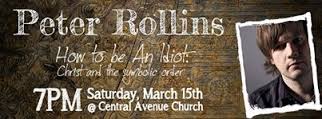
How To Be An Idiot: Christ and the Symbolic Order

rollins idiotRecorded on March 15, 2014 – Those familiar with Pete Rollins work will recognize some familiar themes and stories at the beginning of this video which then moves into some interesting new ideas about “morons, idiots and imbeciles.” Rollins provocative ideas about the relationship of Christ to the symbolic order challenges us all to move beyond our moronic ideas and practices into the roll of idiots so that we might become imbeciles. Well worth a listen for those familiar with Rollins work and for those who have never encountered him before!!!

Can These Bones Live? – a sermon for Lent 5A: John 11:1-45

can these bones liveI am indebted to John Dominic Crossan and Gretta Vosper for the content and the challenges of this sermon.

Readings: Ezekiel 37:1-14, John 11:1-45

ABIDE: Carrie Newcomer and Parker J. Palmer

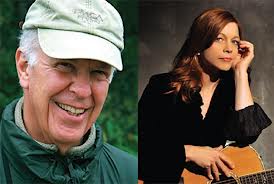
parker palmer Carrie NewcomerI have been a fan of Carrie Newcomer for years – her gentle way of opening me to wonder both sooths and enlightens. I can still remember discovering Parker J. Palmer when I was in seminary and having many of my assumptions about teaching challenged. So, discovering their collaboration was pure joy!!! I’ve been listening to this piece over and over again. Enjoy!!!

Christ in Evolution: Ilia Delio

ilia delioDr. Ilia Delio offers an integration of cosmology and theology which opens the way to a re-articulation of the Christ narrative that is lodged within the reality of our unfolding evolution. Her considerable ability to articulate a wholistic theology which has the potential to move Christianity into the twenty-first century is exciting!!! I am currently devouring her mind-blowing book, “Christ in Evolution” in preparation to spend a day soaking up her wisdom when she visits Guelph in April (for details click here). I hope to have the opportunity to read her latest book The Unbearable Wholeness of Being: God, Evolution, and the Power of Love”, and revisit her earlier book, “The Emergent Christ: Exploring the Meaning of Catholic in an Evolutionary Universe” which introduced me to her exceptional mind. Her just published collection of essays, “From Teilhard to Omega: Co-creating an Unfinished Universe” awaits I will endeavour to post more about her work in the weeks to come. But for now, the video of her lecture “Christ in Evolution” is an excellent introduction to her work. Dr. Delio is an exciting evolutionary theologian whose brilliance is tempered by her sense of humour and her ability to challenge her listeners to stretch ourselves beyond what we think we can possibly comprehend toward a new appreciation of our roles in the ongoing process of evolution. Splendid stuff!!!!

Faith and Begorrrah – A St. Patrick’s Day Sermon

With St. Patrick’s Day just around the corner, I was asked about the sermon I preached last year when the celebration fell upon a Sunday. The person who asked about the sermon remembered laughing a lot during its delivery and encouraged me to re-post it. So, pour yourself a glass of your favourite tipple, sit back and enjoy a laugh.

Readings:  Numbers 27: 1-11; Acts 13:44-51; John 12:1-8

guinnessbeerSt. Patrick’s Day doesn’t often fall on a Sunday, but as our congregation’s Annual Meeting would begin immediately following our worship service, I decided to be somewhat playful and irreverent with a sermon designed encourage folk to think beyond words on a page. The first reading brought the wonderful story of the Daughters of Zelophehad to church and as this reading does not appear in the Revised Common Lectionary it was fun to play withirish these feisty women. The reading from the book of Acts is actually the prescribed reading for the commemoration of St. Patrick and the Gospel text is prescribed for Lent 5C. The Guinness was just for fun! Enjoy.

Listen to the sermon

https://pastordawn.com/wp-content/uploads/2013/03/st_patricks_sermon.m4a

Read a transcript of the sermon here


Approaching the Resurrection – What Did Paul Actually Say?

trouble with resurrection

It may only be the early days of Lent, but many preachers are already beginning to make plans for Easter. Far too many preachers stumble into the celebration of Easter without doing our homework. Resurrection is a central tenant of the Christian faith and Easter is the primary celebration of resurrection and yet, too many of us fail to open ourselves to current scholarship surrounding the doctrine of resurrection. Questions about the nature of the resurrection ought to send us back to the words of the Apostle Paul. Bernard Brandon Scott is a charter member of the Jesus Seminar. His book “The Trouble with Resurrection” is a must read for those who preach during the Easter Season. (some may be familiar with Scott as a result of his contributions to the Living the Questions programs)

If you are planning to write a sermon or listen to a sermon this Easter, this video provides essential background information about the words of the Apostle Paul on the nature of the resurrection which may surprise you. Scott’s treatment of 1 Cor. 15 provides a new understanding of resurrection which is compelling as well as liberating.


Lent: Letting Go of our Tightly Held Piety to See Our Need of Confession

JOHN OF THE CROSS as
Little Crystal was only two and a half years old when she got hopelessly stuck.
 And when she got stuck she did what all small children do, when they have gotten themselves into a situation that the can’t get out of, little Crystal cried for help. She went into her mother’s study, holding in one hand a family treasure and her other hand couldn’t be seen.  Crystal cried out, “Mommy I’m stuck”. Her unseen hand was stuck inside her great-grandmother’s vase.  The precious vase had been handed down from her great-grandmother to her grandmother, to her mother. Crystal had always been told that one day the magnificent vase would be hers.

Crystal’s mother tried to move quickly without panicking. She scooped the vase and her little girl up into her arms and carried them to the kitchen sink. She used warm soapy water to try to loosen the toddler’s hand, which was stuck all right. When soap didn’t work she reached for the butter. While greasing her child’s wrist like a cake pan, she asked the obvious “mother question.” “How in the world did you do this, child?” Crystal carefully explained that she had dropped candy down into the vase to see if she could still see it when it was at the very bottom. But she couldn’t see it, so she reached in for her candy and that’s when she got stuck and she couldn’t get her hand back out.

Well, as time passed, the situation became more and more serious. Crystal’s mother called for re-enforcements. She phoned her own mother and told her to get there as fast as she could. A neighbour suggested Vaseline. The apartment manager got out some WD40. Still no luck.  It began to seem like the only way to get Crystal’s hand out was to break the family heirloom.

When Grandma finally arrived, both Crystal and her mother were almost hysterical. They were both more than a little relieved to have Grandma’s calming presence. Grandma sat little Crystal on her knee. 

Crystal was very upset and still very stuck. Grandma took a good look at the vase that used to sit on her mother’s kitchen table all those years ago.  She looked at the miserable look on her grand-daughter’s face, and she said, “Crystal, sweetheart.  Your mommy told me that you reached into the vase for candy.  Is that right?”

Crystal was a little breathless from all the crying she had been doing and all she could manage was a whimpered, “Mmm hummm.” “Honey, tell grandma the truth now. Do you still have a hold of that candy?” “Mmm humm”.  Crystal sobbed. Then Grandma rubbed little Crystal’s back, held her close and gentle, but firmly said: “Let it go, child.  Let it go.” Sure enough, the vase slipped off as smooth as silk. (I have searched for the source of this story, without success. I first heard it at a retreat on the West Coast a lifetime ago)

In this fast paced world of ours, I often find myself in little Crystal’s predicament.  Surrounded by a treasured family heirloom, desperately clinging to a treasure.  My predicament often makes it difficult for me to appreciate the beauty of the heirloom. Letting go isn’t as simple as it sounds. But sometimes letting go is the only way to preserve the integrity of the heirloom. When I think about the church’s practice of public confession, I can see how desperately I have been holding on to candies that no longer satisfy my need for forgiveness.  Continue reading

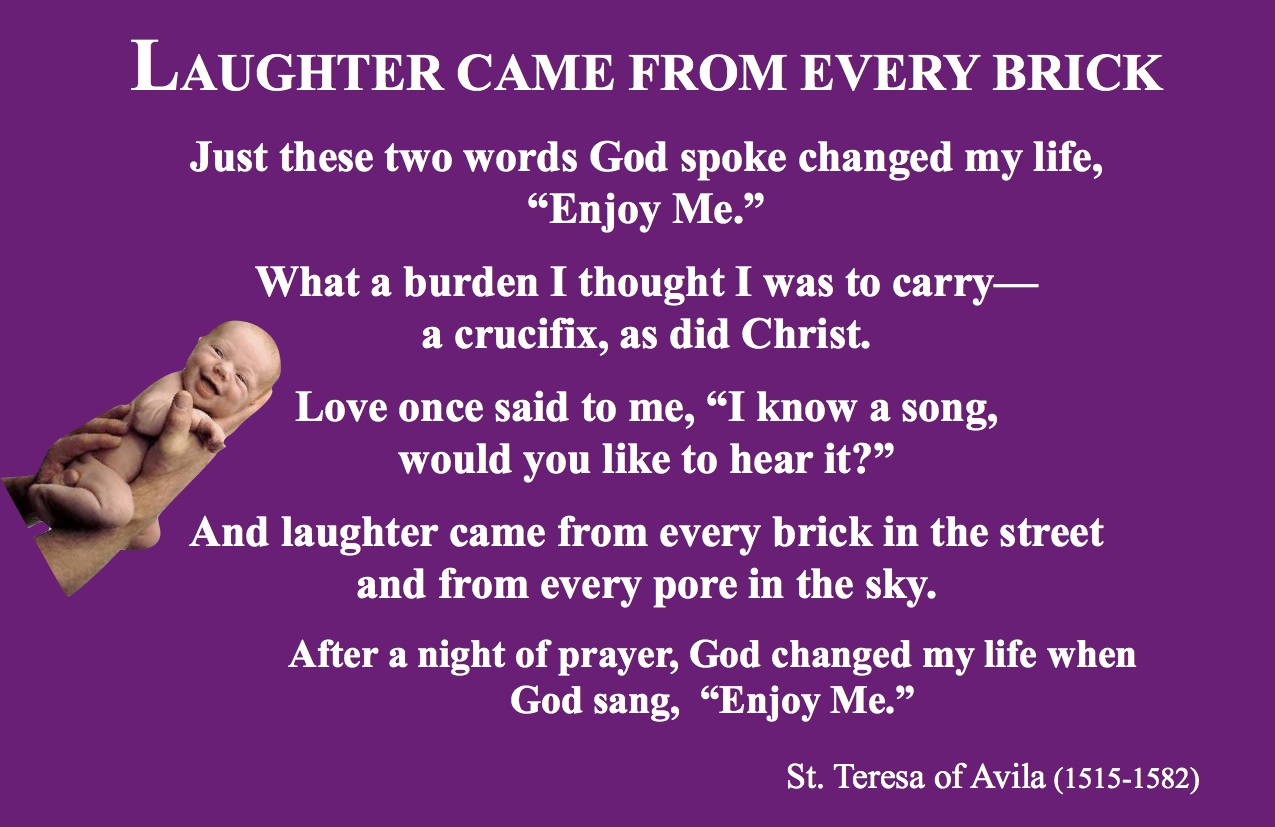
Giving Up Theories of Atonement for Lent in Favour of Listening for God’s Laughter

Laughter St Teresa

Traditionally the season of Lent is a mournful time filled with calls to repentance and self-examination as we follow Jesus into the wilderness to be tempted and then on that long march to Jerusalem where the powers that be will have their wicked way with him. Our liturgies take a mournful tone as we lament our woeful human existence, confess our sinfulness, and hear exultations to take up our crosses so that we too can follow Jesus to the bitter end. Over and over again we are asked to remember that we are in bondage to sin and cannot free ourselves, as we gaze upon the cross remembering that Jesus our savior bled and died as a result of our wicked sinfulness.

Lent is a strange season that harkens back to a forgotten era. Unlike so many of the seasons of the church year it’s not exactly a season that attracts people to church. Not many of you got out of bed this morning and said, “Yippy it’s the first day of Lent. Oh goodie!  We get to be reminded that we are sinful, that life is miserable and unless I’m willing to take up my cross and follow Jesus all the way to Golgotha, there’s precious little hope cause we’re all going to die and when the time comes we want Jesus to remember us.”

Now I know that there are some people who just love Lent and I must confess that I like the quieter, more somber tone that our liturgies take. I actually enjoy the opportunity to slow things done and be more reflective in our worship together. I savor the silences and the opportunities to be more contemplative. I love the colour purple with all its vibrant hues and the best part of all is that the beginning of Lent means that spring is just around the corner. What I don’t like about Lent are the signs, symbols, hymns and stories that make it so easy for us to fall back into the 11th century. Continue reading

I Refuse to Take on Any Lenten Disciplines!

JOHN OF THE CROSS wordsIn the midst of this brutally cold winter I can find no signs that spring is around the corner. To say that it is cold outside is an understatement of epic proportions. Regardless of the challenges of this wild winter, I cannot simply retreat to the warmth of the fireside. I have places to go and people to see. By the time the driveway is shovelled, the ice is scraped, the windshield juice is topped up in my car and all the extra time it takes to navigate the roads in this weather, I can barely complete the regular tasks this busy modern life of ours demands, let alone feel guilty because I’m not adopting some contemplative spiritual exercises that harken back to a simpler time! I heard someone say, “If you are currently not experiencing any stress in your life, you should immediately lie down because it appears that you may be dead.” So, please don’t ask me to take on any Lenten disciplines!

I have also heard it said,  that in Canada the most common response to the question “How are you doing?” is the word “Busy!”. Canadians and I suspect Americans, Europeans, and most inhabitants of the so-called First World, seem to feel the need to justify our existance by assuring others that we are leading busy lives. While I am absolutely convinced that lives lived in the twenty-first century are busier than the lives of our ancestors, I’m not so sure that being busy is something we ought to be proud of.

Growing up, I remember all sorts of predictions about how life in our immediate future would be filled with so much leisure time as a direct result of the technology that would be at our fingertips. But as technology advances, our ability to work wherever and whenever the need arises has severely curtailed our leisure time. Our lives are busy and we have forgotten what it means to be human beings because most of us have become human doers. We have forgotten how to simply be.

I find it reassuring, comforting even, that our ancestors understood  our Creator as YAHWEH, which translated can be understood as “I AM WHO I AM or I SHALL BE WHO I SHALL BE. That the name of God should be understood as the verb “to be” helps me to understand myself as one who is created in the image of the great I AM and not the great I DO. I am a human being not a human doer! What I need from a season like Lent is not a prescription for more things to do. But rather, the encouragement to simply be. 

Might I suggest that we can begin this encouragement to simply be by simply greeting people with a simple word of peace. If such a greeting seems awkward to you then perhaps simply asking people how they “are” rather than how they are “doing” will suffice. Such a subtle change may not be enough for some people to refrain from telling you what or how they are “doing” and you may find them insisting that they are indeed “busy”. But a little gentle persistence may enable some to respond about their very being. Reminding one another that we are beings and not just doers might lead us toward some peace. Shalom, As-salam alaykum, Peace dear beings, Peace…..

Faithfulness to the Opportunities and Talents We Have Been Given: Parker Palmer

Over the years, I have learn so much from Parker Palmer. In this video Palmer warns of the perils of using effectiveness as our only measure and insists that by asking ourselves the question: “Am I being faithful to the opportunities and talents we have been given?” allows us to see beyond our obsession with numbers, results and immediate effects so that we can be about the work of love, justice, and peace.

[vimeo 35028736 w=600&h=338]

We Are ONE: an Ash Wednesday Homily

To help remind us that we are stardust, begin with this video: The Call of the Pleiades – Gerald Jay Markoe

When I was a Child, I was afraid of the dark.

When I was a child I was afraid to venture forth from the familiar.

When I was a child I was afraid of loosing people I loved.

When I was young I would look into the night sky afraid that I’d never be able to understand it all.

When I was young, I would look up at the stars afraid that God was just a figment of our wishful imaginations.

When I was young, a pastor smeared ashes upon my forehead and I was afraid because I thought I might die in bondage to sin.

When I was young, I heard the words “remember that you are dust and to dust you shall return” and I was afraid because I knew that I was nothing more than a worthless sinner.

When I was young, I caught sight of my face in the mirror and I was afraid because the ashen cross on my forehead reminded me that soon I would be dead and to dust I would return.

When I first became a pastor, I mixed the ashes and the oil together and I was afraid that the power of the ritual would remind us that we are dust and to dust we shall return and I was afraid because I loved you and couldn’t bear to loose you.

When the years passed, and ashen crosses became routine, I began to fear that the power of the ritual would fail to remind us that we are dust and to dust we shall return.

When I first became a theologian, I was afraid because I feared that our confessions convicted us of crimes too horrendous to be our own.

When my questions drove me into the wilderness of doubt, I was afraid that the MYSTERY would overwhelm me and even more afraid that in the wilderness I would find no MYSTERY at all.

When I first opened myself to the wilderness that surrounds us, I began to see my fears and I was afraid that I was not worthy of the MYSTERY for which I longed.

When I awakened from my fears, my eyes were clouded by sleepy dust; that strange dried mucus that forms as our tears harden beneath squinting lids that are determined to hide from us the Light we both long for and fear.

When I began to clear the dust from my eyes, it took time before I found the courage to gaze into the night skies to see the millions of bright lights that beckoned me to open myself to the ONE who is MYSTERY.

When I began to feel the embrace of REALITY, I was afraid because I knew that I too am fearfully and wonderfully made capable of reaching out beyond myself to the MYSTERY we call God.

When I began to trust that I too AM the result of the initial bursts of creative energy that brought the universe to birth, I saw in the night skies the light from the dying stars whose dust contains the stuff of life.

When I see the light shining in the darkness, I am beginning to know that we share the light’s energy. The Being that flowed through our ancestors lives and breathes in us.

When I begin to understand that the elements that make up my being are the elements born of stardust, I know that my own molecules have known unimaginable joy, outrageous pain, indescribable beauty, unspeakable suffering, as we journey from dust to dust.

When I consider that we are all One, you and I and the MYSTERY who creates, nourishes and sustains us, we are ONE.   I hear the words that Jesus spoke over and over again: do not be afraid, have no fear, fear not, for I and ABBA are ONE and where once I saw only wormwood and gall, I am beginning to see life and beauty, and love and eternity as we move from stardust, to dust.

To claim that we are stardust is to trust that we are connected to all that is, all that has ever been, and all that shall ever be.

 We are not small. We are not insignificant. We are not just dust. We are intimately ONE with the Source of Being, ONE with Christ, ONE with the Spirit that breathes in all of us; ONE with another, for we are LOVE, and LIGHT, LIFE and DEATH, I and THOU.

Now when I mix the oil and ashes, I sprinkle a few sparkles to remind us that we are not just dust, but stardust, intimately, intricately, interconnected.

 Now the darkness reveals the MYSTERY, the ULTIMATE REALITY, the ONE we call GOD, the ONE who gently beckons us forth into the light of life and the joy of living, trusting that here and now eternity is ours to embrace.

When I was a child, I was afraid of the dark.

I have lived too long under the condemnation constructed by stories that no longer inspire life.

In the starlight, the darkness gives way to eternity.

New stories are born; stories that share the truth of love and life, here and now.

I AM dust, the stuff that stars are made of.

I AM ONE with the LIGHT of LIGHTS, the Source of All Being.

Dust I AM and to dust I shall return; into the MYSTERY; the MYSTERY Who beckons us forth into life, beyond death, asking only that we have no fear, for we were made to embrace eternity.

Remember that we are dust and to dust we shall return.

For we are divine, One with GOD, now and always. Amen