Whose Persistence? Preparing to Preach on the Parable of the Pleading Widow

pleading widowLooking back on a sermon I preached six years ago on this week’s readings from Genesis 32:22-31 and Luke 18:1-8, I am struck by how much my own images of the Divine One we call God have changed and yet remain oddly similar. The intervening years have afforded me the opportunities to begin to leave behind notions of an anthropomorphic God who intervenes in our lives. As I have embraced the writings of progressive and evolutionary theologians, I have struggled to understand and articulate God’s nature from the perspective of panentheism (everything is in God). There are those who suggest that this is a departure from the Christian tradition. Yet looking back, I am beginning to see this movement as a natural progression of the tradition. Indeed, so much of what I have always loved about Lutheran theology has freed me to explore this path. So, I offer this old sermon as a snapshot of my own pathway toward new visions of the Divine. I trust that my early efforts to move beyond the notion of God as the “unjust judge” will move some to begin to see God in, with, and through all those who persistently plead for justice. 

What little I know about the art of wrestling I learned from my brother Alan. He and I are just eighteen months apart in age and together we participated in many a wrestling match. All too often one or the other of us would be bothering the other and before we knew it we were rolling around on the floor wrestling. I’ll have you know that up until the age of about twelve I was quite a good wrestler. Up to that point I usually managed to hold my brother to the ground and with my knees firmly pinning his arms I would be able to get my brother to agree to my point of view. But my brother’s adolescent growth spurt put an end to my winning streak. Just as soon as my brother was big enough to pin me to the ground I decided to stop bothering him. Bothering my brother became dangerous and I had to give it up in order to save my dignity. Continue reading

Ubuntu: Compassion brought into colourful practice.

go be love

“I must never allow my neighbour to go hungry while I’ve got a little food in my house…We as human beings must sustain each other even during times of greatest peril.”  Let our Thanksgiving become compassion and let us bring our compassion into colourful practice!

Critical Thinking and Faith: Phyllis Tickle

critical thinkingPhyllis Tickle is a treasure!!! Let her no-nonsense, down-to-earth, humorous  way of articulating what should be obvious provide encouragement to the timid who sit quietly hoping that someone else will question the dogmas and doctrines that dull our senses. Let herrethinking questions inspire more questions and let set aside our carefully held notions of reality and embrace the awe and majesty of the Mystery we call God. 

The Future of the Church: Phyllis Tickle, Brian McLaren and David Lose

future churchA conversation with Phyllis Tickle, Brian McLaren, and David Lose recorded Oct. 7, 2013, and hosted by Luther Seminary, St. Paul, Minn., during the Celebration of Biblical Preaching.

THINKING About GOD??? Philip Clayton

philip claytonOur Adult Study is currently being inspired by the new study program Painting the Stars (Living the Questions). Philip Clayton is one of the contributors to the program. Clayton is the Dean of Claremont School of Theology (Phd.  Yale – philosophy and religion) who is seeking the development of “a constructive Christian theology in dialogue with metaphysics, modern philosophy, and science.” Here are two short videos that provide an introduction to Clayton’s ideas. 

Painting the Stars

Radically Faithful: Passionate Christianity Confronting Empire and Savage Inequality – John Dominic Crossan

John Dominic CrossanJohn Dominic Crossan is by far my favourite New Testament scholar. That he just happens to be one of the leading New Testament scholars in the world has something to do with why I hold his work in such high esteem. More importantly, my love for Dom stems from the generosity with which he has shared his gifts, talents, wit and considerable charm with our little congregation. Holy Cross has been blessed to play host to Dom twice and during his weekends with us we  learned so very much from him. 

In the videos below, Dom delivers three lectures at All Saints Church in Pasadena (2010). The dvd education program mentioned at the beginning, “The Challenge of Jesus” is brilliant. Holy Cross’ Adult Education Class used it in 2011 and I highly recommend it!!!

Does Science Reveal that Death is No Less Sacred than Life? – Michael Dowd

evolutionary christianityEvolutionary Christian, Michael Dowd suggests that we are in the early states of what he calls an “evidential reformation” that is where our best map of what is real and what is important doesn’t come from the church hierarchy or the Bible but with scientific evidence.  In this video Dowd looks to Big History, Human Nature, and Death and Chaos from an “evidential standpoint” to offer an “Inspiring Vision of the Future” and “enrich our communion with reality”.

For more on Michael Dowd follow this link

The Church is Like a Desert in an Oasis: Peter Rollins

Crucified Identities Peter Rollins PastorDawn

“So, When People Say, ‘That Doesn’t Line Up With Lutheran Doctrine’ I Couldn’t Care Less!”

Bell bkFor me the heart of this conversation is expressed by Rob Bell: “The word ‘evangelical’ means ‘good news’ right? Yea, so we’re all about good news, right? So whatever else that word means, I would hope that we are all people of good news. So, if that word refers to a tribal group deeply aligned with an industrial military complex and the furthering of an empire that has on occasion stormed through the world a little more briskly than we would like, tied into a political party that has an agenda often run by multi-national corporations, I’m not interested. But if its referring to an open tomb and hope for everybody, I’m in. “

“So, you either walk away from the word, and say I don’t want anything to do with that, or the word ‘radical’ has its root in the word radix which is a Latin word that means root. The radical is the person who goes back to the roots. So, you either walk away from it or you grab it and say, ‘No, this is what it means.’ And you just hold on tightly. Secondly, I’m interested in anybody who has fresh word about Jesus: Lutherans or Methodists or Anglicans or Evangelicals, or Catholics, or Jedi. If you have fresh insight into Jesus, that’s what I’m interested in. So, when people say that doesn’t line up with Lutheran doctrine, I couldn’t care less. Is that a fresh word about Jesus?”

“I actually think that what you are realizing right now is that some of these tribal systems are falling apart because all of a sudden I’m having fish tacos with Richard Rohr and Peter Rollins shows up and its just an absolute potluck of  Jesusness. I think what’s tipping now is people are going, ‘You’re interested in following Jesus and I’m interested in follow Jesus and that trumps whatever institution we get our pay-cheque from.”

Video recorded in April 2013 at the Seattle School of Theology. The interviewer lacks depth, but if you fast forward to the Q & A (28min mark) the students questions provide Bell with an opportunity to delve a little deeper.

Beyond Tribalism – Preaching a 21st Century Pentecost

Ideas gleamed from Clay Nelson, John Shelby Spong,

John Dominic Crossan and Marcus Borg

The splendid preacher Clay Nelson of St. Matthews-in-the-City, Auckland, New Zealand, opened me up to a new way of seeing Pentecost.  Nelson tells this lovely little story written by fellow Kiwi Judy Parker, entitled simply “The Hat.”

A priest looked up from the psalms on the lectern, cast his eyes over all the hats bowed before him.   Feathered, frilled, felt hats in rows like faces.  But there was one at the end of the row that was different. What was she thinking, a head without hat.  Was like a cat without fur. Or a bird without wings. 

That won’t fly here, not in the church. The voices danced in song with the colours of the windows.  Red light played along the aisle, blue light over the white corsage of Missus  Dewsbury, green on the pages of the Bible.  Reflecting up on the face of the priest. The priest spoke to the young lady afterwards:  “You must wear a hat and gloves in the House of God. It is not seemly otherwise.”

The lady flushed, raised her chin, and strode out. “That’s the last we’ll see of her,” said the organist.

Later:  The organ rang out; the priest raised his eyes to the rose window.  He didn’t see the woman in hat and gloves advancing down the aisle as though she were a bride.The hat, enormous, such as one might wear to the races. Gloves, black lace, such as one might wear to meet a duchess.  Shoes, high-heeled, such as one might wear on a catwalk in Paris.    And nothing else.

Now some people might ask, “Is this a true story?”  And I’d have to answer that this story is absolutely true!  Now for some that answer might not be enough and they’d want to know, “Did this actually happen?” Well, I’d like to think so. But I doubt that it actually happened. But whether it actually happened or not, most of us know that the truth in this story lies in the power of metaphor.

Metaphor, which literally means:  beyond words. The power of metaphor is in its ability to point beyond itself to truths beyond those that are apparent. And the metaphor in this story points us to buck-naked truths about tradition, worldly power, patriarchy, hierarchy, orthodoxy and many more truths about the very nature of the church itself and religion in general. It doesn’t matter whether or not this actually happened or not. What matters is what we can learn about ourselves and our life together from this story. Continue reading

Conversations Beyond Church: A Place for Rob Bell’s New Book

Bell bkIn the twenty-first century, all too many of the conversations about God are simply beyond the Church. By that I mean, talking about God to people who are outside of the Church is simply beyond the Church’s demonstrated abilities. The faithful remnant who scurry about within Christianity may talk about talking to people who have left the church, or people who have rejected the church, or even to people who have never darkened the door of a church. But when push comes to shove, very few of us are capable of engaging in serious conversation with those who live their lives beyond the Church. Rob Bell’s newly released book: “What We Talk About When We Talk About God” may not be a deep theological endeavour. It may not offer much that is new or insightful. But it does have a place in the conversations that don’t seem to be happening between church-goers and those who live beyond the Church. Indeed, Bell’s book might enable those of us who talk about talking to those outside the walls of the Church to actually begin a conversation with someone who does not share our beliefs. 

In my experience of speaking to those who have rejected Christianity and the Church, I have discovered that the God and the religion that so many people have walked away from the Church over, is not the God or the religion that Christianity, at its best, actually proclaims. Bell’s book articulates a Christianity that is closer to the faith most church-goers actually embrace.

Following the success and controversy surrounding his book “Love Wins”, Bell has the notoriety to generate the kind of interest that leaves the average church professional drooling in an  “if only I could generate that much interest” kind of way. So there will be plenty of “tut, tuts” coming from those who will insist that it’s not a serious academic work. But don’t let their jealousy of Bell’s appeal fool you. Bell has matured some. He’s been talking to scientists and he’s been influenced by academics and he has made an attempt to talk about God in ways that the unchurched as well as the churched will find engaging. Bell’s also been talking to Peter Rollins (Irish philosopher and theologian) whose work appears to have had a refreshing influence on Bell. Indeed, Bell has chosen a title that  could be considered a positive restatement of Rollins’ first book title “How (not) to Speak of God”. 

Whether your a fan of Bell’s work or not, it’s difficult not to concede that Bell has mastered the art of communicating in this social media world in which we live. “What We Talk About When We Talk About God” provides an effective tool that will enable many of us to engage in conversations beyond Church. I’ve already purchased several copies and can’t wait to engage in a conversation or two with folks who are ready to engage in talk about God. Bell has given us the gift of a place from which to begin to engage in some serious God-talk.

Below you will find a promotional video created to promote the book, that will wet your appetite for the second video in which Bell lecture at Vanderbilt addresses some of what you will find in the book. Enjoy and after you read the book, use it to begin a conversation beyond Church.

Promotional Video for “What We Talk About When We Talk About God”

Rob Bell Speaking at Vanderbilt University

A Tough Week for the Planet: Earth Sunday Sermon

earth-day-2013On the heels of Peter Rollins visit to our congregation last weekend, this Earth Sunday sermon flows out of Peter’s work. You can listen to Peter’s sermon which is the jumping off point for this Earth Day sermon here

Listen to the Earth Day sermon here

Worship Bulletin here

The readings are here

The video of the excerpt from Chief Seattle’s Response is below


Resurrection: “Believe Whatever You Want About What Happened. Now Can We Talk About What This Story Means”

borg & Holt

Recorded February 7, 2013: Marcus Borg and Charles Holt discuss Jesus’ resurrection.

“A Revelation of Darkness” – Sermon

peter rollins_thumb[1]Peter Rollins was our guest preacher this Sunday and took us beyond the surface of the story of Paul’s revelation toward the darkness from which we all too often hide.

The scripture readings can be found here – The Worship Bulletin here

You can listen to Peter sermon here

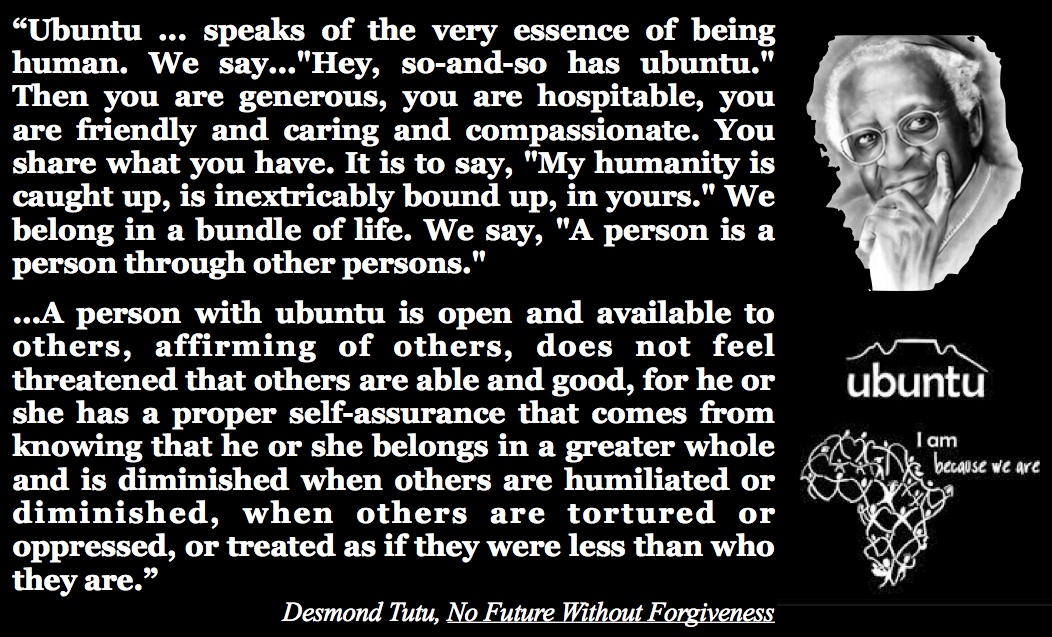
Ubuntu: I Am Because We Are: Desmond Tutu

Ubuntu -- pastordawn.com

Desmond Tutu, Peacemaker: A conversation with Desmond Tutu and John Allen. Recorded March 21, 2013 by Pepperdine University School of Law. This brilliant video provides an opportunity for Desmond Tutu and his Press Secretary John Allen to reflect upon the work of South Africa’s Truth and Reconciliation Commission. It is a marvellous testament to the potential for goodness that exists in humanity. Tutu’s use of the African word “ubuntu” to express his conviction that we cannot be fully human without other humans is wisdom born of human evolution witnessed up close and personal.

The Passion of Jesus: Holy Week, Good Friday and Easter: Marcus Borg

last-weekSpeaking on March 18 2013, Marcus Borg breathes life into the book he wrote with John Dominic Crossan: “The Last Week”

Thanks Marcus, now I have this song on the brain!

Suicide Bombers and Barefoot Prophets: The Forces of Radical Religion in the Early 21st Century

philip clayton chautauquaPhilip Clayton is the Dean of Claremont School of Theology and Provost of Claremont Lincoln University. He also holds the Ingraham Chair at CST. Clayton earned a joint PhD in Religious Studies and Philosophytransforming from Yale University and has held visiting appointments at Harvard University, the University of Cambridge, and the University of Munich. He has published over 20 books, the latest of which “Transforming Christian Theology: For Church and Society” is a must read for anyone presuming to do theology in public. The book is close to a definition of “progressive Christianity” as you are likely to find. 

The Marriage of Church and Empire – Phyllis Tickle

cdtickle1As the Roman Catholic Church prepares to elect a new pope, this presentation by Phyllis Tickle seems very timely. Tickle provides a history lesson which enlightens us on the marriage between the church and empire that gave birth to Western Christianity. Tickle is convinced that a whole new day is dawning in this post-Constantinian church that promises to seriously engage the 21st century.

Recorded on Feb. 26, 2013 at Calvary Episcopal Church in Memphis Tennessee during their annual Lenten Preaching Series. 

Lenten Evening Prayer: Parables Ancient and Modern – Great Misfortune

Orthodox HereticThis year our Lenten Evening Prayer services draw on Peter Rollins collection of Parables found in “The Orthodox Heretic and Other Impossible Tales”. Prayers are drawn from the writings of the Christian Mystics. Each week an audio recording of the service will be posted as well as a copy of our worship bulletin. 

Evening Prayer a copy of the worship bulletin can be found here – it is designed to be printed double-sided and folded into a booklet.

Listen to the worship service here

A Brief Encounter – Peter Rollins

a brief encounterPeter Rollins will wind up his visit to Holy Cross in Newmarket with a Pub Night on April 14th. For details check out the brochure here.

Speaking at ikonNYC Peter Rollins looks back to the classic movie A Brief Encounter to explore the relationship between belief and unbelief as well as the nature of scapegoating as a means of avoiding inner conflict.