Mothers’ Day Angst – sermons for a day not included in the liturgical calendar!

True Mother Julian of NorwichMothers’ Day is not on the church’s liturgical calendar and yet the statisticians tell us that church attendance on Mothers’ Day is surpassed only by Christmas and Easter. Worship leaders who fail to mark the importance of this day do so at their peril; the same kind of peril that compels so many reluctant offspring to accompany their mothers to church. However, a simple liturgical nod in the direction of mothers or an over-the-top sentimental sermon all too often fails to capture the magnitude of the day’s significance in the history of women.  Planning the liturgy is challenging enough, but writing the sermon is a challenge which promises to keep me toiling away into the dark hours of this coming Saturday. So, for my colleagues who share a similar plight: below you will find links to previous attempts to commemorate this day of days. Feel free to share your efforts with me in the comments section. Please! I need all the help you can offer!!! click on the links below for previous Mothers’ Day sermons:

Enough for Everyone

Breasted ONE

Sophia/Wisdom

MOTHERS’ DAY – Peace is the Way

Preaching on Mothers’ Day – Don’t Compromise

Another Option for Mothers’ Day: Bring Many Names

SHE Who Dwells Among Us – A Mothers’ Day Sermon

Arise on this Mothers’ Day: a sermon

ONE in GOD – a sermon


We Are All ONE – Pluralism Sunday – John 21:15-17

A long time ago, I owned a beat-up 1969 Chevy Nova that I paid less than $700 for in the hope that that old car would last long enough to get me through my undergraduate years at the University of British Columbia. I was a late bloomer. I didn’t get around to doing my undergraduate degree until I was 32 years old, when I enrolled in the Religious Studies program at UBC. I was living in a shabby basement apartment, where the rent was cheap, but the parking was non-existent. If I was lucky, I’d find a parking spot in the alley behind my apartment. Walking in that dark alley at night was more than a little scary. Often, as I was hurrying through that dark alley, I would see this old woman who was living rough in a makeshift tent. It wasn’t much of a shelter, just some cardboard held together by old clothes and torn grocery bags.

The old woman and I never spoke to one another. After several weeks of seeing one another in that back-alley, we would quietly nod in recognition of one another. I knew that she belonged in the neighbourhood and she knew that I belonged in the neighbourhood. Neither of us was comfortable in the back alley at night and it seemed almost comforting to see a familiar face, rather than running into some totally unknown stranger.

One morning as I was hurrying off to class, I heard the old woman moaning underneath her makeshift tent. I am ashamed to say that her moans frightened me, and I dashed to my car, unlocked it as quickly as I could, and drove off to the university so that I could continue my study of the religions of the world. The irony was not lost on my and I was ashamed.

I had some brilliant professors at UBC who taught me all sorts of things, but none of those wise professors ever taught me as much as one of my fellow students taught me. My classmate Sannidhi taught me more about religion than any professor. Sannidhi is a Hindu who I suspect has traveled this earth in many incarnations. Sannidhi possessed wisdom beyond his 20 years of age. To this day, some of what I learned from Sannidhi, I continue to try to teach others. It was Sannidhi who taught me the Hindu understanding that all gods are but pale imitations of the ONE God who lies at the very heart of all that IS. It was from Sannidhi that I first learned the Hindu description of the MYSTERY that we call God, that I have come to love above all other descriptions of the DIVINE ONE. I’ve shared this description with you many times:  “God is beyond the beyond and beyond that also.”

Despite the difference in our ages and backgrounds or maybe because of them, Sannidhi and I became study partners. Together, we navigated the murky waters of Religious Methodology as we tried our best to move beyond our own religious practices so that we could learn from the religious practices of others. Sannidhi often spoke about his home in India and how he couldn’t wait to show me what India was really like.

One evening I offered Sannidhi a ride home in my car. To this day, I’m not sure whether or not he was teasing me or if he actually was seriously impressed with my old Chevy. I remember him running his hand over its white vinyl roofand making a sort of tutting sound as his head bobbed from side to side and he expressed his admiration for such a fine mode of transport. Driving along, our conversation about the nature and reality of God was so engrossing that I invited Sannidhi to stop off at my place for a cup of tea so that we could continue our conversation. That’s how we ended up talking to the old woman who live lived in the back-alley behind my basement apartment. turns out her name was Joanna. In just a few moments, Sannidhi had learned that she liked milk and just a touch of sugar in her tea. I myself had never dreamed of offering the old woman a cup of tea. Sannidhi never dreamed of not offering her a cup of my tea. Continue reading

“Resurrection: Not a One-Time Miracle” – Richard Rohr

richard rohr

Can the ways in which we tell the stories of resurrection transform us into followers of Jesus who embody a way of being in the world that can nourish, ground, and sustain the kind of peace that the world yearns for? In responding to this question, our understanding of the Christ all too often restricts the way in which we tell our stories of resurrection. Richard Rohr’s sermon preached at All Saint’s in Pasadena follows readings from Acts 5:27-32 and John 20:19-31 and pushes us to broaden our visions of the risen Christ. 

Jesus forgives Peter: a Way to Understand the Resurrection – Richard Holloway

Peter Callesen's Papercut Resurrection

Peter Callesen’s Papercut Resurrection

As the resurrection stories continue, the story Jesus’ encounter on the lakeshore explores forgiveness in ways that open us to our own   moments of desperation as we too long to be forgive or to forgive. Richard Holloway, the former Primate of the Scottish Episcopal Church, interprets the story of the resurrection not as an historical tale, but as our own story. Holloway has written of his longing for a humbled and broken church. His own humility and brokenness shines through this video as Holloway embodies his own longing.

Resurrection: Believing is NOT the point! – sermons for the Second Sunday of Easter

Looking ahead to Doubting Thomas’ annual appearance, I am reminded that resurrection is not about belief. Resurrection is a way of being in the world. Over the years I have tried serval different approaches to encourage the practice of resurrection. click on the titles below to see

Believing in Resurrection is NOT the point! click here

Easter: 50 Days to Practice Resurrection! click here

Humpty Dumpty, Doubting Thomas, and Resurrection click here

Leap of Doubt – How Do We Believe Resurrection? click here

Can the ways in which we tell the stories of resurrection transform us into followers of Jesus who embody a way of being in the world that can nourish, ground, and sustain the kind of peace that the world years for? click here

Practicing Resurrection: Forgiveness click here

Apostle to the Apostles: Mary’s Story

a to aThis coming Sunday, in churches all over Christendom, worshippers will hear the gospel story of Doubting Thomas. The story of Doubting Thomas is prescribed gospel reading every year for the Sunday after Easter. I’ve never understood why Thomas should hold such a prominent place in our lectionary: I mean, as the stories have been handed down to us, when the chips were down, and Jesus could have used their support, Thomas and the guys deserted Jesus; they left him alone and spread out across the city to hide from the Romans and the religious authorities. According to the anonymous-gospel-story-tellers, it was the two Marys, together with the other women who had financially supported Jesus’ ministry, and who stuck by him to the bitter end. Also according to the anonymous-gospel-story-teller, we know as John, it was Mary, the one they call Magdala who brought back the news that Jesus was not dead, but had risen. Despite the fact that Mary Magdalene was the one chosen to be the Apostle to the Apostles, (the word apostle comes from the Greek for “the one sent”) our lectionary quickly moves on from the empty tomb to the upper room so that we can all once again explore the story of good old, doubting Thomas.

So here, let me honour Mary the Apostle to the Apostles with this my imaginary account of Mary’s story. Remember the power of our imaginations to breathe life into what appears to all the world to be dead. 

Shalom.  I greet you in the name of our risen Christ. My name is Mary.  You may know me as Mary Magdalene. I am not from around here.  I come from a good family in Magdala.  Magdala is a wealthy city on the Sea of Galilee, just south of Capernaum. My family made a lot of money in the fishing industry in Magdala.  While I was growing up I lacked nothing.  But I was not happy.  I was sick.  I would sit around the house moping and complaining and make everyone miserable.  I was so distraught.  Often I was so upset that I pulled out my own hair.

Sometimes I would be so excited that people couldn’t stop me from talking.  I ran up all sorts of bills in the market place which my parents had to pay.  I was always cooking up some mad scheme or other.  I would rant and rave at the slightest provocation.  From time to time I would become ill and stay in bed for weeks on end.  I knew something was terribly wrong and nothing seemed to ease my anxieties. I was a prisoner inside my own mind. Then I met Jesus.  He was teaching outside of the synagogue.  At first, I just stood back in the crowd and listened as he spoke about a new world which God intended to create. It would be a world where the sick are healed and prisoners are set free. I wanted to taste this freedom which Jesus spoke about. I wanted to ask him so many questions.  But the crowd pressed in upon him demanding that he tell them more and I was pushed farther away from him. In despair, I turned to leave. Continue reading

Earth Day: Every Bush Is Burning

On the heels of Peter Rollins visit to our congregation, I preached this Earth Sunday sermon which flows out of Peter’s work. You can listen to Peter’s sermon which is the jumping off point for this Earth Day sermon here

Listen to the Earth Day sermon here

Worship Bulletin here

The readings are here

The video of the excerpt from Chief Seattle’s Response is below

Today, this planet celebrates Earth Day; a time to pause and celebrate the wonders of this planet and to consider the fate of this planet. The church has no day on its calendar to either celebrate the Earth or to pray for the survival of the Earth. Indeed, there are churches in Christendom that actively pray for the demise of the planet, so as to hasten the arrival of Christ.  When I preach about the plight of the Earth, I usually point out some ecological disaster and encourage us all to take better care of the planet.  While there are plenty of ecological disasters that I could point to that’s not what I’m interested in today,  because let’s face it, if you’ve read this far, I’d only be preaching to the choir.  We all know that the planet is in grave danger and that we all have a role to play in saving the planet. Today, I want to talk to you about something that lies at the very heart of our abuse not only of the planet but of one another. You see all week; I’ve been haunted by a line from Pete Rollins sermon last week.

Peter was talking about the gift that Christianity has to offer the world a gift that has the potential to move us beyond religion toward a more connected holistic way of being in the world. The line that has been haunting me all week came near the end of Peter’s sermon. It was almost a throwaway line and with Belfast Peter’s accent and the speed with which he speaks, I almost missed it. Peter said that all too often what we see in religion is our desire to have some sort of holy experience; a burning bush experience like Moses. We want to find this place where the Holy is and there always seems to be things getting in the way of our having this holy experience.

There are people getting in the way and structures getting in the way of this burning bush experience. Pete insisted that in the what he described as the Apostle Paul’s conversion of bedazzlement, in this incomprehensible blinding revelation that seems so incomprehensible, so transformative has the power to transform us so that we can see inside of ourselves and we can begin to see that every bush is burning. We can begin to see that the sacred are everywhere; that the persecuted ones are the place of our transformation and our conversion. Continue reading

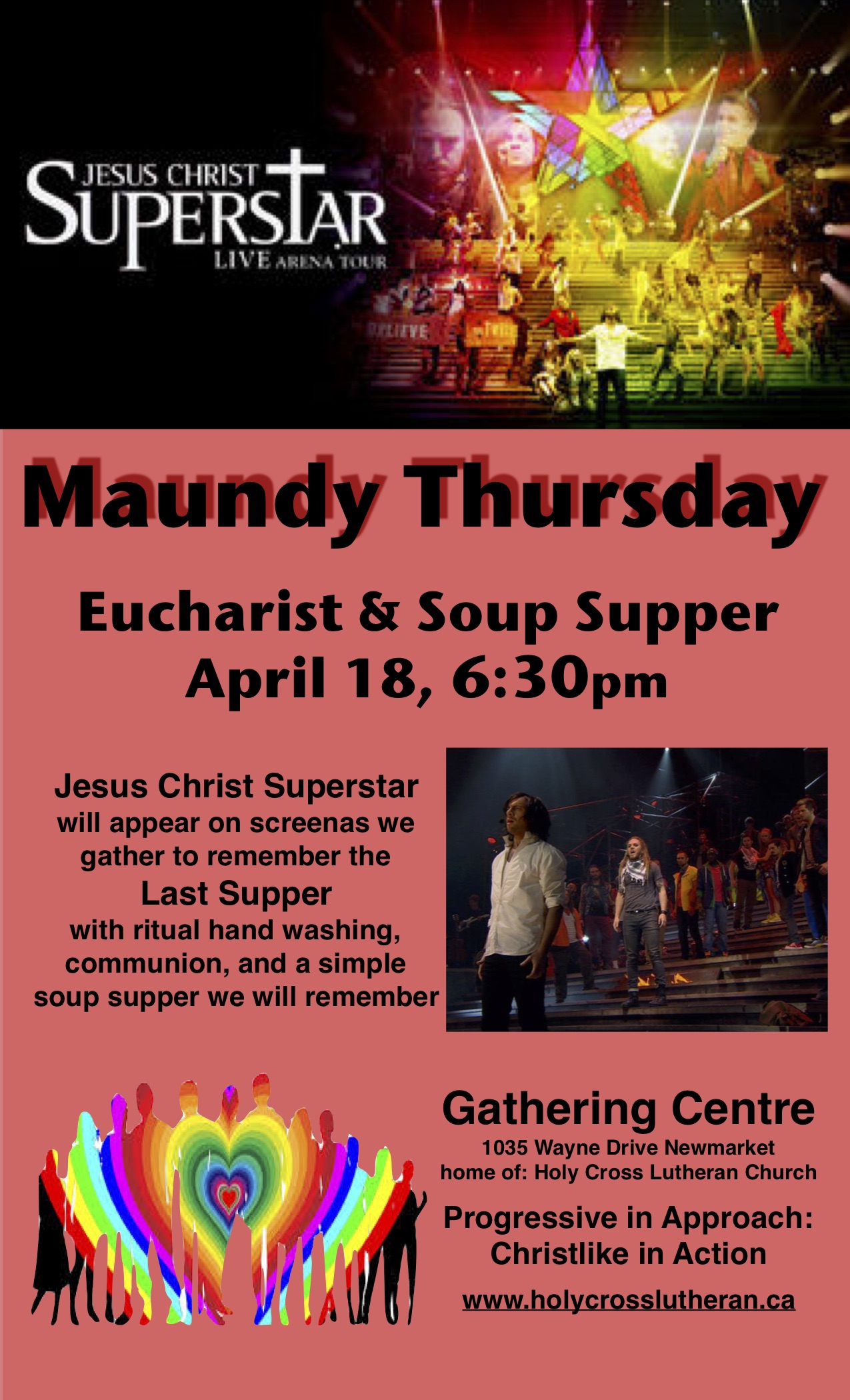
Each Maundy Thursday we must peer beyond Passover lambs and scapegoats if we are to catch a glimpse the LOVE that we call God

Every Sunday I stand at the altar and preside over a mystery. A mystery that has its roots in the events we remember this Holy Thursday.  On Maundy Thursday, we gather together to contemplate MYSTERY. We know what will happen tomorrow as Good Friday plunges us into darkness. So is it any wonder that we cannot fully comprehend this MYSTERY.

The various gospel writers have created a record of Jesus’ last evening that is filled with bittersweet images. Our mystery begins with the foreshadowing of what is to come as we hear the name Judas Iscariot. Judas, son of Simon, is perhaps the most trusted of Jesus’ disciples, after all Judas is the one who is trusted with the financial resources of this struggling little group. Even though we know Judas’ role in this unfolding mystery, we must remember that Judas is among those who Jesus loved to the end. But long before the silver changes hands, we already know enough to dread the betrayal.

Our mystery continues with the tender intimacy of a teacher washing the dirty feet of his beloved bumbling students, as Jesus breaks the bonds of decorum to demonstrate the fierce tenderness of loving service. The image of Jesus washing the feet of his followers still seems undignified all these centuries later. So, is it any wonder that the intimacy of Jesus’ tenderness is more than Simon Peter can bear? In order to get beyond their inhibitions, Jesus must spell it out for them.  “Do you know what I have done to you? You call me Teacher and Sovereign —and you are right, for that is what I AM. So, if I, your Sovereign and Teacher, have washed your feet, you also ought to wash one another’s feet. For I have set you and example.” Jesus has washed their feet; all their feet, even Judas and the talk of betrayal continues as Jesus returns to the meal.

The writer of the Gospel of John does not record the details of the breaking of the bread or the passing of the cup. These details are recorded by Paul in his letter to the Corinthians and by the writers of the gospels of Mark, Matthew, and Luke: “on the night he was betrayed, our Savior Jesus took bread, gave thanks and broke it, saying, “This is my body, which is broken for you. Do this in remembrance of me.” In the same way, after supper, he took the cup and said, “This cup is the New Covenant in my blood. Whenever you drink it, do it in remembrance of me.  For every time, you eat this bread and drink this cup, you proclaim Jesus’ death until Christ comes.” Week after week, year after year, generation after generation, century after century Christian priests have presided over ritual communions using what have become known as the words of institution. In remembrance of Jesus we eat and drink. The body and blood of our Saviour Jesus Christ. And therein lies the mystery. The mystery of communion. Sometimes the meal has transforming power, nourishing power, restorative, profound power. At other times the meal is just one more religious ritual carried out by rote, experienced without feeling, or impact. Sometimes the meal seems foreign to us, almost alien, perhaps even barbaric. Continue reading

Easter Sermons: LOVE IS – Risen!

click on the links

2018 – LOVE Is Risen! here

2017 – LOVE is Risen! LOVE is Risen Indeed! here

Is God Coming Back to Life here

Easter: Yes, Yes, Yes, Laugh – here 

Easter: The Greatest Story Ever Told – here

I Plead Guilty to Denying the Resurrection – But I aint’ leaving – here

Preparing to Preach on Resurrection: Giving up the notion of a physical resuscitation. here

Approaching Resurrection: What Did Paul Actually Say – here

A Resurrection Story In Memory of Nellie, My Gran – here

Words Will Always Fail Us – here


Approaching the Resurrection – What Did Paul Actually Say?

trouble with resurrection

Far too many preachers stumble into the celebration of Easter without doing our homework. Resurrection is a central tenant of the Christian faith and Easter is the primary celebration of resurrection and yet, too many of us fail to open ourselves to current scholarship surrounding the doctrine of resurrection. Questions about the nature of the resurrection ought to send us back to the words of the Apostle Paul. Bernard Brandon Scott is a charter member of the Jesus Seminar. His book “The Trouble with Resurrection” is a must read for those who preach during the Easter Season.

If you are planning to write a sermon or listen to a sermon this Easter, this video provides essential background information about the words of the Apostle Paul on the nature of the resurrection which may surprise you. Scott’s treatment of 1 Cor. 15 provides a new understanding of resurrection which is compelling as well as liberating. For this reason, our Easter worship services ought to include reading from 1 Corinthians 15!!!


Good Friday Sermons

Holy Week marks a sharp uptick in visitors to this blog. From comments, messages, and emails I hear from fellow preachers who, like me, are daunted by the task of preparing the Good Friday sermon. That task is even more daunting for those of us who serve progressive communities. My fellow progressive-christian-preachers tell me of the dearth of progressive-christian Good Friday sermons to be found on the internet and encourage me to re-post my own attempts to rise to the occasion. So, here are the links to some of the Good Friday sermons I have preached over the years of my journey with the progressive community which I serve. The people Holy Cross Lutheran Church have over the years provided an invigorating space for me to pursue my questions. They have also provided the resources which make this blog possible. So, if you find the work posted here  of value to you and your community, please consider supporting this ministry of Holy Cross. I rarely solicit donations. But Holy Cross is a small community that continues to give to others in so many ways and your encouragement is greatly appreciated!!! (Holy Cross Lutheran Church, 1035 Wayne Dr., Newmarket, On. L3Y 1N3) Donate via CANADA HELPS click here

Follow the links to Good Friday sermons and feel free to use/adapt/repost

Moving On From the Tragedy of Good Friday click here

2017 I cannot and will not worship a god who demands a blood sacrifice. But the residue of atonement theories still causes me to tremble click here

2016 I’m still working on getting my body out of the tomb in which it was laid all those years ago – reflecting on everyday crucifixions click here

2015 Not Salvation! Solidarity and Transformation click here

2014 God Is Dead? click here

2013 Giving Up the Theories of Atonement in Order to Move Toward an Evolutionary Understanding of Jesus. click here

2012 Good Friday Rituals or Crimes Against Divinity? click here

Preparing to Preach on Good Friday click here

Maundy Thursday Sermons

MAUNDY THURSDAY SERMONS

Two Suppers – Maundy Thursday – A Strange Night

Scuffed Up Reddish Pumps

MAUNDY THURSDAY – When you don’t believe that Jesus was a sacrifice for sin!

We must peer beyond Passover lambs and scapegoats if we are to understand the LOVE that we call God

Marching to Our Jerusalems – Palm Sunday and Our Passions

The notes used for this sermon can be found here

Extravagant for Christ’s Sake! – John 12:1-8 – Lent 5C

When I was growing up, my family didn’t have a lot of money. We weren’t poor. We managed to live from pay-cheque to pay-cheque; there wasn’t much money left towards the end of the week. When the pay-cheques came, sometimes they didn’t quite stretch far enough to pay all the bills. So, unexpected expenses could mean trouble. The kind of trouble where your parents are so worried about how they are going to make ends meet that tensions run pretty high. If something broke, my Dad was the first line of defense. If Dad couldn’t fix it, hopefully he knew a guy who could fix it. The idea of calling a repair man, who would present us with a bill for his services was simply out of the question. When the do-it-your-selfers required a part that required actual money to get, well they’d have to figure out some way of making do. If it couldn’t be fixed for free, it stayed broke, cause we were broke.

When a car broke down, my Dad could fix it with chewing gum and nylons if he had to. There wasn’t much Dad couldn’t fix. But when something came along that Dad couldn’t fix, like a car that simply couldn’t go another mile without several hundred dollars worth of parts, well that could mean that Dad and Mom wouldn’t be able to get to work, to earn the money, to fix the car, or pay the rent. So, each and every time something broke there’d be hell to pay; especially if I happened to be anywhere near it when it broke. Blame was directly related to proximity. Worrying about money and the lack there of, meant that tensions ran high. To this day, Carol will tell you, if something breaks around the house, I get a little crazy. I forget that we have money in the bank and good credit, so calling a repair person is a real possibility. I forget that my car is under warranty, or that we can afford to fix the water heater, and if worse comes to worse we can liquidate some equity to put a new roof on our house. All these situations would have been a major catastrophe when I was growing up, and try as I might, when stuff breaks, I still panic. Some fears die hard.

I remember when I first moved into the parsonage, the dishwasher wasn’t working. Money was tight, I had big student loans that had come do. But I didn’t own the dishwasher, you all did and there was money in the budget for parsonage repairs. But it took me two years to get up the courage to call a repairperson. I’d never called one before and I was afraid that it would cost more than I could afford. Besides there was a perfectly good sink, and I had two good hands, a dishwasher is an extravagance. So, two years passed, and even though I used the parsonage for all sorts of congregational events, I never called a repair person. It wasn’t until our chairperson found out that the dishwasher wasn’t working and told me that not using it could be bad for the dishwasher in the long run that I mustered up the courage to call a repair person. The bill for the repair was just $35.00. I was so delighted that I paid it myself. Not because I should, it wasn’t my dishwasher, it was the church’s bill, I paid it because I could. In the grand scheme of things, a dishwasher is an extravagance, but it was oh so sweet to line those dirty dishes up and push a few buttons, and hey presto, clean dishes! What an extravagance!!!

When I read the anonymous gospel-storyteller that we can John’s story about the anointing of Jesus, the word extravagance comes to mind. Extravagance in the face of danger and poverty. Of all the stories that this anonymous gospel-storyteller could have told about Jesus, why did he tell this one, and why did he tell it the way that he told it? What is the storyteller trying to tell us about the character of Jesus?

I’ve studied this passage for decades and I’m still surprised at how full and lush, how extravagant the details of this story are. I’m also aware that most of those lush and oh so extravagant details are all too often lost on 21st century ears. We are not first century Jews, so the pungency of this particular extravagance can all too easily elude us. There are details that first century Jews would have been overcome by, details that we need to sniff out if we want to smell the pungent aroma of the spikenard that oozes, soothes, and anoints the feet of the one we claim to follow. This story has but a dozen sentences, but each and every sentence positively oozes with details; details that can open us to a kind of extravagance of our own. “Six days before Passover, Jesus went to Bethany, the village of Lazarus, whose Jesus had raised from the dead.” Continue reading

Amidst the Stink, Be Extravagant for Christ’s Sake – John 12:1-8

anointA sermon for Fifth Sunday of Lent read John 12:1-8 

I got my very first job when I was just ten years old. Our neighbours were going away on holiday and they needed someone to take care of their cat. Now I have never been a cat person. In fact, if the truth be known, I’ve always been sort of afraid of cats.  When I was little I was terrified of them. But as I grew I learned to control my fears and these days I just tend to avoid cats. I don’t really know why, they just give me the creeps. Back when I was ten, cats still had the power to make me very nervous. But our neighbours tempted me with the promise of a dollar a day for ten days. All I had to do was go into their house each day and feed their cat. There was no litter tray to deal with because back then people still had those little trap doors and the cat could go outside whenever it needed to. So, I signed on and each and every day for ten days I mustered up all my courage and I went into the neighbours’ house and I opened a tin of cat food and I filled a dish with water. I did it as quickly and as quietly as I could and in ten days not once did I ever run into that cat. When the neighbours came home they were so delighted with the good job that I had done that they actually gave me a whole dollar as a bonus. Eleven whole dollars, I was wealthy beyond my wildest dreams.  I knew exactly just what I was going to do with that money. You see, Christmas was just a few days away and for the first time in my life I had money to buy Christmas presents! My parents insisted that there was no need for me to buy Christmas presents and they suggested that I should save my money. But I just had to buy presents. To this day I can still remember the joy of hoisting my hard earned cash onto the drugstore counter to purchase my carefully selected merchandise. I can still remember those two amazing gift sets. The first one was for my Dad.  It was manufactured by the Old Spice Company and inside it had a soap on a rope, and a two bottles. One of the bottles contained after-shave and the other something called men’s cologne. I didn’t know what cologne was so I had to ask the saleswoman who explained that it’s what they call perfume for men, and I knew that my Dad just had to have some of that. Now the second gift set was a real bargain it was made by Yardly. I wasn’t fooled by all those tiny bottles of perfume that were so much more expensive.  No, I picked the gift set that had the biggest bottle of perfume. It also had a big container of something that looked like talcum powder but the container said it was actually dusting powder and it came with a little puffy yellow thing for dusting the powder all over your body. I knew that my Mom would just love this. Together the two gift sets cost a just few pennies less than eleven dollars. I don’t think that I have never enjoyed Christmas quite the way I enjoyed that one.

There is something about giving the most extravagant gift that you can afford that brings a special kind of joy to a celebration. Why that Christmas the people that I loved the most in the whole world may have stunk to high heaven, but I dare say my extravagant gift brought them great joy. Maybe that’s why I love this particular gospel story. There’s just something about the outrageous extravagance of Mary’s gift to Jesus that just makes me want to cast caution to the wind and be as extravagant as I can be. A version of this story is told in all four of the gospels. The story is told differently in each of the gospels, sometimes the anointer is Mary of Magdala, sometimes Mary of Bethany and sometimes the women is unnamed, one gospel writer has the woman anoint Jesus head while another account has her anoint his feet. But however the story is told, the act is outrageously extravagant.

The story is so remarkable that each of the Gospel writers include it in their proclamation. So what was it about this event that caused it to be told over and over again and why did they tell it the way in which they told it? The only way to get close to an answer is to fully engage ourselves in the story itself. The anonymous writer of the Gospel we call John wrote his account at the end of the first century, some 60 to seventy years after the event. By this point the story would have been told over and over again, and you know what happens when people tell a story over and over again…It takes on a life of its own. So, for a short time, I want you to set aside your historical hats and simply walk with me into the story to see what we can learn about how people in the year 99 might have heard this story. Continue reading

Revolutionary LOVE – Psalm 139

Following a short video clip of Bishop Michael Curry, Presiding Bishop and Primate of the Episcopal Church in the U.S., is a reflection addressing the discomfort of loving the MYSTERY. Below the video you will find my notes for the reflection.

  • Who do you see when you look into the mirror?
  • Loving others
  • Loving our enemies or opponents
  • Loving the Earth
  • And thereby LOVING the MYSTERY that we call God
  • That we should dare to LOVE is a miracle in and of itself
  • That we should dare to rise above self-interest or the will to survive in order to LOVE is a miracle
  • But that we should dare to LOVE the MYSTERY that we call God, well the word “miracle” simply cannot capture the reality of our audacity
  • The Creator, the Source of all that IS, WAS, and EVER SHALL BE, this is the ULTIMATE REALITY that we seek to LOVE and be LOVED by
  • I must confess that I am tickled by Bishop Curry’s delightful, playful, joyous approach to the audacious endeavour of LOVE
  • For if this MYSTERY that we call God, is LOVE itself, or as Augustine puts it, God is our LOVER, BELOVED and LOVE HERSELF, then as creatures created in the image of LOVE then being human, actually living into our humanity is all about learning to be LOVE
  • Surely Being LOVE is our most sacred destiny
  • Throughout LENT we have been talking about this sacred purpose this destiny of ours as Revolutionary LOVE
  • Loving Others, Loving Enemies, Loving the Earth, LOVING ourselves, and thereby LOVING the MYSTERY that we call God
  • Earlier this week, someone, I promised this someone, that I wouldn’t name them, but I can tell you that we don’t really need to name them, because I suspect that this someone’s observation has occurred to most of us who have struggled to see the MYSTERY that we call God as something other than a faraway sky-god,
  • You see this someone bemoaned the fact that it is so much more difficult to wrap our arms around the MYSTERY that is LOVE, than it is to relate to the faraway-sky-god, the all-powerful, all-knowing, wish-granting, string-pulling, Father-god who lives, safely up in the heavens.
  • I would have to agree with this someone
  • I confess that there are days when I miss the great-far-away-sky-god
  • So, with the image of the great-far-away-sky-god firmly planted in our minds,
  • I want to ask to listen to a Psalm that has been handed down to us by our ancestors

Continue reading

The Prodigal: Religion as a Work of Art – Richard Holloway

prodigalIf religion is to move beyond the supernatural, we must begin to see religion as a work of art. Richard Holloway, the former Primate of the Scottish Episcopal Church points to the power of story to explore human discontent as we crawl toward a better humanity. 

The DIVINE Finds Expression In, With, Through, and Beyond Us – a sermon for Lent 3C

It was nearly 20 years ago, and I still remember it as if it were yesterday. I was working as the on-call Chaplain at the Grand River Hospital in Kitchener. I had been paged to the emergency room to attend to a man who had accompanied a patient to the hospital, VSA, the code for Vital Signs Absent. Someone was waiting for me in the Quiet Room. The Quiet Room was a small ten by twelve room, into which loved ones of really serious patients were asked to wait for the worst possible news. They were kept there in the Quiet Room so that they wouldn’t be disturbed, but I suspect that the real reason is so that they wouldn’t disturb the less seriously ill patients.

Inside the Quiet Room sat one of the largest men I have ever met. He was about six-eight, with big broad shoulders. He wore blue jeans and a black leather jacket. He had long black hair and a bushy beard. He could have passed for the head of a biker gang and under normal circumstances, I probably would have been very afraid of this character. I introduced myself as the Chaplain and he just put his head in his hands. Chaplains are not popular people in hospital emergency rooms. People usually expect the worst when the medical profession calls in a chaplain. I took a seat and together we waited. 

Slowly, this big bear of a man began to tell me what had happened. He said, that everything was all his fault; he was to blame. Anne, his partner wouldn’t be in the other room fighting for her life if it wasn’t for him. After years of being on his own, driving truck from one place to another, never really having a home, he had met Anne and she had changed everything. No more long hauls for him. He switched to driving locally. For the first time in a very long time he had a home; a home he and Anne had made together. She’d made him so happy. He loved her so much. Everything was going so well for them.

Why? Why did this have to happen? He knew he shouldn’t have allowed himself to be happy. It was all his fault. If only he hadn’t of stuck around. None of this would have happened.

Quietly, I asked him just what had happened. He explained that he had come home from the store. He’d gone out for a pack of cigarettes. Anne had asked him to quit. He should have quit smoking. When he got back from the corner-store he found Anne lying on the floor. He dialed 911 and started CPR.

They wouldn’t let him stay with her. Could I go and see how she was doing? I headed back to the resuscitation room. They were tidying up. The doctor said she had a massive coronary, she was dead before she got to the hospital, they had just been going through the motions. I waited while the doctor filled in the paperwork and then together, we headed toward the Quiet Room. The doctor didn’t say a word when we arrived, he let his face do all the talking and I watched as a giant of a man fell to pieces.

When he quieted down a little, he told me that Anne was one of the best things in his life and that he should have known better. It was all his fault. If he’d just left her alone she would have been better off. Mutual friends had introduced them just a year ago. He fell for her right away. He should have known it was too good to be true. It was all his fault. It was happening all over again, only this time he should have known better. Through his tears, he asked me, how I could believe in such cruel God. God took his son away from him and now God had taken Anne.       He began to moan, over and over again, crying out for his lost son Billy.

It took about an hour for him to tell me what had happened, some 25 years earlier. His son had been playing with some friends down by the river. They’d made a makeshift raft. Somehow, little Billy had drowned. Just five years old and he was taken away. It was all his fault. If he hadn’t been such a lousy father, Billy wouldn’t have been taken away from him. After Billy died, his marriage fell apart. That was all his fault too. If only he’d been a better husband, a better man, God would have helped them to work it out. But clearly, God was punishing him for all the terrible things he had done in his life.

He should have known better than to take the chance. He just should have known better. If he had just stayed on the road. If he hadn’t tried to make some sort of life with Anne, she’d still be alive. God had really stuck it to him this time. This was his punishment for trying to be happy. He cried softly then. Over and over again crying out the names of Anne and Billy.

I quietly told this big bear of a broken man, that I didn’t believe in the kind of God that he was talking about. The God that I know wouldn’t do something like that. God is not that cruel. I told him that I believed that God wept for his son and for Anne, and that God knew the kind of pain that he was feeling. He just kept on sobbing, telling me that I didn’t understand, insisting that it was all his fault. Looking back, I realize that I was probably trying to convince myself at that moment that God was not some sort of monster. At that very moment I suppose that I felt like God was indeed some sort of monster. How could I have expected to help this man to reconcile the death of his son and his partner with the notion of a loving God? Surely that man was better off believing in a punishing God rather than an absent or capricious God who allowed the innocent to suffer?  The man himself was willing to blame himself rather than to blame God. God, in that man’s mind, was just doing what had to be done, punishing a guilty man. He knew beyond a doubt that he was to blame. His crimes had caused the deaths of his loved ones, not God. Who was I to destroy his worldview? At least his reasoning allowed him to make some sense out of his life.

Who among us has not done the same when calamity strikes, wondering what we have done wrong to deserve our plight?   Who among us at some time or another has not scrutinized our own behaviour, our relationships, our diets, our faith or lack of faith, hunting from some cause to explain our lot in the vain hope that we can find the reason behind our suffering?  We are only human after all, less interested in the truth than in the consequences. What we crave above all else is to grasp for control over the chaos of our lives. Continue reading

Help Me Jesus, Help, Help Me Jesus – in memory of Marlene Healy-Ogden – a story for our Lenten Journey

When I was in high school, I used to have a recurring nightmare. In my nightmare I would be standing in front of my locker staring down at the combination lock, trying desperately to remember the combination. All the books that I needed for class, all the binders that contained my carefully completed homework assignments, as well as the time-table that would tell me which class I was supposed to go to next, were inside my locker. The clock was ticking, the bell was about to ring, I was supposed to be sitting down at a desk somewhere, but I had absolutely no idea where because I couldn’t for the life of me remember the combination for the lock, that dangled before me, keeping me from the stuff I so desperately needed in order to be where I was supposed to be, doing what I was supposed to be doing. I would have this nightmare whenever my anxiety levels where elevated which when I was a teenager, used to happen quite often. The funny thing is, I never forgot my combination and even though the lock is long gone, confined to the garbage of history, I can still tell you my combination:  21,13, 27. You see whenever I find myself feeling totally overwhelmed and anxious, and not knowing what to do; when I know that I am in over my head and I’m almost paralyzed with fear, in order to get myself going again, in order to find the courage to do something, I will often repeat to myself the numbers of my high school locker combination: 21, 13, 27.

I learned this trick on a September morning standing beside a locker located not in my high school, but up on the second floor of Waterloo Lutheran Seminary. It was my first day at seminary as a student in the Master of Divinity Program. I was 36 years old; the oldest person in a class of a dozen students. I was standing in front of the locker that had just been assigned to me. It had an all too familiar lock on it. In my hand I held a small piece of paper on which the seminary office staff had written the number and combination of the locker that had been assigned to me. I stood there staring at the combination, and suddenly I was a teenager again, standing terrified in front of a locker, with absolutely no idea what to do next. I was 36 years old for crying out loud, I’d travelled thousands of miles to get to this locker, I was about to embark on a program that I’d been preparing to enter for the previous 4 years as an under-graduate. I’d left a good job, and a good life behind, and I was supposed to be headed to some classroom or other to begin a program that I was convinced I didn’t have what it takes to complete. I’d already met my fellow students and they all looked like children to me. I knew that it was only a matter of time before the faculty discovered that I didn’t really belong at seminary. I remember standing there and wanting with all my heart to run away and hide, I remember praying, “help Jesus, help, help, me Jesus, help, me Jesus, yeah, get me out of here.”

I was terrified, when all of a sudden, a well-dressed woman came up beside me and said, “Can I help you with anything?” From her age and the tailored suit, she was wearing, I assumed that she must be a professor and I knew that I should say something, but I was too afraid that anything I might say, would give me away as someone who really didn’t belong at seminary. So, I just sort of stood there. “I’m Marlene” she said, “It looks like we’re locker neighbours. Just take a deep breath you’re going to be all right. Do you feel like you’re back in high school?” I nodded. “Just breathe” she said. “You can do this.”

“I’m too old for all this.” I said. “Ha” she said, “I’m older than you and I keep waiting for the hook to come and drag me off the stage and outta here. But trust me,” she said, “this is way harder than anything you’ve ever done before, but you can do this, just pretend you’re back in high school and put one foot in front of the other and you’ll be just fine. If you need any help, my name is Marlene, I’m in my second year here, so I should be able to help you.”   Continue reading

St. Patrick’s Day – Faith and Begorrra – John 12:1-8 – a sermon

Faith and Begorra! St. Patrick’s Day fall on a Sunday this year!. Yes, it is also the second Sunday in Lent and and the perfect time to explore Jesus’ use of the image of God as a mother hen, but St. Patrick’s Day provides so many rich opportunities to explore some thirst-quenching images. So I’m reposting this sermon I preached six years ago because the memory of preaching with a Guinness glass in my hand still makes me chuckle.  The best way to fully appreciate this sermon is to pour yourself a glass of your favourite tipple, sit back, listen and enjoy a laugh. For those colleagues who are busy searching for sermon ideas for this coming Sunday you can read my attempt to write with a Belfast accent below…you’ll probably need a tipple of some-at to get tru it! Cheers!

Readings:  Numbers 27: 1-11; Acts 13:44-51; John 12:1-8

guinnessbeerOn this particular St. Paddy’s Day, I decided to be somewhat playful and irreverent with a sermon designed encourage folk to think beyond words on a page. The first reading brought the wonderful story of the Daughters of Zelophehad to church and as this reading does not appear in the Revised Common Lectionary it was fun to play withirish these feisty women. The reading from the book of Acts is actually the prescribed reading for the commemoration of St. Patrick and the Gospel text is prescribed for Lent 5C. The Guinness was just for fun! Enjoy.

Listen to the sermon

https://pastordawn.com/wp-content/uploads/2013/03/st_patricks_sermon.m4a

It’s not every year that St. Patrick’s Day falls on a Sunday. “An so,” and so, that’s a very Irish expression. At least it is in some parts of Ireland. You’ll hear someone use that wee phrase, usually at the end of a sentence. An so…Sometimes they follow it with iy….and so, iy. But not from the part of Ireland that my people are from, sure the never said that. An so… What was I sayin? Sure it’s not every year that St. Paddie’s Day falls on a Sunday. And I don’t think it will every happen again that you’ll get all three lined up together like this, St. Paddie’s Day, Sunday and Holy Cross’ Annual Meeting. And so…. So, let me be tellin ye…Such a grand and glorious day as this, calls for a sermon like no other, an so…

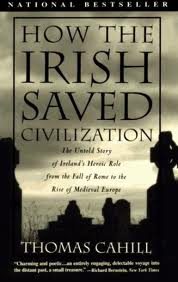
I brought props. Sure St. Paddie had his shamrocks and faith and begorra…an so…I have a book….A book called, “How the Irish Saved Civilization: The Untold Story of Ireland’s Heroic Role from the Fall of Rome to the Rise of Medieval Europe.” By none other than Thomas Cahill, himself. Faith and begorra…did ya ever in all your life hear such a ting as dat??? But that’s not all, I’ve sumtin else…

Take a look at that there??? Sure there’s nothing better on a St. Paddie’s morning than a glass of Guinness….an so… Well you’ll notice that this here particular glass of Guinness, well she’s as empty as Paddie’s pig on market day… An so…for the rest of this wee sermon you just think of me as the preacher who had we tipple before she set about tellin ya what’s what. My glass might be empty, but my heart is full… Full a the devil some may say…or full a the love a Jesus if the truth be told…an so… Where was I? Yeah, sure it’s St. Patrick’s Day and all the world is Irish if only until ya fill there glass. And then faith and begorra…that’s when the truth comes out. That’s when you find out who really saved the world. Now like any good Irish story, we’re gonna wander a bit…so falla me, for like my dear old Nannie used to say, you’d better falla me cause I’m right behind ya. That’s right falla me I’m right behind ya. But that should be no trouble for you lot, cause ya haven’t touched a drop. Yet. And a drop is all you’ll be gettin for have ya seen the size of those Jeesus jiggers;  Why you wouldn’t quench the thirst of the devil’s flees with the wee titch of wine they give ya in dose wee glasses. An so…the Irish and those that want to be Irish well this is a big day indeed. An so… I want to tell us all, exactly how the Irish saved civilization, an, an, I’m gonna tell the truth about St. Patrick himself…an, an, while I’m at it, I wanna take to use about those Daughters of Zolophehad, now there were a bunch of girls if you know what I mean…and speaking about a bunch a girls, while I’m at it I wanna tell ya all about those Marys…Faith and begorra, who’d be havin it?

Sure there’s Mary de Mother of Jesus, and then there’s Mary Jesus’ best friend, you know the girl from over Bethany way…and then there’s that lovely Mary, you know the lovely girl from over there in Magdela who everyone is after confusing with dat other woman, the one the call, Mary who really wasn’t Mary at’al, at’al, at’al… Sure wasn’t she after being healed, her being a sinner from the city and all…Sure there’s more Mary’s in this story, than I have time to be tellin ya about. So, we’ll just leave Mary the mother of Jesus out of it, cause she’s got nothing to do with this really. Unless of course, I loose me, way…and then begorra, I be Jesus, Mary and Joseph, this and Jesus Mary and Joseph that…an so… Were was I ??? I was needin a wee drink that’s where I was…. Continue reading