On Ash Wednesday we are invited to begin a journey into the mystery of our existence. Since the days long ago when the first of our kind gathered together around under the starlit sky, humans have gazed upon the stars and offered up their questions, longing to know who and what we are, where we come from, why we are here, are we alone in the universe, who made us, why are we here, and perhaps most daunting of all our questions: what will become of us. Tonight, an answer of sorts is offered. Dust.
From dust we came and to dust we shall return. Among all the creatures that inhabit creation, we humans are unique in that we alone are conscious of our own mortality. We know that we are made up of the stuff of the earth; that we sprang forth out of the dirt, the dust of the earth, the same dust that was once the stuff that stars are made of. Out of that dust we are made and when our life on this earth is over, we shall return to that dust. We are after all is said and done, mortal. The life that we know will one day end and the stuff that we are made of will be returned to the earth. We hope that out of our remains new life will spring forth and for some of us this is enough; to be part of the endless cycle of life.
For others of us, the recycling of our remains is not enough. Remembering that we are dust and to dust we shall return strikes us as bleak, and we long to be more than just the sum of our parts. We long to be more than just the stuff that is housed in our bodies. We want more than just this present incarnation of dust. We fear the inevitable decomposition of who we know ourselves to be. We can’t help wondering what lies beyond the dust that we are. Most of the time, we can keep our fears under control as the demands of our bodies to be fed, watered, and amused keep us busily scurrying to and fro, this way and that, with precious little time to spare. Day after day we avoid the questions our mortality stirs in us. From time to time, we catch sight of our aging selves in mirrors that reflect the passing of years as we journey closer to our own earthly demise. Sometimes a nagging pain, a frightening diagnosis, a sudden impact, the death of a friend, or a night like tonight reminds us that we are dust and to dust we shall return and we are forced to deny the reality of our eventual demise because it is just to frightening to contemplate; or to embrace the reality of our dustiness trusting that the Love that lies at the heart of all that is will not abandon us to the abyss of nothingness.Continue reading →
Three years ago, I reluctantly gave in to requests to preach on the subject of prayer and I devoted my sermons during the season of Epiphany to the subject of prayer. I have been asked to re-post those sermons. In the course of three years, my theology has continued to evolve. However, I have resisted the temptation to edit the sermons and so the manuscripts are what they are, an exploration of sorts. Here’s the sixth sermon in the series. The final instalment of this series comes in the form of a discussion. Rather than preach on the 7th Sunday of Epiphany, I responded to questions from the congregation. The audio recording of that reflection appears below.
Prayer #6 – PRAY WITHOUT CEASING – preached on Epiphany 6B, 2012 – listen to the sermon here
Prayer #7 – PRAYER TRANSFORMS US – responding to questions about the series, this reflection took the place of the sermon on Transfiguration Sunday, 2012 – listen to the reflection here
Transcript of #6 PRAY WITHOUT CEASING
Cast you minds back to another time and place and tell what the numbers 33 45 and 78 have in common??? Vinyl Records anyone? When I was a kid music came from a portable RCA record player. The sound quality wasn’t all that great, but somehow we didn’t seem to care. Later when I was a teenager, my parents got a fancy state of the art Phillips stereo cabinet and suddenly sound seemed to be coming from booth ends of the room. I never did understand how those old record players managed to pick up sound from the grooves in the vinyl to produce music. I still remember my father’s first reel-to-reel tape recorder, and then there were the eight-tracks, followed by cassettes, followed by CD’s. I can remember these things, but I have no idea how they made music. It doesn’t matter how many times people try to explain it to me, I still think it’s a miracle that such beautiful sounds can come out of machines.Continue reading →
Three years ago, I reluctantly gave in to requests to preach on the subject of prayer and I devoted my sermons during the season of Epiphany to the subject of prayer. I have been asked to re-post those sermons. In the course of three years, my theology has continued to evolve. However, I have resisted the temptation to edit the sermons and so the manuscripts are what they are, an exploration of sorts. Here’s the Fifth sermon in the series. I shall repost the seven sermons in the series over the course of the Season of Epiphany.
Prayer #5 – Jesus Is Not a Super-Human Miracle Worker! Jesus Is Human! preached on Epiphany 5B, 2012 – listen to the sermonhere
Readings:Isaiah 40:21-31; Colossians 3:14-15; Mark 1:29-39
Usually, the stories in the gospels about Jesus healing the sick leave me wanting more. They usually seem so incomplete. I have always wanted more details about how exactly Jesus was able to heal those who were sick. Usually, the stories about Jesus healing are read or referenced by the notion that Jesus was some sort of miracle-worker and we are predisposed to believe that Jesus had miraculous powers; that he was somehow able to harness the healing power of God and dispense it at will. We are encouraged to believe that that very same power is available to us if only we figure out exactly how to cozy up to Jesus and ask him in just the right way to heal us or heal those we love. But these stories found in the earliest of the Gospels and attributed to an early follower of the Way known as Mark, don’t portray Jesus as a miracle-worker at all.
I love the story of Peter’s mother-in-law, because I can easily relate to it. I remember back when I was about 17 and I was suffering from a terrible cold. I had a raging fever and I was as sick as a dog. I also had tickets to an Elton John concert. Even though I could barely breath, when the time came, I got myself up out of bead, and whoa-presto, it was as if the power of Elton John’s name had cured me and I was able to follow the Yellow Brick road all the way to the Coliseum where, together with my friends I was hopping and bopping to the Crocodile Rock . So, I have no difficulty believing that when Simon Peter finally brought Jesus around to visit his mother, the sheer power of all the rumors she’d been hearing about this man Jesus, would have been enough motivation for this Jewish mother to rise up out of her sickbed to see who this fellow was who had enticed her son away from his nets. That Jesus could have harnessed the healing power that lies within our grasp as he traveled from town to town and cured the sick and drove out daemons isn’t difficult to believe. Lets face it, first century daemons sound a lot like mental or emotional illnesses, so Jesus ability to cure people who are disturbed by daemons really isn’t much of a stretch. But after centuries of interpretation and proclamation, we tend to hear these stories in ways that portray Jesus as some sort of super-human, miracle-worker, or dare I say it as some sort of God. Because after all, our image of God is that God is some sort of super-human miracle-worker. So for generations we’ve been looking to Jesus in the same way as we look to God to cure all that ails us. And so we are just as likely to appeal to Jesus in prayer, as we are to appeal to God to heal us. So, as our notions about God change, our notions about Jesus change also.Continue reading →
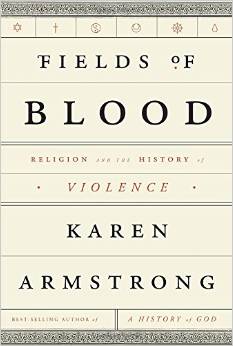
Since 911, the rhetoric has been dialled up to piercing levels when it comes to the relationship between religion and violence. The constant noise has numbed us to the realities of history as many of us accept the judgments of the endless cacophony of popular voices proclaiming that violence is a natural consequence of religion. Karen Armstrong’s meticulous research challenges the popular doctrine of both atheists, theists, and all those who would lay claim to the notion that religion is responsible for violence, terrorism, and war. Armstrong surveys a wide sweep of history, beginning 3000 years before the Common Era with the kind of vigour that has lead readers of her previous epics to trust her conclusions. Adept as Armstrong is when it comes to revealing her encyclopedic knowledge of world religions, Fields of Blood is a must read for all those who work in the field of religion as well as an enlightening read for all those who find themselves on the receiving end of modern pundits of both the religious and political varieties.
In the video below, Karen Armstrong provides an overview of her work which will no doubt compel you to add Fields of Blood to your reading list. Filmed at Chautauqua in August of 2014.
Three years ago, I reluctantly gave in to requests to preach on the subject of prayer and I devoted my sermons during the season of Epiphany to the subject of prayer. I have been asked to re-post those sermons. In the course of three years, my theology has continued to evolve. However, I have resisted the temptation to edit the sermons and so the manuscripts are what they are, an exploration of sorts. Here’s the Fourth sermon in the series. I shall repost the seven sermons in the series over the course of the Season of Epiphany.
Prayer #4 – AWE: Reclaiming the word Religion, preached on Epiphany 4B, 2012 – listen to the sermonhere
Readings: Genesis 28:16-22;
Hildegard of Bingen – Soul Weavings:
“The soul is kissed by God in its innermost regions.
With interior yearning, grace and blessing are bestowed.
It is a yearning to take on God’s gentle yoke,
It is a yearning to give one’s self to God’s Way.
The marvels of God are not brought forth from one’s self.
Rather, it is more like a chord, a sound that is played.
The tone does not come out of the chord itself, but rather,
through the touch of the Musician.
I am, of course, the lyre and harp of God’s kindness.”
Our Gospel reading was extended to include Mark 1:21-35 “Rising Early the next morning, Jesus went off to a lonely place in the desert and prayed there.”
I was about 16 or 17, when God first overwhelmed me. I’d been attending church for about two years. Looking back on that confused young girl, I can see how I might have been attracted to Christianity by Jesus. Jesus the radical, who changed the world, is a compelling figure for a teenager who’s out to change the world. I remember that I prayed a great deal back when I first got involved in the Church. I can remember believing that prayer could change everything. Prayer could change the world. Prayer could change my life. Prayer could change other peoples’ lives. Prayer could even change the mind of God. If only I could figure out the correct way to pray. And if I prayed often enough and hard enough and at just the right moment, prayer would change everything.
The trouble was, I was praying often, I was using all sorts of types of prayer and nothing seemed to be working. So, I remember deciding, that my ineffective prayers had nothing at all to do with the power of God or the power of prayer, but with the power of me. I kept telling myself that if I could just learn how to pray, God would definitely do the rest. So, I prayed and I prayed, and I prayed and when nothing much seemed to happen, I blamed myself for not being a good enough Christian: if only, I’d spend more time reading the bible, or if only I was a better person, or if only I was a better believer. It was all up to me. So, I promised myself, and sometimes I even went so far as promising God, that someday, I’d learn how. Someday, I’d find the right teacher, I’d study hard and I’d learn exactly what I needed to do to make my prayer life, more effective. But in the meantime, I’d keep trying, even though it felt like no one was listening. I told myself that this kind of persistence is precisely what people meant when they said, “have faith”. Having faith means praying when it seems like there’s no point at all, in praying. So, I had faith and I prayed…and nada. Not a single thing. It was like talking to myself. Not even a warm fuzzy glow. But I had faith that somehow God, that big guy up there in the sky, He, and I do mean He, cause back then God was an old, bearded, guy who lived on a fluffy cloud, and spoke King James English, in a very lofty way. Anyway, He, must have been hearing my prayers, but because he was God and all, and knew everything there was to know, he was keeping stuumm in an effort to teach me something. So, all this empty praying was going to pay off in the end.
Eventually, I began to expect very little from prayer. Prayer became something akin to my car insurance. I knew I had to pay it, even though I couldn’t afford it, because someday it might just come in handy. But I never really expected my car insurance to do anything for me, especially as I couldn’t afford to pay for collision insurance. But if I hit someone else, well it just might keep me out of jail. So, I kept on praying, trusting that if I happened to hurt someone else, God would function kinda like my car insurance, only instead of keeping me out of jail, God would keep me out of hell. It was all about me back then. And then one night it happened.
My little world was blown apart and for the first time in my young life, I knew that life wasn’t all about me. It happened on the beach. Actually, it was on a boardwalk down by the ocean. A bunch of my friends and I had managed to talk our parents into letting us spend the night sleeping out under the stars. It was late August and there was supposed to be a particularly amazing meteor shower. The only problem was that in our part of the globe, the best viewing time was supposed to be between 3 and 6 am. So, we begged and we pleaded, or we miss-lead our parents and told them we were staying over at a friend’s place and about a dozen of us headed down to the boardwalk to sleep out under the stars.
It was a fabulous night. No adults to tell us what to do. Good friends to talk to. Swimming after dark. An illegal campfire to make us feel just a little bit afraid that someone might catch us. And just enough beer to make us feel like we were big shots and not enough beer to give us a buzz, because only a couple of us were brave enough to try to buy beer from the dozy lady at the convenience store who never seemed quite able to do the math when she bothered to card us. Did I mention that we’d slipped down across the boarder, not because the meteor shower would be any better down there, but because we lived close enough to Washington state and the beaches in Pt Roberts were very attractive because, we knew that there was only one sheriff on patrol and we figured that we could out-run him if we had to. Besides old Dusty, weren’t much of a sheriff and he pretty much stayed away from the boardwalk cause he knew better than to go looking for trouble. And we were trouble. We were a gang of kids from church, about a dozen kids, with about a dozen beer, and we were gonna stay up all night and watch the stars and no, no good copper was gonna stop us.Continue reading →
A sermon for the Third Sunday after Epiphany. Our readings included Ecclesiastes 3:1-13, “A Blessing for New Beginnings” by John Donohue and Mark 1:14-20. Listen to the sermon here
News of Marcus Borg’s death has caused thanksgiving to well up in so many of us who where touched by his generous way of imparting wisdom. Marcus Borg was blessed with a gentle touch which allowed him to challenge us to move beyond our long held beliefs so that we might see the One in whom we dwell as the One who comes to unique expression in each of us. I have been richly blessed by his scholarship. His ability to make his readers and listeners feel as though he was articulating our thoughts, doubts, questions, and insights was matched by his ability to push us beyond the limits we set for ourselves so that we too could challenge the status quo which plagues religious traditions. I am a better pastor, teacher, preacher, and human as a result of Dr. Borg’s skillful expressions of his passion for delving into the riches of our shared christianity and the gentle, generous way in which he challenged us all to think anew about the wisdom of the ages. Marcus Borg was blessed with gifts which he used to bless others. May it be said of us that we use the blessings he bestowed on so many of us to be a blessing to others. Well done Marcus. Thank-you Marcus. Shalom Marcus. Shalom.
The first reading prescribed for this coming Sunday is from the first chapter of the book of Jonah; a great big fish story! I believe that I was all of ten years old when I first read Hemingway’s “The Old Man and the Sea.” I loved each and every mesmerizing page of it and I’ve been a fan of big fish stories ever since. I didn’t actually read the Book of Jonah until I was in my twenties and it took me many more years to appreciate it too as a splendid big fish story. This short film written by Jack Thorne and directed by Kibwe Tavares revisits the Jonah story with prophetic urgency and reminds me that though we may never go back to the way things were, we can dream of how things may be, so that we might never have to long so desperately to return. Enjoy this feast for the eyes!
Three years ago, I reluctantly gave in to requests to preach on the subject of prayer and I devoted my sermons during the season of Epiphany to the subject of prayer. I have been asked to re-post those sermons. In the course of three years, my theology has continued to evolve. However, I have resisted the temptation to edit the sermons and so the manuscripts are what they are, an exploration of sorts. Here’s the Third sermon in the series. I shall repost the seven sermons in the series over the course of the Season of Epiphany.
Prayer #3 – Corporate Prayer, preached on Epiphany 3B, 2012 – listen to the sermonhere
Readings: Jonah 3:1-5, 10; excerpts from St Thomas Aquinas’ God’s Nature, Mark 1:14-20 – Our worship began with the singing of the old song, I Come to the Garden Alone.
Before we set forth on the third sermon in this series, let’s take a brief look at where we have been. We began looking at what happens when we give up the image of God as a grand-puppeteer in the sky to whom we pray to. We moved beyond the notion that prayer is about us talking and God listening. We looked at a model of prayer that begins with us shutting up and listening, for the voice of God, which in Hebrew is called the Bat Cole, or daughter of a sound. Listening for the still, small voice of God, begs the question: “If I happen to hear this daughter of a sound, how do I know that it is God that’s doing the talking?” This question led us to look at the two streams of thought concerning the nature of God that flow through the religious traditions of Judaism, Christianity and Islam. The first way of looking at God, sees God as a super natural deity; a kind of person writ large, a super hero God capable of interfering and altering the course of human affairs. The second way of understanding God, is just as ancient, and just as biblical, has the fancy theological name “panentheism” which in the words of the Apostle Paul, sees God as “the ONE in whom we, live and move and have our being. Panentheism simply put means, everything is in God and God is in everything; the universe, all of creation is in God, and God permeates all of creation.
When it comes to prayer, we’ve all been trained to see God as a kind of super-hero-santa character who exists to respond to our prayers with either a yea or a nay, and if the answer is yea, then all is well, and if the answer is nay, then this super-hero-santa God is either responding negatively to our request because we haven’t prayed it properly, or this all-knowing supreme being is saying no for our own good, or this super-human-god is simply trying to teach us something. Sadly, for so many people in our day and age, unanswered prayers, especially those unanswered prayers about unmerited suffering, have lead so many of our contemporaries to conclude that this super-hero-stanta God is little more than a creation of our own making and therefore does not exist and so apart from those times when they are so desperate because there’s nothing left to try, they have for the most part given up on prayer.
The popularity of the super-hero God rises and falls upon the responses or lack of a response to our prayers. Panentheism takes us beyond worshipping the image of God that we have created and opens us to the reality of the force that lies at the very heart of creation; a force that lives and breathes in, with, and through us. When we move beyond seeing God as a super-person, to understanding God as that which permeates all that is, we are compelled to open ourselves to a power beyond our ability to name. In the presence of such a deity our prayers can seem hubris at best, ridiculously childlike, or even useless and so we are all too often reduced to a silence born out of frustration rather than intention. But however, we arrive at the silence, it is out of the silence that God comes to us and we hear the Bat Cole, the daughter of a sound, the still small voice of God. So we’ve come full circle and we can’t help but ask, how do we know that the sound we here is God?
As we struggle for an answer to this question, I’m going to try to take us on a journey that I hope will help us learn some of the skills we will need to test the voice of God. It’s a long journey, so we won’t get there with this sermon. After today we will spend four more Sundays on the subject of prayer; four more Sundays in which we will delve deeply into what it means for us as individuals to pray to a God that we understand to be the one in whom we live and breath and have our being. But before we tackle the subject of individual prayer, we’re going to look at corporate prayer.
What are we doing when we pray together? If we are in God and God is in us, what does it mean to get together as a community to pray? How do we pray? What do we expect, if anything to happen? Today we will look at corporate prayer, next Sunday we’ll delve into praying as individuals, then after a couple of Sundays we’ll include an exploration of the Lord’s prayer. Which will take us to the last Sunday of Epiphany, when we’ll arrive at the mountain-top for transfiguration and we’ll wander around the thin places before heading off into the wilderness for Lent, where even Jesus needed all his skill to determine which of the voices he was hearing was actually the voice of God.
Now for some of you beginning by exploring corporate prayer seem counter-intuitive. Most of us are more interested in your own individual prayer life than we are in the prayer-life we share as a community. But I am convinced that if we begin by looking at how our prayer-life together has changed as we’ve opened ourselves to seeing God as the One who permeates all of creation. When you think about it, our prayer-life begins when we are children with a form of corporate prayer, when an adult in our life teaches us to pray. Usually, we are taught to begin by asking God to bless, Mommy and Daddy, grandma and grandpa, our sisters and brothers, our aunts and uncles and whoever else we loved. Sometimes we’d pray for the boys and girls who were less fortunate than we are. Some of us were taught the words of the Lord’s Prayer. Some of us were taught that horror of horrors: “Now I lay me down to sleep, I pray the lord my soul to keep. If I die before I wake, I pray the lord my soul to take.” I don’t think I understood what I was asking in that particular prayer, because if I did, I’d never have let my parents leave the room, because I don’t ever remember wanting God to appear in my room to take me away.Continue reading →
Three years ago, I reluctantly gave in to requests to preach on the subject of prayer and I devoted my sermons during the season of Epiphany to the subject of prayer. I have been asked to re-post those sermons. In the course of three years, my theology has continued to evolve. However, I have resisted the temptation to edit the sermons and so the manuscripts are what they are, an exploration of sorts. Here’s the Second sermon in the series. I shall repost the seven sermons in the series over the course of the Season of Epiphany.
Prayer #2 – Pray to a Super-natural Deity or a Panentheistic God? preached on Epiphany 2B, 2012 – listen to the sermon here
Readings: 1 Samuel 3:1-10, The Flowing Light of the Godhead by Mechthild of Magdeburg, John 1:43-51 – Our worship began with the singing of the old song, I Come to the Garden Alone.
Last week we began a sermon series on prayer. We are spending the season of Epiphany exploring what it prayer is like after you give up the idea that God is some grand-puppeteer in the sky. We spent some time exploring the description of the Voice of God that we find in the Hebrew Scriptures. In ancient Hebrew the Voice of God is described as the Bat Cole. Which translates literally as the daughter of a sound. Our English bibles translate the Bat Cole, the daughter of a sound as the Still Small Voice of God. It is sometimes translated as “the thinnest silence.” I asked you to spend sometime during the week, listening to the Bat Cole that emanates from deep inside of you. Today, I want to talk about what it means to listen.
What does it mean to listen to the voice of God? What does the voice of God sound like? How do you know that the voice you are hearing is God? What are you supposed to do if you think you hear the voice of God? I’ve been thinking about these questions all week long and I’ve got to say that these questions have driven me more than a little crazy. Earlier in the week, a colleague sent me a recording of televangelist Pat Robertson talking about his latest message from God. It seems that God has told Pat Robertson exactly who the next president of the United States is going to be. God has also, rather conveniently told Robertson not to talk about it. So, Pat’s not saying who it will be. But he is saying that God has told him that the current president; that would be Barak Obama, “holds a radical view of the future of the United States that is at odds with the majority” so the nation should expect chaos and paralysis.”
It strikes me as all too convenient that God just happens to hold the same views as Pat Robertson, so I’m not about to listen to the voice that he hears. But then, how do I know that the voice that I hear is God and not just me impersonating God? To hear Pat Robertson tell it, he hears a clear voice and has no doubt that it is God doing the talking. I on the other hand have never heard a clear voice. In fact I’m pretty sure that if I stood up here and told you all that God spoke to me in a clear voice, you’d begin to wonder about my sanity. I mean hearing voices is a clear signal that something has gone terribly wrong and we have all sorts of medication for that. So, if hearing voices is symptomatic of mental illness, then why in the world would we bother listening for the voice of God?
Before we can even begin to understand what the so much of the Christian tradition means when they talk about listening to the voice of God, we need to take a step back and look at what we mean when we say the word god. Throughout the Jewish and Christian traditions you can trace two very distinct ways of understanding and talking about God. The first and most familiar way of understanding God is as a supernatural being. God is described as a sort of person, a supernatural person. The term supernatural describes it all, super means beyond the natural. God is understood as a being beyond the capabilities of most beings. God is personified; given the characteristics of a person; only it is as if God has the powers of a super-hero; someone far greater than we can even imagine.Continue reading →
Wading into the waters of baptism is no simple matter for a progressive Christian. Once you leave the myth of perfection in some distant garden back there in the mists of time, reject the notion of humanity’s fall from grace as a result of original sin, and give up worshipping the sadistic image of a god who demands a blood sacrifice, it’s difficult to navigate the waters of baptism without spouting notions that the institutional church condemns as heresy. But today is the day when the church celebrates the baptism of Jesus and the stories about the baptism of Jesus that have been handed down to us by our ancestors suggest that on this day of all days, we should have the courage to follow Jesus into the river of life even if it does challenge some of our long held assumptions about what it means to be a child of God.
I venture into these troubled waters as someone who treasures the sacrament of baptism. Long before I ever entertained the idea that I might one day respond to the call to become a baptizer, I became a lover of this particular sacrament of the church. I am now, and I have always been one of those people who find it almost impossible not to shed a tear or two at baptisms. The beauty of all that hope and expectation all wrapped up in the guise of a tiny little human has a way of generating in me a watery contribution as my tears join the sprinkling to wet the babies head. When the baptized is an adult my tears flow even more bountifully. Let’s face it folks these days the reality is that infant baptisms are rare enough. Adult baptisms, especially in mainline churches are so rare that the nostalgia alone is enough to send us into spasms of uncontrollable weeping for seer joy at the thought that it is even remotely possible that someone has been able to see beyond the church’s doctrine long enough to embrace the amazing possibilities of the sacrament to provide any benefit in this the twenty-first century.
When we look back to the stories told in the synoptic gospels about the baptism of Jesus we are sometimes so distracted by the opening of the heavens, the descent of the dove and the voice of God declaring Jesus to be the beloved, that we miss an important detail of the way in which the early followers of the Way chose to tell the story of Jesus public coming out party. New Testament scholars remind us that the stories told by the writers of the gospels were written at the end of the first century; a time when it would have been clear to all those who had ears to hear, that by going down to the river Jordan to be baptized by John would have stirred up the political and religious waters. John the Baptist was a revolutionary who made no bones about the fact that the religious authorities and the political rulers were leading the people down the wrong path. John’s shouting in the wilderness was his way of warning the people to repent; to literally turn around and follow a different path. John was doing far more than ranting when he condemned the religious authorities as a brood of vipers; he was calling on the people to reject the teachings of the authorities. John’s insistence on repentance was a call to revolution, a revolution designed to overthrow the status quo. John was out there in the wilderness because it wasn’t safe for him to spout his own particular brand of incendiary fire and brimstone rhetoric within earshot of the authorities. By going down to the River Jordon and submitting to John’s baptism of repentance Jesus was choosing to identify himself with a political revolutionary.
That the writers of the gospels chose to tell there story in ways that see the God of Israel give Jesus a shout out, and the very spirit of God descending like a dove onto the shoulders of Jesus, turns John’s baptism of repentance into a kind of passing of the torch from one revolutionary to the next. Yet, despite the gospel-writers having cast Jesus into the role of revolutionary torchbearer none of the gospel writers shows Jesus following the ways of his predecessor John. There is no record of Jesus calling people to repent nor is there any record of Jesus ever having baptized anyone. All we have is Jesus “Great Commission” which if New Testament scholars are to be believed, Jesus probably never even said, “go therefore and baptize them in the name of the Father and of the Son and of the Holy Spirit.” Yes, it’s true, most preachers, dare I say modern-day baptizers, learned in seminary that rather than being an instruction given by Jesus the Great Commission was actually added to the story by the early followers of Jesus. But I digress, the point I’d like to emphasize about Jesus’ trip down to the waters of the Jordan, is that by choosing to publicly submit to John’s baptism, Jesus was making an important statement about his own public ministry. For just like John, Jesus intended to challenge the religious and political authorities.Continue reading →
I have just completed reading James Carroll’s latest book “Christ Actually: The Son of God for the Secular Age” for the second time. I know that I will read it many more times as I continue my own work of articulating an understanding of Jesus for the 21 century. Carroll’s way of exploring Christianity has always been enlightening and refreshing because he has the courage to question the tradition from the vantage point of someone who has lived the tradition with passion. Carroll is former Roman Catholic priest who now serves as Distinguished Scholar-in-Residence at Suffolk University and is a columnist for The Boston Globe, whose books include: “Constantine’s Sword: The Church and the Jews,” “American Requiem: God My Father,” and the “War That Came Between Us, Crusade: Chronicles of an Unjust War,” “Toward a New Catholic Church: The Promise of Reform,” as well as eleven novels.
Carroll’s critique of Christianity is infused with a sense of responsibility for the ways in which our anti-Jewish texts have misremembered the story of Jesus. His exploration of first century history points to the profound influence of the Roman destruction of the Temple in 70 C.E. upon the way in which the gospel-storytellers crafted their accounts of Jesus for their late first century communities. Insisting that we must measure everything we say about Jesus now against Jesus’ Jewishness, Carroll asks a compelling question: “What if the so-called divinity of Jesus lays bare not so much the mystery of God as it does the majesty of what it means to be human?” Carroll sees that the divinity of Jesus in some way suggests the Divinity in which we all participate. Carroll’s work is a must read for those of us who are working to articulate a 21st century Christology!
The video below was recorded at First Parish in Cambridge on Wednesday, December 10, 2014
Thanks to science and all we have learned about creation, we are beginning to develop new images of the ultimate reality we call God. New images of God challenge the patriarchal misogyny of religious traditions. When it comes to re-imagining the faith, Sister Joan Chittister paints a picture of God as One Who Summons from among us – Emmanuel. The Summoning One calls and encourages us toward a world of equals. “Evolution is shedding new light on our lives.”
A sermon preached on the Second Sunday after Christmas – the readings for this sermon include: John 1:1-9, The Gospel of Thomas 70; Matthew 2:1-12. You can listen to the sermonhere
Two cars were waiting at a stoplight. The light turned green, but the man didn’t notice it. A woman in the car behind him was watching traffic pass around them. The woman began pounding on her steering wheel and yelling at the man to move. The man didn’t move. The woman started to go ballistic inside her car; she ranted and raved at the man, pounding on her steering wheel. The light turned yellow. The woman began to blow her car horn; she flipped off the man, and screamed curses at him. The man, hearing the commotion, looked up, saw the yellow light and accelerated through the intersection just as the light turned red. The woman was beside herself, screaming in frustration because she missed her chance to get through the intersection. As she is still in mid-rant she hears a tap on her window and looks up into the barrel of a gun held by a very serious looking policeman. The policeman tells her to shut off her car while keeping both hands in sight. She complies, speechless at what is happening. After she shuts off the engine, the policeman orders her to exit her car with her hands up. She gets out of the car and he orders her to turn and place her hands on her car. She turns, places her hands on the car roof and quickly is cuffed and hustled into the patrol car. She is too bewildered by the chain of events to ask any questions and is driven to the police station where she is fingerprinted, photographed, searched, booked, and placed in a cell.
After a couple of hours, a policeman approaches the cell and opens the door for her. She is escorted back to the booking desk where the original officer is waiting with her personal effects. He hands her the bag containing her things, and says, “I’m really sorry for this mistake. But you see, I pulled up behind your car while you were blowing your horn, flipping that guy off, and cussing a blue streak at the car in front of you, and then I noticed the “What Would Jesus Do” and “Follow Me to Sunday School” bumper stickers, and the chrome plated Christian fish emblem on the trunk, so naturally I assumed that you had stolen the car.”
We can scoff at this, but I must tell you that one of the things I had to learn when I first began to wear a clergy collar was that I could no longer give people the finger when I was driving. If you give people the finger when you are driving, it’s not you giving that person the finger but the whole of Christian Church; people will use your outburst to condemn the hypocrisy of the entire church.
During Advent we used a question from Meister Eckhart not once but twice during each of our worship services: “What good is it to me if Mary gave birth to Christ twenty centuries ago and I don’t give birth to Christ in my person and my culture and my times?” And now, in this the last day of Christmas, I find myself wondering what it actually means for Christ to be born in me or in you.Continue reading →
An Epiphany Sermon, preached in 2008. I had just read “The First Christmas” by John Dominic Crossan and Marcus Borg. Our congregation played host to Dom Crossan a month before I wrote this sermon. So, Dom’s insights run through this effort. But the heart of this sermon beats as the result of a sermon preached by Bruce Sanguin a self-proclaimed evolutionary christian who is a United Church Minister (Canadian Memorial Church, Vancouver). I had the privilege of meeting this modern mystic while on sabbatical this summer and his compelling way of unlocking the scriptures using the wealth of the christian tradition together with the insights of modern science and psychology borders upon the poetic. This sermon was anchored by Sanguin’s words (Epiphany 2007). Sermons are a “live” event. So, this manuscript is an approximation of what was actually preached.
Just five days before Christmas (2008), The Archbishop of Canterbury, The Most Reverend Doctor Rowan Williams, the leader of the worldwide Anglican Communion started a firestorm. During a BBC interview, His Grace was quoted to say that the story of the “three wise men is a legend”. The Archbishop was also heard to say that he remained unconvinced that there was indeed a star that led the legendary trio to the birth place of the Christ Child.
If that wasn’t enough to send folks off the deep-end, it has been revealed that the Presiding Bishop of the U.S. Episcopal Church The Most Reverend Doctor Katherine Jefferts Schori, who just happens to be the first woman elected primate in Anglican history, has fanned the flames of the fire-storm by sending out what has been judged by some to be an incendiary Christmas card.
I downloaded a copy of the offensive card, so that you could see for yourself. Her Grace’s choice of card has offended the good deacons of Ft Worth Texas who claim that their Primate’s actions defy explanation. As you can see the wise folks depicted on this image look a lot like women. Can you imagine the nerve of the first woman primate! How could she be so bold as to select such an offensive image? Leave it to straight talking Texans to set things straight: for despite the audacity of the Primate, the Texans have pledged to “stand for the traditional expression of the Faith.” Continue reading →
I have tried to locate the source of the parable told in this sermon about the encounter between the little boy and the old woman. But despite the many authors who claim it as their own, I suspect that its origins go back farther than I have been able to trace. The Readings for this first Sunday after Christmas offer us the parable of the Presentation of in the Temple: Psalm 42:1-3, Galatians 4:4-7, Luke 2:8-20
While the world hurdles toward the New Year celebrations, we linger in the Twelve Days of Christmas. I do believe that the counting begins on the first day after Christmas; which means this is only the Third Day of Christmas. That means there is still time to enjoy the music of Christmas and so, I offer up one of my favourite singers: Odetta proclaiming the Good News in her own splendid style with Go Tell it on the Mountain.
During these twelve days of Christmas we celebrate the birth of the Messiah. Messiah, is a word the ancient Hebrews used to describe the anointed one. The one whom God would send to change the world. In Greek the word for Messiah is Christ.
My thoughts swirl around a poem written by the unknown writer of the Gospel of John in which the birth of the Christ is describe as the WORD. It’s a mysterious cosmic poem that moves our minds away from the mundane everyday ordinary stuff of life to the extra-ordinary mysteries of creation, which when you think about it is what every birth does.
Just holding a newborn in your arms and before long you’ll find yourself pondering the mysteries of this life. Who are we and where do we come from? Why are we here? What does it all mean? These are all perfectly wonderful questions and speculating upon the many possible answers to those questions is a fascinating process. But in the end, our words will always fail us when it comes to answers. As we are speculating about the birth of this beautiful little baby, the baby is alive and among us, and needs to be fed and changed, nurtured, guided and protected.
Our speculations about the mysteries of creation are a little like our preparations for Christmas. All the preparations, the decorating, the shopping, the wrapping, the stuffing, the cooking, and the worrying, and in the end all our preparations aren’t really the point. The point is Christmas-tide is now and the guests are all around we’ve arrived and the Messiah has arrived, or not, its up to us to welcome the One who is Love in our midst, to celebrate Christmas.
The trouble is that sometimes, we are so preoccupied with the preparations, with the idea of getting it right that we forget the whole point of Christmas is the celebration itself; the gathering of the clans, the being with one another, the opportunity to be present to one another. It’s one of the reasons why I love the stories that the unknown writers of the gospels of Matthew and Luke put together. In those familiar tales we hear a story of a couple of parents who were not at all prepared to welcome a child into the world. It’s an earthy story that brings the pungent aroma of a animal dung right into our carefully decorated living-rooms. And the Messiah that we greet in the story found in Matthew has no halo hovering over his head. The writer of Matthew makes it very clear that the Messiah comes from a very dubious pedigree, numbering a prostitute, a product of incest, an adulteress and sexual trickster among his ancestors. The Messiah’s parents were an unwed teenage girl and an unspeaking father, who wasn’t a father, and the pair of them appear to be homeless and then on the run, seeking shelter wherever they can find it.
Our romantic notions of a pretty little stable will have to wait a thousand years for St Francis to pretty up and launch us on a quest for cattle lowing, shepherds kneeling and magi bowing. Our expectations of the Messiah have become so very highfalutin, so otherworldly that I wonder if we are really prepared to welcome the Messiah among us. We hardly know what to expect from the Messiah. Are you really ready to welcome the Messiah? What do you expect?
There’s an old Jewish story, I can’t remember where I first heard or read it. I suspect I might have learned it from Scott Peck? The story is now deep in my bones. It surfaces most Christmas mornings to remind me that Christ is born in us.
Once there was a monastery with a long history of commerce and a thriving spiritual community. But as time wore on, fewer and fewer villagers visited the hallowed halls. Fewer people turned to the monastery for advice. Even the sale of their famous wines began to dwindle. The abbot began to despair for his community. “What should they do?” he wondered.
They prayed daily for guidance, but the brothers only became more dispirited. The monastery itself reflected their mood, becoming shabby and untidy. At last the Abbot, hearing that a wise Jewish rabbi was visiting, swallowed his pride and went to visit the rabbi to ask his advice. The abbot and the rabbi visited for a long time.
They talked of their respective religions, and the fickleness of human nature. The abbot explained his problem to the rabbi and asked for advice, but the Jewish sage only shook his head and smiled.
As the abbot sadly departed, the rabbi suddenly rose and shouted after him, “Ah, but take heart my friend for the Messiah lives amongst you!” All the way home the abbot pondered the rabbi’s words, “The Messiah lives amongst you.” What could he mean? Did the Messiah live in the abbey? The abbot knew all the brothers very well. Could one of them really be the Messiah? Surely he, the abbot, was not the Messiah… Was it possible?”
Upon reaching the monastery the abbot confided the rabbi’s words to another brother, who told another brother, who was overheard telling another brother. Soon the whole abbey had heard the news. “The Messiah lives amongst us!” “Who do you suppose he could be?”
As each brother speculated on who the Messiah could be, his view of his brothers began to change. Brother Louis no longer appeared simple, but rather innocent. Brother Jacques was no longer uncompromising, but rather striving for spiritual perfection.
The brothers began to treat each other with greater respect and courtesy; after all, one never knew when he might be speaking to the Messiah. And, as each brother discovered that his own words were taken seriously, the thought that he might become the Messiah would cross his humble mind. He would square his shoulders and attend his work with greater care and start acting like a Messiah.
Soon the neighboring villages began to notice the change that had come over the monastery. The brothers seemed so happy. Villagers flocked to the monastery and were energized by the spirit of the Brothers. And so the spirit grew and the monastery flourished. As each new brother was welcomed, the question arose, “Could he be the Messiah?”
Apparently the monastery still prospers today and it is often whispered both within its walls and in the surrounding towns that the Messiah lives amongst them. As you celebrate Christmas this year, remember that the Messiah lives among you.
If you are waiting for perfection, Christmas is going to be a lonely and frustrating time. If you are waiting for some future time, the wonders of this moment will pass you by. If you are expecting salvation outside yourself, you might miss your own wisdom. If you hold your loved ones to impossible standards you just might miss the Messiah who sits right next to you. I know that you’ve worked hard, and made all kinds of preparations, but today is the day it’s time to greet the Messiah, now. Don’t miss a moment of it. Enjoy. The Messiah arrives in you and right next to you! Enjoy!

 Readings for Ash Wednesday click here






 pastordawn