 Speaking at St. Paul’s (Nov.2012), Brian McLaren reflects on A New Kind of Christianity as he makes his own “case for God”.

Speaking at St. Paul’s (Nov.2012), Brian McLaren reflects on A New Kind of Christianity as he makes his own “case for God”.
 Karen Armstrong provides a stunningly articulate exploration of our inability to define God. Armstrong’s expansive knowledge of the history of humanity’s attempts to to express the inexpressible is astounding. Speaking at St. Paul’s in London (Oct.2012), Armstrong provides an overview of her book The Case for God. Armstrong packs so much of her wealth of knowledge into lecture that I felt like I was hearing a review of my entire under-graduate degree in Religion. Her’s is a vital review for those of us who spend our days preaching and teaching, if only to render us more humble in our proclamations about the divine reality we call God. Armstrong’s overview is also a splendid introduction for those seeking a deeper understanding some of the riches that have been stored up by seekers who have gone before us. Enjoy!!!
GOD’s Radical Mastectomy
 Recently, I found myself in conversation with a young woman who insisted that inclusive language for God is nothing more than political correctness that has been imposed upon the church by feminists. She insisted that because women have now achieved equality with men, the need for inclusive language for God has served its purpose and need no longer be of concern to worship leaders. I am grateful that my age afforded me the maturity not to explode on this young woman who can well afford her opinion as a direct result of some of the language battles that I and my contemporaries struggled to overcome while she was but knee high to a grasshopper. Our conversation has stuck with me and caused me to review some things that I wrote long ago about the impact our language has not only on our images of the Divine but on the way we live together in community. What follows is a portion of a piece I wrote about the disappearance of the Breasted One as a name for God.
“We believe in one God, the Father the Almighty… We believe in one Lord, Jesus Christ, the only Son of God, eternally begotten of the Father… We believe in the Holy Spirit, the Lord, the giver of life, who proceeds from the Father and the Son. With the Father and the Son he is worshipped and glorified. He has spoken through the prophets.[1] In this God: “We believe” and “His kingdom will have no end!” God in three persons: Father, Son and Holy Spirit, our blessed Trinity. As we proclaim our faith in the words of the Nicene, Apostles’, or (heaven forbid) the Athanasian creeds we proclaim a particular image of the Triune God. For generations, a majority of Christians have assumed all three persons in this Trinity are male. Until recently this assumption has resulted in the exclusive use of male images, symbols and pronouns to represent the Triune God which Christians worship. God has been declared to be male. This is not an easy declaration to make. In order to make such a declaration, many of God’s attributes which are revealed in the biblical accounts have been eradicated from the Christian tradition.
Long before the Christian church began to formulate its exclusively male image of the triune God, the Hebrew people used several words to refer to God. The earliest of these words is “El” which is the generic Semitic word for a god.
 My favourite New Testament scholar, Dom Crossan responds to the question “Is God violent.” In a week were more than a few fanatics have been given airtime to call for more weapons in the hands of more people, I find Dom’s gentle responses reassuring. If only we could convince those who would use texts deemed “sacred” to read them before they draw their own conclusions about what these texts say. If only we could begin to take these texts seriously instead of literally!
 Think feminism is passé, think again. Speaking at the Westminster Town Hall Forum in November 2012, Sister Joan Chittister exposes the scandalous realities in the lives of so many women in the world. The situations in the lives of woman that Sister Joan describes are shocking, but the notion that so many young women suffer from the delusion that the need for feminism has passed is positively frightening.
 While musing on the readings for this coming Sunday, I came across these notes that I made the last time these readings came up – Baptism of Jesus 2010. I offer them to my preaching colleagues in the hope that we might move beyond the story as it has been read during worship so that we might challenge old assumptions and images of the Divine.
According to the Revised Common Lectionary, the appointed Gospel reading for this Sunday when the church celebrates the Baptism of Jesus is Luke: 3:15-17, 21-22. But what about the missing verses 18-20?
Whenever the RCL leaves verses out of an appointed reading, I can’t help wondering what they are afraid of. Could the missing verses contain some hidden information that might threaten some established Christian doctrine?
Most of us have heard this story of Jesus baptism so many times that we think we know it all. John the Baptist, proclaimed that the Messiah was coming and that the children of God, needed to repent and be baptized. This baptism of repentance was popular among Jesus’ Jewish contemporaries but troublesome to the Roman Empire. As his first public act Jesus went down to the Jordan River and even though John protested that he was unworthy to baptize Jesus, Jesus submitted to John’s baptism of repentance.
That’s how so many people learned the story and the way most people remember it. That is after all pretty much what the what the Gospel according to Luke actually says provided you leave out verses 18 to 20.
Why don’t we read those verses during our worship on the Sunday that celebrates Jesus baptism? What’s in those verses that caused the folks who decided what is read in church on a Sunday morning shouldn’t include those particular verses?
Well if you consult the lectionary commentaries most of them will tell you that these verses are left out so as not to confuse the people in the pews. These verses are left out to protect worshippers. The so-called “experts” believe that if these verses were read worshippers might become confused and their childhood memories of this story would be challenged.
So here is the story as it appears in print:
“As the people were filled with expectation, and all were questioning in their hearts concerning John, whether he might be the Messiah, John answered all of them by saying, “I baptize you with water; but one who is more powerful than I is coming, the thong of whose sandals I am not worthy to untie. He will baptize you with the Holy Spirit and fire. With a winnowing fork in hand, he will clear the threshing floor and gather the wheat into his granary, burning the chaff with unquenchable fire.”
Note well the missing verses:
“But Herod the ruler, whom John rebuked because of his wickedness, including his relationship with his sister-in-law, Herodias—committed another crime by throwing John into prison.”
Those are the two missing verses. The two verses that the experts decided should not be read this morning lest they confuse you. Herod throws John the Baptist into prison, but we leave that out and without a buy your leave, we read on:
“Now when all the people were baptized, and when Jesus also had been baptized and was praying, the heaven was opened, and the Holy Spirit descended upon Jesus in bodily form like a dove. And a voice came from heaven, “You are my Son, the Beloved; with you I AM well pleased.”
If John was thrown into prison when Jesus went down to the Jordan to be baptized, who baptized Jesus? Now you could say, as many interpreters have said, that the order is not significant and that the writer of the Gospel of Luke didn’t really mean to say that John was already in prison when Jesus was baptized. But if that’s true, then how can we put any faith in the writer’s ability to get the order correct in the other stories he writes about the life of Jesus?
HMMM, as Luther would say, “What does this mean?” Could it be that we don’t know everything about this story? Could it be that there’s more to learn? Could it be that the writer is trying to say something that we’ve failed to consider in the past? Is the writer trying to distance Jesus from the teachings of John? Could it be that the writer of the Gospel is trying to let us know that the Baptism of Repentance practiced by John is different than Jesus’ actual baptism?
John proclaimed that the Messiah will baptize with fire. “The Messiah will carry a winnowing fork in his hand, to clear his threshing floor and to gather the wheat into his granary, but the chaff he will burn with unquenchable fire.” As soon as we hear this, we begin to wonder if we are wheat or chaff and being raised as good Christians we know that we are unworthy and we can almost feel the unquenchable fire singeing at our heels. But according to the writer of Luke, Herod tosses John into prison and we don’t hear from him again until just before his head is lopped off and served up on a silver platter and John sends his disciples to inquire as to whether or not Jesus is the hoped for Messiah. With John in prison the writer of the Gospel according to Luke, has Jesus go down to the Jordan for a different kind of baptism: Not a baptism for the repentance of sin, but a baptism in which God claims Jesus as his beloved son, in whom God is well pleased.
The best kinds of parents that I know, don’t keep their children in a state of constant fear and guilt. They don’t use the treat of punishment as a way to encourage their children to grow. The best kinds of parents encourage their children to grow by loving, nurturing and encouraging them. Really good parents know the importance of empowering their children.
If you read this story carefully you can almost hear the Creator of all that is and all that ever shall be beaming with pride as he says, “That’s my boy! My beautiful child! Just look at him! Isn’t he marvelous! I get such a kick out of him. I could watch him for hours! I’m so very pleased with him!” No wonder the skies opened up and the Holy Spirit descended on him! What parent wouldn’t empower a child that pleased them so?
If we insist on anthropomorphizing the Creator of all that is and all that ever shall be, then shouldn’t we at least create an image of God that reflects the best in us? Forget the image of God as an abusive parent and begin to see God as the best parent we know how to be. That image will still fail to reflect all that God is, but surely it will give us a better glimpse of some of what God is. And then we can begin to see that like any good parent our God is a God who empowers us. Then we can begin to see that in our baptism the power of the Holy Spirit was given to us. That we too are children of God, and that God delights in us. Maybe then we can begin to claim our inheritance as children of God. Maybe we will see that the power of forgiveness has been given to us and that mercy is ours to bestow. And empowered by the Spirit God we can grow into all that God created us to be.
 Evolutionary Christian Bruce Sanguin is the minister at the Canadian Memorial United Church in Vancouver. There are a few preachers that I regularly read, listen to, or watch on Monday mornings and Bruce is one of my favourites. His preaching has influenced my own. While on sabbatical, I had the pleasure of worshiping at the Canadian Memorial United Church and throughly enjoyed experiencing this community that via the internet has been a part of my own development.
Bruce has also written several books that continue to inspire my own worship planning. Two of his books are of particular value to any pastor who seeks to plan worship without slipping into the trap of words that re-inscribe old theological patterns: Darwin, Divinity and the Dance of the Cosmos: An Ecological Christianity and If Darwin Prayed: Prayers for Evolutionary Mystics.
This video in which Bruce is interviewed by fellow evolutionary Andrew Cohen will wet your appetite for Bruce’s work while giving you an interesting look into evolutionary mysticism. (more about Andrew Cohen coming soon) Enjoy!
 For those of you who enjoyed Kester Brewin’s playful, pirate theological take on the Prodigal this conversation will help you walk off the plank and into the sea of “radical theology. Kester Brewin, Peter Rollins, and Barry Taylor engage in conversation at Fuller Theological Seminary explore what they and others in the emergent church are calling “radical theology”. Radical theology seeks to move beyond current concerns about how we do church or express our faith in the 21st century to a movement that seeks to reject traditional notions of “God”.
 Kester Brewin certainly has a different take on the story of the prodigal! Pirate Theology is not a homiletical method that I’ve ever employed. But then pirates tend to work for themselves. Brewin’s playful pirate theology encourages us to leave our places of comfort in order to view a familiar story as a tragedy in order to grasp what he calls “radical theology” in which we take responsibility for who we are rather than defer to “the Big Other”.
Brewin is a founding member of Vaux-London, a collective of artists and faithful urban dwellers that served as an early model of fresh expressions of church in the UK.
Kester teaches Mathematics in London and works as a consultant for the BBC, as well as writing for the national educational press. He is also an acclaimed poet and has been described by Brian McLaren as ‘one of the leading public theologians for a new generation of thoughtful Christians.’
Peter Rollins new book The Idolatry of God: Breaking the Addiction to Certainty and Satisfaction has just been released in North America. I didn’t wait for this release, I had a copy shipped out from the UK last month. So, I can whole-heartedly recommend it! I’ll post a full review soon. Peter Rollins will be our guest at Holy Cross in Newmarket for the weekend of April 12-14: tickets will go on sale in a couple of weeks–so stay tuned.
In the meantime, enjoy the video of Pete talking about his new book.
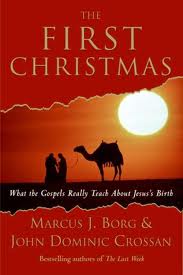 In 2008, our little congregation played host to John Dominic Crossan who has been acclaimed as world’s most famous New Testament scholar. Crossan’s visit to our congregation began with a public lecture based on his best-selling book The First Christmas in which he and Marcus Borg provide a splendid historical outline of the development of the birth narratives. I had the dubious honour of standing before his enlightened audience on Christmas Eve to preach in the great man’s wake. What follows is the Christmas Eve sermon I preached just three weeks after Dom’s illuminating visit.
Just a few weeks ago, this congregation was privileged to play host to a man who has the reputation of being the greatest New Testament scholar in the whole world. Dom, (we get to call him “Dom” now) wrote The First Christmas with Marcus Borg who is the guy who is heralded as the world’s leading expert on Jesus and Christianity in the 21st century. During his lecture, Dom provided us with all sorts of marvellous ways to understand the stories surrounding the birth of Jesus. Ever since that visit, there have been folks who listened very carefully to what Dom had to say and who have been positively gleeful when they’ve asked me what I’m going to do about preaching on Christmas Eve.
I mean what could I possibly say to you after so many of you have just finished hearing from the best in the business! And then there are those of you who bought the book and you’ve read what the experts have to say about the first Christmas. Some of you weren’t able to hide the smirks when you wondered out loud just exactly how I’d go about following the eminent Dr. John Dominic Crossan.
I don’t mind confessing that on several occasions since, I’ve woken up in the middle of the night and wondered what on earth I’d say to you this evening. Even those of you who didn’t manage to hear Dr. Crossan; you’ve probably seen him on TV this week on one of the dozen or so, documentaries on which he appears as the expert scholar who the media turns to in order to unravel the Mysteries of the Bible or to dig up the truth about Jesus. In this the age of information, you can simply go to YOUTUBE or to ITUNES U and download all sorts of podcasts where you’ll discover what pastors have been learning at seminaries for decades as the academic world has unlocked so many of the secrets of the ancient world in an effort to discover the real truth about what may or may not have happened so very long ago. Ever since: “The shepherds returned, glorifying and praising God for all they had heard and seen, as it had been told them.”
Since the end of the first century, some 1900 years now, the story of the nativity has been told. Lately the church has become a little embarrassed by the way in which this story has been told. All sorts of experts have weighed in to tell us that it could never have happened the way we all remember it. Biblical scholars, historians, theologians, bishops, pastors, professors even scientists have cast doubt on the details of the story of the nativity. But even though we know how impossible some of the details may be, we cling to this powerful story. Despite the wisdom of the experts, regardless of our doubts, this story still has the power to stop us in our tracks. No other story or image is more recognizable to people the world over than the Nativity scene of the birth of Jesus.
Tonight the images of a stable in Bethlehem, with Mary and Joseph gazing fondly at the baby Jesus, while the shepherds look on and the heavenly host sing their praises, these images are crystal clear to all of us. The story is part of us; it’s in our bones. And every year this story causes our lives to shift from the routine of winter, to the marvel of this night, when families are drawn together, and strangers greet one another with kindness and from near and far the hope of peace on earth is a dream shared by us all.
Now I know that somewhere in the deepest darkest recesses of our being, or for some of us, just beneath the surface of this dream, the wisdom of the experts causes a shiver to run across our spines as we wonder how the hope for peace on earth can possibly lie with such an unbelievable story. That shiver used to haunt me, until the day I recognized the power of the truth that lies in the story of the birth of Christ.
You see truth is an amazing reality. Truth is never simple. And yet truth is quite simple really. At least for those who have eyes to see and ears to hear. But before I tell you about the truth, let me do what I do every Christmas Eve, Let me tell you a story. It’s a true story about a story about a story.
You see, the easiest way I know to reveal the truth about a story is to tell a story that sheds light on a story. It’s the most ancient way to reveal the truth and it’s the way that Jesus used when he wanted to reveal the truth about the scriptures.
This story took place just about two weeks ago. Our Confirmation students had gathered together for our last class before the Christmas break. Their final assignment was due. Each of the students was required to tell a story that revealed something about the nature of God. They were asked to write a gospel according to them.
One by one they got up and from this very pulpit and they told their gospel stories. I asked one of the students for permission to re-tell their gospel story this evening. The student agreed on the condition that I not reveal to you who actually wrote the story. Which is perfect really because despite all our best efforts nobody can really say who actually wrote the four gospels attributed to Matthew, Mark, Luke and John. So, here I give you the gospel as it was told by one of Holy Cross’ confirmation students and recorded, after a fashion, by me.
It was a cold and snowy night in the town of Newmarket and a homeless couple wandered the streets of Davis and Yong searching for shelter and warmth. They were a strange looking couple; a man and a very, very, very, fat woman.
They were dirty and grubby and they wore layers and layers of clothes trying to  keep warm. They’d been wandering for a very long time and they were very, very, very hungry.
So they trudged up to Wendy’s, hoping to get a warm meal. But when they made their way up to the counter the guy behind the counter shouted at them and said, “Get outta here! We don’t serve fat people at Wendy’s!”
So the hungry couple headed over to Tim Horton’s, but the woman was so fat that she couldn’t fit through the door so the people told her to go away cause there was no room for fat people at Tim Hortons.
So, on they trudged up to MacDonalds and low and behold the fat woman made it through the door and the man managed to get the servers to provide them with a warm meal and just as they were settling into a booth, there appeared a great flood!
And the very, very, very, fat woman leaped up onto the table, right there in the middle of MacDonalds! And the woman began to scream and moan. Because she wasn’t just some fat homeless person, she was with child. And after a lot of screaming and moaning a baby was born in the city of Newmarket. And all the people rejoiced! For unto us a child was given, a child born in the poverty of MacDonalds. For if God came to earth today, God would come where we least expect God to be.
The Holy Gospel as it is told by a young person of this congregation. Thanks be to God.
So, if your struggling over some of the details of the nativity story, if the experts have left you perplexed, cynical or worried, do not be afraid, for I bring you tidings of great joy. The story is true, every last word of it is true. For just like Dom so wisely revealed to us, the story of the nativity is a parable and like all parable’s it represents a truth that cannot be fully expressed in words. Like all good parables the truth is not to be found in the details, but rather in the Spirit of God that breathes life into the parable. It’s a parable about so many things, but most of all it is a parable about peace on earth giving glory to God.
Now there are many down through the ages that have tried to weave stories of peace on earth, but none so everlasting as this. And yes some of us would have rather have had a road map or an expert to set us on the path to peace. But alas, all the experts have failed in their efforts to guide us. The truth that they impart has been rejected. So, once again we are left with this parable. A story so simple that even a child can understand it. A parable that depicts the truth that was experienced by those who walked and talked, loved and learned from Jesus. And the truth echoes through the centuries and the message is clear to everyone who has ears to hear.
“And suddenly there was with the angel a multitude of the heavenly host praising God and saying, “Glory to God in the highest heaven, and on earth peace, goodwill among all people.” And we are left wondering at the power of a love great enough to triumph over death and we claim a Christmas Truth greater than any of the tradition it inspires: the truth of the mystical longing of the creature for the creator—the finite for the infinite— the human for the divine. It’s a longing that transcends culture, religion, language and custom—a longing that is represented tonight for us in the baby in the manger—the sudden, amazing and incomprehensible gift of grace: a God who loved us enough to become one of us.
Yes, we embody the wonder of Christmas in the gifts given, the meals shared, the gathering of family and loved ones. But the greater wonder is that the God who is love incarnate comes down to be among us over and over again. Christ comes to show us how to share that love with a world in desperate need of it— to a world yearning for “peace on earth, good will among all people”.
That shalom—that peace—that unfamiliar hush is the peace on earth I’m praying for this Christmas— the shalom that doesn’t just mean the peace that comes when we’re no longer at war but the shalom that means that all human beings live together at peace with one another and with God, and in right relationship with all of the rest of God’s wondrous creation.
Shalom, the Hebrew word for what we might describe as “turning the human race into the human family” —the peace on earth that we, are called to be about as followers of Christ, not just at Christmas but all year long. The truth is that peace is the only way we can truly give Glory to God.
Peace is the only way to insure that every child born into this world will have an opportunity to play, to learn and to grow. To accomplish peace on earth we will all have to go out into this Christmas night and into this New Year and put our faith into action. That means prayers and protests; speaking up and stepping out; offering whenever and wherever possible the Good News of God’s shalom and realizing the truth of the angels chorus. For we are the followers of the one whose birth they herald. Howard Thurman, a fellow follower of Christ, put it best declaring that:
When the song of the Angel is stilled,
When the Star in the sky is gone,
When the kings and the princes are home,
When the shepherds are back with their flock,
The work of Christmas begins:
To find the lost,
To heal the broken,
To feed the hungry,
To release the prisoner,
To rebuild the nations,
To bring peace among brothers and sisters—
To make music in the heart.
And to radiate the Light of Christ,
every day, in every way,
in all that we do and in all that we say.
The work of Christmas lies before us.
So, dear friends, rejoice and be glad, for unto us a child has been born, a child who is Christ our Saviour. May Christ lead each of us as we go forth to make peace on earth and good will to all. Amen.
 Bishop Spong sums up our age-old problem of prejudice as only Jack can. (Oct.29/2012)
“The reality of killing prejudices in the life of the Christian Church.”
<p><a href=”http://vimeo.com/53429806″>“ The written version of the sermon I preached the last time Luke 21:25-36 came around in the Lectionary. As always the written word is but an approximation of the Word preached.
We have learned to ask questions. Why did the followers of Jesus tell the stories they told about him? Why did the followers of Jesus they tell the stories about Jesus in the way they told them? These questions have revealed new insights into the scriptures and we helped us to understand how Jesus followers understood the life death and resurrection of Jesus.
As we begin a new church year, there is another question that we need to learn to ask. Why did the designers of the church lectionary decided that on this the first day all over the world church goers should read from this particular text from the Gospel according to Luke? It is the first Sunday in Advent, why not read something from the first chapter of the Gospel according to Luke? What are we doing in the 21st chapter of the Gospel According to Luke and why do we have to listen to Jesus going on about the end? Why did the designers of the lectionary decide that we needed to hear what has been described as Jesus’ mini account of the apocalypse? Why take us into this particular darkness?
“Signs will appear in the sun, the moon and the stars. On the earth, nations will be in anguish, distraught at the roaring of the sea and the waves. People will die of fright in anticipation of what is coming upon the earth. The powers in the heavens will be shaken. After that, people will see the Chosen One coming on a cloud with great power and glory. When these things begin to happen, stand up straight and raise your heads, because your ransom is near at hand.” And Jesus told them a parable: “Look at the fig tree, or any other tree. You see when they’re budding and know that summer is near. In the same way, when you see all these things happening, know that the reign of God is near. The truth is, this generation will not pass away until all this takes place. The heavens and the earth will pass away, but my words will not pass away.”
We know that the writer of the Gospel according to Luke wrote very near the end of the first century, some 50 to 70 years after the life, death and resurrection of Jesus. Some 20 to 30 years after the Romans destroyed Jerusalem and for all intents and purposes put an end to the world as Jews and the followers of Jesus had known it. Scholars tell us that in all likelihood the writer of the Gospel according to Luke created this story to reassure the followers of Jesus that even in their present darkness, even though it looked as if the heavens and the earth were passing away, Jesus words will not pass away. But why did the designers of the Revised Common Lectionary decided to begin the church year with this story of Jesus’ apocalyptic vision?
Well the Luke part is easy. This new year is the third in the lectionary’s 3 year cycle and so the mainline churches, that is the Roman Catholic, Anglican, Presbyterian, United, and many other denominations who get their weekly readings from the Revised Common Lectionary read primarily from the Gospel According to Matthew in year A, Mark in Year B and Luke in year C. (John does not have it’s own year and is only read during Christmas and Easter of years A,B, and C.) But why begin with chapter 21 of Luke? Why not Chapter One? Why not begin with that wonderful story of Elizabeth and Zechariah and the birth of John the Baptist? Surely a birth story is more fitting for the first Sunday in Advent when preachers are supposed to preach about hope?
I must confess that I am tempted to ignore the lectionary and skip the darkness of the apocalypse. But the more I read about darkness and the foreboding, the more I realize that at a time of the year when all the world wants to sentimentalize, trivialize and retailize the Christmas story, perhaps we who follow Christ ought to begin our preparations with a sojourn into the darkness.
We do well to remember that even now, for a great many of our sisters and brothers and perhaps even for us the world is coming to an end. And in even in the darkness we need not fear, for God is with us. In the darkness the realization that Christ is coming provides the hope we need to venture forth.
This year, I find myself venturing into Advent not dreading the end, but with the longing for the world to come to an end. I’d very much like the world as we know it to end. I’d like the wars in Afghanistan, Syria and Palestine to come to an end. I long for an end to the regime in Iran that insists on escalating the tensions between our two cultures with their ever-expanding nuclear program. I’d like our own government to live up to its own mandate to put an end to poverty and homelessness here in Canada. I’d like to see the end of an economic system that enslaves 80% of the world’s population in poverty. I’d like to see an end to violence, hunger, plagues and war. But I’ve long since given up the hope that we will be rescued from systemic evil that causes so much grief in the world by a divine rescuer swooping in from somewhere above the clouds.
My hope for the future does not in an apocalyptic vision of Jesus returning to sort out the good from the bad, the wheat from the chaff, rewarding the former and barbecuing the latter. This super-saviour that has long been the hope of Christian communities weighed down and oppressed by savage governments and their policies. While destruction, pain, and oppression are a part of our global reality, a spaceman-saviour is not. We know that, despite our wishes and projections, hope does not come from outer-space. Hope has to be found in our here and now. It has to be worked for, discovered, accepted and developed. This doesn’t mean that as so many pundits and pseudo-intellectuals would have us believe, that God does not exist and we should abandon all hope and run screaming from the church. This does mean that rather than looking to the heavens for salvation, we should look around us, and see that our God is located within our experience, our struggles, our communities and our hearts. Christians believe that God is love.
We believe that permeating our lives, our land, our communities, and all that is beyond us there is a powerful love that can touch our lives. That love is on our side, is for us, and can hold us. That love reaches out to us in a neighbour’s smile, in the strident concerns of a protester, the embrace of a lover and even in a government handout. Love comes in a myriad of ways. Just like hope. That love we call God. That love called God is with us. We are sacred, blest, and loved. The Holy Spirit of love is within us, like a seed waiting to grow and flourish.
Advent is the season pregnant with possibility, when we nurture that love within and prepare to give it birth. The seeds of love are waiting to grow and flourish. Even in the angriest person, in the most arrogant businessman, in the most ridiculous politician, in the toughest tyrant, or the worst murderer, there is a holy seed of love waiting. Those seeds need tending, they need nurturing and they will grow. Hope is not a mental exercise. You don’t just stand up and decide that you are going to be hope-filled. Hope is the result of a combination of encounters with others, our personal receptivity, and our awareness of the spiritual power of love that infuses all of life. Seeds will grow out of the darkness. Advent is a time to build hope. Advent is a time to prepare for Christmas by tending the hope-filled seeds within each other.
Advent is pregnant with possibility, a time to anticipate the coming of Christ by opening our eyes to the Christ growing within us. Advent is a time to acknowledge that at the heart of our world there is a power of love that reaches out to us, believes in us and sustains us, and that power of love is God.
We need not fear the darkness. For it is in the darkness that we will find the seeds. Hope lies in the darkness of our experience. The light of the Holy One is within us. And so this advent, as in all others. we will tell the stories of our experience. And in those stories we will discover the stirrings of Christ who waits to be born in us.
Many of those stories will begin in song. I don’t know what it is about we humans but we tend to sing our best stories. Music opens us in ways that mere words cannot. So let me begin our Advent journey with a story about songs sung in the darkness.
It was a dark and dreary time filled with fear and anticipation. Many years have past, but I can still remember her excitement at being chosen to play the part of the Angel Gabriel in the Sunday School Christmas pageant. Anna was just nine years old and never before had she been well enough at Christmas to take on a role in the annual church extravaganza. When she was just eighteen months old, Anna was diagnosed with leukemia and had spent most of her little life battling the disease.
But this year was different, this year Anna was ready she knew her lines and she must have tried on her angel costume about a million times. My memory is a little fuzzy but I believe that, that year, Christmas fell in the middle of the week.
The pageant was scheduled to take place the Sunday before Christmas Eve. On the Saturday before the pageant was to take place, Anna’s mother called me with the bad news. Anna was in hospital. Her white blood count was dangerously low and it didn’t look like Anna was going to make it home in time for Christmas let alone for the performance of the pageant. Anna’s mother asked me if I would help out with the hospital visiting.
Over the years, a group of us had become all too familiar with this particular routine. Anna had two siblings that kept her parents very busy. Anna didn’t like to be alone when she was in hospital and so friends of the family used to help out when needed. Because I lived only a few blocks from the children’s hospital and because Anna liked my bedtime stories I often found myself taking the night shift with Anna.
Bedtime at the hospital was quite the routine. Anna loved to be told the same bedtime stories over and over again. It sometimes took a couple of hours to get her to the point where she would even consider closing her eyes. And when she got to this point Anna always insisted that I sing to her.
Now you are all too well aware of the fact that my abilities as a chanteuse are severely limited. I’m simply not a great singer. God clearly didn’t see fit to grant me the ability to carry a tune. But this didn’t seem bother Anna. For some unknown reason – perhaps she was tone deaf— or maybe she just had a warped sense of humor—but Anna loved to hear me sing. And so on the Saturday evening before the pageant was to take place, I found myself at Anna’s bedside.
I had already told her several of her favorite bedtime stories when Anna asked if I would read her a story. She pointed to a brand new picture book that lay on the cabinet beside here bed. The book had no words, just pictures. The pictures told the story of Mary and Joseph’s journey to Bethlehem and the shepherds who were watching their flocks out in the fields.
As I turned the pages Anna and I took turns telling the various parts of the story to one another. When we got to the part where the Angel Gabriel appeared before the shepherds, Anna took over and she knew her part well. “Do not be afraid, for see—I am bringing you good news of great joy for all the people: to you is born this day in the city of David a Savior, who is the Messiah, the Lord. This will be a sign for you: you will find a child wrapped in bands of cloth and lying in a manger.”
Anna delivered her lines perfectly and then went on with the story. “And suddenly there was with the angel a multitude of the heavenly host, praising God and saying”Anna signalled to me to join her in the angels’ lines: “Glory to God in the highest heaven, and on earth peace among those whom God favours!”
As I spoke the all too familiar lines, a huge lump rose up in my throat. I wanted nothing more than to curse God. What kind of God allows a beautiful little angel to be stricken with a cruel disease? What kind of God allows the dreams of a beautiful little girl to be destroyed by lousy timing? What kind of God, promises peace on earth and then disappears for 2000 years leaving us to our own devices?
I managed to keep my questions to myself as we continued to turn the pages. When we got to the last scene of the book, Anna declared how wonderful it was that the baby Jesus and the shepherds and the wise guys and Mary and Joseph all got to hear the angels sing. I said that according to the story only the shepherds heard the angels’ song. But Anna told me not to be silly because surely the angels would have started singing again when they saw that everyone had finally arrived at the stable. I asked Anna what she thought the angels might have sung. Anna got a wicked little grin on her face and insisted that they probably sang her favorite bedtime song. I just laughed at the mere thought of angels singing that particular song to the baby Jesus.
You see, over the years of tucking Anna in, I was forced to try to sing quite a few lullabies to her. And with my limited abilities, I can assure you that it wasn’t easy. Not for me and not, I’m sure for the nurses who may have overheard my feeble attempts. But of all my crappy renditions, Anna’s absolute favourite was “You are my sunshine.” And so staring down at the picture of Mary and Joseph and the baby Jesus, the shepherds, wise guys and assorted angels, I began to sing Anna’s favourite lullaby for the baby Jesus.
In order to spare the other people in the ward, I sang ever so softly. “You are my sunshine, my only sunshine, you make me happy when skies are gray. You’ll never know dear how much I love you please don’t take my Sunshine away.”
When I’d finished singing, Anna sang a lullaby for the baby Jesus. And I’ve never heard Away in a Manger sung so sweetly. By the time Anna got to the last verse, a few others had joined in.
That’s how it began. A couple of nurses and some of the other children and their parents joined us in an impromptu caroling session. We sang all the Christmas carols we could think of. And when we couldn’t think of another carol Anna asked me to sing her other favorite.
I couldn’t remember what her other favorite was. Anna just smiled and said you know the one where I get to pretend to play the drum. I thought she meant the little drummer boy and I said that I was sorry but, I don’t think I ever knew that that was one of her favorites.
But from the expression on Anna’s face it was clear that I’d guessed wrong. Anna began to beat out a rhythm on the table by her bed.
And I remembered. Kum by Ah My Lord …someone’s crying lord;… someone’s fighting lord; ….someone’s hurting lord;….someone’s praying Lord;….Come by here
Little Anna didn’t win her battle with leukemia. She died that following spring. But like Christ, Anna lives. She lives in me and she lives in the lives of every life her little life touched.
In a world gone mad, in a world where we have yet to learn just how to love one another, Christ comes to us. When we are hurting or in pain, when our world is darkest, Christ comes to us. When we are sick and tired. Christ comes to us. When we have given up and can no longer bear to hope. Christ comes to us. Because our God is the one who takes on flesh and dwells among us.
Christ is Emmanuel, which means God is with us. Christ, laughs with us, cries with us, rejoices with us, suffers with us, heals with us, walks with us, shouts with us, struggles with us and loves with us. Christ dies with us and we are raised with Christ and born again. And because Christ is with us, death has lost its sting. Because our God is always with us, we will live forever more. And so, today God stands with us and speaks to us a word of hope a word that is the hope of the world.
Come by here my lord, come by here. Come by here and help us to bring the good news of great joy for all the people. Come by here and help us to sing Glory to God in the highest heaven and on earth peace good will to all. Come by here my Lord. Come by here. Amen
 During the season of Advent we approach the MYSTERY through story and song. Unable to fully express our deepest longings with words, we engage the stories handed down to us by our ancestors. Trusting these stories not as history but as truth. For as Marcus Borg teaches, these stories may not have actually happened this way, but they are always happening. Over and over again, we see ourselves and our longings for hope, peace, joy and love in the stories we tell during this season of desire. In the video below Phyllis Tickle tells the stories that speak of the longings and desires of our ancestors. Today, we would do well to remember the stories of old as precursors to the telling of our own stories of longing. For just as our ancestors had the wisdom to engage the MYSTERY with stories, we too know of our need to engage the MYSTERY with our stories. What stories are gestating within us? What stories will we give birth to this Advent.
For those of you using mobile devices my apologies but bliptv is available here
 Our thanks to Trinity Anglican Church in Aurora who graciously hosted a splendid event on Nov.16-18 at which the great Phyllis Tickle shared her wealth of wisdom on the “the great emergence” that is rocking our world. Phyllis claims that she is not a preacher, but the homily she delivered on the Melchizedek’s importance to Emergence Christianity’s understanding of “where it all began,” suggests that Phyllis is mistaken about her homiletical prowess.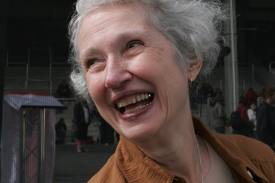
You can listen to Phyllis’ homily here
 Leftover People – Pastor Tom Doherty
Listen to the sermon here
Leftover People our Hymn of the Day: Leftover People
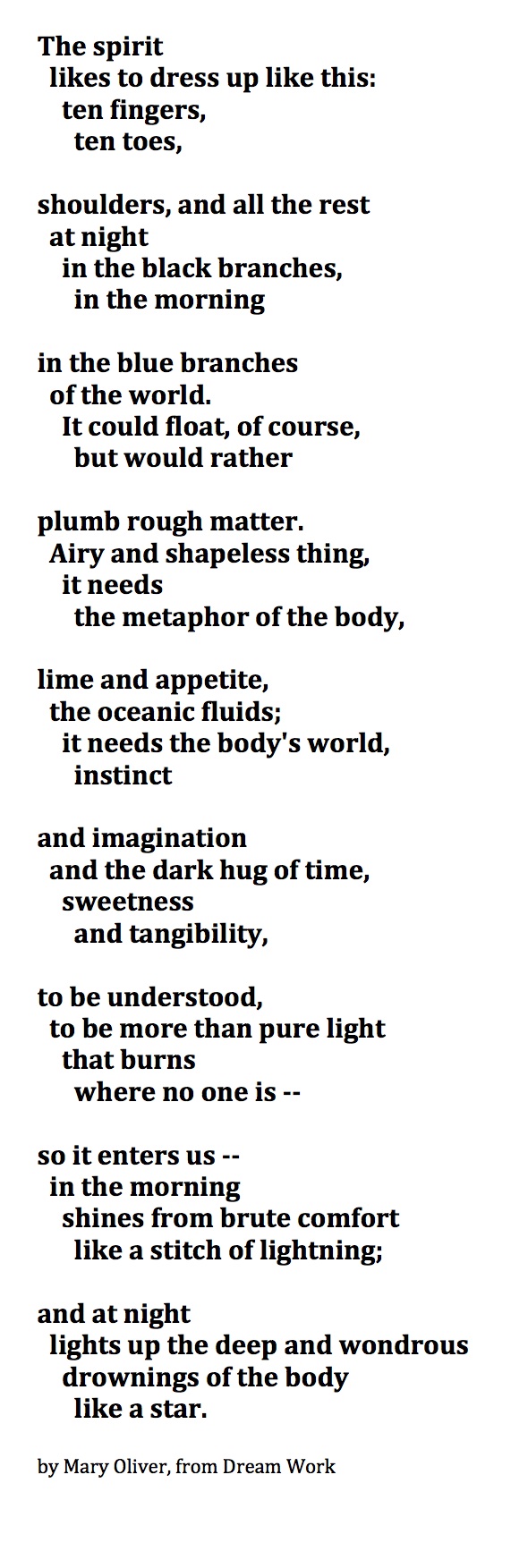
 I put away my work and I spent the early morning hours with an old friend. There have been too many theological tomes of late so I have enjoyed thumbing through poetry and rediscovering those things I know in my bones. This morning Mary Oliver swept me down to the riverside and I have been communing with the enfleshed Mystery that lies at the heart of all. I offer her splendid piece simply entitled “POEM” Enjoy!
 For those who are reluctant to give up the doctrine of “original sin”, Evolutionary Christian evangelist Michael Dowd offers an intriguing re-interpretation of the human condition that uses evolutionary science to offer good news. While I prefer to speak of “original blessing” a la Matthew Fox, Dowd’s re-interpetation offers a radical re-working of a doctrine that has entrenched so many of us in “worm theology” bemoaning our sinfulness. To get a better understanding of Dowd’s approach, I recommend his book “Thank God for Evolution” or check out his website
Click on here to watch the book trailer

Each time I dip into the Qur’an I am surprised by some new insight and I can’t help wondering why I don’t sip more frequently from this deep well’s thirst-quenching wisdom. Over the years, I have tried to keep up my study of Islam which I first began during my  years as an undergraduate in Religious Studies at the University of British Columbia. Back then I believed that anyone who intended to seek a career in the church had better understand the religions of the world. Fortunately my naiveté was matched by my enthusiasm and I quickly learned that, despite my good intentions, there was no way to simply learn about the religions of the world. One doesn’t just apply one’s self to the study of a religion and learn what one needs to know and then move on. Islam like any religion that has survived and evolved over centuries, is a multifaceted and multilayered way of living. While I can from time to time open myself to the riches that Islam has to offer, I can only ever hope to be someone who peers in from the outside.
Like many outsiders I find reading from the Qur’an challenging to the point of being daunting. I require a reading partner to guide me along the way.Recently, I discovered the work of Lesley Hazelton, a self-described agnostic Jew whose unique view of Islam is both enlightening and engaging. Hazleton’s work on Islam includes the 2010 publication “After the Prophet: The Epic Story of the Sia-Sunni Split in Islam”. But I came to know about her via her engaging TED Talk which you can view below. I have just pre-ordered her forth-coming book “The First Muslim: The Story of Muhammad”.
Some have dubbed Hazleton as Karen Armstrong’s successor. While the comparison is apt, Hazelton’s style is very different from her illustrious counterpart. Hazelton is a psychologist/journalist/historian whose colourful approach, pithy language and diligent research earned her this description by Paul Constant writing for Amazon:
Over the last decade, Hazleton has produced a trilogy of books—Mary: A Flesh-and-Blood Biography of the Virgin Mother, Jezebel: The Untold Story of the Bible’s Harlot Queen, and After the Prophet: The Epic Story of the Shia-Sunni Split in Islam—that are difficult to categorize. The books land at the intersection of history, religion, and literary criticism; they are informed by hundreds of texts and intensive traveling to the Middle East (Hazleton spent the 1970s living in Jerusalem); and they sing in the voice of a writer who has finally figured out exactly what she wants to say. Her characters are figures who have been trapped, untouchable, in amber for decades by organized religion.
Any given chapter of these books may include a fictionalized narrative of life in biblical times, a puckish interpretation of three wildly differing accounts of an event that occurred over 2,000 years ago, and a personal account of Hazleton’s own travels. In Jezebel, Hazleton undertakes an ambitious rehabilitation of the queen of Israel whose name has become synonymous with whorish behavior. In a fraught passage, Hazleton visits the birthplace of Elijah, the prophet who destroyed Jezebel’s reputation and demanded that she be torn to pieces by dogs in what is the most brutal, explicit murder to take place in the Bible. Of course, Hazleton is beset by ravenous wild dogs: “The car shuddered under the assault. In front of me, open jaws spattered drool on the windshield. To one side, fangs loomed inches from my eyes.”
When I compliment Hazleton for including that passage—you risk breaking the spell for readers when you pepper a historical narrative with personal anecdotes, but the dog attack is perfectly placed to make Jezebel’s story more compelling for the reader—she beams with pride, recalling that as she raced away from Elijah’s birthplace, she thought, “Oh, fuck. No one’s going to believe that happened. It was just too fucking perfect!”
Although only recently acquainted with her work, I am finding Hazleton to be a charmingly rigorous companion as I dip into the oasis of Islam. Her company is giving me the courage to drink more deeply than I have previously dared for fear of drowning in unfamiliar pools.
Enjoy her brief TED Talk which I am sure will wet your appetite for the full lecture given to the Young Muslim Association at the Islamic Centre of America that you will find below.
 Since quoting Walter Wink in my sermon yesterday, I learned that he died a few months ago. I will always be indebted to this amazing teacher for all that I have learned and continue to learn from him. The videos below comprise the various parts of a lecture that Wink offered on the subject of Jesus’ teaching on Non-Violence. For anyone who aspires to follow Jesus this lecture is a must see. Wink’s books are well worn friends that I have often thumbed through to find more than a nugget or two to enable me to teach anew something that I have long since come to know as a result of Wink’s excellent work! His excellent trilogy: Naming the Powers, Engaging the Powers, and The Powers that Be along with Jesus and Nonviolence: A Third Way should be at every preacher’s fingertips as we proclaim Jesus’ radical way of being in the world.
 pastordawn