New Vision: Exciting and Terrifying – a sermon for Lent 4A John 9:1-41
Reply


Watch Richard Dawkins’ THE GOD DELUSION
and then join us for conversation on
Wednesday April 2, at 10:30 am
when we will explore Sigmund Freud’s critique of religion.
 When I was a child, the word God was one of those words that adults either used in vain or in hushed tones. Outbursts of anger always included the word God. Strange and mysterious circumstances often resulted in the word God being used in hushed tones. I remember the very first movie I was ever taken to see. Bambi may have been a Disney movie, but when the shot that killed Bambi’s mother rang out, as far as my mother was concerned, I broke one of the ten commandments when I shouted, “Oh my God.” Mom warned me that when we got home there would be dire consequences for this offence which confused me to no end, because before the movie began, they did what they always did in back in the 1960’s, they played, “God save the Queen” as we all stood to attention. God’s name been sung out incurred no dire consequences.
When I was little the words of “God save the Queen” mystified me. Not because the words are particularly mystifying, but because I heard them through the ears of a child. “God save our gracious Queen, long live our noble Queen.” I had absolutely no idea what gracious or noble meant, but our Queen, who always managed to cause an argument whenever she was mentioned in Belfast, our Queen was both gracious and noble. “Send her victorious”, that was the queen’s name: “Victorious” “Send her victorious, long to reignoverus.” I couldn’t for the life of me figure out what it was that the queen did that was so bad that everybody wanted to send her all the way to a place called reignoverus. Whatever it was, this horrible thing, it was so bad that only God could save her. Poor old Victorious.

Watch the video below which was shown in worship after the reading of the Gospel: The Woman at the Well (below) and then listen to the sermon.
You can listen to the sermon audio here:
 We will wrap up our conversation on Nietzsche’s critique and how it might help us to examine our own expression of Christianity. You can read a summary of Nietzsche’s views on Christianity here and watch a short lecture on Nietzsche and Christianity below. Please watch episodes 2 and 3 of Atheism: A Brief History of Unbelief (below) to prepare for our next class on Wed. March 23 so that we can begin to look at the critiques of Marx and Freud.
 Dave Van Ronk, aka The Mayor of MacDougal Street, haunted my teen-age years with folk songs that still inhabit my soul. Some say The Mayor is the inspiration behind the movie Inside Llweyn Davis. But to me the growly voiced Mayor remains a poet who inspired me to put pen to paper. As I prepare to tickle my keyboard to create a sermon about John 4:1-42, his voice echo’s in my soul. van Ronk died in 2002 and imagining his journey “on down to Galilee, on that promenade in green” soothes the ache of his absence even as it inspires me to speculate on the rocky road the Samaritan woman travelled to that ancient well. “uka duke soda cracker!”

There’s a commercial currently running on the TV and each time it comes on, I can’t help myself, it makes me smile and if I let myself, it makes me laugh. It’s a collection of scenes in which lovely little babies laugh. They laugh and they laugh and they laugh and before you know it you’re hooked and you just can’t help yourself you are laughing too. Laughter is a great tonic! Laughter is good for the soul! And yet, for some unknown reason we tend to exclude laughter from our religious life. Religion is serious business and so we don’t laugh much in worship. There’s a quote from St. Teresa of Avila that served as a warning sign for me as I was preparing this sermon. “NOT YET TICKLED” writes St. Teresa, “How did those priests ever get so serious and preach all that gloom? I don’t think God tickled them yet. Beloved—hurry.” The thought of being tickled by God is delightfully refreshing. Continue reading
 I am indebted to Jim Kast-Keat, a pioneering preacher who inspired me to open this sermon with the video below. I am also indebted to Bishop John Shelby Spong for teaching me more that I can articulate with words. His excellent book The Fourth Gospel: Tales of a Jewish Mystic opened the Gospel According to John in ways that have helped me to see aspects of the Divine to which I was once blind. Much of the sermon consists of extensive quotes from chapter 9 of Jack’s book.
Readings: John Chapter 2 and John 3:1-17
Watch the video below carefully and then listen to the sermon below.
Listen to the sermon:

Evolutionary theologian Michael Dowd expresses an evolutionary understanding of what it means to be human. His interpretations encourage the adoption of a reality based evidentiary faith.
 Despite a snow-storm, our Atheism for Lent Study is of to a great beginning! Posted below is the Keynote presentation that was used to facilitate the class. Each slide will play for 5 seconds and can be stopped by using the pause button. Videos used in the class are included in the Keynote presentation.
 When I was just a kid, I had what can best be described as an adolescent crush on a teacher. Looking back on it now, I’d have to say that I fell head over heels in love with my teacher. It was the kind of love that only a 13 year-old girl could have; so intense and all consuming. I came to believe that this teacher was the wisest, kindest, most interesting person in all the world. This teacher knew more than anyone else, especially my parents. This teacher was cooler, funnier, more daring and definitely more in tune with my life than anyone I had ever met. I was convinced that if I could only be just like this teacher would mean that I too would be cooler, funnier, more daring and definitely more in tune with life. So, like most adolescent girls who are suffering from a crush I became obsessed with this teacher. I was young and I was in love, and like most thirteen year-old’s the I was convinced that the world revolved around me, so I set about pursuing my passion. This teacher taught English, so naturally, I decided that when I grew up I too would teach English. This teacher loved poetry, so I too became passionate about poetry.
One day this teacher announced that we could gain extra-credit if we wanted to enter a local poetry writing contest; and even though I was pretty sure that year I’d be getting a mark that would be somewhat better than an A, I began to write poetry. I was very serious about my poetry writing. I carried a pad of paper with me everywhere I went, and I began to ruminate about my life. I don’t remember any of those early attempts to wax poetical, but I do remember that each and every one of those poems was about me; me and my life, me and my unrequited love, me and my passion, me and the horrible way that no one paid much attention to me. Me, Me, Me, Me, it was all about me.
As the time drew near for us to submit our poetry to the competition, my teacher announced that there would be a special class after school, so that those of us who were planning to enter the competition could get some feedback on our efforts. So, by the end of the week, I would have to choose one of my great works for feedback. I spent hours pouring over one poem in particular. Tinkering with the words, trying to get things just right. I was so very proud of the final draft. I’d carefully copied it out on to a crisp piece of foolscap. Arranged the letters in the middle of the page so that they looked just so. I could hardly wait for school to be over so that I could rush to see what comments my beloved teacher had placed in the margin. There were barely a handful of us who stayed after school.
Looking back on that scene, we were a nerdy little crew. I was positively breathless as my teacher handed my offering back to me. To this day, I can’t remember a single line of my great work, but I can tell you word for ward what was scribbled in red in the margin of the ever so white foolscap. “A little self-involved, try looking outward.” I was devastated. How could anyone be so cruel? I’d poured my heart out only to have it stomped on by the indifference of truth. Continue reading
 Followers of this blog know that John O’Donohue is one of my favourite sages. I am indebted to a follower of the blog for sending me this podcast of Krista Tripett’s interview of John O’Donohue recorded shortly before his death in 2008. O’Donohue’s words continue to open my soul.
 I have a condition common among members of the clergy this week: black thumb. It lingers long after Wednesday’s ashes have been smeared on the heads of our parishioners. Thoughts of mortality and eternity haunt the pores beneath my thumbnail. The knowledge that we are dust and to dust we shall return continues to delight me.
 View the Ash Wednesday Worship Bulletin here
Ash Wednesday Readings here
Listen to the Ash Wednesday Homily:
 I am indebted to the exegetical work of John Holbert for the insights into Hebrew humour!
Each year as Lent approaches, I find myself flirting with the idea of giving up Lent for Lent. Lent is just too much work. For centuries, during Lent the church has emphasized so many concepts that seem alien to the 21st century mind. Each year during Lent preachers are required to undertake the unenviable task of unpacking unpopular, seemingly antiquated concepts in an effort to encourage the contemporary churchgoer to entertain the equally antiquated rituals of Lent. I mean Christmas and Easter might attract a few more people to our sanctuary, but how do you attract people with talk about repentance or fasting? Just look at our readings for this morning. Temptation is the order for toady. Eve and Adam succumbing to temptation, the Apostle Paul prattling on, heaping condemnation upon the first parents for having given in to temptation, and then Jesus himself resisting temptation from non-other than the Devil. Not exactly cheery stuff designed to bring comfort on a cold damp winter morning, where apart from the time change, there are very few signs of a longed for spring.
But Lent has arrived and so we must tuck into this dish of temptation hoping that it will reveal some hint of the promise of what lays beyond our long Lenten journey as we travel toward Easter’s resurrection joy. But these are not easy readings to unpack.
I could begin by warning against taking these texts literally. But you have heard warnings against taking the text literally and I know that you understand that the story about Eve and Adam is just a story. It never really happened. Most of you, even though you might be tempted to think that Jesus literally went out into the wilderness and was tempted by the Devil, most of you have long since realized that the Devil doesn’t actually exist. If you’re still tempted to believe that this story actually happened, well, the fact that in the story itself, Jesus goes out into the desert all by himself ought to at least make you pause to ask, who wrote this story down, if there was nobody there but Jesus and the Devil?
These stories are just that, they are stories. In the words of Marcus Borg, “The events in these stories never actually happened. But the events in these stories are always happening.” Let me say that again, lest there be any doubt: They never actually happened, but they are always happening. That’s what makes these stories such great stories. The stuff in these stories is always happening over and over again. Temptation is the stuff of our lives. Each and every one of us, each and every day struggles with temptation, each and every one of us and all of us together as humanity. This grand human experiment that we are caught up in requires that we all struggle with temptation. Continue reading

John Dear is a Jesuit priest who is living into Jesus’ call to be a non-violent activist peace-makers. In this video he presents a radical retelling of the Gospel that will change the way you hear all too familiar stories about Jesus. This is perhaps the most exciting interpretation of the life of Jesus that I have ever heard! It will challenge everything you thought you knew about who Jesus was and is. Father John’s gentle style may deceive you into thinking he is just an idealist. But hear him out and I’m convinced you too will be challenged to re-think so many of the stories told about Jesus in the New Testament. I know I will never again hear or preach about the raising of Lazarus without referencing Father John’s insights. A word of caution: you cannot un-hear this passionate call to peacemaking and it will in all likelihood lead you into some dangerous place where you are compelled to deny our culture of death and take up the mantle of peacemaking.
 The mythical stories of Jesus’ transfiguration remind me of old-fashioned love songs. You know the kind of songs that were playing on the radio when you first met, and when you hear them, you are instantly taken back to the days when you first fell in love. My wife Carol and I we have a love song and whenever our song comes on the radio, well, I swoon. “Truly, Madly, Deeply” by a group called Savage Garden; it doesn’t matter where or when, but if “Truly, Madly, Deeply” begins to play, well we are transported back to those early days. The words of the chorus are particularly appropriate for Transfiguration: “I wanna stand with you on a mountain, I wanna bathe with you in the sea.” Now I won’t go on because the lyrics of this particular love song are embarrassing. But I wanna talk to you about love songs and more particularly about standing on a mountain. How many of you have been to a mountaintop? I’ve been to the mountaintop! It’s so beautiful up there on top of the mountain. You can see forever up there. You can breathe deeply and feel the very Spirit of God breathing in you. It all makes sense up there on the mountaintop! It is so beautiful that you just never want to leave. There is nothing quite like being on top of the world.
I still remember some of my first mountaintop experiences in church. I didn’t begin to attend church until I was fifteen. So, it took me a while to get to the top of the mountain but I can still remember exactly what it felt like. Those trips up to the top of the mountain, the way I felt up there in the clouds, well it’s those mountaintop experiences that kept me coming to the church. It’s the Jesus that I met all those years ago that made me stay. The Jesus that I met all those years ago was simply amazing. I fell in love with Jesus and that love took me to great heights. The church I attended back then, was a lot like this place. The congregation was small and they loved to sing and they could certainly sing! All our trips up to the mountaintop began with a song. Singing those songs together lifted us up to the mountain and opened us up in ways that let us see Jesus. “And we walked with him and we talked with him, and he told us we were his own and the joy we shared as we tarried there, none other has ever known.” When that congregation sang they could take me to places I’d never dreamed. I knew that there in the midst of all that singing that, “Just as I am without one plea,” “God’s Amazing Grace would save a wretch like me,” and I learned from all that singing, “What a friend we have in Jesus, all our sins and grief to bear,” as each Sunday we washed ourselves “in the blood of the Lamb.”
I didn’t know it then, because I was in the fresh flush of my love affair with Jesus, but those old songs, those old songs molded and shaped me in the faith. I don’t remember the words of the sermons I heard, but I can remember each and every word of those old hymns that we sang. Today, I must confess that as a preacher it saddens me to say it, but it is most certainly true, that people don’t go home humming the sermon. No, no matter how eloquent the preacher, the people will always go home humming they hymns and not the sermon. Those mountaintop experiences that I remember from my early days in the church, each and every single one of those mountaintop experiences were punctuated by hymns. Those old hymns molded and shaped me in the faith. Those old hymns taught me the faith of the generations that went before me, they nurtured my developing faith, and in so very many ways they came to define my faith. Continue reading

Three years ago, the Strange History of Transfiguration Sunday inspired this sermon. I offer it here because the words of Desmond Tutu speak volumes as I work on this year’s Transfiguration sermon.
When our images of God are tied to the idol of a supernatural sky-dweller who has the power to solve all our problems, despair is sure to follow as our super-hero fails time after time to impress us.
When I was a very little girl, I was absolutely convinced that I had the power to change the mind of God! Confident that I held such power, I never missed an opportunity to exercise it. Now, I’ll grant you that like most children, I was also convinced that the universe itself actually revolved around me, so believing that I was powerful enough to change God’s mind, wasn’t exactly much of a stretch. In fact, when I was a child, it wasn’t all that difficult to change God’s mind. For instance, I could stop God from breaking my mother’s back simply by leaping over a crack in the pavement. “Don’t step on a crack and break your mothers back.” Now, in my young mind the only one powerful enough to crush my mother’s powerful spine, must be God. I also knew that God wasn’t particularly fond of ladders, and that if I refrained from walking under them, God would smile upon me. Continue reading

This sermon is a departure from my usual style; a teaching sermon, working without a manuscript. Using Keynote various images where projected to assist in setting the context for Jesus teaching on non-violent resistance. My a reflection on the creative and transformational power of love explores the tactics of empires that dehumanize enemies. The two video presentations in the Keynote point to the power of seeing the humanity of our enemies. The audio of the sermon is included below as is the Keynote that accompanied it.
Listen to the sermon:
vimeo 9761188 w=600&h=337]
[vimeo 64250360 w=600&h=337]
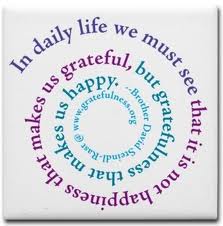 “If you think its happiness that makes you grateful, think again! It is gratefulness that makes us happy.”
 pastordawn