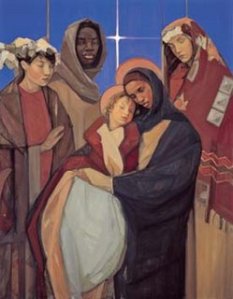
 An Epiphany Sermon, preached in 2008. I had just read “The First Christmas” by John Dominic Crossan and Marcus Borg. Our congregation played host to Dom Crossan a month before I wrote this sermon. So, Dom’s insights run through this effort. But the heart of this sermon beats as the result of a sermon preached by Bruce Sanguin a self-proclaimed evolutionary christian who is a United Church Minister (Canadian Memorial Church, Vancouver). I had the privilege of meeting this modern mystic while on sabbatical this summer and his compelling way of unlocking the scriptures using the wealth of the christian tradition together with the insights of modern science and psychology borders upon the poetic. This sermon was anchored by Sanguin’s words (Epiphany 2007). Sermons are a “live” event. So, this manuscript is an approximation of what was actually preached.
Just five days before Christmas (2008), The Archbishop of Canterbury, The Most Reverend Doctor Rowan Williams, the leader of the worldwide Anglican Communion started a firestorm. During a BBC interview, His Grace was quoted to say that the story of the “three wise men is a legend”. The Archbishop was also heard to say that he remained unconvinced that there was indeed a star that led the legendary trio to the birth place of the Christ Child.
If that wasn’t enough to send folks off the deep-end, it has been revealed that the Presiding Bishop of the U.S. Episcopal Church The Most Reverend Doctor Katherine Jefferts Schori, who just happens to be the first woman elected primate in Anglican history, has fanned the flames of the fire-storm by sending out what has been judged by some to be an incendiary Christmas card.
I downloaded a copy of the offensive card, so that you could see for yourself. Her Grace’s choice of card has offended the good deacons of Ft Worth Texas who claim that their Primate’s actions defy explanation. As you can see the wise folks depicted on this image look a lot like women. Can you imagine the nerve of the first woman primate! How could she be so bold as to select such an offensive image? Leave it to straight talking Texans to set things straight: for despite the audacity of the Primate, the Texans have pledged to “stand for the traditional expression of the Faith.”
I must confess, that I deliberately chose our opening hymn. I wanted us to sing “We Three Kings” so that the traditional interpretation of this Gospel story would be fresh in your minds. It’s a lovely little song; I’ve been singing it since I was a child. It’s a lovely little song about a lovely little story; a story that’s been embellished over the centuries. A song that conjures up images of Caspar, Melchoir and Balthazar riding atop their camels, following the star to the stable where the baby Jesus lays waiting for their precious gifts of gold, frankincense and myrrh .
But, at the risk of offending our Texas cousins, I’m afraid that I much prefer to imagine the possibility that the magi may have been women, and although I would use the Archbishop of Canterbury’s exact words, I too believe that these events are not historical. And I don’t mind telling you, that despite the efforts of the biblical literalists to pinpoint the star or to determine the identity of the magi, I don’t believe that the writer of the Gospel of Matthew ever intended his readers to take this story literally. But, I do believe that the writer of the Gospel of Matthew did intend for us to take the story seriously. Very seriously indeed. For the writer of the Gospel of Matthew is trying to put into words that which words cannot explain.
The writer is trying to express the wonder that was experienced by those who encountered Jesus of Nazareth; an experience so real, so amazing so life transforming that only the language of parable could hope to capture even a hint of who Jesus was, is and ever more shall be.
The story of the magi’s visit is a parable; and like all parables it is a story that captures a timeless and enduring truth about the human condition. I don’t believe it actually happened. But then I don’t believe that the parables of the Good Samaritan or the Prodigal Son, actually happened either, but they couldn’t be more true.
That’s right, the visit of the magi never happened and yet it ‘s always happening. This wonderful tale of three astrologers scouring the heavens for signs of new happenings on the planet captures the imagination of every generation. You see, we humans are meaning-making creatures eternally searching for the Mystery at the heart of the universe that dignifies and enchants our lives. Human beings just can’t help trying to understanding the meaning of it all. We are constantly trying to understand the how and the why of existence.
But alas the indignity of our modern times lies precisely in our being told that the cosmos—this universe in which we live and move and have our being—is essentially purposeless, without meaning or direction.
There’s this thing that some people call Scientism afoot that threatens our ability to see beyond our noses. Scientism is the religion of those scientists who refuse to concede that the phrase, “I don’t know” is sometimes the only answer that we have. Scientism is science that slips into an ideology of materialism—an ideology of materialism is the idea that every thing and every body is nothing more than the random collision of atoms and molecules. Scientism is the assertion that we and the universe are nothing more than a cosmic fluke of enormous proportions going nowhere in particular. According to the dictates of scientism: any meaning that we might attribute to our existence is therefore just that—our own arbitrarily generated attributions of purpose to a journey to what is at the end of the day nothing more than the purposeless march of time. Unlike science, that provides for the possibility of a creator, scientism would have us believe, that there is no meaning behind our existence, we simply randomly evolved and we will someday randomly devolve, or dissolve into a pile of dust. (Sanguin)
That’s why I love the parable of the magi’s visit! For these ancient astrologers had their own ways of determining meaning,“the heavens are telling the glory of God, and the earth proclaims God’s handiwork”. A new star appears in the heavens and for those with enchanted hearts, it means that God is on the move—something new is about to happen. So they chased down the star, to see this thing that God had done.
Unlike our ancestors, we live in a culture in desperate need of enchantment and awe. We are so meaning-starved as citizens of the Western world in the 21st century that we chase after almost any kind of novel spiritual movement. The pendulum swings from scientific materialism to the latest cult so starved are we for spiritual re-enchantment. In our state of spiritual hunger we’ll accept any morsel from the smorgasbord of new age spirituality. But there are few among us who would take seriously the study of the stars. Apart from a fleeting glance at our own horoscope, we’ve long since given up the notion that there’s any wisdom in astrology.
But what of those modern day magi who study the stars, what wisdom can we gleam from the astronomers of our day who peer into the sky seeking the answers to our riddles? We may no longer care if the moon is in the seventh house or if Jupiter is aligned with mars, and I don’t even know if this is still the dawning of the age of Aquarius, or if we’ve moved on to some other season of the Zodiac, but I’ve heard tell of black-holes, the death of stars, and light-years.
The sages of our age, the astronomers who seek meaning from the skies are not all so quick to subscribe to the big bang theory of randomness. For they have seen great things in the sky and there are many among this wise folks who insist that the cosmos is infused with meaning and purpose—Indeed, they tell us that stars and the planetary bodies participate in this journey of cosmic meaning.
Those sages who are engaged in scientific study are not all followers of scientism. The notion of a creator, a first cause, or a driving force, dare we say God, as the power that drives all of existence is seriously explored by the wise folks of academia and science has refused to exclude the possibility. And yet there is the illusion afoot that the followers of science find faith incompatible with the pursuit of meaning. When the truth is that scientism seems to be the choice of those who have given up or forsaken the pursuit of meaning. Science itself would seem to deny scientism!
More and more, scientists, are beginning to speak out and more and more academics are joining the chorus of those who insist that there is indeed a power at work in the large-scale structures of the universe, in the evolutionary unfolding of the planet, and in our own personal and collective lives. To pursue knowledge is to continue the journey of the magi who pursued light, the timeless symbol of knowledge. To follow the light, to go where wisdom and knowledge lead, is to seek the answer to the age old questions: Where do we come from and where are we going? Why are we here?. You don’t need to be a scientist or an academic to ponder the secrets of existence. Like the magi, we too can seek the light. Just as the magi gazed up at the light in the heavens and followed it to the place where it lead—and found the Christ-child—we too can follow the light in our own lives.
Scientist Brian Swimme has a theory, a theory that coincidently, theologians and priests have been taking about for centuries. Swimme calls his theory the principle of allurement. According to this theory there is a power at work in the universe that works by alluring one body to another, until eventually all bodies are drawn into the very power that provides the force of allurement. (Sanguin)
In simple terms it works like this: five billion years ago, our planet became fascinated by an enormous star, a million times its own size. The earth spends a billion years just hanging out in its orbit in a relationship which physicists actually call adoration. There is something about the star that has the capacity to awaken this planet, and the planet gives this source of allurement its undivided “attention”. When it figures out how to make a chlorophyll molecule, the love affair really begins. Through photosynthesis, the earth, discovered how to convert the sun’s light into the energy required for the procession of life to emerge. This is why the earth found the sun’s presence so alluring. The sun had the capacity to awaken the latent potential of the planet earth to come to life. (Sanguin)The theory of allurement isn’t confined to astronomy, it dips into to theology and from the priest come palaeontologist, Pierre Teilhard de Chardin, it borrows the notion of the Omega Point. The Omega Point is the completion and perfection of all creation to which we are being drawn, no-coercively, gently, and in a way that respects our freedom. (Sanguin)
How do we find our way to the Omega Point? Well that’s the real beauty of this theory, you see it’s described as a completely natural process that kicks in the moment we decide to trust this Power—this power that goes by many names, you and I are bold enough to call this power God, some call it Wisdom, but there are other names. (Sanguin)
The point of the Omega Point, is that all we must do is to follow the way of the Magi and look for the light. Physicists call this quest for the light, “attending to our allurement”. The dynamic of allurement is a powerful force in the psychological make-up of the human being. (Sanguin)
Each of us is drawn by this mysterious force toward what for each of us provides ultimate meaning for our lives. If we resist the force, ignore it, deny it or fight it we loose our way. Like the Magi we must follow the light.
Think of the Christmas presents you were given as a child that charted a course for your life; the lego set for the future engineer, the microscope of the future biologist, Gretsky’s first hockey stick, the artist’s first set of water-colour paints. For me it was the books; those wonderful, marvellous books, that lead me through the words to The Word, and back to words about The Word.
The light shining in the darkness can draw us toward divinity, with books, music, other people, world events, dreams; anything and everything may function as the light. The spiritual journey involves following the light to its source—like the Magi.
God has made it easy to find God. The points of light to guide our feet to the Christ are as numerous as the stars in the sky. The essential skill to hone is the capacity to notice your life.
As you begin to take notice of your life, an enchanting awareness may surface—that there is a Mysterious Power at work weaving together all the various strands of your life into a unique and beautiful symmetry or tapestry.
The next step—after noticing that there is this Light guiding your path—is to set out upon a conscious spiritual journey. Become the Magi. Load up your metaphorical camels and set out across the landscape of your soul to where it is that the light stops. (Sanguin)
Here’s a little secret pearl of wisdom to take with you on your way: There is no single, final destination that we’re ever going to arrive at in our lifetime. Do you think that the Magi’s spiritual journey was over when they arrived at the stable—that they found Christ and then stopped growing spiritually? Don’t you believe it!
Christ is the ever-present light of our lives, beckoning from the many stars that allure us, calling us toward our own divine image and inspiring us to give our lives as an offering so that all of creation may continue to evolve. Evolution is not random; each of us has a unique role to play. But let’s not be naïve. Each of us possesses an inner Herod who doesn’t like that we’re paying homage to any king other than our self. The story of the Magi got this detail exactly correct. Something within us resists God—call it ego if you will—but there is something within us that thinks that it alone deserves gifts of gold, frankincense and myrrh. It does not want to worship or pay homage; it wants to be on the receiving end of both and will go to great lengths to make it happen. It wants to know where the light is leading, not to submit to it, not to give thanks, not to sing praise and be in awe, but rather to scope out it’s rival, in a vain attempt to outshine it, or even destroy it.
Herod is also found in our families, and in our social, political, economic and religious systems. Herod is present as the power of domination. Herod hates the fascination of others unless it is directed toward him. Herod—within and without—refuses to serve any higher power; Herod refuses to fit in, to take his place in grace. Herod will try to rule the show.
But fear not. Your inner Magi is very wise. And just like the parable teaches us, Herod may summon the Magi in an effort to find out where the light is leading. Herod may pretend to want to offer gifts. But another light shines upon the Magi. An angel; a messenger speaks to the Magi in a dream, warning them not to cooperate with Herod. The Magi ignore Herod, leave their gifts with the Christ child, and head home by another path.
This is the path of Epiphany, then; the “other” path, the path of spiritual wisdom that trust the light, follows it wherever it may lead, discerns the wily, violent intentions of the inner Herod, and returns home—always home—to the heart of God.
So, you see, the story of the Magi’s journey, never happened, and yet it is always happening. May the light of the world lead you home! Always home—to the heart of God! Amen.

 This morning our gospel text echo’s the Bat Qol which speaks at Jesus’ baptism as the heavens are torn open. The hebrew “bat qol” is often translated as “the still small voice” but when translated literally it is the “daughter of a sound”. The voice of God speaks to declare love. May you hear yourself named and called by that voice, for you are the daughters and sons of God, beloved of God!










 pastordawn