Differentiated ONENESS: John Philip Newell
Reply

 “In this talk, Father Thomas Keating discusses the dynamic nature of God and the paradox implicit in experiencing divine oneness. With humor and wisdom, he explores the practice of contemplative prayer, and how we might begin to approach God through being present to our senses.”
 While Rob Bell’s theology only begins to pierce the dogmas that continue to plague Christianity, he does have the common touch necessary to provoke and encourage Christians to begin to question what they have long been taught about the nature of reality. If you’ve been questioning dogma for some time, you will find a kindred spirit in Bell even as you wish he’d move a little farther and deeper into his vision of what Christianity might have to offer in this new century. But his latest book “What We Talk About When We Talk About God” is worth considering as a gift to someone you might know who is just beginning to open themselves to the possibilities of a new way of exploring and articulating Christianity. In the videos below, Bell’s common touch is demonstrated as Oprah gives him ample opportunities to demonstrate his deftness at expressing Christianity in ways that encourage viewers to re-think what they thought they knew about Christianity.
You can watch the full episode here
 The Spirit of Reformation has broken free from the institutional church and just as Ruah lives and breathes in, with, and through all of creation, She longs to find expression in us. In Thomas Berry the Spirit found wonderful expression. Through Berry’s words the Spirit calls us to a whole new Reformation.
 In 1998 the Bishop John Shelby Spong looked around at the state of the church and decided that it was time for a new reformation. Just as the invention of the printing press helped to distribute Martin Luther’s protests, the development of the internet spread Jack’s vision around the world. To those who were hungry for change, they were a breath of fresh air. Fifteen Reformation Day celebrations have elapsed since their publication and while there are pockets of progress within the church, what Jack has coined as the “church alumni” continue to bemoan the recalcitrance of the institution as yet another generation has been lost. While so many have pronounced a judgment of irrelevance upon the institution, a remnant has begun to embrace Jack’s questions. I repost them here in the hope that the Spirit of Reformation lives and more and more communities will enthusiastically embrace the challenges of being Church for the 21st century. I hope you will add your own theses in the Spirit of Semper Reformanda!
Jack posted his Twelve Theses with these words: “Martin Luther ignited the Reformation of the 16th century by nailing to the door of the church in Wittenberg in 1517 the 95 Theses that he wished to debate. I will publish this challenge to Christianity in The Voice. I will post my theses on the Internet and send copies with invitations to debate them to the recognised Christian leaders of the world. My theses are far smaller in number than were those of Martin Luther, but they are far more threatening theologically.”

 Today’s Reformation Sunday Liturgy followed the theme Semper Reformanda: Always Reforming! The sermon looked at various protests of the ongoing reformation, including Luther’s 95 Theses, (here) John Shelby Spong’s Twelve Theses, (here) Matthew Fox’s 95 Thesis for the 21st Century, (here) Holy Cross’ Mission Statement (here) and Holy Cross’ Statement of Welcome (here).
 “God has, in fact, written two books, not just one. Of course, we are all familiar with the first book he wrote, namely Scripture. But he has written a second book called creation,” so said Francis Bacon. As our knowledge of creation expands, how will our relationship with these two books evolve?
As I contemplate the church’s celebration of the Reformation, I am struck by the wealth of information that can be summoned by my fingertips. Just as the invention of the printing press worked its own kind of magic on the Christian Church, the electronic media has propelled us into the Age of Information and Christianity is evolving. The impact of our expanding knowledge is changing the way we view reality and our place in it. As the religions of the world continue to evolve, we can begin to open ourselves to the wondrous possibilities of an entirely new understanding of reality. No history of the reformation that is happening all around us will be complete without the inclusion of our broadening understanding of our biological origins.
 Evolutionary theologian Joan Chittister articulates an image of God that does not deny the scientific evidence of reality as only she can. As our knowledge of the Cosmos increases our images of the Divine most evolve. These are exciting days to be alive: “a cross-over moment in time” as evolutionary theory casts new light on our definitions of God and understanding of truth. Chittister’s succinct articulation is a brilliant precursor to today’s scripture readings.
 Looking back on a sermon I preached six years ago on this week’s readings from Genesis 32:22-31 and Luke 18:1-8, I am struck by how much my own images of the Divine One we call God have changed and yet remain oddly similar. The intervening years have afforded me the opportunities to begin to leave behind notions of an anthropomorphic God who intervenes in our lives. As I have embraced the writings of progressive and evolutionary theologians, I have struggled to understand and articulate God’s nature from the perspective of panentheism (everything is in God). There are those who suggest that this is a departure from the Christian tradition. Yet looking back, I am beginning to see this movement as a natural progression of the tradition. Indeed, so much of what I have always loved about Lutheran theology has freed me to explore this path. So, I offer this old sermon as a snapshot of my own pathway toward new visions of the Divine. I trust that my early efforts to move beyond the notion of God as the “unjust judge” will move some to begin to see God in, with, and through all those who persistently plead for justice.
What little I know about the art of wrestling I learned from my brother Alan. He and I are just eighteen months apart in age and together we participated in many a wrestling match. All too often one or the other of us would be bothering the other and before we knew it we were rolling around on the floor wrestling. I’ll have you know that up until the age of about twelve I was quite a good wrestler. Up to that point I usually managed to hold my brother to the ground and with my knees firmly pinning his arms I would be able to get my brother to agree to my point of view. But my brother’s adolescent growth spurt put an end to my winning streak. Just as soon as my brother was big enough to pin me to the ground I decided to stop bothering him. Bothering my brother became dangerous and I had to give it up in order to save my dignity. Continue reading
 Phyllis Tickle is a treasure!!! Let her no-nonsense, down-to-earth, humorous way of articulating what should be obvious provide encouragement to the timid who sit quietly hoping that someone else will question the dogmas and doctrines that dull our senses. Let her
 questions inspire more questions and let set aside our carefully held notions of reality and embrace the awe and majesty of the Mystery we call God.
 A conversation with Phyllis Tickle, Brian McLaren, and David Lose recorded Oct. 7, 2013, and hosted by Luther Seminary, St. Paul, Minn., during the Celebration of Biblical Preaching.
 David and Goliath like you’ve never heard this story before! I have enjoyed Malcolm Gladwell’s writing ever since a wise seminary professor put a copy of The Tipping Point on my personal reading list. In addition to gobbling up each of his books, I savour his articles in The New Yorker. Gladwell’s mind works in ways that delight, challenge, encourage and confound. Gladwell is for this preacher/storyteller an inspiration! Gladwell is a storyteller’s storyteller.
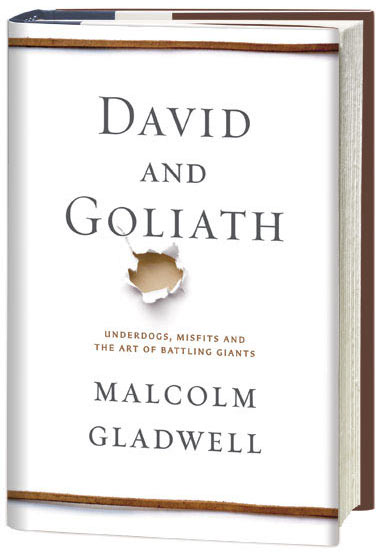 Gladwell’s latest book David and Goliath demonstrates his considerable abilities when it comes to using stories to challenge long-held assumptions. While the book shatters assumptions about underdogs, assumptions and seemingly lost causes. Whether you agree or disagree with Gladwell’s assertions, you’ll find yourself thinking or re-thinking your own biases. It’s a positively splendid read.
Of his own work Gladwell writes: “I write in the genre of what might be called “intellectual adventure stories.” Books like David and Goliath combine narratives and ideas from academic research in an attempt to get people to look at the world a little differently. I have always tried to be honest about the shortcomings of this approach. Stories necessarily involve ambiguity and contradiction. They do not always capture the full range of human experience. Their conclusions can seem simplified or idiosyncratic. But at the same time stories have extraordinary advantages. They can reach large numbers of people and move them and serve as the vehicle for powerful insights.”
Gladwell is a Canadian journalist, raised in the Mennonite tradition. In an article in the Huffington Post, Gladwell discusses his return to religion. here
To wet your appetite or just for sheer entertainment value, watch this TED talk in which Gladwell demonstrates his considerable storytelling/preaching abilities while covering the first part of his book.
 Our Adult Study is currently being inspired by the new study program Painting the Stars (Living the Questions). Philip Clayton is one of the contributors to the program. Clayton is the Dean of Claremont School of Theology (Phd. Yale – philosophy and religion) who is seeking the development of “a constructive Christian theology in dialogue with metaphysics, modern philosophy, and science.” Here are two short videos that provide an introduction to Clayton’s ideas.
Painting the Stars
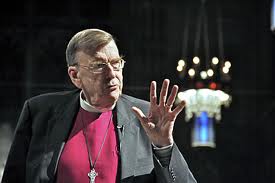 Bishop Spong is not exactly enamoured of religion and or religiosity. Speaking at the Seattle Rotary Club on August 28th 2013, Jack Spong tackles a number of subjects as only Jack can, including his friendship with Desmond Tutu, his belief that the Gay Marriage debate in North America is over, his latest book, number 24, The Fourth Gospel: Tales of a Jewish Mystic, and of course why “Christianity must change or die!” As he often does, Jack reminds us that “Jesus didn’t come to make us religious, but to make us whole, so that we may live life abundantly.” Enjoy!!!

This coming Sunday, we at Holy Cross will begin the new Living the Questions interactive DVD adult education program Painting the Stars. Throughout this week I will be posting introductions to the various contributors to the program. So, if you are anywhere near Newmarket this Sunday consider joining us as we explore the dynamic relationship between science and faith!
One of the primary contributors to the program is Canadian Bruce Sanguin. Until recently, Evolutionary Christian Bruce Sanguin was the minister at the Canadian Memorial United Church in Vancouver. This summer Sanguin left parish ministry to pursue his writing and expanding his speaking career.
Bruce has written several books that have to inspired my own worship planning. Two of his books are of particular value to any pastor who seeks to plan worship without slipping into the trap of words that re-inscribe old theological patterns: Darwin, Divinity and the Dance of the Cosmos: An Ecological Christianity and If Darwin Prayed: Prayers for Evolutionary Mystics. Sanguin’s latest book The Advance of Love: Reading the Bible with an Evolutionary Heart explores the relationship between science and faith to shed light on biblical texts.
This video in which Bruce is interviewed by fellow evolutionary Andrew Cohen will wet your appetite for Bruce’s work while giving you an interesting look into evolutionary Christianity. Enjoy!
 For those of us following the lectionary for the Season of Creation, Diarmuid O’Murchu’s reminder that the word “pagan” comes from the Latin for “lover of the earth” functions as a call for Christians to embrace Creation! O’Murchu is an evolutionary theologian whose work is breaking new ground as he reconnects 21st century Christians to the riches within the tradition and moves beyond the confines of church doctrine toward a holistic understanding of what it means to be human which offers hope for living together in the “companionship of empowerment”.


 “I also think we need to maintain distinctions – the doctrine of creation is different than scientific cosmology and we should resist the temptation, which sometime scientists give into, to try to assimilate the concepts of theology and the concepts of science.” (Pocklinghorne)
Years ago, while visiting Cambridge, I happened upon a lecture being given by John Pocklinghorne. Since then, I have felt compelled to read his work in an attempt to wrap my non-scientific mind around the complex relationship between science and religion. Pocklinghorne’s description of the relationship as one of friendship helped me to see beyond the all too often enforced boundaries between these two ways of seeking understanding reality.
 Over and over again, in conversations with people who have long since left the institution of church behind I hear: “Why don’t clergy pass on what they learned at seminary?” The plea usually comes after I’ve articulated Christianity in a way that makes sense to a 21st century mind. Below are a series of snippets of Church of England clergy articulating what they call “liberal” perspectives of Christianity. I am all too aware of the multitude of reasons/excuses that prevent some clergy from articulating Christianity the way it is taught in the academy, but I can’t help believing that there is a great hunger out there for the kind of theology that does not require church-goers to check their brains at the door!
 pastordawn