“The Force Be With You” or “Live Long and Prosper”

A sermon for the Fourth Sunday of Advent – Luke 1

star-trek-vs-star-wars

The quotes in this sermon are from Steven Pinker’s book “The Better Angels of Our Nature” and Joseph Holub’s “Fear Not” The Acclamation sung prior to the sermon is “The Magnificat” from Holden Evening Prayer, by Marty Haugen, featuring Gary Curran and Linda Condy:   Listen to the sermon here

 live long and prosper

Fear Not for the Progressive Grinch Who Stole Christmas Does Indeed Have a Heart – a sermon for Advent 4

GrinchThe story told in this sermon can be found in Maeve Binchy’s book of short stories “This Year it Will be Different.” As always I am indebted to those progressive grinches Marcus Borg, John Dominic Crossan, John Shelby Spong, and Michael Morwood for their insights into the sacred. Our sermon hymn was No Obvious Angels. The readings were all from Luke 1:1-56.

You can listen to the sermon here  

Years ago, I struggled with most of the stuff I was reading both in the bible and about the bible. I’d been attending church every Sunday since I was 15 and I was doing my best to be a Christian. But the more I read the bible, the more I studied the stories in the bible, the more difficult it became to reconcile all of the inconsistencies. Nowhere are those inconsistencies more apparent than in the stories about the birth of Jesus. Long before I ever dreamed of going to seminary to become a pastor, I was introduced to the work of progressive scholars like Marcus Borg, Dom Crossan and Jack Spong. It was a relief to learn how to take the bible seriously without taking it literally. It was also a relief to discover that my pastor and indeed most of the pastors I knew didn’t take the bible literally. But I have to admit that Christmas in the Church just hasn’t been the same since I learned that the stories about the birth of Jesus that appear in the Gospels according to Matthew and Luke are not historical narratives. I must also confess that since we here in this community embarked upon this grand adventure together of ReThinking our Christianity, the celebration of Christmas in our worship together has become more and more of a challenge. There are days when I feel like a progressive Grinch who is determined to steal Christmas. Then there are other days when I feel like the Grinch’s little dog, who try as he might he just can’t seem to balance those reindeer antlers on his tiny little head. There are days, and some sleepless nights when I simply long for the good old days, when we could sink into the sentimentality of the season without having to delve into scholarship or worry about our evolving theology.

I miss those Advents when we all acted as though prophets foretold the birth of Jesus centuries before it happened, when we suspended disbelief and went along with the idea that angels visited Mary and Joseph, and we marveled at the fact that Mary conceived will still a virgin. It was easier when that Star guided wise guys and heavenly hosts actually visited shepherds abiding in their fields. Damn those progressive Grinches who’ve robbed us of our simple ways of celebrating the birth of Jesus

and as for those radical Grinches who have us questioning everything from the divinity of Jesus to the cosmic reality of the Christ, well I for one wish they’d leave us alone to sing our songs in peace. We Whos did just fine down here in Who-ville before those Grinches tossed all the elements of the birth stories upon their sleighs and left us here wondering what to do and how to sing. For however shall we celebrate the birth of the Son of God now that we know Mary couldn’t have been a virgin, and Matthew and Luke were the worst historians ever?

Well fear not my friends, because like all Christmas stories ours too has a happy ending. The good news is that those progressive Grinches who have stolen Christmas, do indeed have a heart after all. Even that Grinch Marcus Borg knows a thing or two about opening his heart to the wonder of the stories about Jesus birth. Yes, Borg, just like the rest of those Grinches like Spong, Crossan, and Morewood, leads us to understand that the stories of Jesus birth didn’t actually happen the way the gospel storytellers wrote them. The good news is that Borg, just like the rest of those Grinches, does have a heart big enough not to just stop with the reality that the birth stories are not history. Borg’s heart is big enough to cope with his mind’s ability to give us a better question than, “Did the birth stories happen they way they were written? When Borg encourages us to ask: “why did the gospel story-tellers tell their stories they way they told them?”

Borg’s heart leads him to remind us that the stories may not have happened exactly the way they are written, but they are absolutely true because these stories are always happening. The sacred is always being discovered in the ordinary stuff of life. Every birth is sacred because in every birth their lies among the muck and the mess of birth the reality of Divinity which lives in, with, through, and beyond each and everyone of us. The birth narratives open us to the reality of the sacred, which lies at the very heart of life; all life. Humanity is born over and over again, and over and over again comes the sacred possibility of abundant life; life in which we are capable of living deeply and loving more fully that we can possibly imagine.

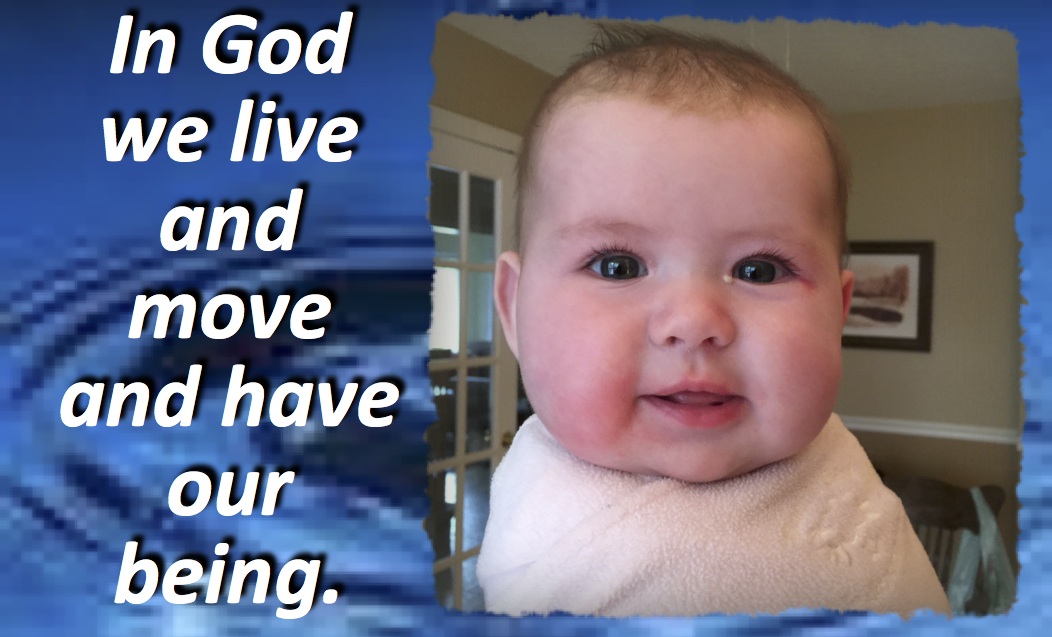
In the life and teachings of Jesus people experienced this divine abundance and it opened them up to the possibilities of a world in which the reign of God who is LOVE accomplishes peace through justice. Why did the gospel storytellers write about the birth of Jesus they way they did? Could it be that the divinity embodied in the life of Jesus of Nazareth could not be killed by the worst that the Romans could conceive? The storytellers told the story of Jesus birth using the tools that they had available to them to open their contemporaries to the reality that in Jesus the sacred dimension of life was experienced in the flesh. These parables about the birth of Jesus have opened generations to the sacred Holy One in whom we live and move and have our being. When we begin to experience the more-than-literal meaning of these parables about the birth of Jesus, we are opened to the sacred in our midst in ways that only LOVE can open humans. Continue reading

Christmas in the Ordinary – Advent 3 – Luke 1:1-38

baby in a tree

Readings Luke 1: 1-4, 5-25, 26-38 Listen to the sermon here

Know Thyself – a sermon for Advent 2C – Luke 3:1-6

knowThyselfQuotes from John Shelby Spong’s essay “Looking at Christmas Through a Rear-View Window” and Ralph Waldo Emerson’s poem Gnothi Seauton: Know Thyself

Listen to the sermon here

St. Nicholas Is Too Old and Too Tired to Defeat the Selling Power of Santa Claus!

santa_as_satanThis Sunday, the Feast of St. Nicholas, the ancient precursor to the modern Santa Claus, will pass without much ado. Some will try to encourage us to resurrect St. Nicholas to save us all from Santa’s powers for we have gone astray.  To those well meaning souls who would rid Christmas of its flagrant consumerism, I can only offer up a feeble, “Baa Humbug!”

The very best traditions about St. Nicholas suggest that he was a protector of children while the worst tradition has him providing dowries so that young girls could be married off by their father rather than be sold into slavery. Meanwhile, the modern character Santa Claus grooms children to take up their role as consumers in the cult materialism. Some parents may bemoan the little gimmie-monsters that their children become, but most adults are rendered helpless by our own remembered indoctrinations and so we join in what we choose to deem as harmless fun.

‘Tis the season for contradictions.  ‘Tis the season when we prepare to celebrate  the incarnation of God in human form while also waiting for Santa Claus to come down our chimneys. Face it; most of the folks dashing about in the malls are more worried about the imminent arrival of Santa Claus than they are about God. I’d even go so far as to say that a good number of people have unconsciously substituted Santa Claus for God.  Santa Claus and the baby Jesus get into some pretty fierce competition at this time of year; and in the culture the larger loyalty belongs to Santa.

Besides, I don’t believe that consumerism is the most dangerous thing about Santa. So, before you accuse me of being a Scrooge or even a Grinch, ask yourself who it is that most children worship at this time of year, and I think you’ll agree that Santa is the one we’ve all been trained to bow down to, and not just at Christmas. It is difficult to deny that sometimes our view of God has been more influenced by Santa Claus than by Christ?  I dare you to compare the number of children standing in the lines at the shopping centre to get their picture taken on Santa’s lap to the number of children in Sunday School? So many of us made that same trip to see Santa when we were little and when we finally got to Santa’s lap, he asked us the big Judgement Day question that Santa always seems to ask, “Have you been good this year?” There’s only one way to answer that question – even though we may have been as deviousness might qualify us as servants of that other mythical character that begins with santa and ends with  n.  For all too many people this laptop confession begins a pattern for interactions with an image we create of the Father-God, who watches and records our offences, making a list if only for the purpose of forgiving us because an appropriate blood sacrifice has been made on our behalf.

Think I’m being harsh? Just listen to that song that pours from muzak speakers, the song that spells out a theology of Santa Claus.  “Oh, you better watch out.  You better not cry.  You better not pout. I’m telling you why. Santa Claus is coming to town.  He knows when you’ve been sleeping. He knows when you’re awake.  He knows if you’ve been bad or good, so be good for goodness sake. He’s making a list, checking it twice, gonna find out who’s naughty and nice. Santa Claus is coming to town.” The trouble with the theology of Santa Claus is that we keep applying it to God as we try to turn the Creator of all that is and ever shall be into a list-checking, gift-giver, whom we better watch out for, lest we be punished. Why then are we surprised that when our Santa-god fails to deliver or bad things happen to good people, that our childish faith in the Santa-god isn’t enough to sustain our trust?

Santa in his present incarnation is indeed pernicious, but like most mythical characters, he cannot be killed and any attempts to resurrect St. Nicholas to replace him are doomed, for the power of Santa’s materialism will always defeat the dim memories of St. Nicholas and his chocolate money. If we are going to break free of the cult of materialism, perhaps we out to try to convince Santa to use his mythical powers for goodness sake!

Yeah, that’s right, I’m going to say it, it’s time to let old St. Nick and his young assistant Santa die, so that a new Santa can be born; a Christmas resurrection if you will. We need a new Santa capable of changing our consuming ways. If the Coca Cola Company could use the advertising industry to transform St. Nick into Santa, surely we can resurrect Santa using the modern persuasive powers of social media to redesign the old salesman extraordinaire into a mythical character with powers fit for the needs of this century.

blue santina

SANTINA- all decked out in her Advent blue!

Imagine if you will, a new and improved Santina, all decked out in Advent blue, she has the power to open young minds to the needs of our neighbours and travels the world via her magic transporter beam, to gather the hopes and dreams of the poor and oppressed into one internet feed, which she magically imprints in our hearts and minds, so that we change the world, creating peace through justice! 

Oh, wait, we already have such a character. We don’t need St. Nicholas or Santa Claus, nor any new-fangled Santina.  We need the One we’ve always needed. The One who comes in the guise of a person. The One we seek is Christ. The One who lives and breathes in, with, and through us to create peace on earth through justice and love. The One who uses our hands, our feet, our lives to change the world!

Suddenly this God, that I had been trying hard to fathom, was there, right there! – a sermon for Advent 2C

jokulsarlon-glacier-lakeAs the world turns expectantly for news from the United Nations Climate Conference in Paris, we hope that leaders everywhere can find the courage to commit us all to change our ways. Prophets have been warning us for decades of the dangers of climate change. The figure of John the Baptist looms large during the first half of Advent. This angry misfit shouts and us, convicting us of hastening the end. This sermon from three years ago, asks questions which ring true today: Do we have the courage to join John the Baptist? Do we have the stamina to become a prophet of doom? Our planet may be depending on us! You can listen to the sermon here or read the text below. 

I didn’t know it at the time, but I actually met John the Baptist when I was fifteen years old. She didn’t look much like you’d imagine John the Baptist would look, but she had that same crazy intensity, that same focus on the fact that we’d better change our ways, we’d better repent, and start doing things differently or we’d be in real serious trouble. Lola was my friend Valerie’s mother and she simply couldn’t stop going on and on about the environment and how we were destroy the earth. At the time, I remember thinking she was a bit of a nut-case and on more than one occasion I wished she’d just shut up about it. I was just a kid, and the earth was just something I took for granted. The earth was just there to provide for our needs. I couldn’t believe how much Lola went on and on about all the stuff we humans were doing to destroy the earth. I just wished she’d leave us along to get on with things; I couldn’t abide her incessant nonsense about how we were going to destroy the planet. All her feeble little attempts to be kind to the earth, made me seriously question her sanity.

I tolerated Lola not just because she was my friend’s mother, but I didn’t really understand her until one day when the three of us were travelling together. We were coming home from church. I had only been going to church for a few months. I was trying hard to understand this whole God thing. So, I went to church a lot. My friend Valerie had persuaded me to start going to church with her and family had become like my second family as the supported me during my first attempts to explore the mysterious world into which I had begun to feel pulled. As we drove home from church, I was feeling a little glum. Try as I might, I couldn’t really understand this church thing; all that singing and praying didn’t really help me to feel closer to God. Mostly I just liked how people at church treated each other. I liked how they went out of their way to help me feel at home. Whether or not God was there, well I really wasn’t sure.

Anyway, we were driving along the road. It was a partly over-cast day on the west coast of British Columbia, just a few clouds. You could see the mountains off in the distance. We were chatting back and forth when all of a sudden; Lola pulled the car over to the far side of the road, switched off the engine and got out. Valerie followed her mother out of the car, so I figured I had better do the same. Val and her mother scampered down from the road and onto the beach. When they reached the water’s edge, they stopped and just looked off into the distance. Apart from a tanker-ship making its way across the horizon, I couldn’t see much of anything. Lola had the most amazing expression on her face. She positively glowed with happiness. Valerie wore a similar expression. I must have looked somewhat puzzled because Val smiled at me and said isn’t it the most beautiful thing you have ever seen. This only confused me more. What were they looking at that had made them stop the car, scamper down the bank and stand there at the water’s edge on a cold autumn evening. Maybe my parents were right, these religious types are a little bit weird. Happy, glowing, smiling people make me nervous. There they stood grinning from ear to ear. What were they on? And then, I saw it. For the first time in my life, I saw it. It had been there before. But I had never really seen it before. The sky was amazing. The colours were overwhelming. It almost didn’t look real. It looked like someone must have painted it that way. It was magnificent, a work of art. The most beautiful thing I have ever seen. Continue reading

Christ Will Come Again, and Again, and Again – a sermon for Advent 1C – Luke 21:25-38, 34-36

Old SpiceChrist has died. Christ is risen. Christ will come again. Outside the world is hurtling toward the Christmas; toward the celebration of the birth of a baby. While the world prepares for the birth, the church says, “wait”. Wait, keep watch, and beware, for the world is ending. While the church cries out:

“Signs will appear in the sun, the moon and the stars. On the earth, nations will be in anguish, distraught at the roaring of the sea and the waves. People will die of fright in anticipation of what is coming upon the earth.” the world sings: “You better watch out, you better not pout, you better not cry, Santa Clause is coming to town.” And all the while we declare the mystery of our faith, “Christ has died. Christ is risen. Christ will come again.”

Somewhere between our deepest fear and our deepest longings we wait, the world prepares and we wait and watch, knowing all the while that, “Christ has died. Christ is risen. Christ will come again.” knowing that because the world will end, our hope lies in the knowledge that Christ, the Anointed One, the Messiah, will come again.

Advent, the very word means come; tis the season of coming. Advent is not about waiting; waiting for Christmas, or waiting for the birth of a baby; Advent is about coming, the coming of Christ. In the darkness of the end, we long for Christ to come. Yes, we will have to wait for Christmas to come; but Christmas will come as it always does. The point is not the waiting, the point is in the midst of darkness, in the trials and tribulations of the end, Christ will come; the point is Christ will come. In the midst of the darkness of the end, our deepest longings are stirred up, our longings for hope, for peace, for love and for joy.

All around us we can see the signs of the end; death is everywhere. Galaxies collide and stars die, and there is darkness, the end. Dreams die, and there is darkness, the end. Barriers go up, bullets fly, bombs explode, people die; there is darkness, the end. Words are spoken, promises broken, hopes are dashed; there is darkness, the end. The work dries up, the job ends, funds are exhausted, the bills pile up; there is darkness, the end. Illness overwhelms, shadows on x-rays frighten, scans scare, falls break us, dreams are dashed; there is darkness, the end. In the darkness of the end, we long for hope, for peace, for love, for joy.

I remember, when I was a kid; I was about thirteen, we’d just moved to the West Coast and I can still remember it as if it was yesterday. I set off on my bicycle in search of the perfect Christmas I was as moody and emotional as any thirteen year-old could be. I was lonely, because we’d moved around so much that my only close friend was my younger brother; and what thirteen year-old girl, wants to admit that her only real friend is her eleven year-old brother. My parents were worried sick about money. We’d moved, Dad’s job was unstable and Mom’s job barely paid anything. About the only good news in my life was that I was twelve and back in those days, at twelve you were considered old enough for babysitting and babysitting meant money. Every weekend, I would babysit. Looking back on it now, I can’t believe that at thirteen, I was actually left in charge of little children. I remember getting a couple of bucks for babysitting on Friday and Saturday night; and I do mean a couple of bucks, two dollars for two nights of babysitting.

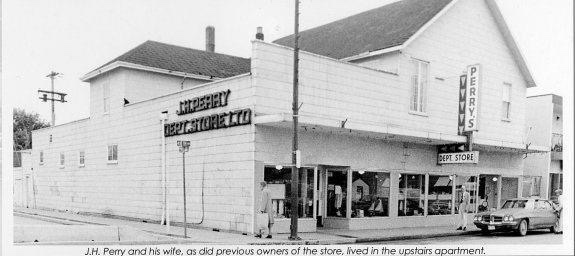
IMG_1220I remember, calculating that by the time Christmas arrived, I should have $27 dollars saved up. Twenty-seven dollars should be just enough to buy presents for my Mom and Dad, my brother, my aunt and uncle, and my two little cousins. I still remember heading off on my bicycle, into the bustling metropolis of Ladner. Ladner was just a small fishing village back then. There were just three stores worth looking for Christmas presents in: Perry’s Department store proved to be far too expensive for my blood. So, I headed off to the 5 and 10 store. For those of you who don’t know what a five and ten store was, just think dollar store, only back then it was the 5 and dime and you could actually get stuff for five and ten cents. I spent hours in there trying to figure out the perfect gifts for my brother and my two little cousins. I left thinking that I could take care of their gifts with about five dollars. So it was off to the drug store to figure out what to get for my Mom and Dad and Aunt and Uncle. That took another couple of hours as I agonized over the various Old Spice gift sets. I could just about afford a 3-piece set for my Dad that included saving cream, after-shave and a soap-on-a-rope. Surely my uncle would be happy with a soap-on-a-rope. Then it was a Yardly gift set for my Mom, dusting powder, perfume and soap all for about six dollars; which would leave enough left over for a small bottle of perfume for my aunt. Continue reading

Wars and Rumours of Wars: The End is Near – a sermon for the 25th Sunday after Pentecost – Mark 13:1-8

Jean Jullien - Nov.13/15

Jean Jullien – Nov.13/15

Listen to the sermon here

Reckless Generosity – a Sermon for Thanksgiving

Gratitude Generosity

When I was a kid, the adults in my life were very fond of telling me how grateful I ought to be because things were so much harder back when they were kids. I’m sure most of us can remember being told by our elders just how tough times were when they were back in the day. My parents, grandparents, aunts and uncles and just about every adult I knew must have grown up poor. Why if I had a nickel for every time I heard someone say,  “When I was a kid we were so poor that…..” well I’d have a whole lot of nickels.

Today, when I hear the words, “We were so poor that…”  I brace myself for an outrageous claim like…. We were so poor that we couldn’t afford Kraft Dinner. Kraft Dinner, you were lucky, we were so poor that we couldn’t afford dinner,  all we had was a cup of cold tea without milk or sugar. Cup of Tea, we were so poor that we only had filthy cracked teacups. Filthy cracked teacups, that’s nothing we were so poor that we couldn’t afford teacups, we used to have to drink our tea out of a rolled up newspaper.  That’s nothing we were so poor that all we could we couldn’t afford newspapers so we had to suck our tea from a damp cloth.

Someone always chimes in with, “Well we might have been poor, but you know we were happy in those days. That’s right money can’t buy happiness. We used to live in a tiny house, with holes in the roof.  “House?  You were the lucky ones we were so poor that we had to live in one room, all 126 of us, with no furniture.  Half the floor was missing; we were all huddled together in one corner for fear of falling!  Ha!  You were lucky to have a room! We used to have to live in a corridor! Ohhh we were so poor we used to dream of living in a corridor! A corridor would have been a palace to us. We used to live in an old water tank on a rubbish tip. We were woken up every morning by having a load of rotting fish dumped all over us!!!   Rubbish tip, you were lucky, we were so poor that we lived in a hole in the ground covered by a piece of tarp, but it was a palace to us…especially after we were evicted from our hole in the ground and we had to go live in a lake. Lake, you were lucky to have a lake, there were a 160 of us living in a small cardboard box in the middle of the road. Cardboard, we were so poor we lived for three months in a brown paper back in a septic tank.  We used to have to get up at six o’clock in the morning, clean the bag, eat a crust of stale bread, go to work down in the mines for 14 hours a day, week in week out.  We had to get up out of that cardboard box at three o’clock in the morning and lick the road clean with our tongues.    In case you didn’t recognize it, that was my interpretation of a classic Monty Python sketch, simply called the “We were so poor sketch”. (watch the video below) Continue reading

A Feminist, the Niqab, St. Francis and the Sultan: a sermon for the Commemoration of St. Francis

niqabThe Season of Creation ends today with the commemoration of St. Francis and the rhetoric of election season together with  the events chronicled in Paul Moses book “The Saint and the Sultan: The Crusades, Islam, and Francis of Assisi’s Mission of Peace” inspired this sermon.

The reading from St. Francis and the Scripture reading can be found here

Listen to the sermon here

Jesus Is the Memory of Our Future – a sermon for Creation 4B

GrandaThis long forgotten photograph of my Granda, William Anderson, moved my sermon beyond my miss-remembering as I attempt to respond to Dietrich Bonhoeffer’s question: “Who is Christ actually for us today?” I first encountered the phrase “Jesus Is the Memory of Our Future” on a t-shirt from Holden Village. Readings for this the fourth Sunday of the Season of Creation included: Dietrich Bonhoeffer’s Letters from Prison (to Eberhart Bethge, 1944), Mark 12:28-34, Mark 16: 14-16 – click here to read texts

Listen to the sermon here

The Truth Will Set You Free: a Homecoming sermon

truth

Homecoming after a splendid summer respite. Readings Proverbs 1:20-23; Ephesians 4:11-13 and John 8:30-32. I am indebted to Peter Rollins for his excellent insights into the need for church to be a place where we consult our suffering. I highly recommend the short video from which I have quoted which you can view here:  Peter Rollins video – Giving the Three Fingers. The story about the starfish on the beach is one I first heard many years ago. There is a version of the story in Marc Gellman’s book “And God Cried, Too: A Kid’s Book of Healing and Hope”

Listen to the sermon here


Spiritual AND Religious – a sermon for Pentecost 11B – John 6:35,41-51

Spiritual & Religious pastordawnListen to the sermon here

We Are the Bread of Heaven: a sermon on John 6:24-35 for Pentecost 10B

Hungry for?It is a holiday weekend here in Ontario. So, in the midst of our relaxed worship, I decided not to preach the sermon I had written and simply spoke briefly in response to the video animation which was shown after the reading of the Gospel John 6:24-35. You can watch the video: The Stonecutter here and listen to the recording of my comments here. The sermon which I prepared but did not preach is printed below. 

Following the video The Stonecutter (1960) Japanese Folklore  view here

Jesus said, “Do not work for the food that perishes, but for the food that endures for eternal life.” Food that endures for eternal life: WOW! Talk about satisfying. Who wouldn’t want some of that? Who isn’t hungry for food that does not perish but lasts for eternal life? No wonder the people cried out to Jesus. “Sir, give us some of that.” To which Jesus replied, “I AM it!” It’s clear that were not talking about ordinary food here. Jesus said to them, “I AM the bread of life. Whoever comes to me will never be hungry, and whoever believes in me will never be thirsty.”

But isn’t hunger and thirst the very stuff of life? Isn’t hunger, thirst, desire, longing, yearning, the very thing that drives us all? Don’t we all hunger for a better, fuller, more satisfying life? Don’t we all want to feed that emptiness that lies within? Aren’t we all looking for something?

If I were to try to tell that ancient Japanese fable in our modern Canadian context what might it sound like? You’re driving along in the car, widows open, listening to some tunes thinking hey look at me, I’ve got it pretty good, when all of a sudden a guy pulls up along side of you in a beautiful in a sleek e-type jag convertible, woe! If I could afford a car like that, just think about how great it would be to pull away from all the other traffic, the wind blowing through my hair, wouldn’t that be great. Well you save your pennies and you finally get the car of your dreams, and your driving along and you see this house, not just any house, but the most beautiful house in the neighbourhood, and you know there’s just got to be a pool in the backyard, and you wonder maybe, just maybe there’s a Jacuzzi in one of the dozen or so rooms and you know that if you could come home to a place like that, well then you’d be really happy. So you work hard and you scrimp and you save and one day, you get your hearts desire and you turn the key in the lock an all of a sudden your living in the house of your dreams. But there’s the pool to clean, and the gardens to maintain, and a lot of rooms that need dusting and you see that your neighbours have a pool boy, a gardener, and a housekeeper and you know if you could only afford to hire some help then you’d be happy. You know that with just a few more bucks in your bank account you’d be happy. So, you wish and you wish and one day you win the 649 and you have millions of dollars, several beautiful cars, lots of staff to keep everything ticking over, and no one to share it with. Continue reading

Jesus is the Human One: Just Look Beneath the Surface of the Text: a sermon on John 6:1-21 for Pentecost 9B

Fully HumanI am indebted to the work of Origen of Alexandria, John Dominic Crossan and Peter Rollins for providing a deeper understanding of the stories of Jesus’ Feeding of the Multitude and Walking on the Water. You can listen to the sermon here

Baptism – Opening to the MORE – two baptism sermons

Evelyn AdeleThe opportunity to baptize my lovely granddaughter brought with it the task of preparing a sermon on the sacrament of baptism. So, I diligently prepared a carefully thought out sermon for the occasion. Standing in the pulpit after reading the Gospel text from Matthew  19:13-15, the sight of all seven grandchildren challenging the abilities of their parents and grandparents to maintain order and decorum gave me pause. Fortunately our pulpit at Holy Cross is on wheels, so I quickly pushed it aside and reached into my missal for a folder I had placed there so that during the announcements I could draw the attention of our members to some very good news about the success of a child of the congregation. The folder contained a story which I proceeded to tell in place of my carefully prepared sermon. You can listen to the story here. I am indebted to the author, Travis Dermott for providing the good news on this very happy occasion. As promised, the text of the carefully and lovingly prepared, undelivered sermon is provided below. 

Listen to the story here

When someone places a newborn human in your arms, it opens you to MORE. Humans have a strange relationship to MORE. Most of us spend our entire lives longing for more, looking for more, hungering for more, desiring more, striving for more, waiting for more, searching for more. Holding a newborn in your arms opens us to the power of MORE. I’m not talking about the more that the world so often gets caught up in seeking, more stuff, more money, more things, more wealth, more land, more resources, more power, more sex, more popularity, more gadgets, more food, more, more, more, more, for me and mine, more. I’m talking about the MORE with a capital M. MORE. The kind of MORE a newborn baby lying in your arms opens us to is the kind of MORE that poets, storytellers, artists, musicians, and messiah’s have been trying to capture for centuries. Holding a newborn in your arms opens us to this MORE because the reality of this new little being connects us to some Beyond ourselves.

Cradling a newborn you can’t help but wonder and marvel at the miracle of life itself. Gently rocking a newborn in your arms opens you to the powers of the cosmos coming together for billions and billions of years to create life. Gazing down at a newborn softly breathing in your arms fills your heart with emotions so powerful that in just an instant you can fall in love. Adoring a newborn in your arms transforms you out of the confines of the ordinary and mundane and into the reaches of time itself as you search for signs of ancestors long gone in tiny features that draw us into futures as yet unknown. And just when you think your heart is going to explode from the shear magnificence of the miracle in your arms, suddenly the newborn in your arms opens up the power of their new little lungs and you can’t help but be stunned by this tiny little creature’s ability to turn your world upside down. Continue reading

Raging Storms are All Around Us – a sermon for Pentecost 4B – Mark 4:35-41

lift every voiceIn addition to being Fathers’ Day, today was National Aboriginal Day, the beginning of Pride Week celebrations, and yesterday was International Refugee Day. All of these events were overshadowed by the tragic events in Charleston on Wednesday. The Gospel text from the Gospel of Mark tells the story of Jesus stilling the storm and calming the waters. Our worship begin with the singing of what has become known as the African American anthem, Lift Every Voice and Sing.  Listen to the sermon here

Truth and Reconciliation – sermon for Pentecost 3B

Pastor Tom Doherty & Terry Hutchings shared their experiences at the Kairos events which preceded the Truth & Reconciliation Commissions delivery of their report. Our readings included Ezekiel 17:22-24 and Mark 4:26-34. The hymn sung after the sermon, “As One” with  words by Gretta Vosper to the familiar Huron Carol – UNE JEUNE PUCELL

The video is a bit choppy at the beginning but settles down in a few moments.

A Little Knowledge Is A Dangerous Thing: a sermon for Pentecost 2B

Schrodinger's Cat

Readings: Genesis 3:8:15 and Mark 3:20-35

Listen to the sermon Pentecost 2B sermon

Maybe Jesus was as the Gospel says, “out of his mind.”

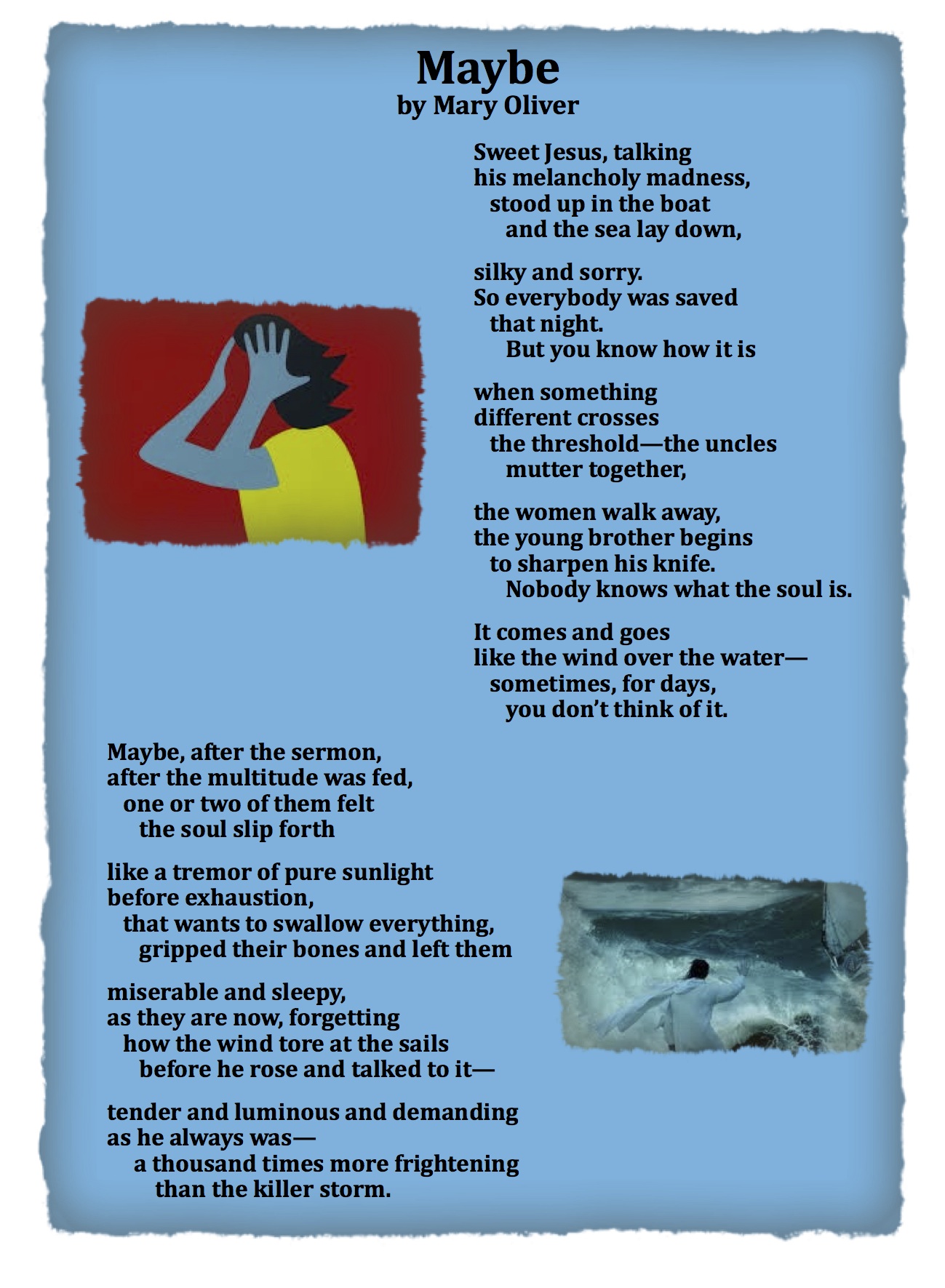
The gospel reading prescribed for this coming Sunday (Mark 3:20-35) paints a daunting picture of the perceptions of the people of Jesus’ hometown. The folks who knew Jesus, including his family worried that he might just be “out of his mind.” This is indeed a contrast to the ways in which Jesus is typically portrayed. This is a dangerous Jesus who ran the risk of being perceived as deranged. In his book “The Underground Church: Reclaiming the Subversive Way of Jesus” Robin Meyers captures some of this danger when he points to Mary Oliver’s poem “Maybe” in which Jesus’ “melancholy madness” is seen by his fellows as more dangerous than a storm.  Safely ensconced in our imaginations, Jesus is rarely allowed to threaten the status quo to which we cling for dear life. Are we prepared for the stormy waters that would be stirred up should we take Jesus at his word? Maybe…

Maybe Mary Oliver pastordawn