Ruled By a Power Greater than Fear: a sermon for Jesus the Christ Sunday

fearnotSince 1925, the last Sunday of the church year has been celebrated as Christ the King or Reign of Christ Sunday. This year at Holy Cross we celebrated “Jesus the Christ Sunday” with readings from Galatians 3:26-28 and Luke 23:33-43.

Listen to the sermon here

Yesterday, my Auntie died. Barbara was a kind woman. A good woman. A woman who welcomed me into her home even though we met long after the marriage that tied us together as kin had ended. A woman who welcomed me into her home even though she could scarcely afford to take care of herself and her two children. A good woman who chose to be hospitable, kind, and welcoming, when it would have been perfectly acceptable for her to send me on my way.

I was a teenager when I first met my Auntie Barb. I was doing what a lot of young people have done since time began. I left the safety of my home to travel the world. I didn’t have much money, just a back-pack on my back, a few dollars in my pocket and all the confidence of a nine-teen year-old, looking for adventure. Barbara must have been in her late forties when I arrived on her doorstep. Her marriage to my uncle was ending and she was struggling to make ends meet. Her two children, my cousins were just kids twelve and fourteen; demanding all the things that kids have always demanded of their parents. Barbara could barely afford to put their food on the table, and yet when I arrived on her doorstep, Barbara opened her door, invited me in, and took me on as one of her own. Her many kindnesses to me, came from somewhere deep inside of her that said, no matter how tough my own life is, no matter how little I have to give, I choose to give, I choose to be kind, I choose to open my door to welcome, I choose to be hospitable. My Auntie Barbara died yesterday, and the lives that she touched are sorely grieved at her passing, but the world goes on. So, what does it matter that Barbara choose kindness when there were so many other less costly options open to her?

Today, in churches all over the world, Christians are celebrating Christ the King Sunday or in as those churches that try to be more inclusive in their use of language, call it, the Reign of Christ Sunday. It is the last Sunday of the Church year and since 1925, the last Sunday of the church year has been used to declare that Christ Reigns; that despite what the world says, Christ and not the rulers of this world reigns supreme. It is no coincidence that Christ the King Sunday began in 1925, by the decree of Pope Pius the 11th. You see in Italy in 1925, there was a king other than Christ. ll Duce, Benito Mussolini rode the crest of fascism to become the supreme ruler of Italy in 1925, declaring himself the heir to the Roman Empire.   Il Duce declared that the fascist state of Italy was born out of the eternal need of the Aryan and Mediterranean races to ensure the purification of their people. Christ the King Sunday was established in defiance of Il Duce.   The church chose to insist that Christ and not racism ruled supreme. It wasn’t the first time that the followers of Jesus insisted that something other than fear would rule their lives. From the very beginning the followers of Jesus insisted that Jesus and not Caesar is LORD. The very first creed was as simple and as complicated as that.            Jesus is LORD. Jesus rules not Caesar. This simple and yet complicated creed, was enough to get you killed in the first century. And yet, people chose to insist that the ways of Jesus would rule their lives and not the ways of the empire.    So swift and harsh was the reaction of the Roman Empire to the rebel claim that Jesus rules, that hundreds and thousands of Jesus followers were crucified for insisting that there was another way to live; a way to live free from fear.

As the followers of Jesus were persecuted for living in the hope that love and not hate offered a better way, it became more and more dangerous to confess that Jesus is LORD, and so the rebels developed ways of recognizing one another that set them apart from those who lived in fear of the powers of the Empire. The Ichthys, the symbol of the fish arose as a way of identifying those who chose love over fear. Ichthys the symbol of the fish was adopted by the early followers of Jesus because the Greek word for fish, ICHTHYS was an acronym for the word fish. The first letters of the Greek words Jesus Christ Saviour of the World, spell the Greek word for fish. The symbol of the Ichthys was simple to draw; it could be traced in the dirt, quietly so the authorities would not notice, the same authorities that insisted that Caesar was the saviour of the world.

Quietly, defiantly, the followers of the way, the way of the one who first called the fishers from Galilee, the rebel Jesus of Nazareth, who dared to suggest that love was more powerful than fear, chose to identify themselves with the symbol of the fish.       It wasn’t until 364, when Constantine co-opted Christianity as the religion of the Empire that the Cross usurped the fish as the symbol of Christianity. The adoption of the cross, the instrument of state execution was an act of defiance. The most fearful symbol of Roman oppression was transformed from an instrument of torture into a symbol of torture and death’s inability to kill hope. Where once the Roman Empire had used crucifixion to terrorize the peoples they had conquered, the very people they conquered used the sign of the cross to declare that hatred could not kill love.

The forces of hatred over and over again have used fear to drive out love. Over and over again, people have found ways to resist hatred in spite of their fears. History is littered with stories of leaders who have insisted that the only way to survive is to play to our fear. Fear mongering is nothing new. Fear mongering has often tried to dominate the hearts and minds of people. During the darkest days of the second world war, when the fascist regime of Germany’s Third Riche rose to power they did so, by playing on the fears of the German people. But despite the fearsome methods of the loathsome fascists, there were those who continued to choose not to be ruled by their fears.

There are all sorts of stories of those who resisted insisting that fear would not rule their lives. There is a story of quiet resistance that happened Norway after the Norwegians were defeated by the Nazi’s. In the darkest days of the German occupation some Germans, adopted the symbol of the paper clip, worn in their lapel pockets as a symbol that hatred would be defeated. As powerful and as frightening as those dark days were, there were those who choose not to be ruled by fear. A symbol as innocuous as a paper clip, declared that love and not hate would rule the day.

Once again there are those who seek power by playing to our fears. Symbols that we thought had been banished to the pages of history are being drawn on mosques and synagogues all over the world. Just this past week, in Ottawa and in Toronto Swastikas have declared that we should be afraid and let hatred rule. Once again there are those who choose not to let fear rule. Safety pins are appearing everywhere declaring that despite the best efforts of those who choose fear and hate as their rulers, hatred will not be allowed to rule those who choose love. Something as innocuous as a safety pin has become a symbol of hope as people declare themselves safe places for those who are being oppressed.

The human spirit is an amazing and fragile work of beauty. The human spirit can and is often crushed by fear and hatred. But the human spirit can also be restored and empowered by love. We can choose to live in fear, or we can choose to live in hope. Our fears can feed hatred. Our hopes can feed love.

For those of us who seek to follow the teachings of the one whose love could not be conquered by what at the time appeared to be the most powerful Empire on earth, symbols like the fish, the cross, a paper clip and a safety pin point to a way of being in the world that moves us beyond our fears so that love is empowered. The symbols in and of themselves are nothing really, just signs pointing to something beyond the powers that be, to something capable of giving life to love.

Sometimes the horrors of our history are so overwhelming that we begin to fear that fear itself with conquer us. Sometimes, in the face of the enormity of our fears, all we need is something simple like a sign, or a symbol to point us beyond our fears so that love can triumph over fear and hatred. Sometimes that sign comes in the form of a fish, a cross, a paper clip, or a safety pin, and sometimes that sign comes in the form of an open door, a welcome, a hot meal, a cup of water, a warm embrace, or the presence of a friend or ally.  The symbol itself is not much in and of itself; insignificant really in the grand scheme of things, but more powerful than the most potent rulers. When you think about it, Jesus himself is but a sign, a symbol pointing beyond himself to the most potent thing in all of creation, the power of love over fear.

My Auntie died yesterday. Hers was an insignificant death in the grand scheme of things. But the love she embodied is more powerful than death. The love she embodied lives on in all the lives she touched. We can live into our fears or we can live beyond our fear. We can be ruled by those who use fear to rule or we can be ruled by a power greater than all our fears. Choose LOVE and live beyond our fears. Choose LOVE.




Home in the Love We Call God – a sermon for Jesus the Christ Sunday- Luke 15

prodigalRather than the recent church tradition of celebrating the Reign of Christ/Christ the King Sunday, on the last Sunday of the church year, we at Holy Cross celebrate our complex relationship with Jesus the Christ. readings include the parables of the lost from Luke 15:1-32. 

Listen to the sermon here

A number of years ago, I’d only been doing this job for a couple of years, immediately after a worship service, I went over to the hospital to visit one of you. I was all decked out in my Sunday best, so I very much looked the part of a pastor. Even though, I still felt more than a little like an impostor. I’ve been at this for over sixteen years now and sometimes I still feel like I have so much to learn before I’ll feel like a real pastor. But it was Sunday and even though the collar around my neck often felt like it might choke the life out of me, it proclaimed to everyone at the hospital that I was there in my professional capacity. I enjoyed a very pleasant visit with one of the seasoned members of this congregation who went out of their way to ensure that we both enjoyed the visit.

As I was leaving the floor a woman beckoned me over to the visitors’ lounge, “Could I please help her.” I sat down beside her and listened to her tale. When you’re wearing a clergy collar people presume all sorts of things about who you are. This distraught young woman presumed that I was a competent professional who could accomplish what she could not. She told me that her father from whom she’d been estranged for many years was dying and needed a priest. They’d called both the Roman Catholic churches in town and none of the priests would be available for a few hours. She was afraid that that might be too late for her father and wondered if I was willing to administer the last rites.

I hesitated. The young woman presumed my hesitation was because I was obviously not a Roman Catholic priest. She asked me, “Protestants do have last rites don’t they?”

I refrained from telling her that since Vatican Two Roman Catholics no longer have last rites. Instead I simply told her what I had been trained to tell her during my scant few months of training as a hospital chaplain. Which was that I’d be happy to spend some time with her father. The young woman persisted, “Can you give my Dad the last rites? Please!”

I nodded and asked her for a few details about her Dad. Armed with only some basic details and the fear that I was in way over my head, we entered the room and the daughter announced to her father that this nice Lutheran priest had come to give him the last rites.

With that, the young woman slipped out of the room and I was left with a man not much older than myself, who looked very much worse the wear.

I introduced myself and explained that none of the local Roman Catholic priests were available for a few hours and that I would be happy to stay with him until one of the priests arrived.

“You’re a priest?” the man in the bed looked unconvinced.

I assured him that I was indeed a priest although in the Lutheran church we call priests pastors. I was babbling. I do that when I’m nervous.

He told me that he’d never met a priest who was a woman. He’d met lots of priests who acted like old women, but never a priest who was actually a woman. He reached out and took my hand, “Can you hear my confession?” Continue reading

Preparing to Preach or Not to Preach on Reign of Christ Sunday

cosmic christI usually have the presence of mind to book my vacation or some sort of continuing education event that takes me far away from the pulpit on Reign of Christ Sunday. Formerly known as “Christ the King Sunday” an attempt to move beyond exclusively male imagery for Christ (in whom there is no east nor west, male nor female) some church-folk have attempted to change the name of this festival to Reign of Christ Sunday. But merely changing the title fails to get  beyond the struggles I have with this festival of the church year!!!!

Born in an age that was birthing fascist regimes, this particular festival of the church clings to it’s christian imperialist past. Instituted in 1925, by Pope Pius XI,  (you can read the full proclamation here) the festival was designed to remind the world that Christ is the King of the World. The irony of proclaiming Christ as “King” when the life of Jesus of Nazareth positively denies “kingliness” seems lost on the church. The appropriateness of asserting Christ over the religions of the world lacks the kind of humility embodied by Jesus of Nazareth. So, this year I am not prepared to celebrate Christ the King or the Reign of Christ Sunday. Instead, we will take a leaf out of Matthew Fox’s book and craft our worship around the theme of the Quest for the Cosmic Christ.

Cosmic ChristYears ago, long before I ventured to seminary, Matthew Fox’s book Original Blessing opened me to the wonders of Creation Spirituality. So, I eagerly worked my way through his book The Coming of the Cosmic Christ. I confess that my first reading of Fox’s tome left me in the dust of my own lack of understanding of traditional Christology. But even back then, without the benefit of theological training, I sensed something of the MYSTERY that I had always trust Christ to BE. I have returned to Fox’s work many times over the years and over and over again I have discovered a WISDOM that moves me beyond the limitations of the historical Jesus toward a more holistic vision of Christ, which like Fox I believe, has the potential to move us to a more wholistic relationship with Creation. I trust that the WISDOM of the Cosmic Christ will lead us into the Season of Advent so that we can be about the work of birthing the Cosmic Christ.

The Curtain Has Been Torn and The Temple Lies in Ruins: Luke 21:5-19 a sermon

Isaiah 65Our readings today were from Isaiah 65:17-25, Dietrich Bonheoffer’s “Letters from Prison, and Luke 21:5-19

A pdf of the worship bulletin which includes the Bonhoeffer reading can be found here  Pentecost 26C Nov 17 2013

Listen to the sermon here

You better watch out. You better not pout. You better not cry. You know who is coming to town. Yes, this is the weekend. In cities, towns, and villages all over the place you know who is coming to town. He knows if you’ve been sleeping. He knows if you’re awake. He knows if you’ve been bad or good so be good for goodness sake! I’m not too old to remember a time when I believed in the person you know in Canada as Santa Claus, but when I was a kid in Belfast we called him “Father Christmas”. I remember the excitement I felt about his pending arrival and I remember trying ever so hard to be good. I don’t remember being disappointed when I realized that Father Christmas was a conspiracy of sorts. Somewhere, somehow in my little child’s brain, I sort of transferred all the love, affection, anticipation, and fear that I harbored for Father Christmas over to THE FATHER. FATHER GOD, who I imagined as a grey-bearded old man who lived up there in heaven. We never went to church, but somehow the adults in my life managed to communicate to me that, I’d better watch out, I’d better not cry, cause HE knows if I’ve been bad our good and I’d better be good for goodness sake. I learned to say my prayers, to thank the Father for all the good stuff in my life, and to ask the Father to take care of Mummy & Daddy,  Nannie and Granda, Gran, my aunts and uncles and oh yes don’t forget my brother Alan, even if little brothers are annoying, please Father take care of him and maybe make sure that Mummy and Daddy have all the money they need to buy us Christmas presents and if there’s time help us all to live in peace.

My childish notions about HIM, up there, eventually gave way to adolescent wonderings about why HE let bad stuff happen to all the good people, and why people died in accidents, or people got hurt, or sick and died. I remember being particularly preoccupied with thoughts about why bad, evil, nasty people got away with stuff; I mean why didn’t HE just use some of HIS all powerfulness to stop bad things from happening? Eventually, when I found my way into the church, I began to add qualities to the character of the FATHER. Gradually, the FATHER became gentler, kinder, wiser, and more gracious. Continue reading

Shusssh…Peace…Shalom…Shusssh… Oh No! the apocalypse is here in this Sunday’s Gospel Reading from Luke 21:5-19

The end is nearIn October of 1977, I was twenty years old.  I was young and adventurous and with a rail pass in my hand, a back pack slung over my shoulders and several hundred dollars worth of American Express Travellers cheques in my pocket, I boarded a train in Zurich, Switzerland, bound for Athens, Greece.

I was tired.  Several months of backpacking in Northern Europe had left me weary.  In just five days my rail-pass would expire, so I decided to head for Greece, where the living is easy, where the warm sun, blue skies and equally blue waters held the promise of rest and relaxation.

As the train made its way through the Alps, I remembered a similar trip which I had made the year before and I tried to calculate whether my remaining funds would allow me to return to the village of Hannia on the island of Crete.  I knew that in Crete I could find work.  I planned to mix a lot of rest and relaxation with just a little work and try to live out the winter on the Mediterranean.

As the train rattled through Austria toward what was then Yugoslavia it began to get dark. I was disappointed that my journey through Yugoslavia would be completed in darkness.  I remembered my previous journey, by car, through Yugoslavia and how at the time, I had marvelled at the diversity of this strange little country.  I remembered men and women driving oxen as they ploughed their fields in much the same way as there ancestors had done.  I also remembered my surprise at entering the ultra modern city of Belgrade; the showcase of Tito’s communist regime. I fell asleep pondering the sharp differences between the lives of the poor people in the villages who appeared to live without any modern conveniences at all and the lives of those who inhabited the city of Belgrade with its towering skyscrapers and streets filled with automobiles.  Several centuries seemed to co-exist in Yugoslavia.

I was awakened by the sound of people shuffling to find their papers as the train conductor instructed us to get our passports and visas ready for customs inspection.  When the Yugoslavian custom officials, with their rifles over their shoulders boarded our train they were preceded by men guided by vicious looking German shepherds.  Even though I knew that I had all the right papers and that my back pack contained nothing more offensive than some dirty laundry, the sight of the dogs, guns and uniformed officials struck fear into my heart.  I nervously handed over my precious passport to an official who looked younger than my twenty years.  He carefully read over the visa which I had obtained in Zurich the day before; a visa that I could not read because it was written in an unfamiliar language and an unfamiliar alphabet. Continue reading

“Makarios” – Blessed, Happy, Fortunate, Evolved – a sermon for All Saints’ Sunday

evolution

All Saints’ Sunday readings:  Contemporary reading:  “A Return to Love: Reflections on the Principles of a Course in Miracles” by Marianne Williamson, Gospel:  Luke:6:20-31 – extensive quote within the sermon from evolutionary scientist Stephen Jay Gould – the hymn sung before the gospel is “I Am the Dream” words: S. Curtis Tufts, Music: Rick Gunn

Listen to the sermon here

All Saints – Giving thanks for the Divine in One-another!

All Saints’ Day is a day for remembering.  The word saint simply means “holy”. In the New Testament, all those who believe and were baptized were referred to as saints. It wasn’t until round about the third century that the church began using the word saint to refer to those who had been martyred for the faith. Over time these martyred saints were held up for veneration and people used to pray to them to intercede on their behalf. I’m not going to go into all of the institutional abuses that led Martin Luther and the later reformers to abolish the veneration of the saints. Except to say, that while the Reformation put an end to the veneration of the saints in the protestant churches, it did not abolish the concept of sainthood.

Within the mainline protestant denominations, we use the term in much the same way as it was used in the New Testament to describe the faithful. We talk about the communion of saints to describe all the faithful who have gone before us who now rest in God, together with all the living who walk in faith. So today as we celebrate the saints, we give thanks for all the faithful those living and those who have gone before us.

Today, I remember and rejoice as I give thanks and praise to God for the witness of St. Joyce of Belfast. St. Joyce who in her own way taught her children to love God and to pray always. And so today, I give thanks and praise to God for the life and witness of St. Joyce of Belfast, my Mom, who was the first to teach me the Lord’s Prayer, and who puts flesh on Christ’s command that we love our neighbours as we love ourselves.

Today I remember and give thanks for the life and witness of St. John of Wales, whose life in the church as a choir-boy was followed by long years of self-exile and whose keen wit and lack of patience with hypocrisy instilled in me a desire for honesty and integrity in the articulation and living of the faith. I give thanks for St. John, my Dad, whose open heart has stretched his discerning mind and enabled many to see the humour in this God-given life we live.

Today, I remember and rejoice as I give thanks and praise to God for the witness of St. Valerie of Ladner. St. Valerie so loved and feared God that she dared to reach out and invite a wayward soul to come and worship God. St. Valerie sang God’s praise, rejoiced in the communion of saints and helped a young friend find a home in God’s holy church. And so toady, I give thanks and praise to God for the life and witness of St. Valerie, my high school friend, who was the first to invite me to come and worship God.

Today, I remember and rejoice as I give thanks and praise to God for the witness of St. Wilton of Lunenburg. St. Wilton loved God all the days of his life and served God with gladness and distinction. St. Wilton went far beyond his call as pastor, he opened up the scriptures to those who eagerly sought the truth of God’s Word with love and dedication and he went on to inspire a diligence to scholarship that nurtured the faith of so many young people. And so today, I give thanks and praise to God for the life and witness of St. Wilton, my first pastor, who taught me to be uncompromising in my study of the scriptures, and steadfast in my love for God. Continue reading

What if the point of Jesus life, death, and resurrection isn’t about that? – a Reformation Sermon

nightListen to the sermon here


Here We Stand, For We Can Do No Other – a sermon for Reformation Sunday

Simcoe Landing

Run-off pond at Simcoe Landing

Listen to the sermon here

Watch the video that was shown in place of the traditional readings for Reformation: Thomas Berry and the Earth Community here

Gospel Text: John 8:31-36

Despite the fact that my parents named me Dawn, I have never been much of a morning person. Those who know me well would probably agree that I should have been called Dusk instead of Dawn. But Dawn I am and so from time to time, I actually venture out to explore this phenomenon for which I am named. Earlier this week, after a long sleepless night, of tossing and turning, wondering and worrying, I decided that as sleep was eluding me, I might as well give up and get up. The sun was about to rise and so out I went into the quiet world of our little subdivision. We moved into our subdivision nine years ago. The subdivision was built about six years before we moved in, so our little community is only about fifteen years old. Before the subdivision was built, the land was used by a farmer to grow corn. On the fringes of our subdivision, they are expanding further into the cornfields. The neighbourhood is expanding, growing, and changing. The demands of modern life are encroaching on a lifestyle that is disappearing from countrysides all over the planet. Modern subdivisions are built to a pretty standard plan. Before the streets and infrastructure can be developed, some pretty basic problems need to be addressed, not the least of which is water run-off. As near as I can tell, modern developers deal with the problem of drainage by establishing ponds which function as catchment basins for rainwater runoff. At the foot of our subdivision there are four such ponds around which the developers created footpaths so that we suburbanites can at our leisure have someplace to take a walk.

When we first moved in, the ponds weren’t exactly picturesque. Just open pits into which runoff had poured, surrounded by paths and building sites. In the beginning these ponds were more like scares on the landscape and failed to inspire us to wander past very often. Indeed, if we wanted to take a walk, Carol and I would often get in the car and drive to a nicer spot to walk. But over the past nine years something miraculous has happen and in our neck of the woods Mother Nature has healed the Earth’s wounds and those ponds have become a favorite place to walk. Where once there was just muck and the open wounds of the Earth, now there are well healed pathways, beautiful bushes, fruit filled trees, and a whole host of wildfowl. Nature has repaired what we humans came close to destroying.

So, as the sun was rising in the east, I couldn’t help thinking about the natural rhythms and blessings of this life. And because I had been kept awake by worrying about the content of this Reformation sermon, my mind began to think about the similarities between the relationship of nature to the pond which humans created where once there was no pond and the relationship between God and the church humans created where once there was no church. Continue reading

Reformation Sunday Resources

semper reformanda

Preparing for Reformation Sunday? Some of these posts might be useful:

Luther, Spong, Fox, and Holy Cross

Enough with “A Mighty Fortress” Already! Sing a New Song!

95 Theses for the Twenty-first Century

Freedom from What?  All this Reforming is Wearing Me Out!

What Darwin Never Knew

A Reformation Day Nailing to the Internet – John Shelby Spong

A Prayer for Reformation – Thomas Berry


Four Ways of Thinking About God – Peter Rollins

Being – Hyper-Being, Ground of Being, Event

Drawing on John Caputo’s book “The Folly of God,” Peter Rollins articulates four ways of thinking about God. As our adult education class explores relationship to the Divine in a world beyond the creeds of our ancestors, these ways of thinking about God provided us with lenses to see beyond what is all too often a theological darkness. To view more of Pete’s facebook live videos click here or check out his website here

What it Means to “Pray Always” – Matthew Fox

Recorded Oct.16, 2016: Matthew Fox preaches on Luke 18:1-8 at All Saints Church in Pasadena. Fox defines prayer as, “a radical response to life; a profound or deep response to life.” As such, working for justice is the embodiment of our response. 

This Persistent Woman Is Wearing Me Out – a sermon on Genesis 32 and Luke 18:1-8

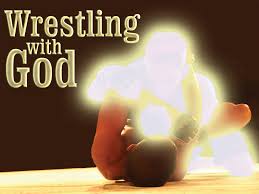
wrestlingBefore I read our Gospel text I took a few moments to reflect upon the story from the Torah that was our First Reading (Gen.32).  I showed the short film below which was created by Jewish scholars to help rabbis teach the stories of the Torah to young children. I use this video to teach the stories of the Torah to our Confirmation students. I think it is important for those of us who follow the teaching of the Rabbi Jesus, to pay attention to the way in which the stories that spoke to Jesus continue to speak to Jewish people here and now. Watch the video and then listen to the sermon here 

Our Gospel reading comes to us from a story told by an anonymous writer named Luke, who tells a parable that he attributes to the Rabbi Jesus: According to Luke: “Jesus told the disciples a parable on the necessity of praying always and not losing heart. “Once there was a judge in a certain city who feared no one—not even God. A woman in that city who had been widowed kept coming to the judge and saying, ‘Give me legal protection from my opponent.’ For a time the judge refused but finally the judge thought, ‘I care little for God or people, but this woman won’t leave me alone. I’d better give her the protection she seeks or she’ll keep coming and wear me out!’” Jesus said, “Listen to what this corrupt judge is saying. Won’t God then do justice to the chosen who call out day and night? Will God delay long over them? I tell you, God will give them swift justice. But when the Promised One comes, will faith be found anywhere on earth?”

I too have met this tiresome, troublesome, annoyingly, persistent widow who constantly cries out for justice. This woman won’t leave me alone. I must confess that I would rather not have this woman clamouring at my door! Each and every time I encounter this woman, she goes on and on, she wears me out! I cannot go anywhere without seeing this woman. She is everywhere. Pointing to her oppressor and demanding justice. She is on the radio in my car as I go about my business. She is on my computer screen as I try to keep up with the news of the day. She is in my living room as I try to relax flipping channels seeking respite from her persistent cries for justice. She appears in my facbook feed, and tweets at me from my phone, I cannot escape her cries for justice. I am sick and tired of this annoying woman. I cannot escape her shouts for justice.
I’m not sure that anything at all can be done to secure justice for this annoying woman. Too much time has passed. There are no witnesses. Boys will be boys. She needs to forgive, forget and move on. Why doesn’t she just leave me alone. There’s nothing that I can do for her. There’s nothing I want to do for her.
I have my own troubles. People to see, places to go, things to do. If only she’d leave me alone. Her persistent cries for justice have begun to haunt me and not even sleep gives me respite from her persistent cries for justice. If only she’d stop going on and on and on and on about her oppressor, about the injustice that has been perpetrated against her.
Maybe if she would just shut up about it, I wouldn’t have to wrestle with her in the night. Round and round we go, pinning one another down, she demanding justice, me pleading for peace. This wrestling over things beyond my control is wearing me down. I’m starting to wonder who this woman thinks she is. Hell, I’m beginning to wonder who I think this woman is. In the darkness of the night I sometimes wonder if this persistent, complaining woman, is just some trumped up version of myself. In her eyes, I sometimes think I see a glimmer of something far too familiar, something ugly, fearsome, unpleasant, and lurking in my own memories. In the wee hours before dawn, I think I can actually see myself in her.
But no, I’m not going there. We are not going there. Women all over the world don’t want to go there. Defenseless, innocent, naive children all over the world we dare not see them in the face of this persistent woman.
And then, just when I think that I have her pinned down and I’m about to wrestle something anything out of this insane encounter, the light begins to dawn on me, as I realize that there in the face of this persistent woman is the ONE in whom we all live and breathe and have our being; the ONE whose name eludes us.
I awaken to the realization that this place where we have all been, this place where we cannot escape is indeed Peniel, for here and now, in the face of this persistent woman, in the face of every persistent woman, indeed in the face of every persistent man, woman, and child, crying out for justice we have seen God face to face. It isn’t always pretty, it isn’t always what we want to see or where we want to see it, but it is the face of the ONE that we call God; the face of God shouting, crying, pleading, for justice.
Wrestling with the persistent, pleading, ones who continue to demand justice from me, I rise wounded from Peniel – the place where I know that I have seen God face to face, and yet my life has been spared. Limping away, forever changed, knowing that the wound that changes the way I walk in this world is the blessing given to me by those who have the courage to cry out for justice. Transformed by this wound I begin to see that I am at one and the same time both the judge who has the power to create justice and the one who cries out for justice.
In this Peniel, is  where ever and when ever we have the courage to look into the face of another and see the face of God, and our lives have been preserved. We cannot walk away from an encounter such as this without responding to the ONE in whom we see the face of God, with justice. Whether our role in this life long wrestling match is that of the judge or the seeker of justice, may we see God face to face.

Wrestling With the Almighty: Locating Our Very Selves in the Sacred Story – a sermon on Genesis 32:3-31

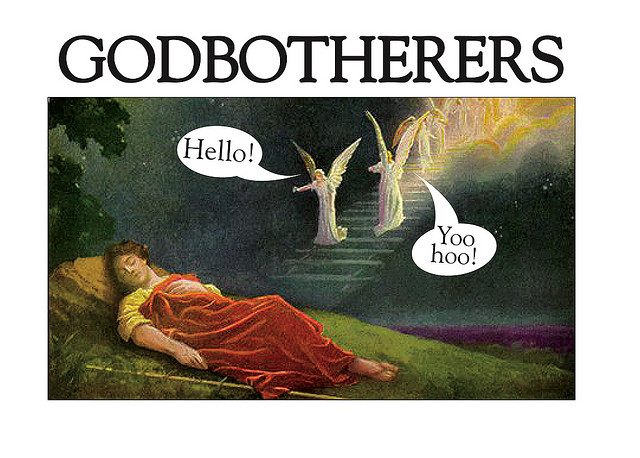
Godbotherers

For those of you preaching on the text from Genesis 32:3-31:

You may not be able to tell from looking at me. But let me assure you that you are looking at someone who used to be a champion wrestler. Believe it or not, my wrestling skills actually helped me rise to the level of a world champion wrestler. Well, perhaps I should qualify that statement. When I was an amateur wrestler, I was a world-class champion wrestler. But like so many athletes, when my status changed from amateur to professional, I lost my championship status and although I still qualify as a professional wrestler, and I like to see myself as a champion, I’m no longer what you would call world-class.

Like many professional wrestlers my career began when I was but a child. Growing up I had a very clear advantage as I developed my wrestling skills. You see having a brother who was just 18 months younger than me meant that I had ample opportunities to hone my wrestling skills. My brother and I were always at it. I’ve got to say that even though we shared the same weight class for most of our childhood, when it came to world class wrestling holds, I had him beat. I had this wicked arm-hold sleeper, and that together with my full Nelson followed by a knee-arm press, was guaranteed to have my brother screaming uncle and agreeing to be my obedient servant until in no time at all. For years I reigned as the champion of our little world! I was unbeatable. My brother didn’t stand a chance. My reign as world champion would have continued if it weren’t for the abrupt ending of my amateur status.

One morning when I was about 13 and my brother was 9 and a half, we were going at it,  and to his credit my bother had me in an ingenious hold. Somehow, he’d managed to secure me with what we professional wrestlers call an arm bar. That’s where you’re opponent wrenches your arm behind your back and applies just enough pressure to cause pain, but not enough to break anything. But just when Alan was approaching the point of no return, I managed with a feat of superhuman strength to rise up, twist around and swing for all I was worth and connect with what I though must be my brothers chest. I expected that such a thrust would have released my arm from Alan’s iron grip. But he still had me. I was about to hit him again, when for no apparent reason Alan released me from his grip. In an instant I wiggled free, spun around and connected with what I figured would be a fatal blow. Just before my blow connected with it’s victim, I realized that I was doomed.

Continue reading

God in the Guise of a Pleading Widow a Sermon on Luke 18:1-8

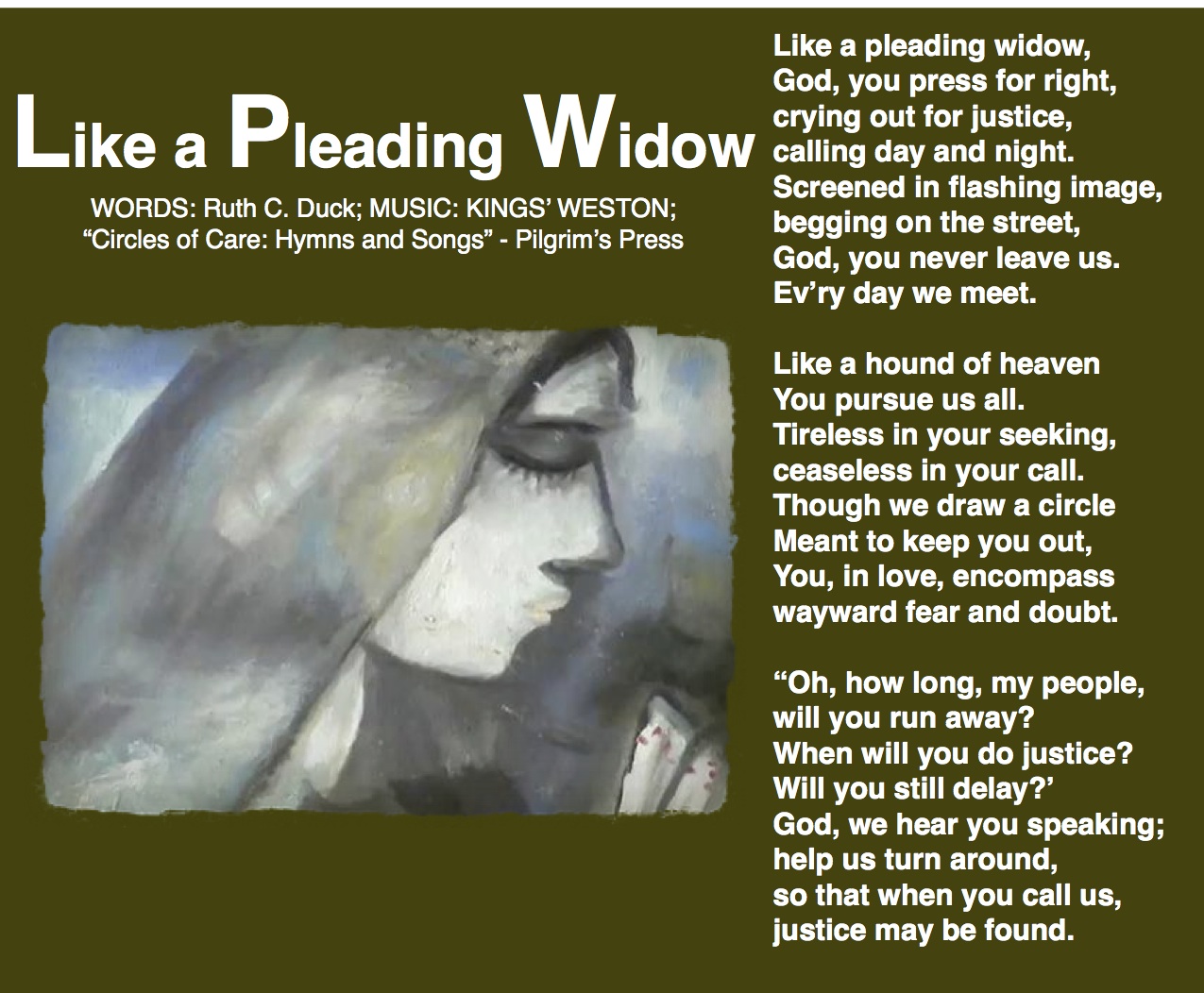
Like a Pleading WidowAi Weiwei’s exhibit “According to What? at the Art Gallery of Ontario inspired me to look beyond traditional interpretations of Jesus’ parable of the Pleading Widow to see our role as the unjust judge. The gentle breath of a newborn granddaughter enabled me to hear God persistently pleading for justice. Read the sermon manuscript below or Listen to the sermon here:  

I spent time exploring the Ai Weiwei exhibit at the Art Gallery of Ontario. It is a powerfully, disturbing, fascinating and compelling exhibit that I know will stay with me for years to come. Ai Weiwei is, according to the AGO’s description, “an artist with a very new kind of visibility. He has transcended his artwork to become a worldly figure who, for many, symbolizes the assertion of freedom of expression against great odds. Using the fame and recognition garnered by his art, Ai Weiwei has taken on issues that could not be raised publically in China.” The exhibit provides a unique window into a part of the world that continues to remain impenetrable.

Ai Weiwei and I are the same age but it is as if our worlds are light-years apart. I first became aware of his work during the Beijing Olympics in 2008. Ai is responsible for the spectacular design of the Beijing Olympic Stadium that has become known as the Bird’s Nest. With his conception of the Bird’s Nest Ai hoped to represent freedom. He saw the Olympics as a splendid opportunity to demonstrate that China was opening up after decades of seclusion with a dismantling of the barriers erected by successive totalitarian régimes. Sadly, Ai’s dreams were dashed as the stadium was constructed and the Chinese government resorted to old methods to drive the poor from their homes in order to build on Olympic sites.

On the opening day of the Olympics, Ai wrote this about his of his decision to boycott the events: “Today China and the world will meet again. People will see that the planet is now smaller than at any time in history, that mankind should bid farewell to arrogance and indifference, to ignorance and discrimination, and understand that we share the same small piece of land. It will be a time to rediscover each other, to share what is good in life, to look each other in the eye and link all 10 fingers. The colourful festival is a time not just for celebration, but also for peace and friendship. To rediscover our future, we should say goodbye to our past. We must bid farewell to autocracy. Whatever shape it takes, whatever justification it gives, authoritarian government always ends up trampling on equality, denying justice and stealing happiness and laughter from the people.

We should also leave behind discrimination, because it is narrow-minded and ignorant, denies contact and warmth; and corrodes mankind’s belief that we can better ourselves. The only way to avoid misunderstanding, war and bloodshed is to defend freedom of expression and to communicate with sincerity, concern and good intentions.

The “Bird’s Nest” National Stadium, which I helped to conceive, is designed to embody the Olympic spirit of “fair competition”. It tells people that freedom is possible but needs fairness, courage and strength. Following the same principles, I will stay away from the opening ceremony, because I believe the freedom of choice is the basis of fair competition. It is the right I cherish most. If we want it to be, today can be a moment of courage, hope and passion. This day will test our faith in the human race, and our determination to build a better future.”

The Chinese government has not reacted kindly to Ai’s public descent and he has felt the weight of their abuse. He remains under house arrest and was not allowed to travel to Toronto for the opening of his exhibit. It is only, Ai’s world renown as an artist and public dissident that protects him from the ultimate fate of so many Chinese dissidents.  Ai Weiwei’s courage in speaking out against injustice over and over again, has robbed him of his liberty and put his life in grave danger and yet he continues to publically protest the abuses of his overlords. Ai’s testimony, expressed in his art, speaks volumes to the world and even tough his protests fall on what appear to be the deaf ears of a régime that continues to oppress the people of China, one wonders how long these unjust judges will be able to resist his persistent pleas for justice. Continue reading

The Science of Happiness – An Experiment in Gratitude

thanksgiving canadaIn place of the sermon this Sunday, we watched the video “An Experiment in Gratitude” followed by brief comments about embodied gratitude. You can watch the video below and listen to our conversation here below are the notes from on which the comments are based:

Your Mom and Dad were right when they taught you that “thank-you” is a magic word. Science now confirms what we learned at our parents’ knees all those years ago. However, many of us do not need science to confirm the power of gratitude. As far back as the 14th century Meister Eckhart insisted that “If the only prayer you said in your whole live was “Thank –you, That would suffice!”
What does gratitude look like when you no longer worship an image of God that personifies or anthropomorphizes God? When God is more than the source of our being, when God is being itself, how do we offer our thanksgiving? When God is the One in whom we live and move and have our being, how do we say thank-you? When we begin to understand that everything is in God and God is in everything, what prayer of thanksgiving will suffice? Leaves – seeing the hand of our Creator in Creation – who do we embody gratitude to creation? Humans seeing God in everyone – how do we embody gratitude to everyone? Jesus pointed to LOVE as the definition of God, God is LOVE and those who know LOVE know God. Jesus said, that he Jesus, this imperfect human being was ONE with God. Jesus taught us to see God in one another, when you give a cup of water to the least of these, you give it to me. Our gratitude is expressed in our loving.

LOVE encompasses a whole lot of things.

John Shelby Spong: “If God is the source of life, I worship God by living. If God is the source of love
I worship God by loving. If God is the ground of being, I worship God by having the courage to be more fully human;the embodiment of the divine.”
Augustine described God as: “LOVER, BELOVED, AND LOVE ITSELF” let LOVE be our embodiment of gratitude!

Happy Thanksgiving!

World Communion Sunday after you Reject Sacrificial Atonement – a sermon on progressive Communion

world-communion-sundayThis sermon is inspired by, infused with, and indebted to the work of Kurt Struckmeyer whose essay “The Words of the Eucharist” articulates communion in terms of “liberation” and pointed me to the work of the Roman Catholic liturgist Gabe Huck; with just a little Martin Luther thrown in to insure that “this is most certainly true.” The readings included 1 Corinthians 11:23-26, Mark 14:22-25 and Luke 22:14-20 – listen to the sermon here

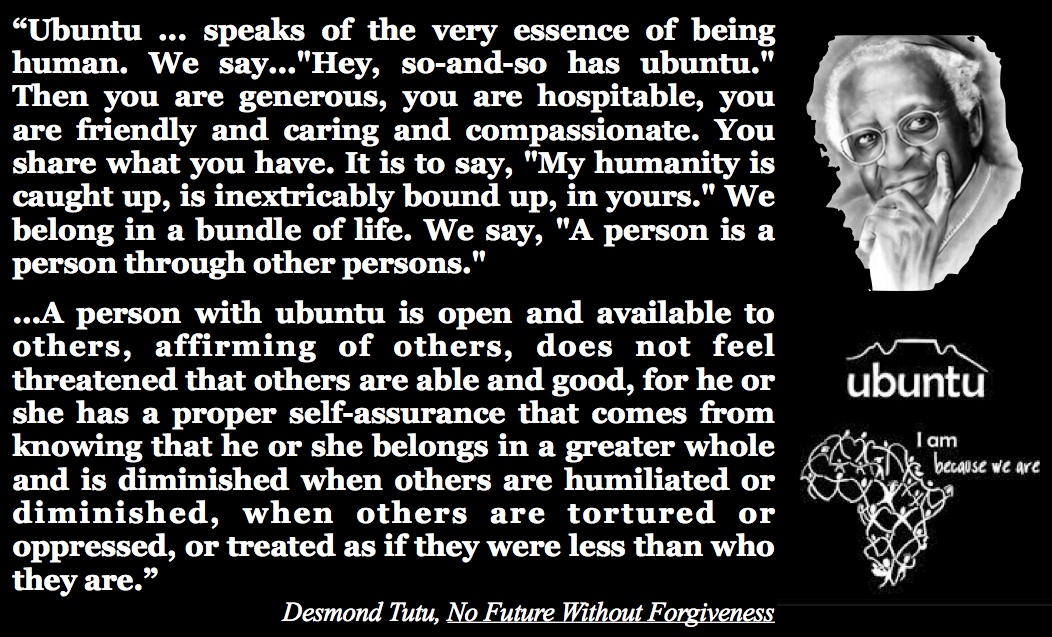
Ubuntu: A Person Is A Person Through Other Persons – Luke 17:5-10 – The Parable of the Mustard Seed

Ubuntu -- pastordawn.com

colemansListen to the sermon here: 

In his book, “The Orthodox Heretic”, Peter Rollins creates a parable which he calls “Finding Faith.”

According to Pete, “There was once a fiery preacher who possessed a powerful but unusual gift. He found that, from an early age, when he prayed for individuals, they would supernaturally lose all of their religious convictions. They would invariably lose all of their beliefs about the prophets, the sacred Scriptures, and even God. So the preacher learned not to pray for people but instead he limited himself to preaching inspiring sermons and doing good works. However, one day while travelling across the country, the preacher found himself in a conversation with a businessman who happened to be going in the same direction. The businessman was a very powerful and ruthless merchant banker, who was honored by his colleagues and respected by his adversaries. Their conversation began because the businessman, possessing a deep, abiding faith, had noticed the preacher reading from the Bible. He introduced himself to the preacher and they began to talk. As they chatted together this powerful man told the preacher all about his faith in God and his love of Christ. He spoke of how his work did not really define who he was but was simply what he had to do.

“The world of business is a cold one,” he confided to the preacher, “And in my line of work I find myself in situations that challenge my Christian convictions. But I try, as much as possible, to remain true to my faith. Indeed, I attend a local church every Sunday, participate in a prayer circle, engage in some your work and contribute to a weekly Bible study. These activities help to remind me of who I really am.’

After listening carefully to the businessman’s story, the preacher began to realize the purpose of his unseemly gift. So he turned to the businessman and said, ‘Would you allow me to pray a blessing onto your life?’

The businessman readily agreed, unaware of what would happen. Sure enough, after the preacher had muttered a simple prayer, the man opened his eyes in astonishment. ‘What a fool I have been for all these years!’ he proclaimed.  ‘It is clear to me now that there is no God above, who is looking out for me, and that there are no sacred texts to guide me, and there is no Spirit to inspire and protect me.’

As they parted company the businessman, still confused by what had taken place, returned home. But now that he no longer had any religious beliefs, he began to find it increasingly difficult to continue in his line of work. Faced with the fact that he was now just a hard-nosed businessman working in a corrupt system, rather than a man of God, he began to despise his work. Within months he had a breakdown, and soon afterward he gave up his line of work completely.

Feeling better about himself, he then went on to give to the poor all of the riches he had accumulated and he began to use his considerable managerial expertise to challenge the very system he once participated in, and to help those who had been oppressed by the system.

One day, many years later, he happened upon the preacher again while walking through town. He ran over, fell at the preacher’s feet, and began to weep with joy.

Eventually he looked up at the preacher and smiled, ‘thank you, my dear friend, for helping me to discover my faith.’”

In a parable handed down to us from our ancestors in the faith, Jesus’ disciples ask him to “increase their faith”. It is a request that I believe many of us can identify with for who among us has not at some point or other asked for the gift of more faith? If only we had more faith we would be able to believe and if we could believe we’d have the courage to  cope with whatever crisis is overwhelming us. If we could only believe, we’d be able to understand why, or how, this or that. If we could just believe strongly enough, we’d have the courage to risk, to speak out, to stand-up for, to open up to, to ask for, to go on, to do something. If only we could believe in God, believe in the life death and resurrection of Jesus, believe in the power of the Holy Spirit if only we could get it all straight in our heads we’d be able to tell all the world what it is we believe. In the meantime, we’ll just keep on struggling to believe.

For years, and years, I used to believe that what was necessary was to just believe. So, I struggled to understand what all those “I believe statements” that the church, the community of believers asks its followers to make.

“I believe in God the Father Almighty,

maker of heaven and earth and in Jesus Christ,

his only Son our Lord,

he was conceived by the power of the Holy Spirit

and born of the virgin Mary.

He suffered under Pontius Pilate,

Was crucified, died and was buried.

He descended into hell.

On the third day he rose again,

He ascended into heaven,

and is seated at the right hand of the Father.

He will come again to judge the living and the dead.

I believe in the Holy Spirit,

the holy catholic Church, the communion of saints,

the forgiveness of sins,

the resurrection of the body and the life everlasting. Amen.”

Over and over again, in liturgies, Sundays after Sunday, the church; the institution of the faith, offered me the opportunity to stand among the faithful to declare what it is that we believe. Whether it was the Apostles or the Nicene or heaven forbid the Athanasian creeds, the Church made it very clear exactly what it is that we are supposed to believe in order that we might number ourselves among the faithful. The very word “creed” itself, was handed down to us from our ancestors creed from the Latin “creedo” which translates into English as “I believe”. Continue reading

Filthy Rich – a conversational Bible Study of Luke 16:19-31

jesus-benchA conversation sermon on Jesus’ parable of the Rich Person. This parable has often been interpreted in ways that fail to see beyond the parable to the hell of our making to the possibility of creating heaven here and now. The website referred to in the in the conversation is http://www.globalrichlist.com Listen to the sermon/conversation here


Global Justice Sunday: Truth and Reconciliation – Guest Preacher Henriette Thompson – Luke 10:25-37

hthompsonCommenting on her former role as the Anglican Church of Canada’s director of public witness for social and ecological justice Henriette said that she had “a front-row seat, and was a witness to a truth process that is unique in Canadian history, that is deeply, deeply relevant to the work of our church, is deeply relevant to who we are as Canadians and whoever lives in this land.”

Listen to Henriette’s sermon, which explores the Parable of the Good Samaritan within the context of the work of reconciliation, here