The plight of particular mothers in Canada promoted a change to the readings for this Sunday. You can find Luke 23:26-34, The Mother’s Day Proclamation, and Luke 24:1-5a by clicking here. The music for the song sung after the sermon “Sweetgrass and Candle” can be found here.
You can listen to the sermon here
To further explore the issues discussed in the sermon, I highly recommend watching the National Film Board’s film “Finding Dawn” it can be viewed by clicking here
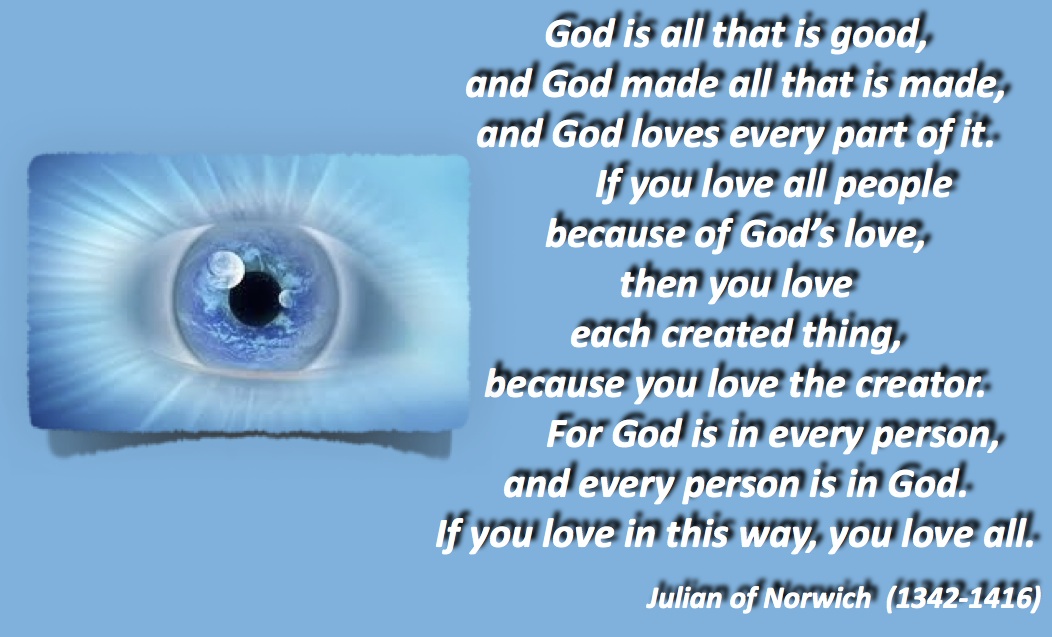
Today churches commemorate Julian of Norwich, who is perhaps one of the greatest English Mystics. Although she has never been canonized by the Roman Catholic Church she is venerated in both the Lutheran and Anglican churches. Julian is the author of the first English book ever to have been written by a woman: Sixteen Revelations of Divine Love.
Click here to listen to a meditative sung liturgy inspired by Julian’s writings
John chapter 10 causes me to remember Mrs Tanner, my grade ten english teacher. I can still see her handwriting all over my carefully crafted compositions. Red ink everywhere as she constantly admonished me not to mix my metaphors. Clearly the writer of the Gospel of John never had the benefit of Mrs. Tanner’s guidance, or he would not have dared to record Jesus words the way he does in his long and rambling I AM passages.
Before we even get to chapter 10, we read that Jesus says: “I AM the bread of life.” and “I AM the light of the world.” In chapter 10, we read, Jesus says, “I AM the gate,” “I AM the Good Shepherd.” Later we will read, that Jesus says, “I AM the Resurrection”, “I AM life.” “I AM the true vine.” “I AM the way.” “I AM in God.” “I AM in you.”
But in the tenth chapter the writer of the Gospel of John goes all out and has Jesus using not just a metaphor but a mixed metaphor. For in chapter 10, we read that Jesus declared: “I AM the Gate. The gate through which the sheep must pass.” and then mixes it up by saying, “I AM the Good Shepherd.”
Which is it? Gate or Shepherd, come on, I know your Jesus but I’m trying to understand how Jesus, who is after all, the lamb of God who takes away the sin of the world is both the Gate and the Shepherd.
I wonder if Mrs. Tanner ever took her red pen to the Gospel According to John? If she did, the letters MMX would have appeared all over this Gospel. MMX = mixed metaphor wrong! Looking back, I know that Mrs Tanner was just trying to help us to be more careful about our ideas. But today I would have to ask of her, and indeed of the writer of the Gospel of John, “What’s a meta for?”Continue reading →
In a world where rape remains an weapon of war as whole populations are transformed into refugees, in a nation where the number of aboriginal women murdered soars above a thousand, in communities where mothers continue to struggle to feed, cloth, and house their children, there is no time for sappy sentiments on the day established to call for peace. Peace can only be achieved through justice and justice for mothers requires action by women and men everywhere.
Preachers have several choices when it comes to proclaiming the Gospel on Mothers’ Day. We can of course ignore the fact that it is Mothers’ Day. After all Mothers’ Day does not appear on the Church calendar of feasts and commemorations. However, Mothers’ Day is reported to be the third highest attendance day; out numbered only by Easter and Christmas! I suspect that a great many offspring choose the day to placate their mothers. So ignoring the event seems like adding insult to injury to those guilt-ridden offspring who hope that their efforts won’t go unnoticed. Sadly, the presence of the Christmas and Easter crowd, all too often tempts the preacher to resort to sentimentality in order to entertain the infrequent worshippers. The history of the creation of Mothers’ Day ought to compel preachers to resist temptation and find the courage not to compromise.
Most of us think of Mothers’ Day as a kind of conventional holiday that celebrates traditional family values; the kind of traditional values that encourage women who are mothers to keep on keeping on. But celebrating the traditional motherhood is definitely not what Mothers’ Day was originally intended for. The very first Mothers’ Day was intended to be a celebration not just of mothers, but rather it was designed to be a call to action by all women.
One of the first founders of Mother’s Day was Anna Jarvis back in 1858. Anna Jarvis gathered women of the Appalachian mountains together in what she called mother’s day work clubs. Where women worked together to eliminate poverty. When the Civil War came about, the mother’s day work clubs created medical camps. They were places of nonviolence for men from both sides who were wounded in the war.
At the end of the Civil War, Anna Jarvis organized the Mother’s Day Friendship Day, which was a call for radical peace. Anna Jarvis brought together the leaders from the north and the south for a time of reconciliation. Mother’s Day was originally about reconciliation and peace.
Then along came a woman named, Julia Ward Howe who wrote “The Battle Hymn of the Republic”. Julia Ward Howe called for women to protest the cruelties of war everywhere and to gather together to call for peace. She called for a national day of peace for all women. She issued women’s’ declaration, and from the streets women shouted :
“Arise then women of this day, arise all women who have hearts, say firmly our husbands shall not come to us reeking with the carnage for caresses and applause. Arise women of peace.”
Anna Jarvis’ daughter also named Anna Jarvis approached President Wilson and petitioned for a national Mother’s Day. It was Woodrow Wilson who called for the second Sunday of May to be the national Mother’s Day. Shortly thereafter, n anti-suffragette movement spoke out against the women who were calling for peace. So instead of being a day for women who were active and present in the world, it became a day to celebrate mothers who stayed at home with the children.
Anna Jarvis the founder of Mother’s Day was so angry with Woodrow Wilson that she filed a law suit, that petitioned the courts to put a stop to Mother’s Day because as the court papers insisted, instead of it being run by women, suddenly Mother’s Day was being run by men in an effort to keep them in the house barefoot and pregnant.
Sadly, the world was not ready for such strong willed women to shout out loud. And so, Anna Jarvis was arrested at a Mother’s Day celebration and she spent the rest of her life in a sanatorium?
On mothers’ day we would all do well to remember Julia Ward Howe’s Mothers’ Day Proclamation. Dated 1870 but sadly it is still so very relevant today:
“Arise, then, women of this day! Arise, all women who have hearts, whether your baptism be that of water or tears!
Say firmly: “We will not have great questions decided by irrelevant agencies. Our husbands shall not come to us, reeking with carnage, for caresses and applause. Our sons shall not be taken from us to unlearn all that we have taught them of charity, mercy and patience. We women of one country will be too tender of those of another to allow our sons to be trained to injure theirs.”
From the bosom of the devastated earth, a voice goes up with our own. It says, “Disarm, Disarm!” The sword of murder is not the balance of justice. Blood not wipe out dishonor, nor violence indicate possession. As men have often forsaken the plow and the anvil at the summons of war, let women now leave all that may be left of home for a great and earnest day of counsel. Let them meet first, as women, to bewail & commemorate the dead. Let them solemnly take counsel with each other as to the means whereby the great human family can live in peace, each bearing after his own time the sacred impress, not of Caesars but of God.
In the name of womanhood and of humanity, I earnestly ask that a general congress of women without limit of nationality may be appointed and held at some place deemed most convenient and at the earliest period consistent with its objects, to promote the alliance of the different nationalities, the amicable settlement of international questions, the great and general interests of peace.”
To those of you who continue to point out that the Mothers’ Day apostrophe belongs between the r and the s, all I can say is: “Move it!” Until we can move beyond thoughts about our very own mother to the realization that mothers everywhere are worthy of celebration the vision of peace that this day is designed to call us all toward will remain but a dream. Let this day be about mothers everywhere!!! Moving the apostrophe is but a small reminder that the holiday does not belong to any individual mother but to mothers every where!!! Let peace break out this Mothers’ Day!!!
For additional resources for the celebration of MOTHERS’ DAY click here to listen to a MOTHERS’ DAY sermon click here
This has been an amazing weekend at Holy Cross as we’ve explored a new story of what it means to be human and discovered new ways of contemplating the Divine Presence that permeates the cosmos. Michael Morwood has taught us and challenged us to peer through 21st century lenses at the one we call G-o-d. Michael concluded his time with us by delivering the sermon on Luke 24:13-35 in which he moved us beyond the Easter stories to a place were we could imagine so much more than words can capture! Enjoy!!!
Firefox users will need to click on this link to listen: Morwood sermon
Richard Holloway, the former Primate of the Scottish Episcopal Church, interprets the story of the resurrection not as an historical tale, but as our own story. Holloway has written of his longing for a humbled and broken church. His own humility and brokenness shines through this video as Holloway embodies his own longing.
Michael Morwood will speak at Dr. Dennison Secondary School (135 Bristol Road, Newmarket) at Friday at 7:30pm and at Holy Cross Lutheran Church on Saturday & Sunday – tickets will be available at the door! For more about this dynamic thinker follow this link
This sermon was inspired on my own journey to Emmaus where in the space of the same afternoon I heard a stranger declare: “Christianity is dead!” and Karen Armstrong’s now famous TED talk about her call for a world Charter for Compassion.
Has anybody here ever been to Emmaus? Which one? According to the latest issue of Biblical Archeology there are at least nine possible locations that are candidates for the Biblical town of Emmaus. Historians tell us that there is no record of any village called Emmaus in any other ancient source. We simply don’t know where Emmaus might have been. Tradition, tells us that it might have been a place just a few hours walk from Jerusalem. New Testament scholar, Marcus Borg suggests that Emmaus is nowhere. Emmaus is nowhere precisely because Emmaus is everywhere. Each and every one of us has at one time, or indeed for some of us, many times, traveled along the road to Emmaus.
I know that I have been on the road to Emmaus most of my life. I’ve had lots of company on the Road to Emmaus. I’ve had many conversations along the way discussing, with anyone who’d care to accompany me, the ifs, ands, and buts of Christianity, of religion, and indeed of life. If you haven’t traveled down the road to Emmaus you must be very skilled in the fine art of turning off your brain and if you check you just might discover that your heart isn’t actually beating.
It’s so easy to imagine, those two characters striding down the Road to Emmaus that we can almost hear them talking, maybe even arguing about what happened. What on earth were they to make of all this! Jesus was supposed to be the Messiah. Jesus was the One who had come to liberate Israel, to free the people from oppression. Jesus was the One who was supposed to draw the people back to God, restore the relationship between God and God’s people. Now Jesus was gone, and what had changed? Now, Jesus was gone, and the Roman Empire was still oppressing them, still inflicting such pain and hardship, still killing them. Was it all a mistake? Was it all a lie? Had they been fooled by some kind of cruel hoax—were they wrong to put their hopes in this man from Nazareth? They had trusted Jesus believed in Jesus, followed Jesus. Their lives had been changed. They had seen the lives of others changed and they had expected even greater changes to come. Jesus had confronted corrupt powers. Jesus had charmed great crowds. Jews and Gentiles alike responded to the truth of Jesus’ teaching. Rich and poor had come to Jesus, believing in Jesus’ healing power. But Jesus had been shamed, and ridiculed, and humiliated, and crucified and now Jesus was dead. Well, was Jesus dead? Some said they’d seen Jesus, alive! Not that Jesus had survived the crucifixion by some miracle of strength, but that Jesus had risen from the dead. They seemed so totally convinced by their own experience…were they confused by their own grief? Were they delirious? Had they loved this Jesus so much—invested so much hope in Jesus life and leadership—that they simply could not let him go? And what did ‘resurrection” mean? Apparently it was not the resuscitation of a corpse. Jesus wasn’t revived to resume his former life; to take up his broken body until the day he might die again. No, somehow this was some new mode of being that seemed to be spiritual to some and yet real to others. And, if Jesus were risen from the dead, what would be the point of all that? What was the point to a Messiah—to a presumed political and religious leader—if Jesus wasn’t able to lead people here on earth? How could Jesus restore Israel when he had so easily been defeated by a handful of Roman guards? How could he bring release to the captives, how could he bring justice for the poor, how could Jesus advocate for the widows and the homeless? How could Jesus call people to account for all the ways they had strayed from God’s intent, now? What good could come from some kind of spiritual ghost? We can hear these two friends wrestling with each other and with their own hearts on the road that day!Continue reading →
This Sunday the gospel text invites us to travel down our own road to Emmaus. Stephane Brozek Cordier is a poet whose words have the power to open us to our deepest wonderings as we wander down that road.
John Philip Newell is a poet, author, and peacemaker. He is the co-founder of Salva Terra: A Vision Towards Earth’s Healing. Formerly Warden of Iona Abbey in the Western Isles of Scotland, he is currently Companion Theologian for the American Spirituality Center of Casa del Sol at Ghost Ranch in the high desert of New Mexico. For more about Newell follow this link Newell’s progressive insights are permeated by his deep understanding of Celtic spirituality. It is no surprise then that Newell calls for a renewed understanding of the sacredness of matter.
In response to the current crisis of institutional Christianity, Newell sees three responses: denial of the crisis, shoring up of the old, or to ask “What is it that is trying to be born? What is it that is trying to emerge from the human soul and how can we within the Christian household be part of leading that and serving it with humility?” Newell’s gentle invitation is challenging the church to serve the deep knowing that is in the hearts of people everywhere and to empower the deep knowing of the sacredness of the knowings that come up from the deepness of our being which is of God.
This sermon is an interactive exploration. Many thanks to the people of Holy Cross for their participation and to Peter Rollins for his beautiful words from his book Insurrection. Readings: John 20:1-18, Philippians 3:10-14, John 20:19-31
It happens every year as Doubting Thomas makes his Easter appearance. It’s a kind of resurrection of a glimmer of the faith that I long to recall in my flesh. I harken back to the time when I could embrace those wounds as proof. Oh how that faith comforted me. Resurrecting the memory of Thomas, who for years functioned as a trusted hero in my scant faith, now sends me into the dream of belief as the answer in and of itself; a kind of innocence that once gone is never forgotten. My nostalgia for my faith in belief will pass. But for just a moment or two, I pause to embrace the wounds, waiting for my doubts to open me to the evolving reality of now. Jump!!!
Now that Holy Week has come and gone and we are shouting our Alleluias, perhaps we can begin to turn our minds to the expectation of some sacred downtime. Barbara Brown Taylor is a preacher from whom I have learned so very much. I am currently enjoying the luxury of enjoying her latest book for the first time. Taylor’s earlier books are like old friends that I return to often. So her latest book, Learning to Walk in the Dark holds all the promise of a new treasured friendship. While searching for a video to introduce her new book, I came upon this video, recorded in the spring of 2009 and only recently posted online, in which Taylor offers a welcome reminder of the contours of downtime. Looking forward to a few busy weeks, and longing for those lazy, hazy days of summer, Taylor has reminded me to stop and luxuriate in the splendour of springtime. So, rather than speed through Learning to Walk in the Dark, I shall take my time and write about it when we’ve become better friends. In the
meantime enjoy Sacred Downtime…..
Christ is Risen! Christ is Risen Indeed! Alleluia! Here we are still in the early days of the fifty daylong celebration of Easter and I’m already wondering how long we should keep chanting that Christ is risen! Sometimes, it seems that after the first flush of Easter Sunday’s excitement, our shouting that Christ is Risen sounds a little like we doth protest too much. The crowds of Easter are pretty much gone and churches all over Christendom are trying to keep up the excitement with the remnant of believers who turn up at church more often than Christmas and Easters. Our shouts of Christ is risen seem a little feeble; almost as if we are trying to convince ourselves that the celebrations of last Sunday actually mean something. After all it’s pretty safe to shout that Christ is risen in church. Nobody is going to challenge us in here about what we mean by that. But what if we were shouting that Christ is risen on the street corners or at work? Would we be comfortable telling people what we mean?
Christ is risen! Are we really willing to shout when it comes to declaring our belief in the resurrection? And if we are willing to shout about the resurrection, what is it that we would be shouting about? After all people have been arguing about the resurrection ever since the rumors about the empty tomb first began and after 21 centuries we still can’t agree what happened to Jesus after he died. Over the centuries the word resurrection has taken on so much baggage that it is difficult for many of us to talk about resurrection because we all bring so much to the conversation whenever we try to discuss it. Most of us grew up believing that we needed to believe in physical resurrection in order to belong. So we have learned to accept that resurrection means the physical resuscitation of a corpse. Yet even the stories that we tell in church don’t necessarily insist that Jesus physically rose from the dead.
The Irish novelist who wrote the famous book about his childhood in Ireland called Angela’s Ashes, also wrote a less famous book about his early years as a teacher in the United States. The book was called T’is and even though it didn’t sell quite as well as his first novel, McCourt’s I love it because it lends some keen insights into a teaching and teaching is one of the things I love about being a pastor. McCourt tells a story about Humpty Dumpty that illustrates some of the difficulties we face when we begin a discussion of the resurrection. McCourt tells his class the story of Humpty Dumpty to his class and for a whole class period there’s a heated discussion of “Humpty Dumpty” itself. (I’m using the term “itself” because no where in this English nursery Rhyme does it indicate what gender Humpty Dumpty is) In McCourt’s class Humpty Dumpty’s gender was automatically assumed to be male. But it was the sixties and so nobody argued about Humpty’s gender when McCourt recited the well known rhyme: “Humpty Dumpty sat on the wall, Humpty Dumpty had a great fall; All the kings horses And all the king’s men Couldn’t put Humpty together again.” Then Frank asked his class what is going on in the nursery rhyme and all the hands shot up to say things like: This egg falls off the wall and if you study biology or physics you know that you can never put an egg back together again. I mean it’s common sense really. That’s when Frank asked the question that set the class at odds with him. “Who says it’s an egg? Of course it’s an egg! Everyone knows that! Where does it say that it’s an egg? The class is thinking. They’re searching the text for egg, any mention, any hint of egg. They just won’t give in. There are more hands and indignant assertions of egg. All their lives they knew this rhyme and there was never any doubt that Humpty Dumpty was an egg. They’re comfortable with the idea of egg and why do teachers have to come along and destroy everything with all this analysis. McCourt insists that he’s not destroying. He just wants to know where they got the idea that Humpty Dumpty is an egg. Because the class insists, it’s in all the pictures and whoever drew the first picture must have known the guy who wrote the poem or he’d never have made it an egg. So Frank says, All right. If you’re content with the idea of egg we’ll let it be but I know the future lawyers in this class will never accept egg where there is no evidence of egg. And so by tacit agreement Humpty Dumpty becomes now and always an egg. (I am indebted to Bernard Brandon Scott’s reminder of the story about Humpty Dumpty in Frank McCourt’s novel “T’is”)
For me the subject of the resurrection of Jesus has a great deal in common with Humpty Dumpty because by some sort of tacit agreement it was decided long ago that the resurrection of Jesus just has to be a physical resuscitation of a corpse; this despite the fact that the earliest writer on the subject of the resurrection, the Apostle Paul denies that the resurrection of Jesus was a physical resuscitation of a corpse.Continue reading →
For this sermon I used a video within the sermon to help illustrate resurrection. You can view the video within the written text of the sermon below or listen to the audio version provided. I am indebted to the work of James Rowe Adams for much of the New Testament Scholarship in this sermon.
The Scripture texts were John chapter 20:19-31 and Acts 4:32-35
Christ is Risen! Christ is Risen indeed! Alleluia! So, Christ is Risen! So What???What can it possibly mean to you and to me, that a rag-tag bunch of Jesus’ followers gathered together in an upper-room and talked about their experiences of Jesus and decided that not even death could extinguish the life that they experienced in Jesus? What difference does it make to you or to I that Christ is risen? The truth is that it can make absolutely no difference what so ever. Now there are a whole lot of people who will tell you that the important thing about resurrection is that you believe it. Those same folks absolutely love the story of doubting Thomas. And so every year on the second Sunday of Easter we read the story of doubting Thomas as a kind of inoculation against Thomas’ disease.
I sometimes think that the designers of the lectionary were trying to build up our resistance to doubt. Having problems believing in resurrection, well don’t do what Thomas did, don’t doubt, because you’ll be proven wrong. Jesus is alive, the wounds in his hands proved that to Doubting Thomas, so have no doubt about it the resurrection happened! Believe in the resurrection!
The trouble with believing in stuff is that it belief can make absolutely no difference what so ever. I can believe in justice for all, but unless I’m prepared to seek justice, to be fair, or to resist injustice, it makes absolutely no difference what so ever. You can shout, “Christ is risen!” all you want but unless you are willing to live it, the resurrection means very little at all. In order to live the resurrection you have to begin practicing resurrection. In order to practice something, you have to know what it looks like, what it sounds like, or what it feels like.
I’ve been trying to figure out how to show you what resurrection looks like in the flesh. Then I remembered a video that’s been doing the rounds on the internet, so I want you to watch this modern miracle of resurrection.
WATCH THE VIDEO CLIP FROM: Alive Inside
Christ is Risen! Christ is Risen indeed! Alleluia! Almost 2000 years ago, a bunch of rag-tag Jesus followers were huddled together in fear. Their beloved leader had been brutally executed by the powers that be and they were terrified that they would be next. Paralyzed by their fear, hiding behind a locked door, something happened that gave them the strength to burst forth from their own tomb and change the world.Continue reading →
This sermon is the second of a two parter which began on Good Friday (you can find that sermon here). It is the fruit of conversations that have been going on at Holy Cross Lutheran Church for a number of months. I am indebted to the members of the congregation for their courage, wisdom and curiosity which they so graciously share. I am indebted to Dom Crossan, Jack Spong, Barbara Brown Taylor, Michael Morwood, and Dick Rauscher whose work has inspired and emboldened me in my preaching. You can listen to the sermon below and I have also provided the manuscript (which is never quite the same as what comes out from the pulpit) Shalom.
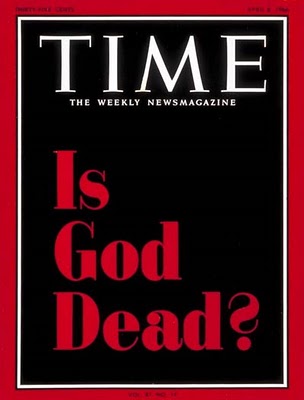
On Good Friday we gathered here to grieve the death of God. I began my Good Friday sermon with the Parable of the Mad Man that was written by Frederich Nietzsche back in 1882. The mad man in the parable goes around announcing that God is dead. The parable gained notoriety 1966 when an issue of Time Magazine asked the question: Is God Dead? The question appeared on the cover of the magazine and created quite a stir. It referenced Nietzsche’s parable as the inspiration behind the “God is dead movement” which insisted that “man” has killed God because “man” has evolved beyond our need for gods.
So, on Good Friday my sermon took a long hard look at the god who is indeed dead. In my sermon, I grieved the death of The Father-god, the Sky-god, God the grand puppeteer, who watches over us like a kindly shepherd, and listens to us, and interferes on our behalf, and judges us and longs to welcome us into heaven, but is willing to let us languish in hell if need be.
I pointed out that parables like the parable of the mad man are stories that tell us what we already know and Nietzsche’s Mad Man was right, this god that so many of us have loved and worshipped for so many years is indeed dead; sacrificed on the altars of reality.All that we have learned about the cosmos; all the scientific breakthroughs, our technologies, our philosophies, biblical scholarship and our evolving theologies have killed the personification of god that we once worshipped and adored.
I looked upon the cross and I wept because the death of the personified god is not easy to bear and I miss the Father-god because I really did love him, and he really did save me. For most of my life the personification of God was the only way I had of knowing anything of the Force that lies at the very heart of reality. God is dead; the Father God, the Sky God, the kindly Shepherd that I was counting on to make me lie down in green pastures, is dead. Our science, technology, philosophy, history, and our theologies have killed this personified deity that we both feared and adored. God is dead and we have killed him. Continue reading →
This year’s Maundy Thursday commemoration at Holy Cross included: hand washing, soup supper, eucharist, intimacy and this story from the Reverend Susan J. Thompson who, along with Pastor Tom Doherty presided over our worship.
It was a dark and . . . windy night. The swinging doors into the sanctuary were banging, the tree branches scraping against the stained glass windows, and casting eerie shadows.
It was then my colleague and I decided to make the place a little cosier for our Maunday Thursday service. We scrambled around the balcony storage and found all our Christmas tea lights and holders, and both of us had plenty of candles in our studies. We placed all of them around the chancel, and on the window sills where the shape-dancing trees seemed a little less intimidating in the warm candle glow.
In a kitchen to the right , Session members were preparing warm scented water and gathering the tubs in which to immerse people’s feet. The towels were at the ready. All we needed now was the chalice and plate for the elements, so I raced downstairs to the cupboard.
I was stopped in my tracks by a pounding on the door. My heart sank as I went to it, for there was (let’s call her Louise) a client of our food bank. I opened the door, exchanged pleasantries, and politely informed her that the food bank would be open next Tuesday.
“Oh, I don’t want food, she said”. Just a pair of shoes”.Continue reading →
This Good Friday sermon was born of the theological struggles our congregations has engaged in over the past few years. It mirrors our theological journey. This year members and friends of our congregation engaged in an “Atheism for Lent” study and so the sermon begins with a parable from an atheist critique of Christianity. I am grateful to the members and friends of Holy Cross Lutheran Church for the courage and wisdom they have shared with one another as together we seek to know the unknowable.You can listen to the audio of the sermon or read the manuscript.
Jesus of Nazareth taught using parables. So, in the shadows of the horrors of the cross, let us turn to a parable; not one of Jesus’ parables, but a modern parable. This parable was first told in 1887. It was reprinted in 1969, in the Time Magazine that bore the iconic “Is God Dead?” cover.
“Have you not heard of that madman who lit a lantern in the bright morning hours, ran to the market-place, and cried incessantly: “I am looking for God! I am looking for God!” As many of those who did not believe in God were standing together there, he excited considerable laughter. Have you lost him, then? said one. Did he lose his way like a child? said another. Or is he hiding? Is he afraid of us? Has he gone on a voyage? or emigrated? Thus they shouted and laughed.
The madman sprang into their midst and pierced them with his glances. “Where has God gone?” he cried. “I shall tell you. We have killed him – you and I. We are his murderers. But how have we done this? How were we able to drink up the sea? Who gave us the sponge to wipe away the entire horizon? What did we do when we unchained the earth from its sun? Whither is it moving now? Whither are we moving now? Away from all suns? Are we not perpetually falling? Backward, sideward, forward, in all directions? Is there any up or down left? Are we not straying as through an infinite nothing? Do we not feel the breath of empty space? Has it not become colder? Is it not more and more night coming on all the time? Must not lanterns be lit in the morning? Do we not hear anything yet of the noise of the gravediggers who are burying God? Do we not smell anything yet of God’s decomposition? Gods too decompose. God is dead. God remains dead. And we have killed him. How shall we, murderers of all murderers, console ourselves? That which was the holiest and mightiest of all that the world has yet possessed has bled to death under our knives. Who will wipe this blood off us? With what water could we purify ourselves? What festivals of atonement, what sacred games shall we need to invent? Is not the greatness of this deed too great for us? Must we not ourselves become gods simply to be worthy of it? There has never been a greater deed; and whosoever shall be born after us – for the sake of this deed he shall be part of a higher history than all history hitherto.”
Here the madman fell silent and again regarded his listeners; and they too were silent and stared at him in astonishment. At last he threw his lantern to the ground, and it broke and went out. “I have come too early,” he said then; “my time has not come yet. The tremendous event is still on its way, still travelling – it has not yet reached the ears of men. Lightning and thunder require time, the light of the stars requires time, deeds require time even after they are done, before they can be seen and heard. This deed is still more distant from them than the distant stars – and yet they have done it themselves.”
It has been further related that on that same day the madman entered various churches and there sang a requiem. Led out and quietened, he is said to have retorted each time: “what are these churches now if they are not the tombs and sepulchres of God?”
This parable first printed in 1882, is known as The Parable of the Mad Man.” It was written by Friderich Nietzsche. One of the characteristics of a parable is that it surprises us with a truth that we already know. God is dead and we have killed him!Continue reading →

 The plight of particular mothers in Canada promoted a change to the readings for this Sunday. You can find Luke 23:26-34, The Mother’s Day Proclamation, and Luke 24:1-5a by clicking here. The music for the song sung after the sermon “Sweetgrass and Candle” can be found here.













 pastordawn