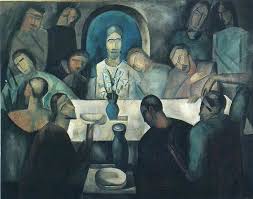
Sometimes I wonder if our liturgical utterances of resurrection are in danger of becoming the last gasps of a Church that is all but dead. – Easter 3C sermon

grave-clothes

Christ is Risen!  Christ is risen indeed! Alleluia! During the Easter season we punctuate our celebration of resurrection by declaring that, “Christ is risen!” and sometimes I wonder if our liturgical utterances of resurrection are in danger of becoming the last gasps of a Church that is all but dead. Are we who gather in churches on a Sunday morning members of a church that is the living body of the risen Christ or are we mourners at the funeral of a religion that died in the last century because it did not have the stamina for 21st century?

As congregations shrink, churches close, and the few mourners who are left insist upon preserving what’s left of the corpse, the season of Easter, designed to celebrate resurrection, is in danger of becoming the church’s final attempt at denying the corpse of Christianity. Generations to come may look back upon this critical time in the church’s life and pronounce that resurrection itself was the cause of the church’s death. While worshipers remained fixated upon the physical resuscitation of Jesus’ corpse determined to defend the doctrines of the church, the life-blood of the body of Christ slipped away, no longer able to congeal around the idea of a deity so small that “HE” could only be worshipped by those who could narrow their thinking so that it could fit into the boxes created by the need to suspend everything they have learned about the nature of reality.

Gathering around the ancient stories of resurrection, those who sought to save the church could not agree on the treatment necessary to save the church. While some insisted that a good dose of biblical literalism was the only way to save Christianity, others advocated for a more radical treatment, one that took on board all that we have learned about the cosmos and what it means to be human. Still others looked to more nuanced forms of treatment and reached into the long traditions of the church which have always worked wonders in the past; traditions that honoured the human need for reason while they still managed to encompass the unfolding mysteries of the cosmos. While the theologians, priests, laypeople, hierarchy’s, would be evangelists, charlatans, worshippers, seekers, and philosophers, tended to the perceived needs of the church, the members of the Body slipped away to seek nourishment and healing elsewhere; leaving the patient to die a slow and laborious death. Oh there are a faithful few, huddling around the corpse doing their damnedest to resuscitate the corpse of Christianity. But life has long since left the patient. All that is left are the mourners who simply cannot believe that their beloved is dead. But like all deaths, life goes on, and the world scarcely notices all that has been lost. Some of us, hang around, finding solace in one another, remembering the good old days, longing for the future we had hoped to see.

When some folk return from the empty tomb that the church became, to tell us that Christ is not there, that Christ is risen. Dare we even begin to imagine that the one place we expected to find Christ is empty? Can it be true? Can Christ have escaped the empty tomb we call the church? Or, is this just one more idle tale? Continue reading

Resurrection: Believing is NOT the point! – sermons for the Second Sunday of Easter

Looking ahead to Doubting Thomas’ annual appearance, I am reminded that resurrection is not about belief. Resurrection is a way of being in the world. Over the years I have tried serval different approaches to encourage the practice of resurrection. click on the titles below to see

Believing in Resurrection is NOT the point! click here

Easter: 50 Days to Practice Resurrection! click here

Humpty Dumpty, Doubting Thomas, and Resurrection click here

Leap of Doubt – How Do We Believe Resurrection? click here

Can the ways in which we tell the stories of resurrection transform us into followers of Jesus who embody a way of being in the world that can nourish, ground, and sustain the kind of peace that the world years for? click here

Practicing Resurrection: Forgiveness click here

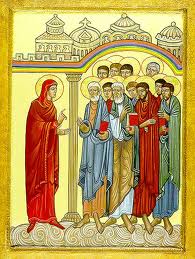
Apostle to the Apostles: Mary’s Story

a to aThis coming Sunday, in churches all over Christendom, worshippers will hear the gospel story of Doubting Thomas. The story of Doubting Thomas is prescribed gospel reading every year for the Sunday after Easter. I’ve never understood why Thomas should hold such a prominent place in our lectionary: I mean, as the stories have been handed down to us, when the chips were down, and Jesus could have used their support, Thomas and the guys deserted Jesus; they left him alone and spread out across the city to hide from the Romans and the religious authorities. According to the anonymous-gospel-story-tellers, it was the two Marys, together with the other women who had financially supported Jesus’ ministry, and who stuck by him to the bitter end. Also according to the anonymous-gospel-story-teller, we know as John, it was Mary, the one they call Magdala who brought back the news that Jesus was not dead, but had risen. Despite the fact that Mary Magdalene was the one chosen to be the Apostle to the Apostles, (the word apostle comes from the Greek for “the one sent”) our lectionary quickly moves on from the empty tomb to the upper room so that we can all once again explore the story of good old, doubting Thomas.

So here, let me honour Mary the Apostle to the Apostles with this my imaginary account of Mary’s story. Remember the power of our imaginations to breathe life into what appears to all the world to be dead. 

Shalom.  I greet you in the name of our risen Christ. My name is Mary.  You may know me as Mary Magdalene. I am not from around here.  I come from a good family in Magdala.  Magdala is a wealthy city on the Sea of Galilee, just south of Capernaum. My family made a lot of money in the fishing industry in Magdala.  While I was growing up I lacked nothing.  But I was not happy.  I was sick.  I would sit around the house moping and complaining and make everyone miserable.  I was so distraught.  Often I was so upset that I pulled out my own hair.

Sometimes I would be so excited that people couldn’t stop me from talking.  I ran up all sorts of bills in the market place which my parents had to pay.  I was always cooking up some mad scheme or other.  I would rant and rave at the slightest provocation.  From time to time I would become ill and stay in bed for weeks on end.  I knew something was terribly wrong and nothing seemed to ease my anxieties. I was a prisoner inside my own mind. Then I met Jesus.  He was teaching outside of the synagogue.  At first, I just stood back in the crowd and listened as he spoke about a new world which God intended to create. It would be a world where the sick are healed and prisoners are set free. I wanted to taste this freedom which Jesus spoke about. I wanted to ask him so many questions.  But the crowd pressed in upon him demanding that he tell them more and I was pushed farther away from him. In despair, I turned to leave. Continue reading

Earth Day: Every Bush Is Burning

On the heels of Peter Rollins visit to our congregation, I preached this Earth Sunday sermon which flows out of Peter’s work. You can listen to Peter’s sermon which is the jumping off point for this Earth Day sermon here

Listen to the Earth Day sermon here

Worship Bulletin here

The readings are here

The video of the excerpt from Chief Seattle’s Response is below

Today, this planet celebrates Earth Day; a time to pause and celebrate the wonders of this planet and to consider the fate of this planet. The church has no day on its calendar to either celebrate the Earth or to pray for the survival of the Earth. Indeed, there are churches in Christendom that actively pray for the demise of the planet, so as to hasten the arrival of Christ.  When I preach about the plight of the Earth, I usually point out some ecological disaster and encourage us all to take better care of the planet.  While there are plenty of ecological disasters that I could point to that’s not what I’m interested in today,  because let’s face it, if you’ve read this far, I’d only be preaching to the choir.  We all know that the planet is in grave danger and that we all have a role to play in saving the planet. Today, I want to talk to you about something that lies at the very heart of our abuse not only of the planet but of one another. You see all week; I’ve been haunted by a line from Pete Rollins sermon last week.

Peter was talking about the gift that Christianity has to offer the world a gift that has the potential to move us beyond religion toward a more connected holistic way of being in the world. The line that has been haunting me all week came near the end of Peter’s sermon. It was almost a throwaway line and with Belfast Peter’s accent and the speed with which he speaks, I almost missed it. Peter said that all too often what we see in religion is our desire to have some sort of holy experience; a burning bush experience like Moses. We want to find this place where the Holy is and there always seems to be things getting in the way of our having this holy experience.

There are people getting in the way and structures getting in the way of this burning bush experience. Pete insisted that in the what he described as the Apostle Paul’s conversion of bedazzlement, in this incomprehensible blinding revelation that seems so incomprehensible, so transformative has the power to transform us so that we can see inside of ourselves and we can begin to see that every bush is burning. We can begin to see that the sacred are everywhere; that the persecuted ones are the place of our transformation and our conversion. Continue reading

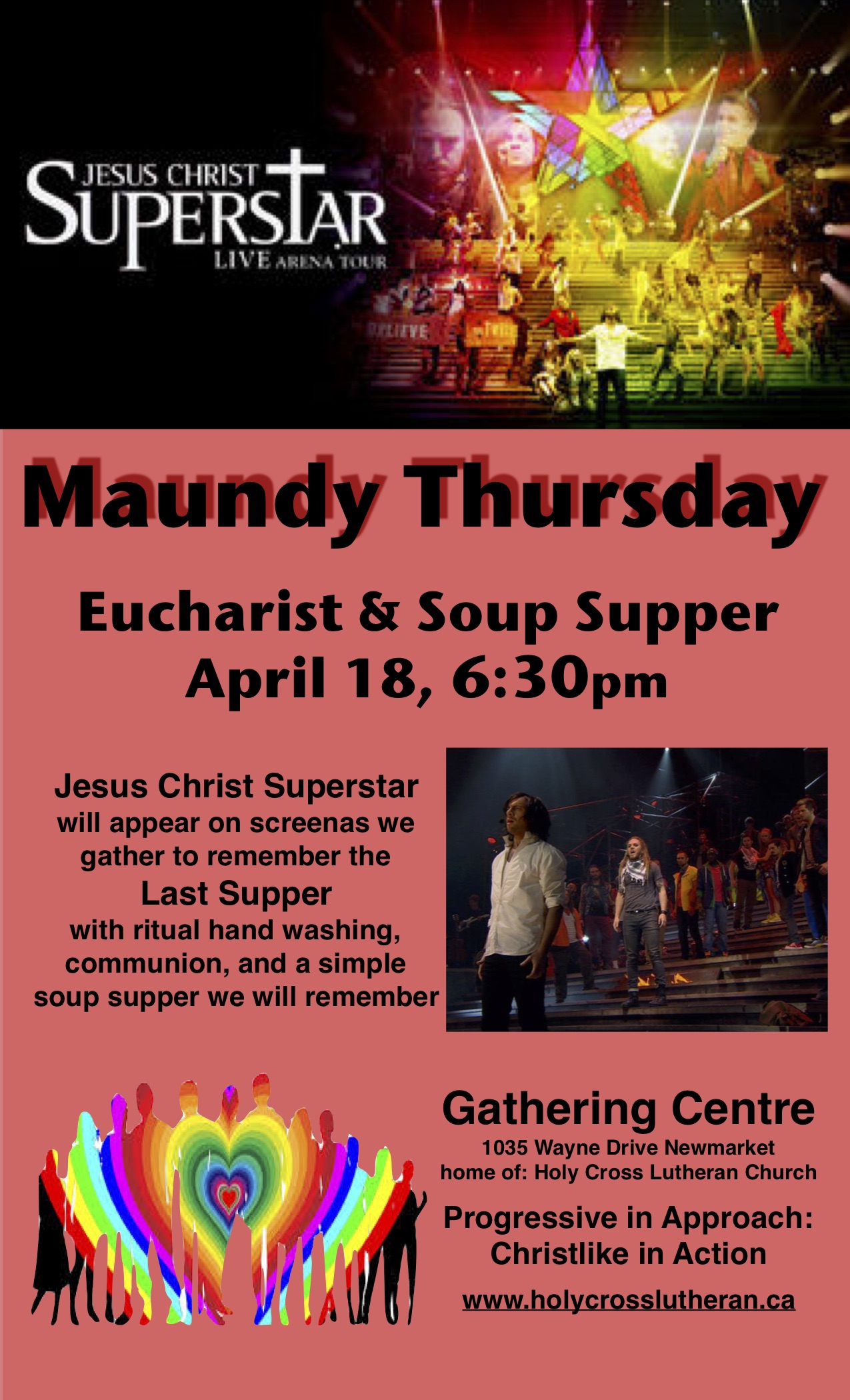
Each Maundy Thursday we must peer beyond Passover lambs and scapegoats if we are to catch a glimpse the LOVE that we call God

Every Sunday I stand at the altar and preside over a mystery. A mystery that has its roots in the events we remember this Holy Thursday.  On Maundy Thursday, we gather together to contemplate MYSTERY. We know what will happen tomorrow as Good Friday plunges us into darkness. So is it any wonder that we cannot fully comprehend this MYSTERY.

The various gospel writers have created a record of Jesus’ last evening that is filled with bittersweet images. Our mystery begins with the foreshadowing of what is to come as we hear the name Judas Iscariot. Judas, son of Simon, is perhaps the most trusted of Jesus’ disciples, after all Judas is the one who is trusted with the financial resources of this struggling little group. Even though we know Judas’ role in this unfolding mystery, we must remember that Judas is among those who Jesus loved to the end. But long before the silver changes hands, we already know enough to dread the betrayal.

Our mystery continues with the tender intimacy of a teacher washing the dirty feet of his beloved bumbling students, as Jesus breaks the bonds of decorum to demonstrate the fierce tenderness of loving service. The image of Jesus washing the feet of his followers still seems undignified all these centuries later. So, is it any wonder that the intimacy of Jesus’ tenderness is more than Simon Peter can bear? In order to get beyond their inhibitions, Jesus must spell it out for them.  “Do you know what I have done to you? You call me Teacher and Sovereign —and you are right, for that is what I AM. So, if I, your Sovereign and Teacher, have washed your feet, you also ought to wash one another’s feet. For I have set you and example.” Jesus has washed their feet; all their feet, even Judas and the talk of betrayal continues as Jesus returns to the meal.

The writer of the Gospel of John does not record the details of the breaking of the bread or the passing of the cup. These details are recorded by Paul in his letter to the Corinthians and by the writers of the gospels of Mark, Matthew, and Luke: “on the night he was betrayed, our Savior Jesus took bread, gave thanks and broke it, saying, “This is my body, which is broken for you. Do this in remembrance of me.” In the same way, after supper, he took the cup and said, “This cup is the New Covenant in my blood. Whenever you drink it, do it in remembrance of me.  For every time, you eat this bread and drink this cup, you proclaim Jesus’ death until Christ comes.” Week after week, year after year, generation after generation, century after century Christian priests have presided over ritual communions using what have become known as the words of institution. In remembrance of Jesus we eat and drink. The body and blood of our Saviour Jesus Christ. And therein lies the mystery. The mystery of communion. Sometimes the meal has transforming power, nourishing power, restorative, profound power. At other times the meal is just one more religious ritual carried out by rote, experienced without feeling, or impact. Sometimes the meal seems foreign to us, almost alien, perhaps even barbaric. Continue reading

Easter Sermons: LOVE IS – Risen!

click on the links

2018 – LOVE Is Risen! here

2017 – LOVE is Risen! LOVE is Risen Indeed! here

Is God Coming Back to Life here

Easter: Yes, Yes, Yes, Laugh – here 

Easter: The Greatest Story Ever Told – here

I Plead Guilty to Denying the Resurrection – But I aint’ leaving – here

Preparing to Preach on Resurrection: Giving up the notion of a physical resuscitation. here

Approaching Resurrection: What Did Paul Actually Say – here

A Resurrection Story In Memory of Nellie, My Gran – here

Words Will Always Fail Us – here


Good Friday Sermons

Holy Week marks a sharp uptick in visitors to this blog. From comments, messages, and emails I hear from fellow preachers who, like me, are daunted by the task of preparing the Good Friday sermon. That task is even more daunting for those of us who serve progressive communities. My fellow progressive-christian-preachers tell me of the dearth of progressive-christian Good Friday sermons to be found on the internet and encourage me to re-post my own attempts to rise to the occasion. So, here are the links to some of the Good Friday sermons I have preached over the years of my journey with the progressive community which I serve. The people Holy Cross Lutheran Church have over the years provided an invigorating space for me to pursue my questions. They have also provided the resources which make this blog possible. So, if you find the work posted here  of value to you and your community, please consider supporting this ministry of Holy Cross. I rarely solicit donations. But Holy Cross is a small community that continues to give to others in so many ways and your encouragement is greatly appreciated!!! (Holy Cross Lutheran Church, 1035 Wayne Dr., Newmarket, On. L3Y 1N3) Donate via CANADA HELPS click here

Follow the links to Good Friday sermons and feel free to use/adapt/repost

Moving On From the Tragedy of Good Friday click here

2017 I cannot and will not worship a god who demands a blood sacrifice. But the residue of atonement theories still causes me to tremble click here

2016 I’m still working on getting my body out of the tomb in which it was laid all those years ago – reflecting on everyday crucifixions click here

2015 Not Salvation! Solidarity and Transformation click here

2014 God Is Dead? click here

2013 Giving Up the Theories of Atonement in Order to Move Toward an Evolutionary Understanding of Jesus. click here

2012 Good Friday Rituals or Crimes Against Divinity? click here

Preparing to Preach on Good Friday click here

Maundy Thursday Sermons

MAUNDY THURSDAY SERMONS

Two Suppers – Maundy Thursday – A Strange Night

Scuffed Up Reddish Pumps

MAUNDY THURSDAY – When you don’t believe that Jesus was a sacrifice for sin!

We must peer beyond Passover lambs and scapegoats if we are to understand the LOVE that we call God

Just Wave the White Flag of Surrender and Go Into the Party: a Sermon for the Lost – Luke 15 – Lent 4C

prodigalI am indebted to Amy-Jill Levine’s book “short stories by Jesus” and Bernard Brandon Scott’s book “Hear Then the Parable” for challenging me to look beyond the Christian bias of interpreting Jesus’ parables through the lens of the repentance and forgiveness and attempting to hear this story in ways more in keeping with Judaism. 

Following the reading of the three parables of the Lost from Luke 15, we watched the video “Prodigal” before the sermon (text below). You can watch the video below and then listen to the sermon here 

Beautiful.

I love a happy ending.

Who doesn’t love the kind of ending that sees those who are lost found.

Reconciliation is a beautiful thing.

Home, safe in the arms of a loving parent.

Who doesn’t long to be Welcomed.

Embraced.

Held.

Loved.

Reconciled.

Celebrated.

Home. 

We recognize the longing because it resides deep inside the darkest places of who we are, who we will always be; children trying to find our way, children longing to be welcomed, embraced, held, loved, reconciled, celebrated, home. 

Is it any wonder that we love a happy ending.

But this is not the happy ending that we long for because this is not the end of the story.

“A man had two sons…”

Our story does not end with the welcome embrace.

The embrace is just the beginning of our story.

All was not forgotten.

It never is.

The pain of past hurts remains.

That hard work of forgiveness and reconciliation is ongoing.

There is more than one child in this story.

This parent has two children.

Imagine for a moment that you are the elder child.

Obviously you are the wise one, the good one, the one who did the right thing, the one who can be counted upon, trusted, looked up to.

Here we are trying to make our way in the world.

Struggling to take care of things, to pay the bills, to ensure that everything is in its proper place, striving to do the right thing.

We too long for happy endings, to be welcomed,embraced, held, loved, reconciled, celebrated, home. 

What separates us from the irresponsible, spendthrifts, who foolishly waste what they have been given, what separates us from them, is that we have the good sense to keep our noses to the grindstone, to always strive to do the right thing.

And yet, no matter how hard we try, how much we forgo in order to be who we know we ought to be, no matter what success we might achieve, we are in the end, just children, longing to be loved.

So, who could blame us for wanting justice?

We just want what is right.

We need to know that all our efforts are worth at least a sense of order to things.

We’ve all felt the pain of betrayal.

A member of our family, a sister, a brother, or a member of our tribe, a loved one, a friend, who disrupts our world with their needs, their wants, who shatters our sense of right and wrong;

a pain so deep we cannot begin to imagine how we can ever recover.

We long for the happy ending.

We wish we could just find a way to forgive and forget.

But it just seems so very wrong to let go.

And the hard work of healing is more than we can begin to contemplate.

So, we set ourselves apart.

We stand outside of events.

And we have every right to do so.

After all, we did what was right, what was just, what was called for, we have nothing to apologize for.

But there they are, the source of our pain, right there as large as life.

What are we to do?

How are we expected to forgive and forget?

It’s too much.

A man had two sons.

A parent had two children.

A woman had two friends.

A man had two loves.

A person had two people needing to be welcomed, cared for, loved, reconciled.

Our story does not end with the welcome embrace, our story begins with the welcome embrace.

The had work of reconciliation is the story’s next chapter, not the final chapter by any means, just the next in a long line of chapters that will include all sorts of gestures, kindnesses, apologies, starting overs, mistakes, offences, delicate negations, concessions, ultimatums, joys, sorrows, tears, laughter, arguments, and make ups.

The hard work of living together and apart, welcoming and good-byes, embraces and refraining from embracing.

It is called life; life in community with people who share our longing to be welcomed, embraced, held, loved, reconciled, celebrated, home. 

So, here we are.

We can almost hear those white sheets of surrender flapping in the wind.

What are we to do?

There they are standing there embracing one another as if nothing had happened.

Here we stand, knowing how well we have behaved, how right we are.

What are we to do?

Do we go into the party?

What are we to make of the one who has wounded us?

How do we respond to the One who is welcoming our betrayer with a loving embrace?

Does it matter that our betrayer hasn’t truly repented?

Does it matter that they don’t appear to have changed their ways?

What about the injustice?

How do we repair the damage?

What will become of everything we have worked for?

Where will it all end?

The scandal of Jesus’ parable is that we don’t get any answers to these questions.

Just a fatted calf, a party, a bbq if you will.

What are we left to do?

Go in and have lunch.

Set aside our need for repentance and forgiveness and simply enter into the party.

When it comes to families, there are factors other than repentance and forgiveness that hold us together.

The sheep and the coin did not nor could they repent.

But the celebration happened nonetheless,

because the man and the woman were able to rejoice at the finding of the lost and the restoring of wholeness.

Sometimes the one we have lost is right under our nose, sometimes we are the ones who are lost.

Do whatever it takes to find the lost and then celebrate what has been found and then work to ensure that what has been found will never be lost again.

Don’t wait until you receive an apology, you may never get one.

Don’t wait until you can muster the ability to forgive; you may never find forgiveness.

Don’t stew in your sense of being ignored, for there is nothing that can be done to retrieve the past.

Instead, go have lunch.

Go celebrate, and invite others to join you.

If the repenting and the forgiving come later, so much the better.

And if not, you still have done what is necessary.

You will have begun a process that might lead to reconciliation.

You will have opened a second chance for wholeness.

Take advantage of resurrection—it is unlikely to happen often. 

What counts for the family also counts for the world.

So let us go into the party and dance, dance the dance of life, dance the dance of love.

It’s a complicated dance, but once you catch on to the rhythms of the music you’ll figure out the steps, and even if you look a little silly, waving and flapping about, your moves will lighten everyone’s load and help the party to be just that much more enjoyable, for everyone.

The DIVINE Finds Expression In, With, Through, and Beyond Us – a sermon for Lent 3C

It was nearly 20 years ago, and I still remember it as if it were yesterday. I was working as the on-call Chaplain at the Grand River Hospital in Kitchener. I had been paged to the emergency room to attend to a man who had accompanied a patient to the hospital, VSA, the code for Vital Signs Absent. Someone was waiting for me in the Quiet Room. The Quiet Room was a small ten by twelve room, into which loved ones of really serious patients were asked to wait for the worst possible news. They were kept there in the Quiet Room so that they wouldn’t be disturbed, but I suspect that the real reason is so that they wouldn’t disturb the less seriously ill patients.

Inside the Quiet Room sat one of the largest men I have ever met. He was about six-eight, with big broad shoulders. He wore blue jeans and a black leather jacket. He had long black hair and a bushy beard. He could have passed for the head of a biker gang and under normal circumstances, I probably would have been very afraid of this character. I introduced myself as the Chaplain and he just put his head in his hands. Chaplains are not popular people in hospital emergency rooms. People usually expect the worst when the medical profession calls in a chaplain. I took a seat and together we waited. 

Slowly, this big bear of a man began to tell me what had happened. He said, that everything was all his fault; he was to blame. Anne, his partner wouldn’t be in the other room fighting for her life if it wasn’t for him. After years of being on his own, driving truck from one place to another, never really having a home, he had met Anne and she had changed everything. No more long hauls for him. He switched to driving locally. For the first time in a very long time he had a home; a home he and Anne had made together. She’d made him so happy. He loved her so much. Everything was going so well for them.

Why? Why did this have to happen? He knew he shouldn’t have allowed himself to be happy. It was all his fault. If only he hadn’t of stuck around. None of this would have happened.

Quietly, I asked him just what had happened. He explained that he had come home from the store. He’d gone out for a pack of cigarettes. Anne had asked him to quit. He should have quit smoking. When he got back from the corner-store he found Anne lying on the floor. He dialed 911 and started CPR.

They wouldn’t let him stay with her. Could I go and see how she was doing? I headed back to the resuscitation room. They were tidying up. The doctor said she had a massive coronary, she was dead before she got to the hospital, they had just been going through the motions. I waited while the doctor filled in the paperwork and then together, we headed toward the Quiet Room. The doctor didn’t say a word when we arrived, he let his face do all the talking and I watched as a giant of a man fell to pieces.

When he quieted down a little, he told me that Anne was one of the best things in his life and that he should have known better. It was all his fault. If he’d just left her alone she would have been better off. Mutual friends had introduced them just a year ago. He fell for her right away. He should have known it was too good to be true. It was all his fault. It was happening all over again, only this time he should have known better. Through his tears, he asked me, how I could believe in such cruel God. God took his son away from him and now God had taken Anne.       He began to moan, over and over again, crying out for his lost son Billy.

It took about an hour for him to tell me what had happened, some 25 years earlier. His son had been playing with some friends down by the river. They’d made a makeshift raft. Somehow, little Billy had drowned. Just five years old and he was taken away. It was all his fault. If he hadn’t been such a lousy father, Billy wouldn’t have been taken away from him. After Billy died, his marriage fell apart. That was all his fault too. If only he’d been a better husband, a better man, God would have helped them to work it out. But clearly, God was punishing him for all the terrible things he had done in his life.

He should have known better than to take the chance. He just should have known better. If he had just stayed on the road. If he hadn’t tried to make some sort of life with Anne, she’d still be alive. God had really stuck it to him this time. This was his punishment for trying to be happy. He cried softly then. Over and over again crying out the names of Anne and Billy.

I quietly told this big bear of a broken man, that I didn’t believe in the kind of God that he was talking about. The God that I know wouldn’t do something like that. God is not that cruel. I told him that I believed that God wept for his son and for Anne, and that God knew the kind of pain that he was feeling. He just kept on sobbing, telling me that I didn’t understand, insisting that it was all his fault. Looking back, I realize that I was probably trying to convince myself at that moment that God was not some sort of monster. At that very moment I suppose that I felt like God was indeed some sort of monster. How could I have expected to help this man to reconcile the death of his son and his partner with the notion of a loving God? Surely that man was better off believing in a punishing God rather than an absent or capricious God who allowed the innocent to suffer?  The man himself was willing to blame himself rather than to blame God. God, in that man’s mind, was just doing what had to be done, punishing a guilty man. He knew beyond a doubt that he was to blame. His crimes had caused the deaths of his loved ones, not God. Who was I to destroy his worldview? At least his reasoning allowed him to make some sense out of his life.

Who among us has not done the same when calamity strikes, wondering what we have done wrong to deserve our plight?   Who among us at some time or another has not scrutinized our own behaviour, our relationships, our diets, our faith or lack of faith, hunting from some cause to explain our lot in the vain hope that we can find the reason behind our suffering?  We are only human after all, less interested in the truth than in the consequences. What we crave above all else is to grasp for control over the chaos of our lives. Continue reading

The Fox is in the Henhouse – a sermon for Lent 2C – Luke 13:31-35

Written 3 years ago, before the fox became the most power person on the planet.

Sadly, it still resonates.

Drawing the connection between the French word “lent” as meaning slow and the historical Lenten practice of fasting, we began our Lenten journey with the suggestion that we adopt a spiritual practice of slowing down for lent by fasting from fast. So, following a delightfully slow start on Monday morning, I read the assigned gospel text for this Sunday and spent some time luxuriating in the study of fables about foxes in henhouses.  The gospel’s description of Jesus describing himself as a mother hen longing to gather up her chicks in the safety of her breast so to protect them from encounters with Herod the fox created images that suggested that we lean into the Mystery that we call God. If as our friend Dom Crossan is fond of saying, Jesus really “is what God looks like in sandals,” then surely the gospel-storyteller’s casting Jesus as someone who compares himself to a mother hen, must tell us something about how Jesus want’s his hearers to understand the nature of God. So, I began thinking about preparing a liturgy devoted to gently leaning into the MYSYERY of God.

Part of my lenten practice of fasting from fasting from fast caused me to shun my regular Monday morning consumption of news media, as most of you know, I’m a bit of a news-aholic and so on my day off, I usually spend way too much time catching up on the news of the world. These days the news tends to send my blood pressure racing so, I avoided my usual media haunts in favour of enjoying a few movies and some exercise.  As the week wore on, I developed a cold and so Wednesday and Thursday were spent drifting in and out of consciousness as I tried to sleep off the effects of fever and congestion. So, imagine my horror when I finally tuned back into the news of the world on Friday. The fox was actually in the hen house. There he was a fox whose sly cunning makes Herod Antapis look tame, attacking a beautiful tender sweet hen, who over and over again wants for nothing more than to gather children as a mother hen collects her babies beneath her wings. Donald John Trump was attacking the Pope! At first, I thought the decongestants that I was taking were causing hallucinations! Talk about foxes in the hen houses!

Herod Antipas wanted nothing more than to be King of the Jews and Trump wants nothing more than to be King of the World! Herod Antipas scandalized the first century and Trump is well on his way to scandalizing the 21st century. Jesus Christ shocked the first century by comparing himself to a hen.

Donald Trump continues to shock this century with the size of his ego. For over a billion Roman Catholics, Pope Francis is Christ’s representative on earth, billions more see him as a religious leader of impeccable credentials, others see him as a kindly old gentleman who is struggling to bring a stodgy religious institution into the 21st century by opening the doors to welcome in the poor and marginalized.  Donald Trump is a narcissist of epic proportions; a real-estate mogul, who despite his three financial bankruptcies has managed to translate his business savvy into reality show ratings that paved the way to a media career which he is currently trying to translate into a political career in his quest for the White House. Responding to a question about the astonishing popularity of Donald Trump, the Pope said something to the effect that “any person who focusses on building walls and not trying to build bridges is not a Christian.” And that audacious fox stopped dead in his tracks just long enough to insist that the Pope is and I quote, “disgraceful”.

Can you blame me for suspecting that I’d taken one too many decongestants?  I turned the TV off lest I discover that aliens were about to land on earth and lock us all up for our own safety. Back in the relative safety of my office I returned to biblical commentaries to read about metaphors for God. What exactly is the anonymous gospel-storyteller we call Luke getting at with this particular metaphor?  I mean why a chicken? Why not something more elegant or graceful or majestic; an eagle perhaps, or a lion, or a bear? This are metaphors for God that were good enough for other biblical storytellers, but not for this one. Now I have only ever really had a relationship with one chicken in my life.  I’ve got to say a chicken is the last thing I would want to be compared to let along something I’d compare myself too. If Jesus is comparing himself to a mother hen collecting her babies under her wings, and the gospel-storyteller wants us to think of Jesus as God then is the gospel-storyteller actually asking us to think of God as a mother hen?

Let me tell you about the one chicken I have actually known personally. Her name was Betty, Betty the Broiler. We called her Betty the Broiler because she wasn’t anything much to look at. You see back in the day, when I was helping to run a retreat centre, among the various animals we kept on Seabright Farm were chickens. Seabright chickens to be exact.  Seabright chickens were breed to as ornamental chickens and a flock of seabrights are about as beautiful a flock of chickens as ever adorned a farmyard. For some unknown reason, our flock of seabright chicks came complete with a rather plain looking banti hen that was anything but a seabright, she was a plain white hen which we nicknamed Betty the Broiler on account of how she looked like a generic hen fit for broiling.

But Betty was anything but generic. Betty thought she was human. Right from the start rather than scratch about with the other hens, Betty liked nothing better than to follow the children wherever they went. The kids on the farm loved Betty and because they loved her, they fed her stuff that the average hen never eats; sandwiches, crackers, bananas, berries, ice-cream, Betty’s favourite food was hot dogs. The kids used to squeal with laughter as Betty chased them around the yard demanding that they share their food with her. Well one day, depending on whose telling the story, either one of the dogs on the farm, wanted to share in the food that the kids were eating or a strange dog wandered onto the property to only to attack one of the kids, anyway long story short the kids ran into the farmhouse screaming for help because “a dog tried to kill Betty.” By the time we got to her Betty was gasping on the lawn surrounded by feathers. Her throat had clearly been cut. Betty looked ready for the broiler.

But the children insisted, and so none of the adults had the heart to do what seemed like the kind thing and simply finish her off. Instead against better judgement of the adults, Betty the broiler was rushed to the vet, who even though he thought the so-called adults had taken leave of their senses, agreed to stitch Betty up. The vet had never before tried to rescue a chicken, so when he handed her back to the adults, he suggested that she might be in considerable pain, but rather than prescribe costly drugs, he suggested that we might try alcohol to ease her pain. Continue reading

Bows and Arrows – sermon for Lent 2C

This morning’s sunshine has left me longing for spring. I know that when all is said and done this winter will probably go into the record books as a particularly mild one. But even so, I’ve grown weary of the trappings of winter and I cannot wait for spring to arrive. On Friday I found myself suffering from a case of cabin fever. I’d spent the day working in my office and even though my desk faces a large window, the dull grey hue of the cold, overcast, afternoon made me long for spring, when the sunshine would entice me to open my widow and I’d hear the sounds of the world out there waking up from its long winter nap. From my office window I caught a glimpse of some kids who judging from the time of day, were heading home from school. As they trudged along the sidewalk, the sight of their mother tagging along behind them made me incredibly sad. Those poor kids were being escorted by their mother. How in the world were they ever going to have any adventures with their mother tagging along behind them? I know that the world has changed some since I was a kid, but the adventures that we could have on the way home from school, well let’s just say, what our mothers don’t know can’t hurt them. The kids walking down the street on Friday, were going straight home; something we rarely did. We wandered home from school, and it could take hours to get home. Now I know that some of you may be fond of saying that when we were kids, we had to walk for miles and miles and miles, and it was all uphill and the sidewalks weren’t ploughed back in the day and the snow, well you should have seen it back then it was piled as high as the rooftops and we had to trudge through snow drifts that were taller than we were. Yeah, yeah, kids today, they just don’t know how well off they really are. Or are they?

Kids are escorted home from school and there’s no time for dilly-dallying. I’ve got to say that dilly-dallying on my way home from school was some of the best fun I can remember. After a day spent at school there was nothing quite like the fun we could get up to on our way home. I remember one spring my friends and I spent days and weeks collecting tree branches. We wandered here and there trying to find branches with just the right amount of sap in them to make them supple and pliable. You had to be able to bend them just so and unless they had lots of sap in them, they would snap in two. We needed branches that we could bend into bows and when we found those branches, we collected other branches that we could fashion into arrows. It wasn’t difficult because all of us had jack knives and we would take those branches and with our jack knives we’d sharpen them just so. When we had all our bows and arrows ready, we’d practice shooting arrows. Continue reading

Carcasses Torn Asunder – Do We Really Have to Listen to This In Church? Lent 2C

Genesis 15:1-12,17-18 – Musing About Genesis Bloody Carcasses

Genesis 15From time to time, the prescribed readings from the Common Lectionary fill me with dread and despair. Something about those bloodied, split, rotting carcasses that sealed the deal between God and Abraham makes me wonder about the nature of the god we have projected into the heavens and ask: Have we evolved or has God? The story of God’s promises to the “Chosen People” portrays God as a churlish player in humanity’s game of tribal rivalry. While I’d rather not preach on the text from Genesis this Sunday, I know full well that simply reading this text during worship without elaboration, will if folk are paying attention, leave a distasteful oder in the sanctuary  that will surely spoil our appetite for our common meal of body and blood disguised as bread and wine.

The readings for this coming Sunday have me thinking about tribalism. There’s always more than one way to look at things. Tribalism has served us well. New people to meet can be exciting or it can be frightening. Taking comfort with your own people is wonderful, but taking too much pride in your own kind is dangerous. One minute you’re cheering for your team the next minute you’re hurling insults at the other guy and one too many insults and the next thing you know you’re at war. A little tribalism is a good thing, but how much tribalism is too much? Tribalism is a basic human survival instinct. Tribalism is lodged deep within our psyches and has been from the very beginning of time. Tribal is part of our primordial selves. Tapping into this basic human instinct can mean the difference between survival and death.

Tribal thinking exists on almost every level of human life, from the international to the local. Attack a human on any level and that human will resort to instinctive behaviour. When threatened humans have two basic instincts, fight or flight and the choice between the two often comes down to tribalism. If you have enough people to back you, you’ll probably choose to fight. Not enough people and you’ll probably choose flight.

Human kind has evolved a great deal over the centuries but we haven’t evolved very far from our basic instincts. You don’t have to scratch a fan too deeply to find the primitive tribal mentality. Tribalism is seen in the way we portray our rivals. I once heard a Kiwi say, “I root for two teams, New Zealand and whoever is playing Australia.” Sporting competition is all well and good, but when tribalism is carried to its worst possible conclusion, wars beak out. Tribal feeling is then exacerbated in times of war, and tribal propaganda is used to dehumanize our enemies to make it easier to hate or kill without any qualms of conscience.           We don’t kill human beings in war; our victims are not someone’s child, spouse, or parent.  NO, one kills either, the Huns, the Krauts, the Japs, the Nips, the VC, the insurgents, the fanatics or the terrorists.

There is within us all a basic, dominant, intrinsic fear of those tribes different from our own, a predisposition to be on guard against them, to reject them, to attack and even to kill them. This tribal tradition arises out of our deep-seated survival mentality and it feeds something at the heart of our insecure humanity. We are tribal people to our core. Far more than we will consciously admit, the religions of the world including Christianity rise out of and undergird our tribal thinking. Continue reading

Don’t Give up Chocolate, Give Up God for Lent: a sermon for the first Sunday in Lent

Eckhart rid me of GodAn article by Brandon Ambrosino in the Religion section of the Hufington Post sent the wheels in motions. I am indebted to Pete Rollins  book the Idolatry of God as well as his video Atheism for Lent for providing me with the courage to preach this sermon.

I swear to you it happens to me every year! It usually happens when the first person asks me what I’m giving up for Lent. When you’re in the line of work that I’m in, I suppose you should just get used to it. But somehow that particular question makes me wish I did something else for a living. People don’t usually mean much by asking the question. At this time of the year, “What are you giving up for Lent?” is sort of like when people ask you, “How are you doing?”  They’re not really interested unless you have a pithy answer. I must confess that over the years, I’ve come up with more than a few pithy answers. Like the time, shortly after I first came to Newmarket to be your pastor and my Mother, who does not observe Lent asked me what I was giving up for Lent and in a feeble attempt to make my Mother laugh, I told her I was giving up drugs and sex for Lent. Things went very quiet on Mom’s end of the phone line. The truth is that the answer I most feel like giving when people ask me what I’m giving up for lent requires so much time to explain that I rarely answer the question truthfully. But t’is the season for confession, so please forgive me but I’d really, really, really, like to give up Lent for Lent. I mean who among you, woke up this morning and said to yourself, “Oh goodie it’s Lent! Yippie!!!”

I remember when I first started going to church, I was a teenager, and I don’t mind telling you that my first experience of Lent almost sent me packing. All I heard was that we are in bondage to sin and cannot free ourselves. All that talk about sin made me feel so guilty and worthless. I was just 15 years old and I hadn’t had much of an opportunity to commit much in the way of sin, and all I kept hearing was repent, repent! The message I received loud and clear during those first few Lents in the church was that I was nothing but a wicked sinner, a worthless worm! Poor, poor, pitiful me! But have no fear, cause Jeeeeesus can make you better. All you have to do is give something up for Lent!!!  Jeeeeesus, he’s on his way to be executed on a cross, because of you, so you owe it to Jesus to feel lousy because he’s going to sacrifice everything for you. They’re going to nail him to a cross because of you. You wicked sinner. The least you can do is give something up for Lent. I know, how about a little chocolate? That’s it, that’s it, just give up some chocolate for Jeeeeesus! Hands up anybody who has ever thought about giving up chocolate for Lent. Now Lord knows, I could sure do with giving up chocolate, I mean lets face it, I could give up chocolate and maybe loose a few pounds andhave something to say to folks when they ask me what I’m giving up for Lent.

I remember years ago, listening in on a conversation between two little kids about the merits of giving up chocolate for Lent. Little Katie asked her big brother why people were giving up chocolate for Lent and her big brother carefully explained that: “We have to give up chocolate for 40 days and 40 nights so that when Easter comes, we can really, really enjoy the lots and lots of chocolate that the Easter Bunny brings us.”

So, while I’m busy confessing my distaste for Lent, let me move on to that other Lenten subject that I love so very much: temptation! Chocolate!!!! First of all, let me just say: I firmly believe that chocolate is a sublime pleasure, not a sin. Yes, chocolate can be sinful. When I have all the chocolate and you have none; that’s a sin. So, I brought you all a little taste of temptation. The very idea of giving up something you love for Lent strikes me at the very least as self-indulgent. So, I brought enough chocolate for everyone to have a taste, because today I want to see if we can move on from wanting to give up Lent for Lent.

Let me remind you that there is indeed some very good news about Lent. You see Lent doesn’t appear in the Bible. Lent is not based on any biblical instruction. Nowhere in scripture will you find anybody saying, “You shall keep a holy Lent; ponder your sinfulness; give up your pleasures; for you are a worthless worm.” Lent is a season that was developed by the church to encourage people to fast, confess, repent and pray. Now the people the church was trying to convince to fast, confess, repent, and pray were for the most part uneducated, superstitious and illiterate and to keep the masses in line the clergy used fear and intimidation. Death was all around and so why not play on people’s fear of death. Life was full of danger and all sorts of evils lurked around every corner, so why not play on people’s fascination with the temptations of evil. So, over the centuries the church developed what some theologians like to call worm theology. Miserable sinners that we are: why we deserve to have to wallow in Lent. I mean if we want people to rejoice in the glories of God’s grace why not deprive them for a while so that they can really whoop it up come Easter. Now, I know I’m over simplifying things here. But I hope you get the idea. Lent is a season that was designed by the Church to control its members (pardon the pun). All that excessive wallowing in guilt went a little over the top and even the church has had to re-think Lent. For years now the church has been encouraging people to forget about giving up things for Lent and instead try taking something positive for Lent. But even these attempts at putting a positive spin on Lent hasn’t done much to encourage people to embrace the season of Lent. I mean come to church all you good, busy people, and we’ll make you feel so guilty that you’ll feel compelled to add one more thing to your busy days. For forty days and forty nights, excluding Sundays, you can take on some Lenten discipline or other to make yourself feel good about you.

Well, not this year!  We don’t have to keep up the control games of Lent. This year, I’m going to suggest something really radical for Lent. Something that ought to move us beyond the trivial self-indulgent, control games that we are tempted by the traditions of Lent to give up or take on. Before you get excited, I’m not going to suggest that we actually give up Lent for Lent. What I have in mind is more radical that simply giving up something that doesn’t really make much of a difference to the world. This Lent, I’m going to put it all on the table. This year for Lent I’d like you to consider the possibility of giving something up for Lent. This year, how about giving God up for Lent? Continue reading

Embrace Your Mortality in MYSTERY: Ash Wednesday Our Wake-up Call!

I’m not sure that I need any ashes to remind me of my mortality. I think the wake-up call that Ash Wednesday provides rang for me over a week ago. I was driving down the road – distracted by thoughts of this and that, when all of a sudden it happened, a car came at you out of nowhere and I slammed on the breaks and quickly swerved to avoid a disaster. I could have been killed. I could have killed someone. My life or someone else’s life could have been radically changed in an instant. As I pulled back into traffic, I was ever so conscious of the weight of my foot on the accelerator and I swore out loud to no one in particular! I began to scold myself. What was I thinking? Why wasn’t I paying attention? Wake-up you could have been killed!

Well, just in case you haven’t had a wake-up call like that recently, welcome to Ash Wednesday. What have you been thinking? Why weren’t you paying attention? Wake-up — you are going to die!!! Ash Wednesday is our winter wake-up call. Some of us may not need the wake-up call. Some of us know all too well that death is all around us. Some of us have lost someone dear, others are walking with someone who is close to death. Some of you may have felt that fear in the pit of your belly when the doctor suggested a particular test. Wake-up calls come in all sorts of ways.

Traditional Ash Wednesday worship would require us to focus on the brevity of life and remember that none of us will get out of this life alive. Our ancestors in the faith, entered into a morose season of Lent via the awesome reminder that they came from dust and soon they shall return to the dust.  Lent was a season of lament and repentance based on a particular understanding of what it means to be human. Since the 11thcentury most of Christianity has understood the human condition as that of those who have fallen from grace. But we live in a post-modern world. We no longer believe that Adam and Eve were the first humans. We read Genesis not as history but as myth. We understand that humans evolved over millions of years. There was no perfect human condition for us to fall from. What happens when you reject the theological construct of original sin? What happens when you embrace the idea that we are fiercely and wonderfully made? What happens when you see humanity as originally blessed? Continue reading

Lent: Letting Go of our Tightly Held Piety to See Our Need of Confession

JOHN OF THE CROSS as
Little Crystal was only two and a half years old when she got hopelessly stuck.
 And when she got stuck she did what all small children do, when they have gotten themselves into a situation that the can’t get out of, little Crystal cried for help. She went into her mother’s study, holding in one hand a family treasure and her other hand couldn’t be seen.  Crystal cried out, “Mommy I’m stuck”. Her unseen hand was stuck inside her great-grandmother’s vase.  The precious vase had been handed down from her great-grandmother to her grandmother, to her mother. Crystal had always been told that one day the magnificent vase would be hers.

Crystal’s mother tried to move quickly without panicking. She scooped the vase and her little girl up into her arms and carried them to the kitchen sink. She used warm soapy water to try to loosen the toddler’s hand, which was stuck all right. When soap didn’t work she reached for the butter. While greasing her child’s wrist like a cake pan, she asked the obvious “mother question.” “How in the world did you do this, child?” Crystal carefully explained that she had dropped candy down into the vase to see if she could still see it when it was at the very bottom. But she couldn’t see it, so she reached in for her candy and that’s when she got stuck and she couldn’t get her hand back out.

Well, as time passed, the situation became more and more serious. Crystal’s mother called for re-enforcements. She phoned her own mother and told her to get there as fast as she could. A neighbour suggested Vaseline. The apartment manager got out some WD40. Still no luck.  It began to seem like the only way to get Crystal’s hand out was to break the family heirloom.

When Grandma finally arrived, both Crystal and her mother were almost hysterical. They were both more than a little relieved to have Grandma’s calming presence. Grandma sat little Crystal on her knee. 

Crystal was very upset and still very stuck. Grandma took a good look at the vase that used to sit on her mother’s kitchen table all those years ago.  She looked at the miserable look on her grand-daughter’s face, and she said, “Crystal, sweetheart.  Your mommy told me that you reached into the vase for candy.  Is that right?”

Crystal was a little breathless from all the crying she had been doing and all she could manage was a whimpered, “Mmm hummm.” “Honey, tell grandma the truth now. Do you still have a hold of that candy?” “Mmm humm”.  Crystal sobbed. Then Grandma rubbed little Crystal’s back, held her close and gently, but firmly said: “Let it go, child.  Let it go.” Sure enough, the vase slipped off as smooth as silk. (I have searched for the source of this story, without success. I first heard it at a retreat on the West Coast a lifetime ago)

In this fast paced world of ours, I often find myself in little Crystal’s predicament.  Surrounded by a treasured family heirloom, desperately clinging to a treasure.  My predicament often makes it difficult for me to appreciate the beauty of the heirloom. Letting go isn’t as simple as it sounds. But sometimes letting go is the only way to preserve the integrity of the heirloom. When I think about the church’s practice of public confession, I can see how desperately I have been holding on to candies that no longer satisfy my need for forgiveness.  Continue reading

Beyond the Veil – a story for Transfiguration Sunday

buterfliesListen to the sermon here

Back in November of 2015, my Mom, who lives in Vancouver, fell. The fall was the cumulative effect of years and years of ill health, which for all sorts of reasons my Mom was unable to face; ill health that my family has fretted over and worried about. But no matter how hard we tried, it took a fall to get my Mom into the hospital. Many of you know the pain of living thousands and thousands of kilometers away from loved ones. The telephone rings and suddenly your life is turned upside down as you anxiously try to decide if you should book a flight, pack a bag, and rush to the bedside of someone you love. As I was agonizing over whether I should or shouldn’t rush out to Vancouver, my brother called and said that I needed to come right away. The sound of my brother’s voice cracking in mid-sentence convinced me to move heaven and earth in order to race to Vancouver, in order to sit at what we were now convinced would be my mother’s deathbed.

As a pastor, I have had the privilege of being present with all sorts of people as they sit vigils with their loved ones. Over the years, I have learned the value of a quiet, gentle, presence to accompany us in the darkest of journeys.  In my head, I knew that whatever my family was about to experience, all that was really necessary was for me to do was to be present. So, I went to Vancouver, not as a pastor, not as someone who has been trained to be a non-anxious presence in the midst of a crisis, not as a professional who has accompanied many people on this kind of journey, not as Pastor Dawn; no on this journey I was simply, as my Mom calls, me when she wants to talk seriously to me, “Dawn Lesley”, a little girl, terrified of what lay in front of me.

The flight to Vancouver is about five hours long and during that five hours, I imagined what it would be like when I arrived and I tried to steel myself. My family is not what you would call religious, they don’t go to church, they don’t much talk about what they believe in, and they view my involvement in the church as a bit of strange; I’m an oddity in my family. They don’t really know this persona, Pastor Dawn is a mystery and to them I am simply their daughter Dawn, or their sister, or their Auntie Dawn. To the youngest members of the family Carol and I are lovingly referred to as their far-away aunties. We fly in for a visit every once in a while and the history that I share with my family, reminds us of the love we share for one another, and carries us through our all too brief encounters. The history that we share filled my thoughts as the plane carried me and all my baggage home; home so that I could be present for whatever might happen. The seats on either side of me were empty. Normally, empty seats on a plane, meant more room to stretch out and be more comfortable. But this time those empty seats only served to remind me of my own emptiness. I wanted Jesus to be in the seat beside me. I wanted God the “Father” to be in the other seat. And I wanted the Holy Spirit to be outside the plane somewhere holding us all up there in the sky, keeping the plane safely above the clouds. I wanted the Father, Son, and Holy Spirit to keep me safe, to comfort me, to take care of my Mother. I wanted the big and powerful, Almighty Sky God, to reach down and interfere in the world, and I wanted it right then and there for me and for mine. I wanted that old-time religion, the kind of religion I signed up for way back when, when life was simpler.  The kind of religion where all I need was to have faith and God would answer my prayers. Instead, all I had with me was my iPad full of theological books about the nature of God, the historical Jesus, and progressive Christianity. Cold comfort when your tens of thousands of feet up in the sky, hurtling in a metal tube towards a situation that strikes fear in your heart and could rob you of your Mother. Somehow, the Ground of my Being, the One Who Lies at the very heart of Reality, the God who Is LOVE, was obscured by God the Father, the Almighty Idol who served me so well in the past, was back, and the only problem was that I have long since stopped worshipping idols. Continue reading

Bat Qol – The Daughter of a Sound: Hearing the Word Utter Our Name

Preparing to Preach on Jesus’ Baptism

BAT QOL pastordawnEach year, I begin my preparations for preaching on the Baptism of Jesus with this video in which  Heather Murray Elkins tells her story, “The Secret of Our Baptism.” Elkins opens us to a new way of hearing the Bat Col, the Daughter of a Sound, the Voice of the Divine, the Word, who speaks in this Sunday’s Gospel reading. Luke 3:15-17, 21-22

A Blessing for the New Year (John O’Donohue)

The art of blessing is often neglected. The birth of a New Year calls forth the desire in us to bestow a blessing upon those we love. Several years ago, John O”Donohue, one of my favorite Irish poet’s created a New Year’s blessing for his mother entitled Beannacht-for Josie. It is a blessing of superior quality. And so, on this New Year’s Eve, may you all receive this beannacht with my added blessing for a peace-filled New Year in which the God in whom all of creation is held, might find full expression in your miraculous life! 

Beannacht John O'Donohue pastorDawn.pages

Sermons for Christmas Eve/Day

homeless-nativity

Click on these links for some of the sermons I have preached on Christmas Eve

Preaching Christmas Eve in the Wake of New Testament Scholarship

Shattered Angel: an Imperfect Christmas Story

Mary’s Story  

Living Nativity

Keeping Christmas Well

The Nativity: A Parable So Simple a Child Can Understand It

The Power of LOVE Who Lives In Us

Cheap, Small, and Plastic: a Christmas Eve Sermon for Progressive Christians

Tell Us About God. We Have Almost Forgotten

Way Back When: Christmas Oranges

Christ Is Born Anew

Christ is Born In You

A Newborn Baby Positively Oozes with the Aura of the MYSTERY that Lies at the Very Core of Reality

 Every Christmas is a Thin Place