Enough of John the Baptist Already! a sermon for the Second Sunday of Advent

mandelaIn addition to Isaiah 11:1-10 and Matthew3:1-2, the readings today included Maya Angelou’s poem “His Day Is Done: a Tribute to Nelson Mandela“.  I am indebted to Glynn Cardy for much of this sermon and we are both indebted to John Dominic Crossan and Robert Funk for providing historical perspective. 

Theology From Exile Volume II – The Year of Matthew

Theology from Exile IIAttention progressive christians who despair over the lectionary!!!

A new Church Year brings a new lectionary resource for progressive christians. This coming Sunday, the church begins a new year. Which for preachers and those who partake of our sermons means the beginning of lectionary readings for “Year A”. For those of you who have been spared the need to know, many of the so-call “mainline” churches follow a three year cycle of readings call the Revised Common Lectionary which include four prescribed readings for each Sunday. During “Year B” the gospel readings are largely drawn from the Gospel According to Matthew.

Theology From Exile is written by Sea Raven, D.Min., an Associate of the Westar Institute (that’s right the home of the Jesus Seminar). In the Introduction Raven declares, “This project is grounded in the paradigm-shifting biblical scholarship of Karen Armstrong, Marcus J. Borg, John Dominic Crossan, Robert Funk, and Amy-Jill Levine, as well as the transformative work of Rev. Dr. Matthew Fox, whose theology of Creation Spirituality has reclaimed Catholic mysticism for post-modern cosmology.” Yippie!!! Yippie only begins to capture my delight at having found this resource!!! In addition to providing a lectionary commentary Raven puts her considerable  skills as a worship leader and planner to good use by providing suggestions for liturgical innovations.   I only wish I’d discovered Raven’s excellent work last year’s Volume I – The Year of Luke. 

For colleagues who have the daunting task of preaching in this the 21st century this resource is a must. For those who listen to sermons, you will find Raven’s work to be an excellent resource for Bible Study!!! Raven in her introduction accurately accesses the current conundrum of christianity which she hopes this provocative series will address: “The continued existence of a Christian “faith” as a religious system of belief is clearly under siege by twenty-first century Biblical scholarship as well as the continuing evolution of scientific knowledge. The question addressed by this series of commentaries is whether and how ancestral scriptures remain relevant and revelatory to twenty-first century cosmology.” Amen! Amen! Amen!

Stellarella It’s Saturday – A Book for “Progressive Little Thinkers”

Stellarella thinkers

The newly published, “Stellarella It’s Saturday”, story by Deborah W. Dykes, illustrated by Christina Mattison Ebert-Klaven comes with ringing endorsements from John Dominic Crossan and Joan Chittister.  With progressives of this calibre singing its praises pre-publication, I ordered several copies sight-unseen for the little ones in my life and I haven’t been disappointed. It is a rare think to find God imagined as a woman!!! So, imagine my delight when I discovered that the shero Stellarella is portrayed as a strong, intelligent, brave little girl! This little book would be a valuable addition to any child’s library. Enjoy!

The Historical Jesus: John Dominic Crossan

My favourite New Testament historian doing what Dom does best!!!

Radically Faithful: Passionate Christianity Confronting Empire and Savage Inequality – John Dominic Crossan

John Dominic CrossanJohn Dominic Crossan is by far my favourite New Testament scholar. That he just happens to be one of the leading New Testament scholars in the world has something to do with why I hold his work in such high esteem. More importantly, my love for Dom stems from the generosity with which he has shared his gifts, talents, wit and considerable charm with our little congregation. Holy Cross has been blessed to play host to Dom twice and during his weekends with us we  learned so very much from him. 

In the videos below, Dom delivers three lectures at All Saints Church in Pasadena (2010). The dvd education program mentioned at the beginning, “The Challenge of Jesus” is brilliant. Holy Cross’ Adult Education Class used it in 2011 and I highly recommend it!!!

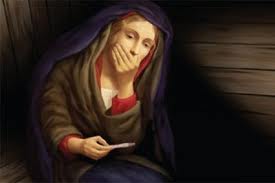
Commemoration of Saint Mary: Was Mary a Virgin or Was Mary Raped?

pregnancy test

Mary Pregnant? St. Matthew-in-the-City (Auckland, NZ)

I’m on vacation so I don’t get to preach this coming Sunday. But if I did, I suspect that I would move the Commemoration of St. Mary to Sunday and take the opportunity to explore the life and witness of this amazing woman. Today the Church celebrates the feast of St. Mary the Mother of Jesus or as it is still called in the Roman Catholic Church The Feast of the Assumption of St. Mary into Heaven. This enigmatic  woman has remained in the shadows for centuries. All too often the epithet “virgin” has been applied to the young woman who fell pregnant so long ago. So on this festival day I this re-post this sermon which I preached a couple of years ago in which I asked some questions about Mary. At the time I was reading Jane Schalberg’s “The Illegitimacy of Jesus”, John Shelby Spong’s “Born of a Woman” and “Jesus for the Non Religious” along with John Dominic Crossan and Marcus Borg’s “The First Christmas” and this sermon is laced with their scholarship. As always the written text is but a reflection of the sermon preached on the Fourth Sunday of Advent 2009.  

Sadly, one doesn’t have to travel too far into the past to arrive at the time when women’s voices were not heard. Indeed, in the Lutheran church, it was only a few short decades ago.  For most of us that time is within our own lifetime. For generations, men have told our sacred stories. Men have decided which stories made it into the canon of Sacred Scriptures. Men have interpreted the stories that were allowed to be told. Men have translated, taught, and commented upon those stories from pulpits, in universities, in seminaries, in commentaries and in the public square.  Continue reading

Mary and Elizabeth: Visitation or Escape?

rape victimsMay 31st is the day the Church commemorates “The Visitation” the story of Mary’s visit to Elizabeth  as it is recorded in the Gospel According to Luke 1:39-56. Since reading Jane Schalberg’s “The Illegitimacy of Jesus”, I can’t help but wonder if Mary’s visited her cousin Elizabeth or escaped to her cousin Elizabeth seeking protection for the crime of being raped in a culture that all too often blamed the victim.  Historians estimate that Mary may have been all of twelve years old when she became pregnant. There is ample evidence in the New Testament accounts of Mary’s story that suggest that she may indeed have been raped.  So rather than sweep the possibility under the rug, on this the Feast of the Visitation, I’m reposting a sermon I preached a few years ago during Advent.  I do so because women young and old continue to be raped and to this day, are forced to flee from the accusations and persecutions of cultures that continue to blame the victim. What follows is a written approximation of the sermon which in addition to Jane Schalberg is also indebted to John Shelby Spong’s “Born of a Woman” and “Jesus for the Non Religious” along with John Dominic Crossan and Marcus Borg’s “The First Christmas”.

Sadly, one doesn’t have to travel too far into the past to arrive at the time when women’s voices were not heard. Indeed, in the Lutheran church, it was only a few short decades ago.  For most of us that time is within our own lifetime. For generations, men have told our sacred stories. Men have decided which stories made it into the canon of Sacred Scriptures. Men have interpreted the stories that were allowed to be told. Men have translated, taught, and commented upon those stories from pulpits, in universities, in seminaries, in commentaries and in the public square. Continue reading

Beyond Tribalism – Preaching a 21st Century Pentecost

Ideas gleamed from Clay Nelson, John Shelby Spong,

John Dominic Crossan and Marcus Borg

The splendid preacher Clay Nelson of St. Matthews-in-the-City, Auckland, New Zealand, opened me up to a new way of seeing Pentecost.  Nelson tells this lovely little story written by fellow Kiwi Judy Parker, entitled simply “The Hat.”

A priest looked up from the psalms on the lectern, cast his eyes over all the hats bowed before him.   Feathered, frilled, felt hats in rows like faces.  But there was one at the end of the row that was different. What was she thinking, a head without hat.  Was like a cat without fur. Or a bird without wings. 

That won’t fly here, not in the church. The voices danced in song with the colours of the windows.  Red light played along the aisle, blue light over the white corsage of Missus  Dewsbury, green on the pages of the Bible.  Reflecting up on the face of the priest. The priest spoke to the young lady afterwards:  “You must wear a hat and gloves in the House of God. It is not seemly otherwise.”

The lady flushed, raised her chin, and strode out. “That’s the last we’ll see of her,” said the organist.

Later:  The organ rang out; the priest raised his eyes to the rose window.  He didn’t see the woman in hat and gloves advancing down the aisle as though she were a bride.The hat, enormous, such as one might wear to the races. Gloves, black lace, such as one might wear to meet a duchess.  Shoes, high-heeled, such as one might wear on a catwalk in Paris.    And nothing else.

Now some people might ask, “Is this a true story?”  And I’d have to answer that this story is absolutely true!  Now for some that answer might not be enough and they’d want to know, “Did this actually happen?” Well, I’d like to think so. But I doubt that it actually happened. But whether it actually happened or not, most of us know that the truth in this story lies in the power of metaphor.

Metaphor, which literally means:  beyond words. The power of metaphor is in its ability to point beyond itself to truths beyond those that are apparent. And the metaphor in this story points us to buck-naked truths about tradition, worldly power, patriarchy, hierarchy, orthodoxy and many more truths about the very nature of the church itself and religion in general. It doesn’t matter whether or not this actually happened or not. What matters is what we can learn about ourselves and our life together from this story. Continue reading

The Passion of Jesus: Holy Week, Good Friday and Easter: Marcus Borg

last-weekSpeaking on March 18 2013, Marcus Borg breathes life into the book he wrote with John Dominic Crossan: “The Last Week”

Thanks Marcus, now I have this song on the brain!

Good Friday Rituals or Crimes Against Divinity? – A Good Friday Sermon

A Good Friday Sermon preached at Holy Cross Lutheran Church in 2012

it is finished 22The memory of it still haunts me to this day. I was 18 years old. Some friends of mine from church convinced me to go to a big youth gathering. I don’t remember who sponsored the gathering, I do remember that most of the Lutheran youth groups in the greater Vancouver area were in attendance and various Lutheran pastors were involved in the leadership. At some point near the beginning of the event we were each given a small nail, divided into groups and asked to line up behind one of the three wooden crosses that were laying in the hall. We were then given our instructions. We were about to hear a dramatic reading of the Gospel According to John’s account of the crucifixion. When the reading was over we would be invited to proceed to the cross nearest us, knell down, take a hammer, and drive our nail into the cross. With each blow upon the nail we were asked to remember our own responsibility for the death of Jesus. We were asked to remember that it was we who had crucified Jesus, for we were the guilty sinners for whom Jesus died. It was a powerful, gut wrenching experience that still haunts me to this day.

I wasn’t the only young person who wept buckets that day. I immersed myself into the ritual act as I recounted inwardly the list of my own sins. Together with my friends, we left that hall believing that Jesus died because of us. We left judged, convicted, guilty, tormented, anguished, and full of hope, for we knew that Jesus had died to save us from our sinfulness. Like so many who have gone before us and like so many who will gather on this Good Friday, we left that hall believing that God sent Jesus to die for us; to pay the price for our sin.  Continue reading

Two Suppers – MAUNDY THURSDAY – A Strange Night

   Re-posted from last year:On Maundy Thursday, followers of Jesus will gather together to remember what we have been told about the night before Jesus died.  In our community we will begin with a ritualized washing of hands, then dine over a simple meal of soup, wine and bread.  Over the meal we will talk together about the events of Jesus’ life, paying special attention to what we have been told about the Last Supper and Jesus’ betrayal.  As the meal and the conversation comes to a close, we will take bread, give thanks bless it and give it to one another saying, “The bread of Christ given for you.”  Then we will take a glass of wine give thanks and pass it to one another saying, “Christ poured out for you.”   Then we will strip our sanctuary in preparation for what the morrow brings.

In this post I have included a copy of the worship bulletin for this liturgy of suppers. It can be downloaded here. to be printed double-sided

21st century minds often find it difficult to reconcile the gospel accounts of this evening with.  So, in place of the homily, we will discuss our struggles to understand the events of this evening in light of all that we have learned together.  

For those of you who have asked, a copy of a previous Maundy Thursday homily is included here.  This homily was preached in 2007 and while I am tempted to make some changes to it in light my own struggles to come to terms with the gospel accounts, I offer it unaltered, trusting that others may see in it the early stirrings of my own desire to discover a more progressive Christianity.  At the time I had just completed reading Marcus Borg and John Dominic Crossan’s “The Last Week” and John Shelby Spong’s “Jesus for the Non-Religious” and their work permeates the homily.

 Maundy Thursday 2007:

It’s a strange night. For several decades after the Resurrection, Jesus’ followers were known as the People of the Way, or the Followers of the Way. Almost 2000 years separate the first followers of Jesus from 21st century Christians.

I wonder if the early People of the Way would have as much difficulty recognizing modern Christians as Jesus’ followers as we modern Christians have understanding the practices of the People of the Way.

The People of the Way understood Jesus to be the embodiment of what can be seen of God. Jesus shows us who God is and Jesus shared with his followers his vision of God’s justice. Continue reading

Jesus Sets Us Free to Save Ourselves – Palm Sunday Sermon

palm brsIn our parish on Palm Sunday, our liturgy stays with the commemoration of Jesus’ entry into  Jerusalem. Trusting that our members will join us on Good Friday, we have not adopted the practice of rushing to the Passion of Christ. This allows us time to linger over our Hosannas.

Our worship began outside with the reading of Luke 19:28-4, followed by a procession of palm waving, hosanna cheering congregation. This year I changed the first reading to the story of Jacob’s wounding during a wrestling match with God in Genesis 32:22-31, followed by an feminist interpretation of Psalm 118, and the Gospel text John 12:12-15. 

I am indebted to Michael Morewood’s book “Is Jesus God” for the inspiration behind this sermon and to John Dominic Crossan and Marcus Borg’s “The Last Week” for the historical details.

You can listen to the sermon here.

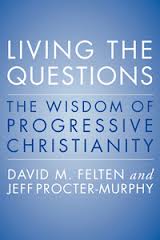
The Wisdom of Progressive Christianity – Adult Ed. Class

living the questions bk

Having worked our way through the Living the Questions 2 and Saving Jesus dvd series, our Adult Education Class is using the book: Living the Questions: The Wisdom of Progressive Christianity as a frame for our review of progressive Christian theology. Each week I will post the video clips that were used during the class. This week’s class consisted of an introduction as well as an exploration of what it means to move beyond definitions of the Divine toward the reality of unknowing. 

Thinking Theologically

“We must get away from this theistic supernatural God that imperils our humanity and come back to a God who permeates life so deeply that our humanity becomes the very means through which we experience the Divine Presence.”  John Shelby Spong

Talking Sense – John Dominic Crossan

walk humblyMy favourite New Testament scholar, Dom Crossan responds to the question “Is God violent.” In a week were more than a few fanatics have been given airtime to call for more weapons in the hands of more people, I find Dom’s gentle responses reassuring. If only we could convince those who would use texts deemed “sacred” to read them before they draw their own conclusions about what these texts say. If only we could begin to take these texts seriously instead of literally!

The Journey of the Magi never happened and yet it is always happening.

Epiphany-Wise+WomenAn Epiphany Sermon, preached in 2008. I had just read “The First Christmas” by John Dominic Crossan and Marcus Borg. Our congregation played host to Dom Crossan a month before I wrote this sermon. So, Dom’s insights run through this effort. But the heart of this sermon beats as the result of a sermon preached by Bruce Sanguin a self-proclaimed evolutionary christian who is a United Church Minister (Canadian Memorial Church, Vancouver). I had the privilege of meeting this modern mystic while on sabbatical this summer and his compelling way of unlocking the scriptures using the wealth of the christian tradition together with the insights of modern science and psychology borders upon the poetic. This sermon was anchored by Sanguin’s words (Epiphany 2007). Sermons are a “live” event. So, this manuscript is an approximation of what was actually preached.   

Just five days before Christmas (2008), The Archbishop of Canterbury, The Most Reverend Doctor Rowan Williams, the leader of the worldwide Anglican Communion started a firestorm.  During a BBC interview, His Grace was quoted to say that the story of the “three wise men is a legend”. The Archbishop was also heard to say that he remained unconvinced that there was indeed a star that led the legendary trio to the birth place of the Christ Child.

If that wasn’t enough to send folks off the deep-end, it has been revealed that the Presiding Bishop of the U.S. Episcopal Church The Most Reverend Doctor Katherine Jefferts Schori, who just happens to be the first woman elected primate in Anglican history, has fanned the flames of the fire-storm by sending out what has been judged by some to be an incendiary Christmas card.

I downloaded a copy of the offensive card, so that you could see for yourself. Her Grace’s choice of card has offended the good deacons of Ft Worth Texas who claim that their Primate’s actions defy explanation. As you can see the wise folks depicted on this image look a lot like women. Can you imagine the nerve of the first woman primate! How could she be so bold as to select such an offensive image? Leave it to straight talking Texans to set things straight: for despite the audacity of the Primate, the Texans have pledged to “stand for the traditional expression of the Faith.”

I must confess, that I deliberately chose our opening hymn. I wanted us to sing “We Three Kings” so that the traditional interpretation of this Gospel story would be fresh in your minds. It’s a lovely little song; I’ve been singing it since I was a child. It’s a lovely little song about a lovely little story; a story that’s been embellished over the centuries. A song that conjures up images of Caspar, Melchoir and Balthazar riding atop their camels, following the star to the stable where the baby Jesus lays waiting for their precious gifts of gold, frankincense and myrrh .

But, at the risk of offending our Texas cousins, I’m afraid that I much prefer to imagine the possibility that the magi may have been women, and although I would use the Archbishop of Canterbury’s exact words, I too believe that these events are not historical. And I don’t mind telling you, that despite the efforts of the biblical literalists to pinpoint the star or to determine the identity of the magi, I don’t believe that the writer of the Gospel of Matthew ever intended his readers to take this story literally. But, I do believe that the writer of the Gospel of Matthew did intend for us to take the story seriously. Very seriously indeed. For the writer of the Gospel of Matthew is trying to put into words that which words cannot explain.

The writer is trying to express the wonder that was experienced by those who encountered Jesus of Nazareth; an experience so real, so amazing so life transforming that only the language of parable could hope to capture even a hint of who Jesus was, is and ever more shall be.

The story of the magi’s visit is a parable; and like all parables it is a story that captures a timeless and enduring truth about the human condition. I don’t believe it actually happened. But then I don’t believe that the parables of the Good Samaritan or the Prodigal Son, actually happened either, but they couldn’t be more true. 

That’s right, the visit of the magi never happened and yet it ‘s always happening. This wonderful tale of three astrologers scouring the heavens for signs of new happenings on the planet captures the imagination of every generation. You see, we humans are meaning-making creatures eternally searching for the Mystery at the heart of the universe that dignifies and enchants our lives. Human beings just can’t help trying to understanding the meaning of it all. We are constantly trying to understand the how and the why of existence.

But alas the indignity of our modern times lies precisely in our being told that the cosmos—this universe in which we live and move and have our being—is essentially purposeless, without meaning or direction.

There’s this thing that some people call Scientism afoot that threatens our ability to see beyond our noses. Scientism is the religion of those scientists who refuse to concede that the phrase, “I don’t know” is sometimes the only answer that we have. Scientism is science that slips into an ideology of materialism—an ideology of materialism is the idea that every thing and every body is nothing more than the random collision of atoms and molecules. Scientism is the assertion that we and the universe are nothing more than  a cosmic fluke of enormous proportions going nowhere in particular. According to the dictates of scientism: any meaning that we might attribute to our existence is therefore just that—our own arbitrarily generated attributions of purpose to a journey to what is at the end of the day nothing more than the purposeless march of time. Unlike science, that provides for the possibility of a creator, scientism would have us believe, that there is no meaning behind our existence, we simply randomly evolved and we will someday randomly devolve, or dissolve into a pile of dust. (Sanguin)

That’s why I love the parable of the magi’s visit! For these ancient astrologers had their own ways of determining meaning,“the heavens are telling the glory of God, and the earth proclaims God’s handiwork”. A new star appears in the heavens and for those with enchanted hearts, it means that God is on the move—something new is about to happen.  So they chased down the star, to see this thing that God had done.

Unlike our ancestors, we live in a culture in desperate need of enchantment and awe. We are so meaning-starved as citizens of the Western world in the 21st century that we chase after almost any kind of novel spiritual movement.             The pendulum swings from scientific materialism to the latest cult so starved are we for spiritual re-enchantment. In our state of spiritual hunger we’ll accept any morsel from the smorgasbord of new age spirituality. But there are few among us who would take seriously the study of the stars. Apart from a fleeting glance at our own horoscope, we’ve long since given up the notion that there’s any wisdom in astrology.

But what of those modern day magi who study the stars, what wisdom can we gleam from the astronomers of our day who peer into the sky seeking the answers to our riddles? We may no longer care if the moon is in the seventh house or if Jupiter is aligned with mars, and I don’t even know if this is still the dawning of the age of Aquarius, or if we’ve moved on to some other season of the Zodiac, but I’ve heard tell of  black-holes, the death of stars, and light-years.

The sages of our age, the astronomers who seek meaning from the skies are not all so quick to subscribe to the big bang theory of randomness. For they have seen great things in the sky and there are many among this wise folks who insist that the cosmos is infused with meaning and purpose—Indeed, they tell us that  stars and the planetary bodies participate in this journey of cosmic meaning.

Those sages who are engaged in scientific study are not all followers of scientism. The notion of a creator, a first cause, or a driving force, dare we say God, as the power that drives all of existence is seriously explored by the wise folks of academia and science has refused to exclude the possibility. And yet there is the illusion afoot that the followers of science find faith incompatible with the pursuit of meaning. When the truth is that scientism seems to be the choice of those who have given up or forsaken the pursuit of meaning. Science itself would seem to deny scientism!

More and more, scientists, are beginning to speak out and more and more academics are joining the chorus of those who insist that there is indeed a power at work in the large-scale structures of the universe, in the evolutionary unfolding of the planet, and in our own personal and collective lives. To pursue knowledge is to continue the journey of the magi who pursued light, the timeless symbol of knowledge. To follow the light, to go where wisdom and knowledge lead, is to seek the answer to the age old questions: Where do we come from and where are we going?  Why are we here?. You don’t need to be a scientist or an academic to ponder the secrets of existence. Like the magi, we too can seek the light. Just as the magi gazed up at the light in the heavens and followed it to the place where it lead—and found the Christ-child—we too can follow the light in our own lives.

Scientist Brian Swimme has a theory, a theory that coincidently, theologians and priests have been taking about for centuries. Swimme calls his theory the principle of allurement. According to this theory there is a power at work in the universe that works by alluring one body to another, until eventually all bodies are drawn into the very power that provides the force of allurement. (Sanguin)

In simple terms it works like this: five billion years ago, our planet became fascinated by an enormous star, a million times its own size. The earth spends a billion years just hanging out in its orbit in a relationship which physicists actually call adoration. There is something about the star that has the capacity to awaken this planet, and the planet gives this source of allurement its undivided “attention”. When it figures out how to make a chlorophyll molecule, the love affair really begins. Through photosynthesis, the earth, discovered how to convert the sun’s light into the energy required for the procession of life to emerge. This is why the earth found the sun’s presence so alluring. The sun had the capacity to awaken the latent potential of the planet earth to come to life. (Sanguin)The theory of allurement isn’t confined to astronomy, it dips into to theology and from the priest come palaeontologist, Pierre Teilhard de Chardin, it borrows the notion of the Omega Point. The Omega Point is the completion and perfection of all creation to which we are being drawn, no-coercively, gently, and in a way that respects our freedom. (Sanguin)

How do we find our way to the Omega Point?  Well that’s the real beauty of this theory, you see it’s described as a completely natural process that kicks in the moment we decide to trust this Power—this power that goes by many names, you and I are bold enough to call this power God, some call it Wisdom, but there are other names. (Sanguin)

The point of the Omega Point, is that all we must do is to follow the way of the Magi and look for the light. Physicists call this quest for the light, “attending to our allurement”. The dynamic of allurement is a powerful force in the psychological make-up of the human being. (Sanguin)

Each of us is drawn by this mysterious force toward what for each of us provides ultimate meaning for our lives. If we resist the force, ignore it, deny it or fight it we loose our way. Like the Magi we must follow the light.

Think of the Christmas presents you were given as a child that charted a course for your life; the lego set for the future engineer, the microscope of the future biologist, Gretsky’s first hockey stick, the artist’s first set of water-colour paints. For me it was the books; those wonderful, marvellous books, that lead me through the words to The Word, and back to words about The Word.

The light shining in the darkness can draw us toward divinity, with books, music, other people, world events, dreams; anything and everything may function as the light. The spiritual journey involves following the light to its source—like the Magi.

God has made it easy to find God. The points of light to guide our feet to the Christ are as numerous as the stars in the sky. The essential skill to hone is the capacity to notice your life.

As you begin to take notice of your life, an enchanting awareness may surface—that there is a Mysterious Power at work weaving together all the various strands of your life into a unique and beautiful symmetry or tapestry.

The next step—after noticing that there is this Light guiding your path—is to set out upon a conscious spiritual journey. Become the Magi. Load up your metaphorical camels and set out across the landscape of your soul to where it is that the light stops. (Sanguin)

Here’s a little secret pearl of wisdom to take with you on your way: There is no single, final destination that we’re ever going to arrive at in our lifetime. Do you think that the Magi’s spiritual journey was over when they arrived at the stable—that they found Christ and then stopped growing spiritually? Don’t you believe it!

Christ is the ever-present light of our lives, beckoning from the many stars that allure us, calling us toward our own divine image and inspiring us to give our lives as an offering so that all of creation may continue to evolve.             Evolution is not random; each of us has a unique role to play. But let’s not be naïve. Each of us possesses an inner Herod who doesn’t like that we’re paying homage to any king other than our self. The story of the Magi got this detail exactly correct. Something within us resists God—call it ego if you will—but there is something within us that thinks that it alone deserves gifts of gold, frankincense and myrrh. It does not want to worship or pay homage; it wants to be on the receiving end of both and will go to great lengths to make it happen. It wants to know where the light is leading, not to submit to it, not to give thanks, not to sing praise and be in awe, but rather to scope out it’s rival, in a vain attempt to outshine it, or even destroy it.

Herod is also found in our families, and in our social, political, economic and religious systems. Herod is present as the power of domination. Herod hates the fascination of others unless it is directed toward him. Herod—within and without—refuses to serve any higher power; Herod refuses to fit in, to take his place in grace. Herod will try to rule the show.

But fear not. Your inner Magi is very wise. And just like the parable teaches us, Herod may summon the Magi in an effort to find out where the light is leading.  Herod may pretend to want to offer gifts.  But another light shines upon the Magi. An angel; a messenger speaks to the Magi in a dream, warning them not to cooperate with Herod. The Magi ignore Herod, leave their gifts with the Christ child, and head home by another path.

This is the path of Epiphany, then; the “other” path, the path of spiritual wisdom that trust the light, follows it wherever it may lead, discerns the wily, violent intentions of the inner Herod, and returns home—always home—to the heart of God.

So, you see, the story of the Magi’s journey, never happened, and yet it is always happening. May the light of the world lead you home! Always home—to the heart of God!  Amen.


Was Mary a Virgin or Was Mary Raped?

pregnancy test

Mary Pregnant? St. Matthew-in-the-City (Auckland, NZ)

As Advent draws to a close, our readings turn toward the woman from Nazareth known as Mary. This enigmatic  woman has remained in the shadows for centuries. All too often the epithet “virgin” has been applied to the young woman who fell pregnant so long ago. I have been asked to post a sermon which I preached a couple of years ago in which I asked some questions about Mary. At the time I was reading Jane Schalberg’s “The Illegitimacy of Jesus”, John Shelby Spong’s “Born of a Woman” and “Jesus for the Non Religious” along with John Dominic Crossan and Marcus Borg’s “The First Christmas” and this sermon is laced with their scholarship. As always the written text is but a reflection of the sermon preached on the Fourth Sunday of Advent 2009.

Sadly, one doesn’t have to travel too far into the past to arrive at the time when women’s voices were not heard. Indeed, in the Lutheran church, it was only a few short decades ago.  For most of us that time is within our own lifetime. For generations, men have told our sacred stories. Men have decided which stories made it into the canon of Sacred Scriptures. Men have interpreted the stories that were allowed to be told. Men have translated, taught, and commented upon those stories from pulpits, in universities, in seminaries, in commentaries and in the public square.

Today, as more and more women take on the tasks of translating, interpreting, writing, teaching, preaching and imagining the texture of our sacred stories are changing in ways that our mothers and grandmothers may not have been able to imagine. This morning, I’d like to ask you to imagine with me a radical re-telling of the birth narratives; a re-telling based on the New Testament and the hidden gospels of the apocrypha; a retelling based on good sound historical scholarship; a retelling grounded in the ways of the world; a retelling by women; religious women, scholarly women, women trained in Hebrew, Greek, Latin, theology, doctrine, and the ways of the world.

Our story begins thousands of years ago in the occupied territories of Palestine were being a woman was a very dangerous and even death defying occupation. It is the story of a young girl; who couldn’t have been more than about 12 or 13, who fell pregnant. Notice the verb, it is chosen deliberately. The heroine of our sacred story is a young girl, a child, who fell pregnant. A dangerous and fall one for which the penalty was clear, for there was no ambiguity in the law, such fallen women were subject to stoning; stoning unto death.

But before I tell you this story, let me tell you another story. It’s the story of a woman who made it into the sacred halls of academia.  She was a daughter of the Roman Catholic Church who against all odds managed to earn a PHD and teaches at a Roman Catholic University in Detroit.  In 1987, when she dared to publish her scholarly account of our fallen heroine, she faced the wrath of the men in academia, who poo pooed her work and discounted her evidence without so much as a by your leave.  This much she had expected, what she didn’t expect was the violence or the strange characters who showed up at her lectures hurling more than verbal insults; and she certainly didn’t expect to wake up in the middle of the night to find her car burning out in her driveway. The police told her to keep a low profile. She did for a while, but then people outside the academy picked up her book and the odd reporter quoted her theories and that’s when the death treats got really serious. You may not have heard of this obscure New Testament Scholar, but Jane Schaberg is a hero to many female biblical scholars, for daring to speculate on exactly how a young girl may have fallen pregnant 2000 years ago.

You see then like now, rape was not just a random crime committed by isolated individual men. Then like now, rape was a military tactic designed to terrorize an occupied population. Jane Schaberg uncovered, what many believe to be a deep dark family secret about a young woman, a child who fell pregnant a long time ago and fled for her life. She wasn’t the first to talk about it.  There were men in the past that had dared to speculate about it and felt the wrath of the institution.

Some say the evidence is clear, if you’re willing to see it.  After all there was a large cohort of Roman soldiers encamped near Nazareth.  The people of Nazareth had participated in an uprising against their oppressors and the Roman’s had raided Nazareth in retaliation.  There are numerous Jewish accounts of Roman raids that include details of strategic rapes. Could our young heroine be the victim of such a rape?

There are New Testament scholars who ask you to simply consider the New Testament story of Jesus’ audacious first sermon in Nazareth.  What could have made the good people of Nazareth so angry that they wanted to kill Jesus? Nazarenes were accustomed to listening to itinerate preachers make all sorts of outlandish claims. But this Jesus was a mamzer Jewish texts written within 500 years of his birth attest to it. Historians do not even dare to translate mamzer for fear of reprisals. I won’t translate it for you now, not out of fear but rather because there are children present.  I’ll let you guess the English term we used to use to describe a child born without benefit of wedlock a term that is now used to describe many a man.  Could Jesus’ neighbours have been offended that this mamzer had dared to occupy their pulpit?

 Deuteronomy 23 is clear, “A mamzerim shall not enter into the congregation of the Lord; even to his tenth generation shall he not enter into the congregation of the Lord.” The writer of the Gospel of Matthew alluded to Jesus status as a mamzer in his very first chapter. The writer traced Jesus lineage back through four women who could be described as fallen women. These four women by the standard of the day in which this story was told, these four women were sexually tainted women, “shady ladies” a couple seductress a couple of prostitutes and an adulterer.   These women:  Tamar, Rahab, Ruth, and Bathsheba, were all under the shadow of scandalous sexual activity and the inclusion of these women in Jesus genealogy should alert us that we should expect another women who becomes a social misfit by being wronged.

But if imagining Jesus as a mamzer is offensive to you, set it that aside for a moment and let’s look at the Gospel according to Luke and try to see past our rose coloured glasses.        The Gospel of Luke tells the story from the perspective of Mary. Over the years generations of listeners and readers have taken the author’s depiction of Mary and created an image of Mary that is larger than life.

The popular image of Mary paints her as the ideal woman, the ideal woman that none of us could ever live up to. The image of Mary is that of both virgin and mother, meek and mild, obedient and perfect. She is impossible as a role model of course and totally unreal.

In order to see Jesus we have to move beyond the popular image and look at what the author of Luke actually wrote about Mary. It’s in the words of the Magnificat that the author reveals the revolutionary Mary. The Magnificat is the song Mary sings when she meets Elizabeth. When read in its original Greek it is clear that Mary bursts into song. The text of the song is a revolutionary text full of historical meaning that would have been clear to it’s first century listeners, but the radical nature of this song has been lost as successive generations have set it to music and prettied it up as best they can. But in the first century Mary was a revolutionary figure. The author of the gospel of Luke, does not intend her to be “mother Mary meek and mild.” The references, with which the author and his audience would be familiar, are to heroines of Israel, to revolution and to war.

The song of the Magnificat is written in the style of two other songs from the Scriptures that would have been so familiar to the gospel writer’s audiences. Elizabeth addresses Mary as “Blessed…among women.” This was not a normal greeting. There are only two other texts in the Scriptures where this phrase is used. In the Book of Judges, Deborah, who was herself a prophetess and a judge of Israel sings, “Blessed among women be Jael”.  And Deborah’s song goes on to tell us who Jael was and what she did. “Most blessed of women be Jael, the wife of Heber the Kenite, of tent-dwelling women most blessed. He asked for water and she gave him milk she brought him curds in a lordly bowl. She put her hand to the tent peg and her right hand to the workman’s’ mallet; she struck Sisera a blow, she crushed his head, she shattered and pierced his temple. He sank, he fell, he lay still at her feet; at her feet he sank, he fell; where he sank, there he fell dead.” Sisera was the commander of the Canaanite army. Deborah the ruler of Israel promised her general Barak, that Sisera would be delivered into his hands. So, Barak summoned up his troops and went into battle. As the Israelites seemed to be winning Sisera fled to the camp of his ally Heber the Kenite—who was married to Jael. Jael invites Sesera into her tent, offers him hospitality, and after a meal of milk and curds he falls asleep. While Sesera the enemy of the Israelites lies sleeping, Jael bashes a tent peg through his skull. And for this Jael is heralded as a great heroine of the people as Deborah sings her praises calling her blessed among women.

The second woman in the Scriptures who is hailed as blessed is Judith. Judith is also a heroine of Israel.   Her story takes place as the Assyrians are laying siege to the town of Bethulia, where the Israelites have almost run out of water. Judith leaves the city, allows herself to be captured by they Assyrians and taken to their leader Holofernes. Judith pretends to be fleeing from the Hebrews and offers to betray them to Holofernes. Holofernes welcomes Judith and offers her hospitality.

Judith then seduces Holofernes. After taking him to bed, while he is sleeping, Judith chops off his head with his own sword. She tucks his severed head in her food bag, escapes and returns to the Israelites. When she returns Uzziah, one of the elders greets her with the words, “O daughter, your are blessed by the Most High God above all other women on earth.” Later at a party giving to celebrate her victory, Judith sings a song to God in which God’s support for the oppressed is proclaimed, just as Mary proclaims that the rich and mighty will be brought down.

The author of Luke makes other references in his narrative, which would have been equally clear to his first century audiences. Starting with that angel who appears to Mary. Read Judges 13 for a similar story of an angel appearing to a woman and declaring that she will conceive and bear a son. There you will find the story of Manoah ‘s wife and the miraculous conception that led to Samson’s birth.

Today the angel Gabriel is usually portrayed as a white effeminate male in a flowing white gown. But this depiction is not one that would have been recognized as Gabriel in the first century. Back then Gabriel was understood to be the angel of war and he was associated with metal and metal workers. The mere mention of Gabriel would have conjured up images of a fierce warrior clothed in amour, ready to do battle on the side of the Israelites.

The name that the warrior angel insists on for Mary’s child is Jesus. Jesus is the Greek form of the Hebrew, Joshua. Joshua succeeded Moses, conquered Canaan and established the twelve tribes of Israel in the Promised Land. Joshua was a hero and a warrior. The author of the gospel of Luke makes a deliberate link suggesting to his readers that Jesus will follow in the same mould.

First century audiences would have been very familiar with the parallels being drawn. Mary is being clearly established as a revolutionary heroine, in a nationalistic and violent tradition.  And the Magnificat is a song of revolution which proclaims the downfall of the prevailing order.  The Magnificat is a rallying cry to overturn the established order of wealth; a tune intended to rouse the troops.   

The author of the Gospel of Luke knew exactly the kind of Messiah the people are waiting for. Two thousand years ago in the dusty streets of Jerusalem, revolutionary ideas passed from house to house. The bitterness of Roman bondage had robbed the Jewish people of their ideals but not their Messianic hope. Jewish eyes continued to peer through the darkness imploring hands were still lifted towards heaven and the plaintive cry of Israelites begged the question:  “When will the dark night be over?” In their despair, the idea of revolution was born. It was linked to the coming Messiah; the promised Saviour whom they were counting on to free them from oppression; the longed for a Saviour to lead Israel to freedom.  That was the kind of Messiah the Jews living in the first century wanted.       

The author of the gospel of Luke knows his audience well and he plays to their expectation of a Messiah who will lead them in battle; a military hero. The author presents Mary as a woman, who has a vision of what God will do.  Mary’s song is the song of a heroine of Israel, for blessed is she among women. Mary’s song echoes the words of the Hebrew Scriptures: “My soul magnifies the Most High, and my spirit rejoices in God my Saviour, who has looked with favour on the lowliness of God’s servant: Surely, from now on all generations will call me blessed; for the Mighty One has done great things for me, and holy is God’s name. God’s mercy is for those who revere God from generation to generation.            God has shown strength with God’s arm, and has scattered the proud in the thoughts of their hearts. God has brought down the powerful from their thrones, and lifted up the lowly;  God has filled the hungry with good things, and sent the rich away empty. God has helped God’s servant Israel, in remembrance of God’s mercy, according to the promise God made to our ancestors, to Abraham and Sarah and to their descendants forever.”     

Mary’s song takes on new meaning when heard within the context of violence and rape. Mary’s song takes on new meaning in our world where rape continues to be a military tactic. Let me give you the figures according to a report by the United Nations dated this past June.  In Rwanda more than 500,000 women were raped during the genocide that ravaged that country. In Sierra Leon 64,000 women were raped as part of an attempt to impregnate women in order to shift the racial makeup of that war torn nation. 40,000 military rapes were reported in Bosnia Herzegovina. In the first six months of this year 4500 rapes were documented in the Democratic Republic of the Congo. The UN estimates that every day 100 women are raped in Darfor. This past summer the government of South Africa released statistics that reported that 28% of South African men polled admitted to having committed rape in the past year, many of these men admitted to having raped more than one woman.

I need not tell you that the fate of women who are raped is one of shame and isolation, more often than not disease. Indeed in some places in Africa rape ends in death. The children of rape are stigmatized, abandoned and in some cases left to die. The world remains a cruel place for the mamzerim.

The church has told the story of Mary in it’s own particular way for centuries, holding up the image of unattainable femininity to women and men; an image that offers as an example of the perfect woman as both virgin and mother. That image may have suited the purposes of an institution that had a vested interest in having women behave in a certain way, but the time has come to tell Mary’s story differently. For in a world were over half the population is oppressed by attitudes that kill, maim, terrorize, oppress and enslave in poverty, isn’t it time we heard the story of a God who can do great things against all the odds. Isn’t it time to hear the story of God told in ways that liberate, empower those who have been most afflicted. Isn’t it time to hear Mary’s story told in ways that proclaim God’s plan for justice in a world obsessed with violence?

We can re-inscribe the image of Mary as the passive handmaiden of the Lord or we can tell the story of Mary a victim of abuse who with steely grit, courage and support struggles to raise her son not as a mamzer but as a child of God.  The choice of how we read and tell Mary’s story will affect how we read the whole Christian story, and how we understand sin, sex, holiness, and redemption. The Mighty One has done great things for us. 

Now, we like Mary, are part of God’s plan to scatter the proud and bring down the powerful from their thrones, to lift up the lowly.  To help fill the hungry with good things, and to send the rich away empty.  We like Mary, are part of God’s plan.  Part of the promise God made to our ancestors, to Abraham and Sarah and to their descendants forever.

The truth is: Mary had the courage to say yes, to trust God.  Mary had the courage to let something grow inside her.  She had the courage to harbour a Child of God in her body.  Do we have the courage to harbour Christ in our bodies?  When the power of the Most High overshadows you will you have the courage to trust God? Will you have the courage to be a bearer of God to the world? 

That’s the terrifying challenge that this story offers.  This story challenges us to be at God’s disposal, to become filled with God’s life–for the sake of the world.  But be warned, God-bearing is more than a little inconvenient:  it can be heart breaking and even lethal.  Bearing God to the world means letting some of God’s passion for the world become flesh and that can be costly.      

When God sends a messenger to you, will you have the courage to say “Here am I, the servant of God; let it be with me according to your word.  Will you have the courage to join the legions of Mary in bearing God to the world?  Let it be, oh God.  Let it be, according to your word….

May El Shaddai, the Breasted One,

who is God our Mother,

hold you in the love of Christ the Sophia of God,

so that the Holy Spirit can empower you

to follow in the footsteps of Mary

and bring God to birth in the world.

In the name of She who is was

and ever more shall be,

Mother, Christ and Spirit One. Amen.

Preaching Christmas Eve in the Wake of New Testament Scholarship

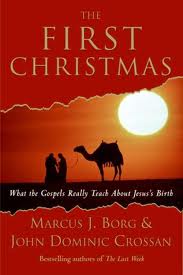
the first christmasIn 2008, our little congregation played host to John Dominic Crossan who has been acclaimed as world’s most famous New Testament scholar. Crossan’s visit to our congregation began with a public lecture based on his best-selling book The First Christmas in which he and Marcus Borg provide a splendid historical outline of the development of the birth narratives. I had the dubious honour of standing before his enlightened audience on Christmas Eve to preach in the great man’s wake. What follows is the Christmas Eve sermon I preached just three weeks after Dom’s illuminating visit.

Just a few weeks ago, this congregation was privileged to play host to a man who has the reputation of being the greatest New Testament scholar in the whole world. Dom, (we get to call him “Dom” now) wrote The First Christmas with Marcus Borg who is the guy who is heralded as the world’s leading expert on Jesus and Christianity in the 21st century. During his lecture, Dom provided us with all sorts of marvellous ways to understand the stories surrounding the birth of Jesus.  Ever since that visit, there have been folks who listened very carefully to what Dom had to say and who have been positively gleeful when they’ve asked me what I’m going to do about preaching on Christmas Eve.

I mean what could I possibly say to you after so many of you have just finished hearing from the best in the business! And then there are those of you who bought the book and you’ve read what the experts have to say about the first Christmas. Some of you weren’t able to hide the smirks when you wondered out loud just exactly how I’d go about following the eminent Dr. John Dominic Crossan.

I don’t mind confessing that on several occasions since, I’ve woken up in the middle of the night and wondered what on earth I’d say to you this evening. Even those of you who didn’t manage to hear Dr. Crossan; you’ve probably seen him on TV this week on one of the dozen or so, documentaries on which he appears as the expert scholar who the media turns to in order to unravel the Mysteries of the Bible or to dig up the truth about Jesus. In this the age of information, you can simply go to YOUTUBE  or to ITUNES U and download all sorts of podcasts where you’ll discover what pastors have been learning at seminaries for decades as the academic world has unlocked so many of the secrets of the ancient world in an effort to discover the real truth about what may or may not have happened so very long ago.  Ever since: “The shepherds returned, glorifying and praising God for all they had heard and seen, as it had been told them.”

Since the end of the first century, some 1900 years now, the story of the nativity has been told. Lately the church has become a little embarrassed by the way in which this story has been told. All sorts of experts have weighed in to tell us that it could never have happened the way we all remember it. Biblical scholars, historians, theologians, bishops, pastors, professors even scientists have cast doubt on the details of the story of the nativity. But even though we know how impossible some of the details may be, we cling to this powerful story.  Despite the wisdom of the experts, regardless of our doubts, this story still has the power to stop us in our tracks. No other story or image is more recognizable to people the world over than the Nativity scene of the birth of Jesus.

Tonight the images of a stable in Bethlehem, with Mary and Joseph gazing fondly at the baby Jesus, while the shepherds look on and the heavenly host sing their praises, these images are crystal clear to all of us. The story is part of us; it’s in our bones. And every year this story causes our lives to shift from the routine of winter, to the marvel of this night, when families are drawn together, and strangers greet one another with kindness and from near and far the hope of peace on earth is a dream shared by us all.

Now I know that somewhere in the deepest darkest recesses of our being, or for some of us, just beneath the surface of this dream,  the wisdom of the experts causes a shiver to run across our spines as we wonder how the hope for peace on earth can possibly lie with such an unbelievable story. That shiver used to haunt me, until the day I recognized the power of the truth that lies in the story of the birth of Christ.

You see truth is an amazing reality. Truth is never simple. And yet truth is quite simple really. At least for those who have eyes to see and ears to hear. But before I tell you about the truth, let me do what I do every Christmas Eve, Let me tell you a story. It’s a true story about a story about a story.

You see, the easiest way I know to reveal the truth about a story is to tell a story that sheds light on a story. It’s the most ancient way to reveal the truth and it’s the way that Jesus used when he wanted to reveal the truth about the scriptures.

This story took place just about two weeks ago. Our Confirmation students had gathered together for our last class before the Christmas break. Their final assignment was due. Each of the students was required to tell a story that revealed something about the nature of God. They were asked to write a gospel according to them.

One by one they got up and from this very pulpit and they told their gospel stories. I asked one of the students for permission to re-tell their gospel story this evening. The student agreed on the condition that I not reveal to you who actually wrote the story. Which is perfect really because despite all our best efforts nobody can really say who actually wrote the four gospels attributed to Matthew, Mark, Luke and John.  So, here I give you the gospel as it was told by one of Holy Cross’ confirmation students and recorded, after a fashion, by me.

It was a cold and snowy night in the town of Newmarket and a homeless couple wandered the streets of Davis and Yong searching for shelter and warmth. They were a strange looking couple; a man and a very, very, very, fat woman.

They were dirty and grubby and they wore layers and layers of clothes trying to macdsxmaskeep warm. They’d been wandering for a very long time and they were very, very, very hungry.

So they trudged up to Wendy’s, hoping to get a warm meal. But when they made their way up to the counter the guy behind the counter shouted at them and said, “Get outta here!  We don’t serve fat people at Wendy’s!”

So the hungry couple headed over to Tim Horton’s, but the woman was so fat that she couldn’t fit through the door so the people told her to go away cause there was no room for fat people at Tim Hortons.

So, on they trudged up to MacDonalds and low and behold the fat woman made it through the door and the man managed to get the servers to provide them with a warm meal and just as they were settling into a booth, there appeared a great flood!

And the very, very, very, fat woman leaped up onto the table, right there in the middle of MacDonalds! And the woman began to scream and moan. Because she wasn’t just some fat homeless person, she was with child. And after a lot of screaming and moaning a baby was born in the city of Newmarket. And all the people rejoiced! For unto us a child was given, a child born in the poverty of MacDonalds. For if God came to earth today, God would come where we least expect God to be. 

The Holy Gospel as it is told by a young person of this congregation. Thanks be to God.

So, if your struggling over some of the details of the nativity story, if the experts have left you perplexed, cynical or worried, do not be afraid, for I bring you tidings of great joy. The story is true, every last word of it is true. For just like Dom so wisely revealed to us, the story of the nativity is a parable and like all parable’s it represents a truth that cannot be fully expressed in words. Like all good parables the truth is not to be found in the details, but rather in the Spirit of God that breathes life into the parable. It’s a parable about so many things, but most of all it is a parable about peace on earth giving glory to God.

Now there are many down through the ages that have tried to weave stories of peace on earth, but none so everlasting as this.  And yes some of us would have rather have had a road map or an expert to set us on the path to peace. But alas, all the experts have failed in their efforts to guide us. The truth that they impart has been rejected. So, once again we are left with this parable.  A story so simple that even a child can understand it.  A parable that depicts the truth that was experienced by those who walked and talked, loved and learned from Jesus. And the truth echoes through the centuries and the message is clear to everyone who has ears to hear.

“And suddenly there was with the angel a multitude of the heavenly host praising God and saying, “Glory to God in the highest heaven, and on earth peace, goodwill among all people.” And we are left wondering at the power of a love great enough to triumph over death and we claim a Christmas Truth greater than any of the tradition it inspires: the truth of the mystical longing of the creature for the creator—the finite for the infinite— the human for the divine. It’s a longing that transcends culture, religion, language and custom—a longing that is represented tonight for us in the baby in the manger—the sudden, amazing and incomprehensible gift of grace: a God who loved us enough to become one of us.

Yes, we embody the wonder of Christmas in the gifts given, the meals shared, the gathering of family and loved ones. But the greater wonder is that the God who is love incarnate comes down to be among us over and over again. Christ comes to show us how to share that love with a world in desperate need of it— to a world yearning for “peace on earth, good will among all people”.           

That shalom—that peace—that unfamiliar hush is the peace on earth I’m praying for this Christmas— the shalom that doesn’t just mean the peace that comes when we’re no longer at war but the shalom that means that all human beings live together at peace with one another and with God, and in right relationship with all of the rest of God’s wondrous creation.        

Shalom, the Hebrew word for what we might describe as “turning the human race into the human family” —the peace on earth that we, are called to be about as followers of Christ, not just at Christmas but all year long.  The truth is that peace is the only way we can truly give Glory to God.

Peace is the only way to insure that every child born into this world will have an opportunity to play, to learn and to grow. To accomplish peace on earth we will all have to go out into this Christmas night and into this New Year and put our faith into action. That means prayers and protests; speaking up and stepping out; offering whenever and wherever possible the Good News of God’s shalom and realizing the truth of the angels chorus. For we are the followers of the one whose birth they herald. Howard Thurman, a fellow follower of Christ, put it best declaring that:

            When the song of the Angel is stilled,

            When the Star in the sky is gone,

            When the kings and the princes are home,

            When the shepherds are back with their flock,

            The work of Christmas begins:

            To find the lost,

            To heal the broken,

            To feed the hungry,

            To release the prisoner,

            To rebuild the nations,

            To bring peace among brothers and sisters—

            To make music in the heart.        

            And to radiate the Light of Christ,

            every day, in every way,

            in all that we do and in all that we say.

            The work of Christmas lies before us.

So, dear friends, rejoice and be glad, for unto us a child has been born, a child who is Christ our Saviour. May Christ lead each of us as we go forth to make peace on earth and good will to all.   Amen.


What Kind of Saints Are We?

All Saints’ Sunday Sermon

Listen to the sermon here

The Search for Jesus