Teach Us to Pray – a recording of our first class

Below you will find a recording of our first class.  The video of the Keynote presentation includes the Youtube videos by John Shelby Spong and Fred Plumer that were shown during the class together with an audio recording of the class (the audio is stilted in places but if you wait but a moment it will sync with the presentation). Or, below the video you will find an audio recording of the class.

Unedited audio recording of the class.


The Cross in John: Not Tragedy But Triumph – John Shelby Spong

jack spongJack concludes his five day lecture series by explaining the Crucifixion in the fourth Gospel. (filmed June 27, 2014) Our friends at College Street United Church in Toronto will be hosting Jack April 17-18, 2015. I shall post more details when they are available. 

The Mother of Jesus: A Symbol of Judaism – John Shelby Spong

maryuniversalmaryw.jpgJack explains how the 4th Gospel creates a symbol from the presence of Christ’s mother. This is the fourth lecture of a five lecture series. Filmed June 26, 2014 at the Chautauqua Institution.

Johannian Characters: Literary Creations Not People of History – John Shelby Spong

spong cartoonRecorded last week (June 25) Jack explains the colorful characters who hold dual purposes in the fourth Gospel. Enjoy!

The Fourth Gospel Warns Against Literal Reading: John Shelby Spong

SPONG swirlRecorded last week, June 25, 2014 at Chautauqua: Jack continues to challenge readers to look beyond the page. Enjoy!

Separating the Fourth Gospel: John Shelby Spong

SPONG Living pastordawnRecorded last week (June 25, 2014) at Chautauqua, John Shebly Spong, doing what Jack does best, opening listeners to new ways of understanding the New Testament. Enjoy!

Wolf Blitzer Learned that there are Indeed Atheists in Fox-holes! – a sermon for Trinity Sunday

Eckhart rid me of GodThis Trinity Sunday sermon owes much to John Shelby Spong’s book a “New Christianity for a New World” You can listen to the sermon here then watch the tail end of the Wolf Blitzer interview mentioned in the sermon.   

In the midst to the devastation and debris that was left of the town of More, Oklahoma, it was all to clear that the power of the tornado that whipped through such a heavily populated area had left behind the kind of destruction that tears not only the foundations of buildings but also of lives. In living rooms around the world millions of people watched as the news media descended on what was left in the wake of nature’s wrath. One particular news report is still reverberating around the Internet. I had just come from my office where I had spent the afternoon, reviewing the Doctrine of the Trinity in order to write this sermon. My wife Carol was in the kitchen cooking supper and I sat down to catch up on the news events of the day. I tuned into CNN and there amidst the rubble of More Oklahoma was the familiar face of Wolf Blitzer. It was the day after the tornado and the big name newscasters had been rushed to the scene in time to provide color-commentary on the evening news. Wolf was interviewing a young mother named Rebecca Vitsmun who was holding a squirming her 19 month old, toddler Anders in her arms. The young mother gave a blow-by-blow account of her narrow escape from. All afternoon Rebecca was paying attention to the weather reports. Rebecca was not from More, but rather from New Orleans and so she was not used to tornado warnings. She’d grown up with Hurricane warnings and so her first instinct was to evacuate the area. But her husband and neighbours had told her that the safest thing to do would be to take shelter. Six-teen minutes before the tornado struck the weather service issued a warning to take shelter. As Rebecca’s husband raced home from work, this young mother grabbed her laptop, a mattress and her toddler and took shelter in the bathtub. Huddled in the tub covered by a mattress she anxiously watched the reports on her laptop. Tracing the path of the tornado, Rebecca realized that the tornado was headed straight for her street. Rebecca’s New Orleans’ instinct kicked in and with her baby in her arms she jumped into her car and without taking time to put her baby in the car seat, she drove as fast as she could out on to the freeway where she pulled over and put Anders into his car seat and then drove some more. After the tornado, Rebecca reunited with her husband, and they headed back to what was left of their home. The bathtub was so full of debris that it was clear to them that Rebecca’s instincts had saved her life.

After telling her harrowing tale, Wolf Blitzer congratulated Rebecca for saving her baby’s life and then said to this young woman, “You gotta thank the Lord.” Rebecca was clearly taken aback by the comment and hesitated. I held my breath, annoyed as hell at Blitzer for asking such a stupid question. Rebecca’s hesitation gave Blitzer the opportunity to move on, but no he just had to have an answer, and so he persisted. “Do you thank the Lord?” Rebecca gave Blitzer the kind of look that says, “Are you kidding me?” Then Rebecca gave Blitzer an answer that he sure wasn’t expecting from an American from the heartland of Oklahoma; Rebecca smiled as she answered, “I’m actually an atheist.”

As Rebecca laughed awkwardly, I cheered so loudly that Carol came into the room to see what was going on. I was so proud of that young woman for not going along with Blitzer’s nonsense. Who in their right minds would believe in a Lord who would pluck one family out of a bathtub and let seven children die in an elementary school? I mean, if this Lord that Bilitzer is so willing to give credit too is such a great rescuer, why didn’t this Lord change the twister’s path and send it out over the cornfields where the only damage it could do would be to crops?

I know they say there are no atheists in fox-holes, but I for one think that that bathtub Rebecca was hunkered down in was indeed a fox-hole and I’m delighted that when all was said and done, she and little Anders were saved by her instinct for survival. As for this Lord of Blitzer’s, well, judging by the awkwardness that Blitzer exhibited after Rebecca stood her ground, I can only guess that this reporter misjudged the situation. Blitzer a city-slicker from New York, assumed that all the local yokels must be bible-thumping Christians, and he probably thought that his question would have received a mindless ra, ra, yeah God, kind of response from all Oklahomans. I trust he won’t make that mistake again. I kind of feel sorry for him, because after all it only took a few hours before some televangelist’s were suggesting that God did indeed send the tornado to teach people a lesson. According to some bible-thumpers, if people prayed hard enough they would have been saved. Some even went so far as to suggest that the tornado was punishment for gay marriage. Continue reading

Mary and Elizabeth: Visitation or Escape?

rape victimsMay 31st is the day the Church commemorates “The Visitation” the story of Mary’s visit to Elizabeth  as it is recorded in the Gospel According to Luke 1:39-56. Since reading Jane Schalberg’s “The Illegitimacy of Jesus”, I can’t help but wonder if Mary’s visited her cousin Elizabeth or escaped to her cousin Elizabeth seeking protection for the crime of being raped in a culture that all too often blamed the victim.  Historians estimate that Mary may have been all of twelve years old when she became pregnant. There is ample evidence in the New Testament accounts of Mary’s story that suggest that she may indeed have been raped.  So rather than sweep the possibility under the rug, on this the Feast of the Visitation, I’m reposting a sermon I preached a few years ago during Advent.  I do so because women young and old continue to be raped and to this day, are forced to flee from the accusations and persecutions of cultures that continue to blame the victim. What follows is a written approximation of the sermon which in addition to Jane Schalberg is also indebted to John Shelby Spong’s “Born of a Woman” and “Jesus for the Non Religious” along with John Dominic Crossan and Marcus Borg’s “The First Christmas”.

Sadly, one doesn’t have to travel too far into the past to arrive at the time when women’s voices were not heard. Indeed, in the Lutheran church, it was only a few short decades ago.  For most of us that time is within our own lifetime. For generations, men have told our sacred stories. Men have decided which stories made it into the canon of Sacred Scriptures. Men have interpreted the stories that were allowed to be told. Men have translated, taught, and commented upon those stories from pulpits, in universities, in seminaries, in commentaries and in the public square. Continue reading

“In God We Live and Move and Have Our Being – Acts 17:22-31, Easter 6A

PanentheismThis coming Sunday’s first reading from the book of Acts provides an excellent opportunity to explore a vision of God that has all too often been ignored by institutional Christianity. While doctrines of the Trinity abound, the rich tradition of panentheism that permeates the writings of the mystics is neglected. For those of us who are attempting to reconcile all that we are learning about the realities of the cosmos with our visions of the ONE who lies at the very heart of reality, panentheism provides a way of speaking about God that moves us beyond theistic notions of personifications of the deity toward a deeper awareness of the presence of God in all things together with the assurance that everything is in God.

Let me begin by saying, that panentheism is, in and of itself, an evolving term. The term can be found in the works of German philosopher G.W.F. Hegel, process theologian Alfred North Whithead, and more recently in the work of Juergen Moltmann, Matthew Fox, Philip Clayton and Marcus Borg (for Borg’s ideas about panentheism follow this link). The word itself is made up for three Greek words: pan = all, en = within, theism = god. Panentheism is used to describe God as ONE who is in everything.  Panentheism (unlike pantheism) does not stop with the notion that God is in everything, but goes on to posit that everything is God. God is in the universe and God transcends the universe. God is greater than the sum total of the universe. But the universe cannot be separated from God. We are in God and God is in us.  God breathes in, with, through, and beyond us.  

The term panentheism is proving helpful to Christians in the 21st century who are working to articulate our faith in light of all that we are learning about the universe. It is also invaluable to those of us who have a deep reverence for creation and are seeking ways to live in harmony with creation by treading lightly upon the earth. Panentheism is also a concept present in many faiths and provides us with a common way of speaking together about our Creator. But like all language the term fails to fully capture the nature of the Divine. It is merely a tool to help us think beyond the idols we have created to function as objects of our worship.

The Apostle Paul insisted that God is “the One in whom we live and breath and move and have our being.”  (Acts 17:28) As we look towards the heavens, we see an ever expanding new story of who we are. Just as Paul struggled to find ways to articulate the nature of the Divine to his contemporaries, Christians continue in every age to find ways to articulate the nature of the Divine to each new generation. We do not abandon the wisdom that has been offered by those who have gone before us. But we cannot ignore the wisdom that is being revealed to us here and now in our time and place within the communion of saints. 

Whenever we try to articulate what God IS, language fails us. For the most part, the institutional church has defined God with words and expected that members of the institution will confess loyalty to those words. Many of the words, with which the institution has traditionally described God, craft an image of God as a supernatural being up there or out there who is responsible for creation and from time to time interferes in the workings of creation. As we continue to learn more and more about the magnitude of creation, both in time and space, our traditional words about God seem ever more puny. While some respond to our ever-expanding knowledge about creation by attempting to make our notions of God fit into the tight little containers that were crafted by our ancestors, some are seeking new ways to speak of the CREATOR OF ALL THAT IS, WAS OR EVER SHALL BE. Often our attempts are as clumsy and as limited as the attempts of our ancestors. But sometimes, sometimes the likes of Tillich breathes new life into the notions of our ancestors and Paul’s description of our God as “the one in whom we live and move and have our being” becomes for us, as Tillich imagines, “the Ground of our Being”.

Below is a video that I have shown to Confirmation students (ages 12-15) as we begin to explore the great religious questions that have inspired wisdom seekers from the beginning of human consciousness: Who am I? What am I? Where do I come from? Why am I here? Where am I going? etc. The responses of young people inspire me! I cannot wait to see what they will reveal to us about the nature of our reality! As you watch this video, I offer you a benediction. It is a blessing that I have adapted with permission from the work of John Shelby Spong.

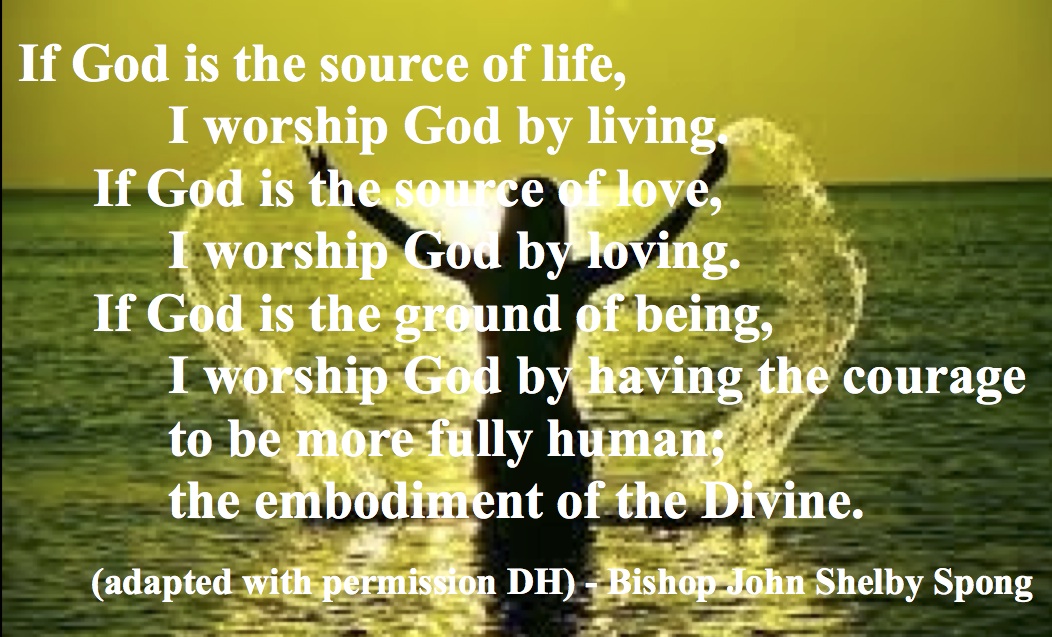
God is the source of life, so worship God by living,

God is the source of love, so worship God by loving.

God is the ground of being, so worship God by having the courage

to be more fully human; the embodiment of the Divine.

SPONG Living pastordawn

Multi-coloured Meanings of those Red-letter Words in John 14:1-14

coloured pencilsWay back when I first began going to church, I had one of those bibles…and I dare say many of you have probably had one too…I had a red-letter bible. For those of you who’ve never had one, a red-letter bible is a bible where all the words of Jesus are printed in red and for a long time I actually believed that if it was printed in red, then Jesus actually must have said it and there are hundreds of thousands, possibly millions of Christians who still believe that if they are printed in red they are the actually words of Jesus.

When I first began reading the New Testament, many of those red-letter words were difficult to read. The 14th chapter of the Gospel according to John was just one of the many texts that I read with great trepidation. “I am the way, the truth and the life no one comes to the Father except through me.” These particular words in red led me to believe that my family and most of the people I loved, were doomed, because they didn’t believe in Jesus. So, you can imagine my delight when I went to a young adults’ retreat and one of the pastors told us that just because words are printed in red, it doesn’t mean that Jesus actually said those words. I remember going back to my home parish and asking my pastor why he never told us about the things he was taught at the seminary about the words of Jesus and I can still hear him answering, “Most laypeople aren’t ready to hear that. It would destroy their faith.”

It’s an old argument amongst the clergy. It’s as if some of, “them” whoever “they” are, believe that the world as they know it will come to an end as they know it if they were to let lay-people in on the secrets of the trade. Should we or should we not teach laypeople about the historical critical methods that we all learned in seminary. When I say we all learned, I’m talking about the vast majority of clergy from the mainline denominations, like the Lutheran church, the Anglicans, the United Church, Mennonites, even Roman Catholics, and I dare say more than a few Baptists. We all learn the historical critical methods that academic scholars have been perfecting over the years. But the sad truth is that very few of us actually teach the historical critical methods that we have learned when we get into the parish. Many of my colleagues still argue that either laypeople aren’t ready to hear it, or that they don’t want to hear it. Either way, they’re not about to start preaching it from the pulpit and run the risk of destroying people’s faith. Besides, the folks who clearly don’t want to hear any of it just might run them out of town.

I’ve never really understood this attitude. I think perhaps the fact that as a layperson I was relieved to hear that Jesus didn’t actually say all the stuff that’s printed in red. So, from the beginning, I’ve always tried to teach the historical critical methods that I have learned to apply to my own study of the bible. Continue reading

While We Wait for Resurrection: a reminder from John Shelby Spong

Good Friday Rituals or Crimes Against Divinity? – A Good Friday Sermon

A Good Friday Sermon preached at Holy Cross Lutheran Church in 2012

it is finished 22The memory of it still haunts me to this day. I was 18 years old. Some friends of mine from church convinced me to go to a big youth gathering. I don’t remember who sponsored the gathering, I do remember that most of the Lutheran youth groups in the greater Vancouver area were in attendance and various Lutheran pastors were involved in the leadership. At some point near the beginning of the event we were each given a small nail, divided into groups and asked to line up behind one of the three wooden crosses that were laying in the hall. We were then given our instructions. We were about to hear a dramatic reading of the Gospel According to John’s account of the crucifixion. When the reading was over we would be invited to proceed to the cross nearest us, knell down, take a hammer, and drive our nail into the cross. With each blow upon the nail we were asked to remember our own responsibility for the death of Jesus. We were asked to remember that it was we who had crucified Jesus, for we were the guilty sinners for whom Jesus died. It was a powerful, gut wrenching experience that still haunts me to this day.

I wasn’t the only young person who wept buckets that day. I immersed myself into the ritual act as I recounted inwardly the list of my own sins. Together with my friends, we left that hall believing that Jesus died because of us. We left judged, convicted, guilty, tormented, anguished, and full of hope, for we knew that Jesus had died to save us from our sinfulness. Like so many who have gone before us and like so many who will gather on this Good Friday, we left that hall believing that God sent Jesus to die for us; to pay the price for our sin.  Continue reading

Religionless Christianity: Commemoration of Dietrich Bonhoeffer

Reposted today as the Church commemorates the life and witness of Dietrich Bonhoeffer.

When I was just a teenager, I was introduced to the writings of Dietrich Bonhoeffer by a wise Lutheran Pastor. I remember devouring Bonhoeffer’s “Life Together” and “Letters and Papers from Prison”. To this day, I credit Bonhoeffer for making me a Lutheran.  While a great deal of water has flowed under a good many bridges since I was first enamoured of Lutheran theology, to this day I am grateful to that wise old Lutheran pastor who gave me my first taste of Bonhoeffer.   Of late, there has been much ado about a little phrase that has been extracted from Bonhoeffer’s work: “religionless Christianity”.

(click here for full quotations from Letter and Papers from Prison)

“It is not for us to prophecy the day when men will once more ask God that the world be changed and renewed. But when that day arrives there will be a new language, perhaps quite non-religious. But liberating and redeeming as was Jesus language. It’ll shock people. It’ll shock them by its power. It’ll be the language of a new truth proclaiming God’s peace with men.”  Bonhoeffer: Agent of Grace

Tragically, Bonhoeffer was executed before he had the opportunity to expand on his idea of Christianity beyond religion.  The phrase “religionless Christianity” has intrigued agnostics, atheists, humanists, liberal christians and progressive christians.  Eric Metaxas, author of “Bonhoeffer” dismisses the idea that Bonhoeffer was anything but a serious, orthodox Lutheran pastor right up to the end.

Despite the historical evidence of Bonhoeffer’s religious orthodoxy, the notion of religionless Christianity will not die. Bishop John Shelby Spong is among those who have tried to build on Bonhoeffer’s phrase and his book “Jesus for the Non Religious” has certainly moved the conversation along among progressive christians.  

The dream of religionless christianity has moved well beyond Bonhoeffer as twenty-first century christians wrestle with archaic images of God and move beyond the religious trappings of traditional christianity. The notion of moving beyond religion has always intrigued me. Years ago, while studying Hinduism my professor offered a definition of God from one of the Vedas: “God is beyond the beyond, and beyond that also”.  As I continue to explore the life and teachings of the man none as Jesus of Nazareth it becomes more and more evident that such a definition is compatible with his portrait of God.  Jesus of Nazareth attempted to move his co-religionists beyond their religious images of God. What might our images of God become if we move beyond the idols offered to us by the religion of Christianity?   Might we move toward images of God that more closely resemble the teachings of Jesus by moving toward a religionless christianity?

Sometimes we can better reflect upon our own tradition from the perspective of another tradition. In the video below, twentieth century philosopher and theologian Alan Watts explores the concept of the Religion of No Religion. 

“Beyond the Beyond and Beyond that also.” Letting go of our images is the gift of faith that moves us beyond religion. I can hear Jesus call us to let go!

Atonement? – John Shelby Spong

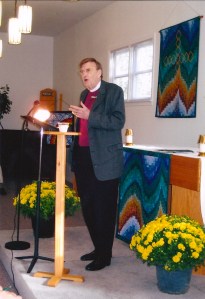
Jack speaking at Holy Cross

Jack speaking at Holy Cross

Bishop John Shelby Spong’s weekly column continues to provide so very much wisdom. Today Jack responded to a reader’s question about “atonement” and the nature of God. Jack is succinct, insightful, wise and inspirational in his response. If you don’t subscribe to Jack’s weekly column, you can find the details here

Question:

God is defined as an Almighty being. An Almighty being does not require atonement (for “sins”). Therefore if God requires atonement as the Bible says, he is imperfect and not Almighty. Does this make sense? In other words, philosophically, the need for atonement indicates a lack of something, which detracts from the perfection which God should have. I would appreciate your thoughts.    

 Answer:   Dear Raymond,

I don’t think that elementary equations in logic are the way to do theology. So let me start my answer by looking at your givens. “God is defined as an Almighty being.” By whom and on what authority? The traditional idea of God present at the heart of Christianity certainly tends to express this, but is it accurate? Can God ever be defined by human beings? Are the limits of the human brain able to be transcended sufficiently so that the fullness and mystery of God can be embraced and articulated? I do not think so.

I consider the popular definition of God as “a being,” who lives in a realm that is external to this world and who is equipped with supernatural power, to be not only inadequate but idolatrous. That is the meaning of theism. If theism as the definition of God becomes inadequate, then the only alternative is atheism. If, however, theism is an inadequate or even inaccurate attempt to define God, then atheism is simply a conviction that the theistic definition, not God, but the theistic definition of God, is not a proper way to understand the holy. In that sense I am certainly not a theist, but I am not an atheist either. The fact that I reject the theistic definition of God does not mean that I reject the reality of the God experience.

Your second given assumes that atonement is the experience of bringing God and human life into a state of oneness, and that somehow this is the goal of religion in general and Christianity in particular. I think atonement theology is bankrupt in that it is built upon a definition of human life as sinful and fallen and then it proceeds to portray God as a rescuer and the savior of the fallen, sinful life.

When I look at the origins of human life, I do not see an original perfection broken by original sin and the subsequent need for divine intervention to save the sinner. I see rather evolving life that went from single cells to complex self-conscious human beings. If there was no original perfection, there was no fall from perfection and therefore no need for a savior and the whole system collapses.

I see God as a presence and a power that leads to expanded life, expanded love and expanded being, and even the experience of an expanded consciousness. Atonement is not the word to characterize this understanding of either God or life. So, rather than worrying about whether God can be understood in terms of atonement, I would prefer to remove atonement from the Christian vocabulary altogether. I hope these brief comments will serve to open up new possibilities in your theological thinking.

My best, John Shelby Spong

Atonement? – John Shelby Spong

Jack speaking at Holy Cross

Jack speaking at Holy Cross

Bishop John Shelby Spong’s weekly column continues to provide so very much wisdom. Today Jack responded to a reader’s question about “atonement” and the nature of God. Jack is succinct, insightful, wise and inspirational in his response. If you don’t subscribe to Jack’s weekly column, you can find the details here

Question:

God is defined as an Almighty being. An Almighty being does not require atonement (for “sins”). Therefore if God requires atonement as the Bible says, he is imperfect and not Almighty. Does this make sense? In other words, philosophically, the need for atonement indicates a lack of something, which detracts from the perfection which God should have. I would appreciate your thoughts.    

 Answer:   Dear Raymond,

I don’t think that elementary equations in logic are the way to do theology. So let me start my answer by looking at your givens. “God is defined as an Almighty being.” By whom and on what authority? The traditional idea of God present at the heart of Christianity certainly tends to express this, but is it accurate? Can God ever be defined by human beings? Are the limits of the human brain able to be transcended sufficiently so that the fullness and mystery of God can be embraced and articulated? I do not think so.

I consider the popular definition of God as “a being,” who lives in a realm that is external to this world and who is equipped with supernatural power, to be not only inadequate but idolatrous. That is the meaning of theism. If theism as the definition of God becomes inadequate, then the only alternative is atheism. If, however, theism is an inadequate or even inaccurate attempt to define God, then atheism is simply a conviction that the theistic definition, not God, but the theistic definition of God, is not a proper way to understand the holy. In that sense I am certainly not a theist, but I am not an atheist either. The fact that I reject the theistic definition of God does not mean that I reject the reality of the God experience.

Your second given assumes that atonement is the experience of bringing God and human life into a state of oneness, and that somehow this is the goal of religion in general and Christianity in particular. I think atonement theology is bankrupt in that it is built upon a definition of human life as sinful and fallen and then it proceeds to portray God as a rescuer and the savior of the fallen, sinful life.

When I look at the origins of human life, I do not see an original perfection broken by original sin and the subsequent need for divine intervention to save the sinner. I see rather evolving life that went from single cells to complex self-conscious human beings. If there was no original perfection, there was no fall from perfection and therefore no need for a savior and the whole system collapses.

I see God as a presence and a power that leads to expanded life, expanded love and expanded being, and even the experience of an expanded consciousness. Atonement is not the word to characterize this understanding of either God or life. So, rather than worrying about whether God can be understood in terms of atonement, I would prefer to remove atonement from the Christian vocabulary altogether. I hope these brief comments will serve to open up new possibilities in your theological thinking.

My best, John Shelby Spong
The Beatitudes and the Power of One: a sermon for Epiphany 4A – Matthew 5:1-12

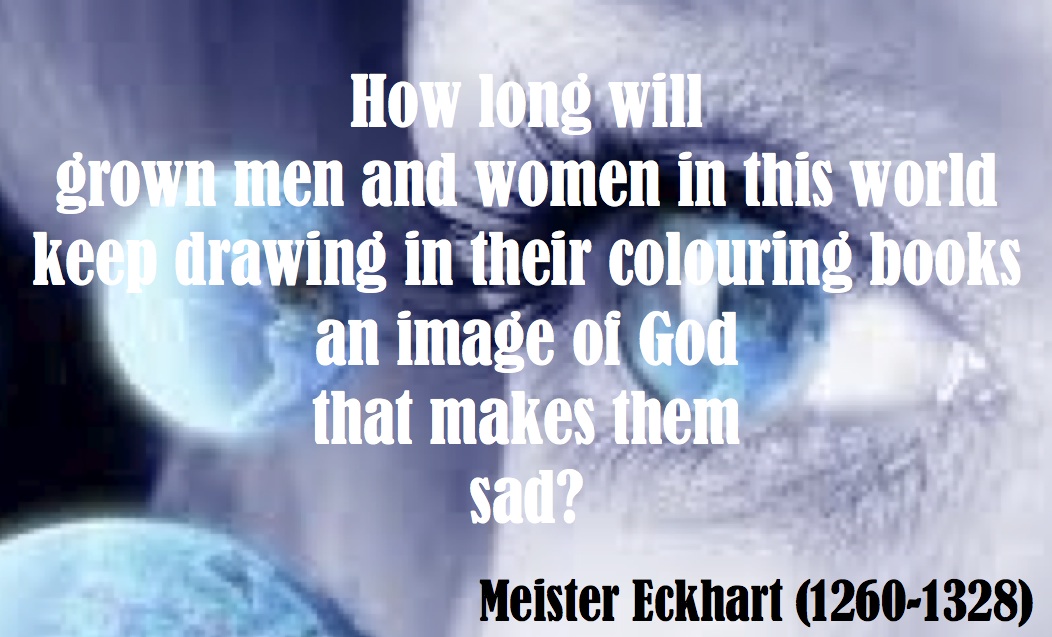
sad EckhartMost us us have heard the words from Matthew 5, known as the Beatitudes, so many times that we can recite them from memory. Indeed, the Beatitudes are at the very core of our Christian tradition. But there is a danger in our familiarity with these words because it allows us to distance ourselves from them as we relegate them to some idealized notion of some unattainable goal.

I have studied these words many times and I do not believe that Jesus intended these words to become a prescription for how to be a better Christian. So, I won’t be encouraging anyone to be poor in spirit, to mourn, or to be meek in the hope that they might gain the kindom of heaven, or be comforted, or inherit the earth. While hungering and thirsting for righteousness is in and of itself a good thing, along with being merciful, pure of heart, and peace-making, all of which I heartily encourage. However, these attributes or beatitudes are not a prescription for holiness or wholeness.

So, if Jesus wasn’t prescribing the beatitudes from atop the mountain, what was he doing? Well, there’s an old storytellers’ ploy that I’d suggest in order to better understand Jesus words. The ploy doesn’t have a name, but most of us are very familiar with the trick. It’s the one where you tell an unfamiliar story alongside of a very familiar story in the hope that the unfamiliar story will help to shed some new light on the words of the familiar story. The unfamiliar story is taken from Bryce Courtenay’s autobiographical novel “The Power of One.” The Power of One was are into a movie about twenty years ago, so the story may be somewhat familiar. Continue reading

Jesus, the Lamb of God Who Takes Away the Sin of the World? It ain’t necessarily so! (a sermon for Epiphany 2A – John 1:29-42)

Lamb of GodLooking back upon what I preached the last time John 1:29-42 appeared in the lectionary, I realize just how indebted I am to John Shelby Spong for giving me the words to articulate my own objections to the label attached to Jesus by a late first century writer also known as John. Most if not all of this sermon is derived from Jack Spong’s work. For more details I would refer you to Jesus for the Non-Religious and The Fourth Gospel: Tales of a Jewish Mystic. We at Holy Cross were privileged to have Jack speak to us about both of these books. In fact a year before it was published, Holy Cross was the test audience for the material in The Fourth Gospel: Tales of a Jewish Mystic. This sermon ought to have all sorts of footnotes, but I trust you will forgive me for simply confessing that I can no longer tell were Jack leaves off and I begin. Suffice it to say that this sermon is my feeble attempt to put Jack’s work into the form of a sermon.

When I turn the gospel according to John and read about John the Baptist pointing to Jesus, saying:  “Here is the Lamb of God who takes away the sin of the world!”  I want to scream,  “NO!” I have come to believe that our images of God are far too narrow. As far as I’m concerned most of our ideas about God fall far short of every even beginning to describe who God might be. One thing I’m absolutely certain of is if we can imagine ourselves being more loving, more gracious, or more merciful that our theology suggests that God is, then we had better go back to the drawing-board and think again. The ways in which we have traditionally interpreted the life, death and resurrection of Jesus the Christ, paint a picture of a God who is far less loving, gracious or merciful than you or I. Nobody in this room, would demand a blood sacrifice of a lamb, let alone the blood sacrifice of their own child. So, the image of God that is based on this kind of theology must be judged as inadequate to the task of evening beginning to provide us with a glimpse of who our God is.

As we go back to the drawing-board, we ought to take a long hard look at how we arrived at this image in the first place. Thank goodness for the work of our friend Jack Spong who has enabled us to see beyond the literal to the more-than-literal meanings of the various ways in which the followers of Jesus have understood the life and teachings of Jesus. During the years that followed the crucifixion, Jesus’ followers were left wondering what it was all about. How could someone in whom they had seen the fullness of God, be taken from them in such a horrendous way? How could their God allow it?   What were they to do? Over the years that followed, Jesus’ followers looked back at the life, death, and resurrection of Christ through the lens of their own religious experiences. Jesus’ followers were primarily Jewish and so it didn’t take long for the familiar Jewish symbol of the Lamb of God to be applied to Jesus as a way of making some sense out of his death.  Today most Christians associate the symbol of the Lamb of God with the Jewish celebration of Passover.  While the Gospel narratives do indeed locate the time of Jesus death during the celebration of the Passover, and there is indeed a sacrificial lamb involved in the Passover, the actual phrase “the Lamb of God” comes not from the religious rites of Passover, but rather the religious rites of Yom Kippur: The Day of Atonement.  Phrases like “the Lamb of God”, “died for our sins” and “washed in the blood of the lamb” can all be found in the religious rites of Yom Kippur.  Continue reading

Pregnant with Possibility: Was Mary a Virgin or Was Mary Raped?

pregnancy test

Mary Pregnant? St. Matthew-in-the-City (Auckland, NZ)

Mary, this enigmatic  woman has remained in the shadows for centuries. All too often the epithet “virgin” has been applied to the young woman who fell pregnant so long ago. As her Advent appearance approaches, I this re-post this sermon which I preached a couple of years ago in which I asked some questions about Mary. At the time I was reading Jane Schalberg’s “The Illegitimacy of Jesus”, John Shelby Spong’s “Born of a Woman” and “Jesus for the Non Religious” along with John Dominic Crossan and Marcus Borg’s “The First Christmas” and this sermon is laced with their scholarship. As always the written text is but a reflection of the sermon preached on the Fourth Sunday of Advent 2009.  

Sadly, one doesn’t have to travel too far into the past to arrive at the time when women’s voices were not heard. Indeed, in the Lutheran church, it was only a few short decades ago.  For most of us that time is within our own lifetime. For generations, men have told our sacred stories. Men have decided which stories made it into the canon of Sacred Scriptures. Men have interpreted the stories that were allowed to be told. Men have translated, taught, and commented upon those stories from pulpits, in universities, in seminaries, in commentaries and in the public square.  Continue reading

Shady Ladies, Forgotten Stories, and Images of God: Casualties of Our Advent Lectionary

women Matthew1

In the preface to her beautiful children’s book, “But God Remembered: Stores of Women from Creation to the Promised Land” Jewish writer Sandy Eisenberg Saso tells this revealing story:

“Before God created man and woman, God wanted to create Memory and Forgetfulness. But the angels protested.
The angel of Song said, ‘Do not create Forgetfulness. People will forget the songs of their ancestors.’
The Angel of Stories said, ‘If you create Forgetfulness, man and woman will forget many good stories.’ The Angel of Names said, ‘Forget songs? Forget stories? They will not even remember each other’s names.’
God listened to the complaints of the angels. And God asked the angels what kinds of things they remembered.
At first, the angels remembered what it was like before the world was formed. Then as the angels talked about the time before time existed, they recalled moments when they did not always agree.
One angel yelled at another, ‘I remember when your fiery sword burned the hem of my robe!’
‘And I remember when you knocked me down and tore a hole in my wing,’ screamed another.
As the angels remembered everything that ever happened, their voices grew louder and louder and louder until the heavens thundered.
God said, ‘FORGET IT!’
And there was Forgetfulness.
All at once the angels forgot why they were angry at each other and their voices became angelic again. And God saw that it was good.
God said, “There are some things people will need to forget.’
The angels objected. ‘People will forget what they should remember.’
God said, ‘I will remember all the important things. I will plant the seeds of remembrance in the soul of My people.’
And so it was that over time people forgot many of the songs, stories and names of their ancestors.
But God remembered.”

As we approach the Third Sunday of Advent, I can’t help wondering why the creators of the Revised Common Lectionary (the list of prescribed readings for Sunday worship) have failed to remember the stories and names of our foremothers? John the Baptist will strut across the stage again in this Sunday in churches all over the planet. We have begun a new cycle in the RCL in what is know as Year A the lectionary Gospel readings will focus upon readings from the Gospel according to  Matthew. But followers of the RCL will not hear the names of Tamar, Rahab, Ruth, or Bathsheba; no, not even Mary will put in an appearance despite the fact that all of these women are mentioned in the very first chapter of the Gospel according to Matthew! Last year was the same even though the RCL focussed upon the Gospel according to Luke, neither of the women of the Luke’s first chapter make an appearance without a great deal of effort. Unless worship planners are prepared to tinker with the lectionary Elizabeth and Mary will have to cede the stage to John the Baptist. So, all you worship planners and preachers out there, I say to you, “TINKER AWAY! TELL THE STORIES!” Continue reading

A Reformation Day Nailing to the Internet

spong cartoonIn  1998 the Bishop John Shelby Spong looked around at the state of the church and decided that it was time for a new reformation. Just as the invention of the printing press helped to distribute Martin Luther’s protests, the development of the internet spread Jack’s vision around the world. To those who were hungry for change, they were a breath of fresh air. Fifteen Reformation Day celebrations have elapsed since their publication and while there are pockets of progress within the church, what Jack has coined as the “church alumni” continue to bemoan the recalcitrance of the institution as yet another generation has been lost.  While so many have pronounced a judgment of irrelevance upon the institution, a remnant has begun to embrace Jack’s questions. I repost them here in the hope that the Spirit of Reformation lives and more and more  communities will enthusiastically embrace the challenges of being Church for the 21st century. I hope you will add your own theses in the Spirit of Semper Reformanda!

Jack posted his Twelve Theses with these words: “Martin Luther ignited the Reformation of the 16th century by nailing to the door of the church in Wittenberg in 1517 the 95 Theses that he wished to debate. I will publish this challenge to Christianity in The Voice. I will post my theses on the Internet and send copies with invitations to debate them to the recognised Christian leaders of the world. My theses are far smaller in number than were those of Martin Luther, but they are far more threatening theologically.”

12 Thesis John Shelby Spong