 Listen to Pastor Tom Doherty’s sermon Dec. 29, 2013
Joy to the World???
Reply

Listen to Pastor Tom Doherty’s sermon Dec. 29, 2013
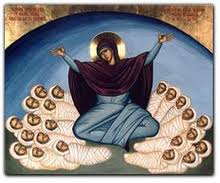 “A voice was heard in Ramah sobbing and lamenting loudly: it was Rachel weeping for her children; she refused to be consoled, for they were no more.” Matthew 2:18
Matthew 2:13-23 seems like such an offensive text to be reading so soon after Christmas. And yet, this gospel text, known as the “Slaughter of the Innocents” is indeed the prescribed lesson for the first Sunday of Christmas. Amid our celebrations, and in the midst of the gospel writer’s account of the birth of Christ, this horrendous story of the slaughter of innocents begs the question: WHY? It’s Christmas for heaven’s sake! My preaching professor, used to remind us of the first question that we should ask when we are preparing a sermon on a particular text. After reading the text over several times,we were encouraged us to ask the obvious question. “So What?”
So What? Well for this child of the sixties, only one Christmas song comes to mind when I read of the slaughter of the innocents, it’s the one Christmas song that asks the question: So What? We’ve just celebrated Christmas? So what does this mean? Please listen. “So this is Christmas?”
John Lennon was murdered on December 8, 1980. Shot by a deranged fan. And so is it any wonder, the melancholy why in which he sang this song, haunts our Christmases? So, what possible difference can Christmas make? We haven’t even had a chance to finish our celebrations and the news is far from good. Thousands continue to die in Sudan, Palestine is a mess. The people of the Philippians continue to suffer in the aftermath of disaster. Militants in Afghanistan are growing stronger despite the presence of foreign forces, violence and death are the order of the day in Syria where hundreds and thousands have been slaughtered. Millions have died in Darfur and still the world cannot find a solution so today thousands more will se-come to starvation and genocide. The war on Terror rages on as one side scores points on the other at the cost of human flesh and the word “drone” has taken on a horrific meaning. AID’s continues to ravage Africa and still we withhold the money and the medicines that could save millions. Hunger continues to claim the lives of the poor despite the fact that we have more than enough food to feed the world. Poverty continues to enslave millions the world over.
Rachel’s children—our children, yours and mine—born for love and mercy, die from neglect and ugliness and Rachel weeps bitterly. There’s a little book of prayers called: “Children’s Letters to God”. The prayers in that book have the power to make you smile and cry all at once. The very first letter to God in that book reads: “Dear God, in Sunday School they told us what you do. Who does it, God, when you are on vacation?” We may smile, but sometimes it feels as if for all intents and purposes, God is on vacation. For surely God would not stand idly by and allow so many innocents to perish?
Once we broaden our images of God; the source of our being, the One who dwells in us, we can begin to see that the place where we have traditionally located the Divine One changes from up there to in and around here and we can begin to seek God not out there but within and around us. If God is on vacation, it is because we are on vacation. For the Divine one works in, with and through us to sooth the pain caused by violence and greed.
So, let me assure you sisters and brothers, our God is not on vacation. Despite appearances to the contrary, our God is not absent, but God is surely weeping. For in Christ God showed us the way. The Christmas story insists that our God is in-fleshed and dwells among us. This changes everything. It’s not enough to pray with words expecting some far off deity to change the world. The changing of this world will happen when we begin to live into our full humanity and the sacred nature of our very being shines forth with LOVE. In, with and through us is how the LOVE we call God changes the world.. For we are God’s people on earth; Christ’s body on earth and it is through Christ’s body that God will save the innocents. There’s no time for us to waste feeling overwhelmed by the magnitude of the problems. It’s time for us to roll up our sleeves and get busy.
There’s a song that helps me to remember the hope born in Bethlehem. These Hands
And so this is Christmas… Rachel weeps. We’ve been on vacation long enough. Our God has taken on flesh and dwells among us! It’s time for the work of Christmas to begin again. We are God’s hands!
 Several years ago Lesley attended a small church in the suburbs. Every year toward the end of Advent the members of this church would create a living nativity. About a week before Christmas when most people were busy getting ready for the holiday they would conscript a few volunteers to begin the preparations for the living nativity. Out on the front lawn of the church, the volunteers would slap together a few boards in the shape of a stable. Costumes would be created out of old sheets and bathrobes so that children from the congregation could be dressed up as Mary and Joseph, shepherds, angels and wise folks. Then the children would be arranged in the make-shift stable so that people passing by in their cars would be reminded of what took place in Bethlehem on the first Christmas. The church was located at a fairly busy intersection and year after year, Lesley would marvel at the fact that the living nativity had never caused an accident, as drivers strained to see a motley band of children pushing and shoving each other inside what only remotely resembled a stable.
The living nativity was the brainchild of Deedee the dreaded church organist. Deedee was a rather severe woman, who always wanted everything to be done just so. Deedee worked hard to plan various grand events that she felt would benefit the congregation. But somehow, Deedee’s grand plans were always beyond the capabilities of the volunteers that she usually managed to conscript. Over the years, people in the congregation learned to hide whenever they saw Deedee coming toward them with her clipboard. If Deedee managed to corner you and your name got put onto her clipboard, you were sunk. Once your name was on the list, you were one of Deedee volunteers. Deedee’ s conscripts never really knew what it was they had volunteered for until they arrived for their first rehearsal. And by then it was too late, because Deedee had never been known to let a volunteer slip through her hands. Continue reading
Our worship service was cancelled at Holy Cross this morning. So, there is no recording of the sermon. Just this transcript of what I intended to preach. Transcripts never fully reflect a sermon; all the tangents that occur in the moment are missing from transcripts. So, this morning you will have to provide your own tangents. Enjoy!
The icy weather is playing havoc with the usual hustle and bustle of the season. Usually, the church’s season of Advent offers a sanctuary from the endless demands of preparation for the big day. Our Christmas traditions, if they are to be maintained, require a great deal in the way of preparation. But there’s one Christmas tradition that I’ve been enjoying since I was a child that requires little or no preparation save for the effort to carve out the time, when time seems to be in short supply. Somehow over the years, I’ve never missed the opportunity to watch the old black and white version of Dickens’ classic, A Christmas Carol. There is of course only one portrayal of Ebenezer Scrooge that will do.
 If it’s not Alistair Sim, it’s just not Scrooge. I usually wait until Christmas Eve to watch the movie. But this year I found the time to read the book and I’ve got to say, there is much in Dickens exploration of Christmas that I’ve been missing over the years.
In the words of Charles Dickens: Ebenezer Scrooge “was as cold and miserly a man as one could ever meet. “He was a tight-fisted hand at the grindstone, Scrooge! A squeezing, wrenching, grasping, scraping, clutching, covetous, old sinner! He carried his own low temperature always about with him; he iced his office in the dog-days; and didn’t thaw it one degree at Christmas.”
Ebenezer Scrooge’s transformation on Christmas Eve is nothing short of a miracle. Scrooge was a broken man. Broken, years before the story begins. The women he loved, Belle, broke her engagement to him one Christmas, she tells Ebenezer, “you fear the world too much. All your other hopes have merged into the hope of being beyond the chance of its sordid reproach. I have seen your nobler aspirations fall off one by one, until the mast passion, GAIN, engrosses you.”
Belle doesn’t tell us how this fear of the world developed. She doesn’t tell us what Scrooge’s nobler aspirations had been. We don’t know what made Belle fall in love with Scrooge in the first place—but we do know that whatever it is, it is gone now. As the Ghost of Christmas Past moves through Scrooge’s life we catch glimpses of what may have broken him – a distant father, the death of his much loved sister, his exposure to wealth in the first place – but we are never quite told what made Scrooge the man he is at the beginning of Dickens’ tale. All we know is that Scrooge is broken and greed and anger have possessed his very soul. Scrooge’s life was broken. While he had all of the wealth, and then some, that any person might need – he was miserable.
I used to think that A Christmas Carol was the story of Scrooge’s metamorphosis. The scene in the movie were Scrooge realizes that it is Christmas morning and that life doesn’t have to be the way it has always been and he does that wonderful dance and sings: “I don’t know anything! I never did know anything all on a Christmas morning!” I always thought of that wonderful dance as the culmination of Scrooge’s metamorphosis, like a butterfly bursting forth from a cocoon. But now I see it for what it really is. It is a dance of resurrection. For Scrooge was dead. Dead and gazing at his own tombstone, when suddenly, and suddenly for me always indicates the work of the Spirit, suddenly, Scrooge realizes that what he is seeing are only the shadows of things that might be. Suddenly, Scrooge knows “that men’s deeds foreshadow certain ends. But if the deeds be departed from surely the ends will change!” Scrooge is born again and is able to declare with confidence, “I’m not the man I was.” And so, the resurrected Scrooge becomes all that God intended him to be. Scrooge’s past didn’t go away—the hurtful Christmas memory of Belle ending their engagement, all of the ill-spent years somewhere between the party at Fezziwig’s and the visit of the spirits would still be a part of Scrooge’s life, resurrection doesn’t erase the past, but transforms the future, hope becomes part of the resurrected life! And so, Scrooge reborn, becomes “as good a friend, as good a master, and as good a man as the good old City ever knew…and it was always said of Scrooge “that he knew how to keep Christmas well!” Knew how to keep Christmas well. Keeping Christmas well is very different than celebrating Christmas. Keeping Christmas well is about resurrection; resurrection of our very selves. I always thought of that wonderful dance as the culmination of Scrooge’s metamorphosis, like a butterfly bursting forth from a cocoon. Keeping Christmas well is to forget what you have done for other people and to remember what other people have done for you. Keeping Christmas well is to see your neighbours as just as real as you are, and to try to look behind their faces to their hearts, hearts hungry for human connection, for dignity, for love and for joy. Keeping Christmas well is the realization that the only good reason for your existence is not what you are going to get out of life, but what you are going to give to life. Keeping Christmas well means closing your book of complaints against the management of the universe and looking around you for a place where you can accomplish some good. Keeping Christmas well is remembering the weakness and loneliness of people who are growing old; it means not worrying so much about how much your friends love you but asking yourself whether you love, honour and care for them enough; it means stepping down from your pedestal long enough to see that you are not the centre of the universe; it means bearing in mind the things that other people have to bear on their hearts; trying to understand what those who live in the same home with you really want, without waiting for them to tell you; it means burying your ugly, destructive and selfish motives and nurturing your nobler ones.
Keeping Christmas well includes the realization that your generation is not the last generation; that you have received an astonishing inheritance given by God, that your very next breath of life is pure gift; that all your various abilities and capacities were knit together in your mother’s womb and you had nothing to do with this original blessing, and that the bounty planet earth offers—its beauty and majesty – are both a wondrous blessing and an awesome responsibility; it’s the realization that you have duties to perform as citizens of a free nation in a dangerous world; that matters of war and peace are not just problems for others to solve; that much, if not most, of what goes on in the space around you depends upon your choices and your actions.
Keeping Christmas well is about being fully alive to all that life has to offer and being gracious in your responses to this amazing grace and living into all that God created you to be. When you keep Christmas well you are willing to believe that forgiveness is the doorway to a hope-filled future;
that mercy reflects God’s nature; and that love is the most powerful thing in the universes—stronger than hate, stronger than evil, stronger than death! Keeping Christmas well is living with the knowledge that there is nothing in heaven or on earth that can separate you from the love of God in Christ Jesus. e Scrooge’s metamorphous began, dancing and singing: “I don’t know anything, I never did know anything, all on a Christmas morning.” To keep Christmas well you must first realize that in the grand scheme of things you don’t know anything. For then, in humility, you can see the hope that lies in the manger. The hope of resurrection.
Scrooge knew how to keep Christmas well, may that be said of all of us. And as Tiny Tim said, “God bless us everyone!

As Christmas draws near, we turn to stories to express the inexpressible. Like the Gospel writers we are at a loss to explain the activity of our God in the world and so we too resort to story telling. Families gather and the reliable old stories are told. Each year new stories are added to our treasure troves as we seek to express the inexpressible and touch the hem of our God who is love. What better way to touch and be touched by God than to tell stories of God’s love in the world? We all have treasure troves of stories of Christ taking on flesh and dwelling among us. My story took place when I was a young woman determined that my first Christmas living out in the world would be the type of Christmas that dreams are made of.
It’s a story about the quest for the perfect Christmas. When I was growing up, I always wanted Christmas to be just so. But the reality of life with all its inherent dysfunctions coupled with financial limitations meant that we just couldn’t pull off the perfect Christmas. I used to comfort myself with the notion that when I grew up things would be different. When I grew up, I’d do things better. I’d save up my money so that no one would be disappointed and there’d be enough to ensure that the house would be filled with Christmas cheer! The decorations would be perfect and no family arguments or disappointments would be allowed to ruin my dream of the perfect Christmas. I knew that just as soon as I had my own place, I’d be able to pull off the kind of Christmas that would be so full of peace and harmony that the angels wouldn’t be able to keep from singing. Continue reading
 Historian and spiritual philosopher, Ian Lawton describes the dilemma of those of us who seek to put a “little reason into the season” this way: “Picture the scene. Mary and Joseph are huddled together in a manger surrounded by farm animals. Joseph is drifting in and out of various dreams. Angels fly in and out of the manger singing songs and bringing earth-shattering messages. Three eastern kings gather around Mary and Joseph with gifts. Out of the window a large star can be seen in the day sky. Two sheep sit beneath the window having a conversation. One says to the other, “I don’t know why you’re being so stubborn. Let me go through this one more time. The virgin is having a baby. They’re naming him Jesus because of a dream. Angels told them that their baby would become the saviour of all humanity. Kings travelled hundreds of miles to find the place of birth like a needle in a haystack because they were led by a giant star moving through the day sky. Now which part of this are you having trouble believing?” The Christmas story is fantastic in the literal sense of the word. It is mostly fantasy. Which parts of it do you have trouble believing?
You’re in good company. This story is as unlikely as talking sheep. The laws of nature tell us that sheep don’t talk, virgins don’t have babies, stars don’t travel across the day sky and then hang like a blip over one home and angels don’t sing choruses. Even if a reliable source suggested that something happened that broke the laws of nature, you would demand evidence and there is little evidence for the details of the Christmas story outside of the Bible which has contradictory details. All in all, the Christmas story is highly unlikely. But don’t let details get in the way of a good holiday story, right? If you’re like me, you’re torn between the desire to be true to your common sense that is skeptical and your heart that just wants to let the story be a good story. The good news is that you can have both. You can question the literal account of the story AND you can enjoy the timeless message of the story. You can put a little reason into the season, and still take a yuletide joyride of inspired meaning. The Christmas story is mostly myth, but the message is real and powerful.”
Since the end of the first century, some 1900 years now, the Christmas story has been told. Lately the church has become a little embarrassed by the way in which this story has been told. All sorts of experts have weighed in to tell us that it could never have happened the way we all remember it. Biblical scholars, historians, theologians, bishops, pastors, professors even scientists have cast doubt on the details of the story of the nativity. But even though we know how impossible some of the details may be we cling to this power of the story. Despite the wisdom of the experts, regardless of our doubts this story still has the power to stop us in our tracks. No other story or image is more recognizable to people the world over than the Nativity scene of the birth of Jesus. The images of an angel announcing the birth, a virgin responding in faith, a carpenter leading a woman on a donkey to a stable in Bethlehem, cumulating with Mary and Joseph gazing fondly at the baby Jesus, while the shepherds look on and the heavenly host sing their praises, these images are crystal clear to all of us. The story is part of us; it’s in our bones. Every year this story causes our lives to shift from the routine of winter, to marveling at the wonder of it all, as we enter into a sacred time, where families are drawn together, and strangers greet one another with kindness and from near and far the hope of peace on earth is a dream shared by us all.
Now, I know that somewhere in the deepest darkest recesses of our being, or for some of us, just beneath the surface of this dream, the wisdom of the experts causes a shiver to run across our spines as we wonder how the hope for peace on earth can possibly lie with such an unbelievable story. That shiver used to haunt me, until the day I recognized the power of the truth that lies in the story of the birth of Christ. It happened a few years back, when my youngest niece Sheri Lynn was about three years old. I have three nieces and over the years I’ve gained a bit of a reputation as their eccentric auntie. I can’t help myself, my love of stories and books just oozed over into my role as their auntie. And so to mark every occasion in their little lives their dear old Auntie Dawn showered them with books. Before every birthday, every Easter, and every Christmas every special occasion I could be found in the children’s section of the bookstore, scouring the shelves to find the perfect book that told the perfect story. My family used to tease me mercilessly and insist that I ought to get those little girls something they could play with. But only books were good enough for my nieces. So, you can just imagine the collection of books they have that tell the story of the Nativity. My family are not churchgoers, so on Christmas Eve I used to go to the Midnight service before heading over to my brother’s house to spend the night. Well the year that Sheri Lynn was just three, I arrived at my brother’s house at about 1:30 in the morning. My brother and his wife, my parents and my nieces were all safely tucked up in bed. On the dining room table were the remains of the milk and eating the cookies that had been left for some other visitor. I poked my head into the room where my youngest niece was sleeping. Little Sheri was snorting as little ones do when they sleep. In the glow of her nightlight I could see a rather unusual gathering on the floor by the foot of her bed. Standing upright on the floor was a large picture book opened to show a picture of an empty stable above which a star hung in the night sky. Beside the book was a doll’s cradle; inside the cradle was a naked doll covered only in a tea-towel. Sitting proudly with their legs sprayed out as if they were doing the splits were what could only be Mary and Joseph even tough they looked a lot like Barbie and Ken. Surrounding this scene were all sorts of little people, some smurfs, a few princesses all, no doubt, standing in for shepherds and angels. The most wonderful part was that all of God’s animals were there, not just the donkey, the sheep and the cattle, but giraffes, zebras, horses, pigs, lions, tigers, turtles, alligators, elephants, hippos, bears and even an alligator and a snake. It was just as the prophet Isaiah had foretold a peaceable kingdom were all the animals lived in peace together and where the lion would eat straw with the ox and the wolf and the lamb would lie down together. The great thing about toddlers playing with animals is that in their minds all of the animals can play together. Sheri Lynn knew that the giraffe eats leaves because I saw her holding it up to the Christmas tree so that it could feast. She knew that the horse and the cow and the sheep and the chickens lived over at the Fisher Price farm and that some of the other animals lived aboard Noah’s ark, and that snakes and alligators could be very scary indeed, but on this night all the animals played together, and all of them gathered together at the baby’s cradle to love and to warm and to care for the child, who lay naked and vulnerable before them. Sheri Lynn had created an image of the Nativity story; an image whose details weren’t exactly correct, but an image that told the truth about all our longings during this most holy season. Continue reading
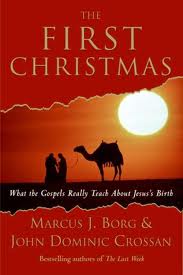 In 2008, our little congregation played host to John Dominic Crossan who has been acclaimed as world’s most famous New Testament scholar. Crossan’s visit to our congregation began with a public lecture based on his best-selling book The First Christmas in which he and Marcus Borg provide a splendid historical outline of the development of the birth narratives. I had the dubious honour of standing before his enlightened audience on Christmas Eve to preach in the great man’s wake. What follows is the Christmas Eve sermon I preached just three weeks after Dom’s illuminating visit.
Just a few weeks ago, this congregation was privileged to play host to a man who has the reputation of being the greatest New Testament scholar in the whole world. Dom, (we get to call him “Dom” now) wrote The First Christmas with Marcus Borg who is the guy who is heralded as the world’s leading expert on Jesus and Christianity in the 21st century. During his lecture, Dom provided us with all sorts of marvellous ways to understand the stories surrounding the birth of Jesus. Ever since that visit, there have been folks who listened very carefully to what Dom had to say and who have been positively gleeful when they’ve asked me what I’m going to do about preaching on Christmas Eve.
I mean what could I possibly say to you after so many of you have just finished hearing from the best in the business! And then there are those of you who bought the book and you’ve read what the experts have to say about the first Christmas. Some of you weren’t able to hide the smirks when you wondered out loud just exactly how I’d go about following the eminent Dr. John Dominic Crossan.
I don’t mind confessing that on several occasions since, I’ve woken up in the middle of the night and wondered what on earth I’d say to you this evening. Even those of you who didn’t manage to hear Dr. Crossan; you’ve probably seen him on TV this week on one of the dozen or so, documentaries on which he appears as the expert scholar who the media turns to in order to unravel the Mysteries of the Bible or to dig up the truth about Jesus. In this the age of information, you can simply go to YOUTUBE or to ITUNES U and download all sorts of podcasts where you’ll discover what pastors have been learning at seminaries for decades as the academic world has unlocked so many of the secrets of the ancient world in an effort to discover the real truth about what may or may not have happened so very long ago. Ever since: “The shepherds returned, glorifying and praising God for all they had heard and seen, as it had been told them.”
Since the end of the first century, some 1900 years now, the story of the nativity has been told. Lately the church has become a little embarrassed by the way in which this story has been told. All sorts of experts have weighed in to tell us that it could never have happened the way we all remember it. Biblical scholars, historians, theologians, bishops, pastors, professors even scientists have cast doubt on the details of the story of the nativity. But even though we know how impossible some of the details may be, we cling to this powerful story. Despite the wisdom of the experts, regardless of our doubts, this story still has the power to stop us in our tracks. No other story or image is more recognizable to people the world over than the Nativity scene of the birth of Jesus.
Tonight the images of a stable in Bethlehem, with Mary and Joseph gazing fondly at the baby Jesus, while the shepherds look on and the heavenly host sing their praises, these images are crystal clear to all of us. The story is part of us; it’s in our bones. And every year this story causes our lives to shift from the routine of winter, to the marvel of this night, when families are drawn together, and strangers greet one another with kindness and from near and far the hope of peace on earth is a dream shared by us all.
Now I know that somewhere in the deepest darkest recesses of our being, or for some of us, just beneath the surface of this dream, the wisdom of the experts causes a shiver to run across our spines as we wonder how the hope for peace on earth can possibly lie with such an unbelievable story. That shiver used to haunt me, until the day I recognized the power of the truth that lies in the story of the birth of Christ.
You see truth is an amazing reality. Truth is never simple. And yet truth is quite simple really. At least for those who have eyes to see and ears to hear. But before I tell you about the truth, let me do what I do every Christmas Eve, Let me tell you a story. It’s a true story about a story about a story.
You see, the easiest way I know to reveal the truth about a story is to tell a story that sheds light on a story. It’s the most ancient way to reveal the truth and it’s the way that Jesus used when he wanted to reveal the truth about the scriptures.
This story took place just about two weeks ago. Our Confirmation students had gathered together for our last class before the Christmas break. Their final assignment was due. Each of the students was required to tell a story that revealed something about the nature of God. They were asked to write a gospel according to them.
One by one they got up and from this very pulpit and they told their gospel stories. I asked one of the students for permission to re-tell their gospel story this evening. The student agreed on the condition that I not reveal to you who actually wrote the story. Which is perfect really because despite all our best efforts nobody can really say who actually wrote the four gospels attributed to Matthew, Mark, Luke and John. So, here I give you the gospel as it was told by one of Holy Cross’ confirmation students and recorded, after a fashion, by me.
It was a cold and snowy night in the town of Newmarket and a homeless couple wandered the streets of Davis and Yong searching for shelter and warmth. They were a strange looking couple; a man and a very, very, very, fat woman.
They were dirty and grubby and they wore layers and layers of clothes trying to  keep warm. They’d been wandering for a very long time and they were very, very, very hungry.
So they trudged up to Wendy’s, hoping to get a warm meal. But when they made their way up to the counter the guy behind the counter shouted at them and said, “Get outta here! We don’t serve fat people at Wendy’s!”
So the hungry couple headed over to Tim Horton’s, but the woman was so fat that she couldn’t fit through the door so the people told her to go away cause there was no room for fat people at Tim Hortons.
So, on they trudged up to MacDonalds and low and behold the fat woman made it through the door and the man managed to get the servers to provide them with a warm meal and just as they were settling into a booth, there appeared a great flood!
And the very, very, very, fat woman leaped up onto the table, right there in the middle of MacDonalds! And the woman began to scream and moan. Because she wasn’t just some fat homeless person, she was with child. And after a lot of screaming and moaning a baby was born in the city of Newmarket. And all the people rejoiced! For unto us a child was given, a child born in the poverty of MacDonalds. For if God came to earth today, God would come where we least expect God to be.
The Holy Gospel as it is told by a young person of this congregation. Thanks be to God.
So, if your struggling over some of the details of the nativity story, if the experts have left you perplexed, cynical or worried, do not be afraid, for I bring you tidings of great joy. The story is true, every last word of it is true. For just like Dom so wisely revealed to us, the story of the nativity is a parable and like all parable’s it represents a truth that cannot be fully expressed in words. Like all good parables the truth is not to be found in the details, but rather in the Spirit of God that breathes life into the parable. It’s a parable about so many things, but most of all it is a parable about peace on earth giving glory to God.
Now there are many down through the ages that have tried to weave stories of peace on earth, but none so everlasting as this. And yes some of us would have rather have had a road map or an expert to set us on the path to peace. But alas, all the experts have failed in their efforts to guide us. The truth that they impart has been rejected. So, once again we are left with this parable. A story so simple that even a child can understand it. A parable that depicts the truth that was experienced by those who walked and talked, loved and learned from Jesus. And the truth echoes through the centuries and the message is clear to everyone who has ears to hear.
“And suddenly there was with the angel a multitude of the heavenly host praising God and saying, “Glory to God in the highest heaven, and on earth peace, goodwill among all people.” And we are left wondering at the power of a love great enough to triumph over death and we claim a Christmas Truth greater than any of the tradition it inspires: the truth of the mystical longing of the creature for the creator—the finite for the infinite— the human for the divine. It’s a longing that transcends culture, religion, language and custom—a longing that is represented tonight for us in the baby in the manger—the sudden, amazing and incomprehensible gift of grace: a God who loved us enough to become one of us.
Yes, we embody the wonder of Christmas in the gifts given, the meals shared, the gathering of family and loved ones. But the greater wonder is that the God who is love incarnate comes down to be among us over and over again. Christ comes to show us how to share that love with a world in desperate need of it— to a world yearning for “peace on earth, good will among all people”.
That shalom—that peace—that unfamiliar hush is the peace on earth I’m praying for this Christmas— the shalom that doesn’t just mean the peace that comes when we’re no longer at war but the shalom that means that all human beings live together at peace with one another and with God, and in right relationship with all of the rest of God’s wondrous creation.
Shalom, the Hebrew word for what we might describe as “turning the human race into the human family” —the peace on earth that we, are called to be about as followers of Christ, not just at Christmas but all year long. The truth is that peace is the only way we can truly give Glory to God.
Peace is the only way to insure that every child born into this world will have an opportunity to play, to learn and to grow. To accomplish peace on earth we will all have to go out into this Christmas night and into this New Year and put our faith into action. That means prayers and protests; speaking up and stepping out; offering whenever and wherever possible the Good News of God’s shalom and realizing the truth of the angels chorus. For we are the followers of the one whose birth they herald. Howard Thurman, a fellow follower of Christ, put it best declaring that:
So, dear friends, rejoice and be glad, for unto us a child has been born, a child who is Christ our Saviour. May Christ lead each of us as we go forth to make peace on earth and good will to all. Amen.

As we approach the Third Sunday of Advent, I can’t help wondering why the creators of the Revised Common Lectionary (the list of prescribed readings for Sunday worship) have failed to remember the stories and names of our foremothers? John the Baptist will strut across the stage again in this Sunday in churches all over the planet. We have begun a new cycle in the RCL in what is know as Year A the lectionary Gospel readings will focus upon readings from the Gospel according to Matthew. But followers of the RCL will not hear the names of Tamar, Rahab, Ruth, or Bathsheba; no, not even Mary will put in an appearance despite the fact that all of these women are mentioned in the very first chapter of the Gospel according to Matthew! Last year was the same even though the RCL focussed upon the Gospel according to Luke, neither of the women of the Luke’s first chapter make an appearance without a great deal of effort. Unless worship planners are prepared to tinker with the lectionary Elizabeth and Mary will have to cede the stage to John the Baptist. So, all you worship planners and preachers out there, I say to you, “TINKER AWAY! TELL THE STORIES!” Continue reading
 Today, the Feast of St. Nicholas, the ancient precursor to the modern Santa Claus, will pass without much ado. Some will try to encourage us to resurrect St. Nicholas to save us all from Santa’s powers for we have gone astray. To those well meaning souls who would rid Christmas of its flagrant consumerism, I can only offer up a feeble, “Baa Humbug!”
The very best traditions about St. Nicholas suggest that he was a protector of children while the worst tradition has him providing dowries so that young girls could be married off by their father rather than be sold into slavery. Meanwhile, the modern character Santa Claus grooms children to take up their role as consumers in the cult materialism. Some parents may bemoan the little gimmie-monsters that their children become, but most adults are rendered helpless by our own remembered indoctrinations and so we join in what we choose to deem as harmless fun.
T’is the season for contradictions. ‘Tis the season when we prepare to celebrate the incarnation of God in human form while also waiting for Santa Claus to come down our chimneys. Face it; most of the folks dashing about in the malls are more worried about the imminent arrival of Santa Claus than they are about God. I’d even go so far as to say that a good number of people have unconsciously substituted Santa Claus for God. Santa Claus and the baby Jesus get into some pretty fierce competition at this time of year; and in the culture the larger loyalty belongs to Santa.
Besides, I don’t believe that consumerism is the most dangerous thing about Santa. So, before you accuse me of being a Scrooge or even a Grinch, ask yourself who it is that most children worship at this time of year, and I think you’ll agree that Santa is the one we’ve all been trained to bow down to, and not just at Christmas. It is difficult to deny that sometimes our view of God has been more influenced by Santa Claus than by Christ? I dare you to compare the number of children standing in the lines at the shopping centre to get their picture taken on Santa’s lap to the number of children in Sunday School? So many of us made that same trip to see Santa when we were little and when we finally got to Santa’s lap, he asked us the big Judgement Day question that Santa always seems to ask, “Have you been good this year?” There’s only one way to answer that question – even though we may have been as deviousness might qualify us as servants of that other mythical character that begins with santa and ends with n. For all too many people this laptop confession begins a pattern for interactions with an image we create of the Father-God, who watches and records our offences, making a list if only for the purpose of forgiving us because an appropriate blood sacrifice has been made on our behalf.
Think I’m being harsh? Just listen to that song that pours from muzak speakers, the song that spells out a theology of Santa Claus. “Oh, you better watch out. You better not cry. You better not pout. I’m telling you why. Santa Claus is coming to town. He knows when you’ve been sleeping. He knows when you’re awake. He knows if you’ve been bad or good, so be good for goodness sake. He’s making a list, checking it twice, gonna find out who’s naughty and nice. Santa Claus is coming to town.” The trouble with the theology of Santa Claus is that we keep applying it to God as we try to turn the Creator of all that is and ever shall be into a list-checking, gift-giver, whom we better watch out for, lest we be punished. Why then are we surprised that when our Santa-god fails to deliver or bad things happen to good people, that our childish faith in the Santa-god isn’t enough to sustain our trust?
Santa in his present incarnation is indeed pernicious, but like most mythical characters, he cannot be killed and any attempts to resurrect St. Nicholas to replace him are doomed, for the power of Santa’s materialism will always defeat the dim memories of St. Nicholas and his chocolate money. If we are going to break free of the cult of materialism, perhaps we out to try to convince Santa to use his mythical powers for goodness sake!
Yeah, that’s right, I’m going to say it, it’s time to let old St. Nick and his young assistant Santa die, so that a new Santa can be born; a Christmas resurrection if you will. We need a new Santa capable of changing our consuming ways. If the Coca Cola Company could use the advertising industry to transform St. Nick into Santa, surely we can resurrect Santa using the modern persuasive powers of social media to redesign the old salesman extraordinaire into a mythical character with powers fit for the needs of this century.

SANTINA- all decked out in her Advent blue!
Imagine if you will, a new and improved Santina, all decked out in Advent blue, she has the power to open young minds to the needs of our neighbours and travels the world via her magic transporter beam, to gather the hopes and dreams of the poor and oppressed into one internet feed, which she magically imprints in our hearts and minds, so that we change the world, creating peace through justice!
Oh, wait, we already have such a character. We don’t need St. Nicholas or Santa Claus, nor any new-fangled Santina. We need the One we’ve always needed. The One who comes in the guise of a person. The One we seek is Christ. The One who lives and breathes in, with, and through us to create peace on earth through justice and love. The One who uses our hands, our feet, our lives to change the world!
Enjoy this version of Let There Be Peace on Earth in which Vanessa Williams uses not only inclusive language, but celebrates the Earth as our Mother!
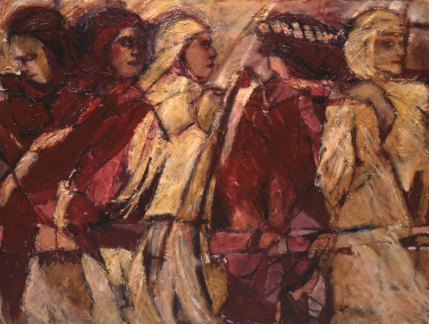
Tamar, Rahab, Ruth, Bathsheba, Mary by Sallie Poet
As we enter Advent to await the coming of Christ, it is important for us to remember who Jesus was. I offer this snippet from an Advent sermon given by Bishop John Shelbly Spong on the first seventeen verses of the Gospel according to Matthew. After exploring the lives of the women the gospel writer includes in the genealogy of Jesus, Bishop Song invites us to re-think our image of Jesus. You can read a rough transcript of Bishop Spong’s sermon here There have been several Advent seasons when we have gone off lectionary in order to facilitate a re-thinking of our traditions. Using Matthew 1 as a gospel lesson has worked well for the first Sunday of Advent.
In this snippet, Bishop Spong invites us to re-think our image of God in light of our knowledge of Jesus.
 This sermon was preached at Holy Cross Lutheran November 28, 2010. The readings included Isaiah 2:1-5, “Amazing Peace” by Maya Angelou, and Matthew 24:36-44, during the sermon I read from the Qur’an Sura 19:1-30 which you can find by following the link in the body of the sermon.
While I was studying for an undergraduate degree in Religious Studies at the University of British Columbia, I worked as a volunteer women’s center. Because I was studying the religions of the world, women who were being persecuted as a result of religious belief were often referred to me.
I’d been working with a young woman who was being abused by her father and brothers because they felt that she was adopting Canadian ways and thereby abandoning Islam. I remember visiting her in the hospital emergency room after her brothers had beaten her nearly to death. She told me that the last thing her brother said to her before tossing her out of the back of a van, was that she should consider herself lucky that they had talked their father into letting them beat her, instead of doing what he had ordered in the first place which was to kill her. I sat at her bedside wondering how a brother could do such a thing to his sister. I decided that they must be religious fanatics and I wondered how any religion could drive a father to seek the death of his own daughter.
The next morning I didn’t feel much like going to my Religious Studies Methodology Seminar. The Seminar was comprised of 7 students from various faith traditions along with 4 atheists and 3 agnostics. Together we studied the various methods of studying religion. We were about to embark on the phenomenological approach to the study of religion. “The Phenomenology of Religion” is a fancy academic way of describing the study of actual religious experiences of the divine. As we stumbled to our seats the professor announced that he would be dividing us into groups of two and he wanted us to learn all that we could about our partner’s religious experience. We would have two weeks to come up with a 1,000 words describing on the phenomenology of our partner’s religious life. I was paired with an Imam who was studying Western approaches to religion prior to taking up a position in a local mosque. Ibrahim was a recent immigrant from Pakistan. But he might as well have been from Mars as far as I was concerned. On that day of all days, Muslim men were not exactly my favorite characters. Continue reading

THE WIND WILL SHOW ITS KINDNESS Meister Eckhart (1260-1328)
During the offertory, our Music Director Marney Curran offered an impromptu rendering of Sarah McLachlan’s “I Will Remember You” a sacred moment!
 In the past fifteen years, I have only preached on Reign of Christ Sunday twice. I usually have the presence of mind to book my vacation or some sort of continuing education event for this festival of the church year. Formerly known as “Christ the King Sunday” an attempt to move beyond exclusively male imagery for Christ (in whom there is no east or west, male nor female) some church-folk have attempted to change the name of this festival to Reign of Christ Sunday. But neither title gets away seems to suffice in a pluralistic world.
Born in an age that was birthing fascist regimes, this particular festival of the church clings to it’s christian imperialist past. Instituted in 1925, by Pope Pius XI, (you can read the full proclamation here) the festival was designed to remind the world that Christ is the King of the World. The irony of proclaiming Christ as “King” when the life of Jesus of Nazareth positively denies “kingliness” seems lost on the church. The appropriateness of asserting Christ over the religions of the world lacks the kind of humility embodied by Jesus of Nazareth. So, even though it’s too late to book a vacation, I for one would rather not have the task of preaching on this particular festival.
I was tempted to welcome the congregation on Sunday morning with something like: “Welcome to what I hope will be the last celebration of Reign of Christ Sunday here in this place.” But I suspect that between now and Sunday, I will find it within myself to be somewhat more circumspect. I suspect that rather than proclaiming Christ as the King of the World, I will look at the reign of the current rulers of the world and explore the contrasts between their reign and the justice that Jesus of Nazareth lived and died for. This video clip seems like the place from which to begin writing the sermon.
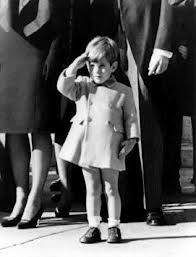 In 1963, I was in grade one. My memories of my five-year-old self are vague; filled with blurred images and impressions. But one memory stands out. George Kennedy sat up close in the front row with me. George Kennedy was an odd looking little boy. I only know that he was an odd looking little boy because my classmates were in the habit of teasing him about his looks. I cannot tell you why they thought that he was odd looking because in my memory he looks like a cute little five-year-old boy. George Kennedy and I must have lived near one another because I can remember him walking up ahead of me and so I choose to believe that we were headed in the same direction and not that I was stalking him. My most vivid memory of George Kennedy happened the day that we were all unexpectedly sent home from school.
The crackly voice of the school principal announced over the PA system that President Kennedy had been shot and was dead and we were all told to go straight home. I did not know what a president was, I only knew that Mr. Kennedy was dead and so I remember walking home behind George Kennedy and feeling really bad because George’s daddy was dead.
I have flashes of memory from that week, spent huddled around the TV set with my mother and father, knowing that they were so very sad. I remember their tears. It is my first memory of them crying. President Kennedy’s funeral was the first funeral I can remember attending. The first three funerals that I remember from my childhood were John Kennedy’s, Martin Luther King’s and Robert Kennedy’s funerals. In my mind’s eye, I can see clearly little John John’s salute, Corretta’s black veil, and Ethel standing there with all Bobby’s children. There is a song from those long ago days, a song that to this day makes me weep no matter where or when I hear it. It begins with the sound of a mournful flute.
The sound of the electric organ gives us but a moment to breath as verse by verse our good friends John, Martin and Bobby are snatched from us. That song is a lament that lives in the souls of those of us who grew up grieving common losses.
There have been other times when we have grieved together, times when we have lamented, like September 11, 2011, our cries of lamentation at the loss of so many lives on a day that forever changed our world. Not all our losses have been shared so widely. Sometimes we have gathered to lament losses that don’t quite make it to the world stage, but which are earth-shattering in their own circles. Sometimes we have lamented the ongoing pain that exists as a result of the lack of justice in this world.
The art of lament, in a world that hungers for closure so that it can be about its business, is a struggling art-form. It seems that our ancestors were so much better and lamenting and could launch forth into wailing and gnashing of teeth with much more abandon than we like are likely to tolerate in public places.
These days we think it unseemly for mourners to wail at a funeral, choosing celebrations of life over the wailing in the face death. But the act of lament has over the centuries played an important part in our human development and I would argue that the act of lament has also played an important role in the life of our God.
Lament is a transformative act. Lament moves us from one place in our lives to another. Lament moves us and thereby transforms our humanity. Lament is very much a part of our human evolution. And so I lament the disappearance of lament from our worship. Lament is the voicing of one’s anguish or complaints to God.
Lament provides us with the opportunity to gather together and express our anguish in the presence of the ONE who is, was and ever more shall be. The ONE we call God. For in the pit of despair we are made painfully aware that our hope lies beyond ourselves. Because hope is the only way out of the pit of despair we look to the ONE who is so much more than we can comprehend to through us a life-line and so we wail and weep, and shout and rant until we can begin to know the presence of the ONE. Often, the knowledge of the presence of the ONE comes to us through the presence of one-another. Sometimes, the knowledge of the presence of God comes to us in the very lament itself as we discover God in the midst of our pain. All too often our modern sensibilities tempt us to arrive at hope by trying to avoid the lament. But when we fail to utter our rage over suffering or injustice we tend to arrive at false hope, or failing hope.
Lament allows us to fully engage our despair, and by engaging one another and indeed God in our despair we are transformed. Lament is where we must begin if our rage at the suffering and injustice in this life is to be transformed into peace and justice. Lament is the place where our grief begins to move us from deadness of our shock and horror into a place were we can begin to cope and find healing. Lament is the place where we can begin to discover our God weeping with us; grieving with us and being transformed with us.
There’s a line from the Mystic Meister Eckhart that has been a sort of mantra for me of late: Eckhart insists that: “Every act reveals God and expands God’s Being.” As I look around me at the pain and suffering that exists in the world, I can’t help but lament all the poverty, the violence, and the hatred that exists as a result of our incomplete humanity. Most of us cope with the magnitude of suffering by limiting our exposure to it. We try not to dwell on it because we are afraid that it will overwhelm us and we won’t be able to cope. From time to time we let just a little bit of the suffering in; just a little lest we be overcome by despair. Sometimes we have no choice and the suffering bursts in on us and we are forced to deal with it. Either way, whether we let ourselves be touched by suffering or we have suffering thrust upon us, that suffering transforms us. Suffering can transform us in unhealthy ways or in healthy ways. But suffering will change us. If we have the courage to lament, to engage our God in our rage over the suffering; I mean really engage our God, we can be changed in ways that were once unimaginable.
In our lament we touched the pain of the suffering, we didn’t heal it, we didn’t cure it we just touched it. And the power of our lament changed us. We were changed by their impotent silence. And God, well God was revealed in our lament. And God’s being was expanded. Now I know that some will say that it was our perception of God’s being that was expanded and not God’s being itself. But to deny that God’s Being is capable of expansion as a result of interaction with us, is to deny the reality of relationship. God lives and breathes in with and through us so our evolution as beings changes God. In with and through us God weeps, God bleeds, God cries and God waits, for transformation. Our lament is an act of trust. An act that declares our intent to wrestle with God, to struggle with God as we begin the difficult transformation into the beings that we are becoming. The power of lament to transform our mourning into dancing, injustice into justice, and violence into peace is transformative.
Lament is a process, a process of transformation. There’s absolutely no point in lamenting the suffering of the world unless you’re prepared to be touched by that suffering and transformed by it.We are called to suffer with the poor in order that we might lend our strength to transform suffering into life-giving joy. Our God will wipe away every tear from every eye and our God will do this as God lives and breathes in with and through you. Taking up the cross of suffering is not about signing up for suffering for suffering’s sake. Taking up the cross of suffering is about engaging with those who suffer in ways that will forever change the world. It is about lamenting alongside, so that together we can be transformed. Engaging in the act of lament is no easy thing. But just like the blues, lament has the power to transform our mourning into dancing. To transform our weeping, bleeding, crying, suffering God, into a powerful loving, justice making, peace keeping, God who works in with and through us to transform our world. Let it be so.
 Our readings today were from Isaiah 65:17-25, Dietrich Bonheoffer’s “Letters from Prison, and Luke 21:5-19
A pdf of the worship bulletin which includes the Bonhoeffer reading can be found here (designed to be printed double-sided, landscape legal paper and folded into a booklet)
 I am indebted to Joshua S. Goldstein’s book “Winning the War on War: The Decline of Armed Conflict Worldwide” and his brilliant statistical analysis and summation of the successes won by peacekeepers, diplomacy and humanitarian aid.
Our liturgy this Remembrance Sunday was a service of lament. Our readings included a section from Elie Wiesel’s book “Night”. Here you will find a copy of our bulletin which contains the readings as well as the words to Brian Wren’s hymn “The Horrors of Our History” with which our Choir opened our lament. (pdf of the bulletin laid out to be printed double sided on legal paper)
 Lest we forget” is a phrase that has become synonymous with Remembrance Day. Sadly, our Remembrance Day commemorations have become disconnected from our history and the vast majority of those of us who observe Remembrance Day have forgotten its origins. Our collective amnesia about the phrase, “Lest we forget” is a case in point. I have always assumed that the phrase was coined to encourage the world not to forget those who have served, fought and in too many cases died to protect our freedoms. While the phrase’s attachment to Remembrance Day has served as a call to collective remembrance, it was coined for a far more humbling purpose than to honour the fallen heroes of foreign wars. The phrase, “Lest we forget” was coined by the great poet laureate of the British Empire Rudyard Kipling, in his daunting poem, “Recessional” written to commemorate Queen Victoria’s Diamond Jubilee in 1897. Kipling’s poem was a sobering call to humility at a time when the British people were basking in the glory of Empire. Recessional served as a reminder that the sun might never set on the British Empire, but God was still in God’s heaven and thus, the sun rises upon the evil as well as the good. Kipling warned those drunk on the excesses of Empire that God was sovereign and not the British people.
The entire poem is addressed to God as a prayer, and serves as a call to the Empire’s powerful Victorians to remember their place.
Amongst the pomp and circumstance of this solemn day, it is all to easy for those of us who aspire to be Christians, to forget who we are and whose we are. For we are a people who follow a man whose life was given to the cause of non-violence; a man who resisted the temptation to fight even in the face of the most brutal occupation army that the world had seen in first century. Jesus of Nazareth refused to take up arms against cruel oppression. Jesus proclaimed a radical new response to violence. Continue reading
 Pastor Dawn and Pastor Tom Doherty’s All Saints’ Sunday sermon included stories from the congregation celebrating the saints in their lives. Be sure to listen to the Hymn of the Day that follows the sermon: “We Come to Tell Our Stories” with new words by Jann Aldredge-Clanton to an old familiar tune (HANKEY by William E. Fischer – I Love to Tell the Story).
click here to see an earlier post about Jann Aldredge-Clanton
 Today’s Reformation Sunday Liturgy followed the theme Semper Reformanda: Always Reforming! The sermon looked at various protests of the ongoing reformation, including Luther’s 95 Theses, (here) John Shelby Spong’s Twelve Theses, (here) Matthew Fox’s 95 Thesis for the 21st Century, (here) Holy Cross’ Mission Statement (here) and Holy Cross’ Statement of Welcome (here).
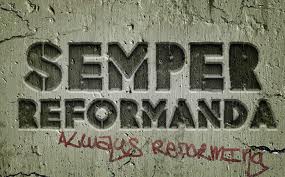 In the spirit of the Reformation motto: semper reformanda – always reforming, what say we abandon the fortresses of our traditions. This Sunday, Lutheran churches all over the world will begin their Reformation Sunday worship services vigorously singing “A Mighty Fortress” and I for one wish they wouldn’t. I suspect that the hymn’s author Martin Luther might just agree with me. After all didn’t Luther write a Mighty Fortress in an attempt to bring the popular music of the day into the church? I am convinced that this particular Reformation Sunday tradition has dear old Martin spinning in his grave at the thought that the church that bears his name is still singing a tired old chestnut like A Mighty Fortress to celebrate the Reformation. The very idea of 21st century Lutheran’s celebrating the Reformation by clinging to the events of the 16th century is an affront to the memory of Martin Luther. Continue reading
 pastordawn