Christ is Risen! Christ is Risen Indeed! Christ is risen indeed – SO WHAT! Today, we gather to proclaim that the LOVE that we call God is more powerful than death. On Good Friday, we gathered here in this sanctuary surround by images of death. I had posted all sorts of photographic images of the kind of human failures that proclaim the power of death; images collected from the news of the day. On these walls, hung examples of human failure – graphic representations of the reality that the embodiment of LOVE, which is what we call Christ, continues to be crucified. The crucifixion did not happen once and for all when Jesus, the embodiment of the LOVE that we call God, was executed by the powers that be.
Today, over and over again, the embodiment of LOVE dies at the hands of the powers that be. The embodiment of LOVE, which is what we can the Christ, continues to be crucified each time LOVE is impoverish, starved, bombed, executed, imperiled, tortured, neglected, murdered, or forsaken, by the powers of death; powers that put selfishness, greed, indifference, and lust for power above LOVE. And so, on this Good Friday you would have seen examples of modern crucifixions in which the Earth was being ravaged and abused by our greed and indifference, animals driven out and killed by pollution and climate change, children starving in parts of the world we would prefer not to think about, First Nations people suffering without adequate housing or drinking water, homeless people neglected on our streets, war-torn ravaged villages, and a collection of modern martyrs who like Jesus, have been crucified as a result of their passion for justice. These disturbing images formed our Stations of the Cross as we lamented so many crucifixions.
After our Maundy Thursday service when we’d finished remembering Jesus’ new commandment that we love one another, I hung the evidence of the death of embodied LOVE upon these walls. One of the images, reduced me to tears. I suspect that the image that undid me, lies in each of your minds because this image was beamed all over the world.Continue reading →
Holy Week marks a sharp uptick in visitors to this blog. In comments, messages, and emails I hear from fellow preachers who, like me, are daunted by the task of preparing the Good Friday sermon. That task is even more daunting for those of us who serve progressive communities. My fellow progressive-christian-preachers tell me of the dearth of progressive-christian Good Friday sermons to be found on the internet and encourage me to re-post my own attempts to rise to the occasion. So, here are the links to some of the Good Friday sermons I have preached over the years of my journey with the progressive community that I serve. The people Holy Cross Lutheran Church have over the years provided an invigorating space for me to pursue my questions. They have also provided the resources which make this blog possible. So, if you find the work posted here of value to you and your community, please consider supporting this ministry of Holy Cross. I rarely solicit donations. But Holy Cross is a small community that continues to give to others in so many ways and your encouragement is greatly appreciated!!! (Holy Cross Lutheran Church, 1035 Wayne Dr., Newmarket, On. L3Y 1N3)
Follow the links to Good Friday sermons and feel free to use/adapt/repost
2016 I’m still working on getting my body out of the tomb in which it was laid all those years ago. – reflecting on everyday crucifixions click here
2015 Not Salvation! Solidarity and Transformation click here
In the wake of a week that saw sarin gas released once again on the people of Sryria, followed by the firing of U.S. tomahawk missiles, parading around waving Palm Branches seems as foolish as it did when Jesus lead a parade into Jerusalem to face the Roman Empire on an ass. Today’s gospel picks up where the Gospel According to Matthew’s story of Jesus’ parade into Jerusalem ends, when Jesus overturns the tables of the moneychangers in the Temple – Matthew 21:12-16. Listen to the sermonhere:
Hosanna! Hosanna! Hosanna! Save us! Save us! Save us! This morning, as we shout our Hosannas to the world, the world remains entangled in a vain attempt to achieve peace through violence. The two most powerful nations on earth are leading the charge: as I speak the United States has dispatched an aircraft carrier-led strike group to the waters off the coast of North Korea, while the Russian Navy has dispatched a frigate to the Mediterranean Sea so that its cruise missiles will be in striking distance of Syria. We’ve been here so many times before; seeking peace through violence.
On Friday, according to CNN, “Raytheon, the company that makes the Tomahawk missiles used in the air strikes on Syria by the United States, saw its stocks rise. Investors seem to be betting that President Trump’s decision to retaliate against Syria after the chemical attack on Syrian citizens earlier this week may mean the Pentagon will need more Tomahawks. The US Department of Defense asked for $2 billion dollars over five years to buy 4,000 Tomahawks for the US Navy in its fiscal 2017 budget last February.
Nearly five dozen Tomahawk cruise missiles were launched at military bases in Syria from U.S. warships in the Mediterranean Sea late on Thursday. Raytheon wasn’t the only defense stock that rose sharply on Friday. Lockheed Martin which partners with Raytheon on the Javelin missile launcher system and also makes Hellfire missiles, gained nearly 1%. Defense stocks General Dynamics and Northrop Grumman also rallied Friday, a day when the broader market was flat due to a mixed US jobs report. It’s unclear whether President Trump and his Defense Secretary James Mattis will ask for a lot more money for Tomahawks once they officially submit a fiscal 2018 budget request. But Trump said in his preliminary budget blueprint last month that a brad increase in defense spending was needed. A sizable chunk of that was earmarked for upgrading warships, fighter planes and missiles. So it should come as no surprise that defense stocks are among the top performers on Wall Street not just on Friday, but for all of this year.”
What this CNN report doesn’t say, is that according to his own disclosure forms filed during the election, Trump hold a substantial amount of stock in Raytheon. Now, the cynic in me can’t help but marvel at the Commander-in-chief’s selection of Tomahawk missiles as the pathway to peace. If I only I could figure out which tables to over-turn I would lead the parade.Continue reading →
Last year our Palm Sunday worship began outside in the bright sunshine of the first morning of springtime, where we spoke of the reenactment of one of the two parades that took place in Jerusalem nearly 2000 years ago. Embracing Jesus’ political act of performance art we processed into the sanctuary waving our palm branches and shouting our hosannas. Rather than the familiar Palm Sunday readings our worship included the story from Genesis chapter 32 which tells of Jacob wrestling with God, Psalm 118, and John 12:12-15. you can read them here and listen to the sermon here
Hosanna! Hosanna! Hosanna! Save us! Save us! Save us! Once again, we travel back to Jerusalem to welcome Jesus into the city where we all know that the powers of empire will execute him. Hosanna, Hosanna, Hosanna: save us from this story that has the power to turn us into cheerleaders for an abysmal, obscene, cruel, madness that portrays the creator of everything that is, was, and ever shall be as a maniacal child killer who cannot bring himself to forgive the very ones he has created unless the most beloved of his children sacrifices himself upon a cross on a hill far away.
It happens every Palm Sunday. Over and over again, we hear atrocious interpretations of the meaning of Jesus execution that continue to distract us from the power that embodied love might have to resurrect the world in ways that will see the violence end as justice climbs out of the empty tombs into which we have tossed our dying dreams of peace. In our darkness, we have wrestled with the One who gave us light. Like Jacob of old, we too have fought, demanding a blessing from the divinity of our creation. We have wrestled in the night to find the God who will save us from ourselves. Praying for peace, longing for justice, shouting to the heavens for a blessing that will save us, save us from our hunger and greed, restore justice, and lead us forth to peace. Like Jacob, we long to know the name of our Creator, so that we will recognize our saviour when the saviour comes. Like Jacob we too have been wounded by the very sight of the face of God. For in the darkness of the night, we have wrestled our God to the ground only to discover that the blessing this God delivers, leaves us limping into the future wounded, stumbling forth with as many more questions than simply to know the name of the One whose blessing we seek. As the first light of sunrise shines on a new day, we too can but limp along injured, still seeking the One whose reluctant blessing we carry forth into an uncertain future. Hosanna, save us! Save us from our woundedness. Save us from the desires that haunt us, over power us and fracture our humanity.Continue reading →
John Dear is a Jesuit priest who is living into Jesus’ call to be a non-violent activist peace-makers. In this video he presents a radical retelling of the Gospel that will change the way you hear all too familiar stories about Jesus. This is perhaps the most exciting interpretation of the life of Jesus that I have ever heard! It will challenge everything you thought youknew about who Jesus was and is. Father John’s gentle style may deceive you into thinking he is just an idealist. But hear him out and I’m convinced you too will be challenged to re-think so many of the stories told about Jesus in the New Testament. I know I will never again hear or preach about the raising of Lazarus without referencing Father John’s insights. A word of caution: you cannot un-hear this passionate call to peacemaking and it will in all likelihood lead you into some dangerous place where you are compelled to deny our culture of death and take up the mantle of peacemaking.
Their baby was stillborn. Their pain was unbearable and so they asked, “Why?”
Her husband went out for his regular run; something he did every morning as part of his effort to stay healthy so that he would live long and prosper. Her husband was run over by a car and was dead by the time she arrived at the hospital. To this day she asks, “Why?”
She was raped. The pain of violation refuses to leave her even after nine long years, during which her marriage fell apart. She could not and she cannot stop asking, “Why?”
On Friday, I watched a news briefing about the massive famine that encompasses much of Africa. Yemen, South Sudan, Somalia, Nigeria, and Ethiopia are suffering from the ravages of starvation. More than 20 million people, many of them children are about to starve to death; 20 million people. It is the largest humanitarian crisis in the history of the United Nations. As I watched the horrific footage from the comfort of my living-room, all my being asked the question, “Why?”
This “Why?” was and is so much more than all the other Whys. This aching “Why?” is not the same as the other Whys. The Why that groans in me, that cries out for an answer is not: Why are babies still-born? Why do accidents happen? Why is there so much violence? Why are millions of people, so many of them children, starving to death? These whys we can seek and find answers to. The Why that groans in me, is the Why that has haunted our ancestors for generations. I’m talking about THE great big existential WHY?
Why does God allow some people to suffer while others escape suffering? There must be a reason that you and I were born. There’s got to be a reason that we were born here and not in Africa. There simply must be a reason that some of us escape suffering while others of us can’t seem to catch a break. Why? Why God? Why? Nearly two-thousand years have passed and still this great big Why screams out from the deepest darkest places of our being. Why?
When I was a child, I spoke like a child, I thought like a child, I even prayed like a child. I prayed to God to save me and mine from all sorts of suffering. I believed that God heard my prayers and that God saved me and mine. But when I grew up, I put away my childish notions as I began to see some of my dear ones suffer. I saw the suffering but I refused to see what the suffering did to my carefully held beliefs about the god I chose to worship. My faith blinded me to the idol that I had created. Out of the stories handed down to us from our ancestors I, like so many of the members of my tribe, I had carefully constructed an idol which I believed was worthy of my worship; an all-powerful, all knowing god, whose wisdom was more powerful than my reasoning; who loved me beyond measure and just as surely loved all those dying babies and suffering victims. Mine was not to reason why. Mine was but to trust and obey. The “big guy in the sky” would work it all out in the end. In the sweet by and by all would be revealed; no more blindness, no more doubt. In the meantime, all we could wonder, “Why?” as long as we didn’t let our questions draw our attention from the idol we chose to worship. Blind faith was the only answer that could keep our attention firmly at the feet of the god of our creation.
Then one day a child died; a child I knew and loved, a child who had suffered most of her short little life and I was overwhelmed by the “Why?” that screamed out from the depths of my being. I, we had put all our faith in the omni god, this omnipotent, omnipresent, omniscient god, the all-powerful, everywhere, and all knowing god that we willed into being, confident that by worshiping our idol, our precious little one would not be subjected to such suffering. When she died, the idol of my worship died with her. I was blind but now I see the folly of worshipping a god of my own making. My omni idol, had all the answers. No mystery, just reassurances. Nothing beyond my ability to imagine or conceive. Like the Pharisees before me, I could not see beyond the parameters of the Law and the traditions handed down to me. But once my eyes had been opened, my vision changed and I could no longer see the way I once saw. My WHY? Shattered my idol and my eyes were opened to a new reality. Where once I could only see death as an enemy to be conquered, the death of one so sweet, so dearly loved, revealed to me the precious beauty of life. My eyes were opened to the reality of death as a part of life, the part that makes life so very precious. It took a long time, and more questions than I can begin to recall, but slowly, I began to see the contours of a MYSTERY beyond my wildest imaginings.
There is no sin in blindness. Blindness can be a safe haven from the tremendous MYSTERY that lies at the very heart of all that IS. But there is beauty beyond the darkness. Beyond the shattered pieces of our idolatry Beyond the horizon of our limited views, there is an EMBRACE the likes of which the mystics longed for; an EMBRACE that comes from the Source of all that IS, the great I AM of which our ancestors insisted permeated all that IS. An EMBRACE that is so much more that we can ever begin to express, and yet an EMBRACE whose contours stretch beyond the heavens to permeate all of life.
This MYSTERY that some of us call God, is the LOVE that is the ground and source of all being; the RELATIONSHIP that touches every life and lures us into being more than we dreamed possible. This MYSTERY may shatter our idols, but it also compels us toward a faith that opens the eyes of the blind to possibilities that deepen life by deepening relationship in ways that broaden our vision so that we too can become all that we are created to be. This MYSTERY invites all our WHYs. This MYSTERY is powerful enough to walk with us and all our questions into the dark clouds of unknowing that make life so very precious. This MYSTERY does not demand blind faith. This MYSTERY opens our eyes to the beauty of becoming, over and over again, ONE with the MYSTERIES of LIFE.
These days, the great big WHY continues to overwhelm me and I confess that I am so very grateful to be overwhelmed because every time I am blinded by the idols of my own creation, Jesus comes along, heals my blindness, and disturbs me with visions that lead me Beyond my wildest imaginings. WHY? I do not know the answer. But I can see a way Beyond the WHYs a way that does not deny the pain or the beauty of the quest, a way that deepens and expands the beauty of the journey, a way that compels me toward the MYSTERY that is the LOVE some of us call God.
That LOVE empowers us to reach out in love to those whose whys overwhelm them; those who are grieving, those who desperately trying to recover from violence, and to do what is necessary to feed those who are starving. May your WHYs open your eyes so that you too can see BEYOND the BEYOND, and BEYOND that also, to the MYSTERY that is LOVE. Amen.
Watch the video below which was shown in worship after the reading of the Gospel: The Woman at the Well (below) and then listen to the sermon.
You can listen to the sermon audio here:
I did not know her. She had been calling the church for years and I had been responding to her calls for help for, I’d say about three years. But I did not know her. She was just another woman down on her luck who needed help to buy food for her family. She would call, almost every other week and because she did not have transportation, I would drive over to whatever hovel she and her two boys were living in. But I did not know her. She was just another woman who couldn’t seem to get her act together and so she relied on hand-outs from the church to supplement her social assistance. Whenever I went over to wherever it was that she was living, she would always invite me in and I would always agree, but just for a moment, I’d tell her I was very busy and I had other places to go and other people to see. But the truth is, the places where she managed to find shelter always smelled so band and I usually just wanted to be on my way so that I could escape the odors that permeated the filthy apartments in musty basements. Her various homes were so depressing that I could not bear to sit down. She would always offer me tea and I would always politely refuse, claiming that I’d just had a cup, thank-you very much. I did not know her.
I suppose I did not want to know her. Maybe I’ve met too many women just like her. Maybe I’m jaded. Maybe the thought of becoming immersed in the sinkhole of sadness that is her life was just too much to bear. So, I’d just smile and give her a handout. I’d learned a long time ago not to ask too many questions; her problems were more than our meager resources could handle. I’ve been down that road before, so I’d hand over the grocery vouchers and indulge in some small-talk. I did not know her. I did not want to know her.Continue reading →
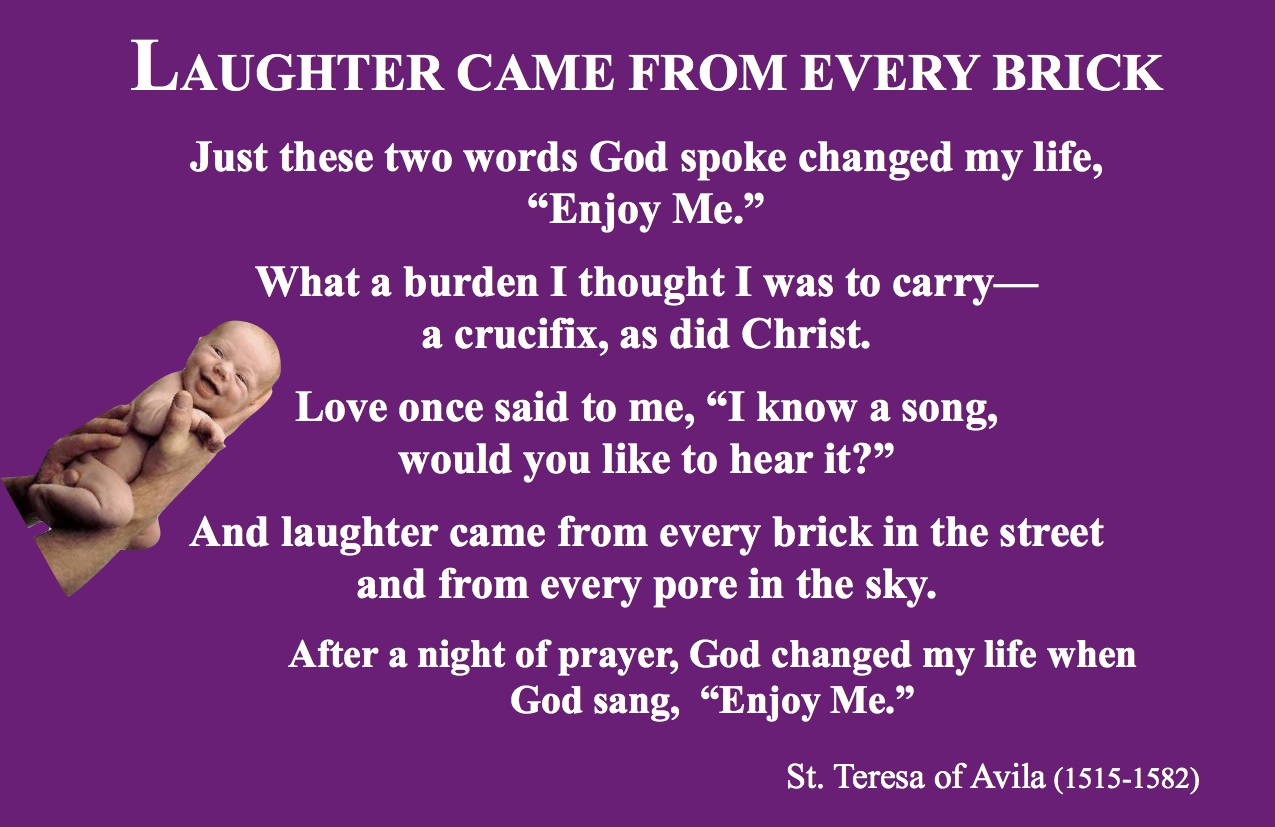
There’s a commercial currently running on the TV and each time it comes on, I can’t help myself, it makes me smile and if I let myself, it makes me laugh. It’s a collection of scenes in which lovely little babies laugh. They laugh and they laugh and they laugh and before you know it you’re hooked and you just can’t help yourself you are laughing too. Laughter is a great tonic! Laughter is good for the soul! And yet, for some unknown reason we tend to exclude laughter from our religious life. Religion is serious business and so we don’t laugh much in worship. There’s a quote from St. Teresa of Avila that served as a warning sign for me as I was preparing this sermon. “NOT YET TICKLED” writes St. Teresa, “How did those priests ever get so serious and preach all that gloom? I don’t think God tickled them yet. Beloved—hurry.” The thought of being tickled by God is delightfully refreshing.
I must confess that I don’t spend much time laughing with God. Listen to this quote from the writings of St. Teresa: “Just these two words God spoke changed my life, “Enjoy Me.” “What a burden I thought I was to carry—a crucifix, as did Christ. “Love” which is Teresa’s name for God. “Love once said to me, ‘I know a song would you like to hear it?’ And laughter came from every brick in the street and from every pore in the sky. After a night of prayer, God changed my life when God sang, “Enjoy Me.” Enjoy Me. What a different place the world would be if we could only hear God beseeching us, “Enjoy Me.”
We are a serious lot we Christians. Duty, responsibility, guilt, and consternation have left us precious little time to “Enjoy!” We’ve got things to do, stuff to learn, values to instill and standards to uphold, so we’ve put enjoyment on the back-burner. After all, God is far too high and mighty to be trifling with, we daren’t laugh in the presence of our God. And yet, God continues to tickle us. Over and over again, with the most absurd wonders, and we can’t help ourselves, but smile. Creation is so full of laughs. Life is so funny! And church, I mean, whenever I think of the ridiculous things we get up to in church, well its enough to make you laugh until you cry. So to those of you who insist upon personifying our Creator, don’t you try to tell me that the Creator of all that is or ever shall be, the one who is responsible for creating humour itself, doesn’t just roar with laughter at the stuff that we get up to. So, isn’t it just possible that when it comes to laughing babies, God has plenty of scope for delighting in us? Surely, laughter is one of the most sublime forms of prayer? We ought to lighten up and enjoy our time with God. Cause lord knows, serious people are all well and good but who wants to spend time with a bunch of folks who can’t enjoy a joke.
So with that said, let’s turn to this mornings Gospel reading. This story is a real tickler! But in order to get the jokes, you’ve got to know some of the stuff the insiders knew. It’s a bit like trying to understand British humour, sometimes you don’t quite get the joke, if you don’t know something about life in Britain. The Gospel of John is full of stories that play on the local humour of Palestine in the first century. This story, about the Woman at the Well is full of double en-ton-dras. Indeed, this story is so outrageous that when the powers that be were sitting around deciding which books would make it into the New Testament, The Gospel of John almost didn’t make the cut. This story was far too racy and I mean racy in both senses of the word, this story was about race and it was far too risqué for the likeings of the religious authorities who were functioning as the thought police for the early church. So, sit back and allow yourselves to be tickled as I let you in on the jokes. Continue reading →
Way back when I first began the formal process of becoming a pastor, the church committee responsible for helping people become pastors, recommended that I get a “spiritual director.” Among the many pieces of paper that the candidacy committee gave me, included both a definition of what a “spiritual director” is and who I might approach to be my “spiritual director”.
I remember three things about the church’s recommendation:
A spiritual director walks with, guides, encourages and challenges people to deepen their relationship with the divine.
A spiritual director is someone whose wisdom is derived from their own deep relationship with the divine together coupled with formal theological education.
The spiritual director is someone in whom the candidate for the ministry of Word and Sacrament can place their trust.
Although, I was blessed to know several people that that I trusted who might be able to walk with me, guide, me encourage me, there was only one person who I could trust to challenge me; I mean really challenge me. The problem was, I wasn’t actually sure if Henry’s theological education was quite what the church had in mind. Nevertheless, I decided to ignore that particular detail as I proceeded to invite Henry to serve as my “spiritual director”.
I had met Henry years earlier when we both were working for a package tour operator. Henry was responsible for graphic design and we worked together to produce some pretty snazzy travel brochures. At the time, I thought Henry was a little odd. He was older than everyone in the office. Henry came from Brooklyn and looked very much like the stereo-typical Jewish rabbi. I’m talking full black beard, black clothes, and a yarmulke. Turned out, Henry looked like a typical Jewish rabbi because he was a Jewish rabbi. Henry was working as a graphic designer to put food on the table for his family while he took a long-deserved break from serving as the director of a Jewish Yeshiva. Henry and I became fast friends.
Ours was a strange sort of friendship. Most of our conversations comprised of a series of questions without answers. I’d ask Henry a question, to which Henry would respond with an even deeper question, which would inspire and even deeper question with which I would be compelled to respond; it was kinda like dancing with ideas. Years later Henry would teach me that our dancing was actually an ancient form of the Jewish art of pilpul used by Talmudic scholars to get to the very heart of the sacred mysteries. It took me years to realize that Henry had become my spiritual director long before I ever asked him to formerly take on the role.
It turned out that Henry had studied at one of the best rabbinical schools in New York and was an accredited to be a “spiritual director”. Somehow, despite the urging of the church to select from their list of suggestions, I managed to get my candidacy committee to approve Henry as my spiritual director. To this day, I think the committee members over-looked the fact that Henry is Jewish, only because Henry offered to serve as my spiritual director without me having to pay him the going rate, which back then would have cost me way more than I could afford. As it turned out, Henry’s direction was priceless. So, many of the treasures that Henry shared with me continue to shape and direct me to this very day.Continue reading →
I am indebted to Jim Kast-Keat, a pioneering preacher who inspired me to open this sermon with the video below. I am also indebted to Bishop John Shelby Spong for teaching me more that I can articulate with words. His excellent book The Fourth Gospel: Tales of a Jewish Mystic opened the Gospel According to John in ways that have helped me to see aspects of the Divine to which I was once blind. Much of the sermon consists of extensive quotes from chapter 9 of Jack’s book.
Readings: John Chapter 2 and John 3:1-17
Watch the video below carefully before reading or listening to the sermon the sermon below.
Listen to the sermon:
So, before tackling the story of Nicodemus, I want to toss two balls into the congregation. The first ball I want to toss over here to this side of the congregation represents something all too familiar, biblical literalism. We know all too well that this particular ball has been distracting the church and most of the western world for the past few centuries. The second ball I want to toss over here to this side of the congregation represents historical biblical criticism. This particular ball is newer. It’s only been seriously tossed about for the past couple of centuries, but it is a really serious contender for our attention. But these balls have acquired a rather rhythmic bounce that tends to mesmerize us. Add to that these other balls the balls of church doctrine and theological dogma and before you know it we are so distracted that we forget what game we were trying to play in the first place as we try to keep up with the various passes made by players that have taken on a professional edge that leaves us watching from the sidelines unable to focus one of them.
None of these balls commanded the attention of the early Christians. They simply weren’t interested in taking the scriptures literally, nor were they particularly interested in the historicity of the scriptures. As for doctrine and dogma, well they were left to the professionals who only came to town on those unpleasant occasions when the league needed to ensure that it’s franchises continued to rake in enough money to keep the game on a sure footing. The scriptures, like all sacred writings, were about so much more than words scribbled on a scroll. The scriptures, like all scared writings, are about the mysteries of life. But these balls have been served up for us to play with and literalism and concerns about historical accuracy have done a magnificent job of distracting us from what really matters in these texts. Our fascination with the details of the fight-patterns of the balls that are tossed around whenever the stories in these texts play through our lives, have caused us to miss so many moon-dancing bears over the years.
Please don’t get me wrong, I love tossing these balls around and over the years I’ve learned to play ball with the best of them. But when a moon-walking bear dances onto the court, at the very least, we ought to notice the bear’s moves because the only way we’re going to learn to dance with these bears is by paying attention.Continue reading →
When I was just a kid, I had what can best be described as an adolescent crush on a teacher. Looking back on it now, I’d have to say that I fell head over heels in love with my teacher. It was the kind of love that only a 13 year-old girl could have; so intense and all consuming. I came to believe that this teacher was the wisest, kindest, most interesting person in all the world. This teacher knew more than anyone else, especially my parents. This teacher was cooler, funnier, more daring and definitely more in tune with my life than anyone I had ever met. I was convinced that if I could only be just like this teacher would mean that I too would be cooler, funnier, more daring and definitely more in tune with life. So, like most adolescent girls who are suffering from a crush I became obsessed with this teacher. I was young and I was in love, and like most thirteen year-old’s the I was convinced that the world revolved around me, so I set about pursuing my passion. This teacher taught English, so naturally, I decided that when I grew up I too would teach English. This teacher loved poetry, so I too became passionate about poetry.
One day this teacher announced that we could gain extra-credit if we wanted to enter a local poetry writing contest; and even though I was pretty sure that year I’d be getting a mark that would be somewhat better than an A, I began to write poetry. I was very serious about my poetry writing. I carried a pad of paper with me everywhere I went, and I began to ruminate about my life. I don’t remember any of those early attempts to wax poetical, but I do remember that each and every one of those poems was about me; me and my life, me and my unrequited love, me and my passion, me and the horrible way that no one paid much attention to me. Me, Me, Me, Me, it was all about me.
As the time drew near for us to submit our poetry to the competition, my teacher announced that there would be a special class after school, so that those of us who were planning to enter the competition could get some feedback on our efforts. So, by the end of the week, I would have to choose one of my great works for feedback. I spent hours pouring over one poem in particular. Tinkering with the words, trying to get things just right. I was so very proud of the final draft. I’d carefully copied it out on to a crisp piece of foolscap. Arranged the letters in the middle of the page so that they looked just so. I could hardly wait for school to be over so that I could rush to see what comments my beloved teacher had placed in the margin. There were barely a handful of us who stayed after school.
Looking back on that scene, we were a nerdy little crew. I was positively breathless as my teacher handed my offering back to me. To this day, I can’t remember a single line of my great work, but I can tell you word for ward what was scribbled in red in the margin of the ever so white foolscap. “A little self-involved, try looking outward.” I was devastated. How could anyone be so cruel? I’d poured my heart out only to have it stomped on by the indifference of truth. Continue reading →
So many of our Lenten practices revolve around theories of atonement that cast the HOLY ONE as a participant in a grand bargain that saw Jesus of Nazareth die as a sacrifice for sin. For those of us who have left behind theories of atonement that set Jesus up as payment for our sin, Lent can seem a very lonely place. While many churches busy themselves with rituals that encourage repentance from the perspective of confessing our unworthiness to a grand-inquistor deity, it is tempting to give up the season of Lent all together. But with the explosion of information about the nature, beauty, and complexity of the cosmos, perhaps we can achieve the humility that the ritual of confession offers in ways that do not require us to adopt the attitude that human’s are unworthy creatures in need of a god who would demand satisfaction at the expense of a blood sacrifice.
Each time I look up into a starlit sky I am overcome with a sense of awe and wonder that is in and of itself a prayer that inspires humility in me. A sense of awe and wonder at that which is beyond ourselves is the beginning of a prayer that always leads me to a sense of ONENESS with all that IS.
This morning, my Lenten devotion came to me in the form of this splendid video The Overview, which describes the awe and wonder of those who have had the privilege of looking at the earth from the perspective of space. They describe their awe and wonder, their prayer if you will, as the “overview effect”. The overview effect serves to connect these space travellers to the earth itself and moves them to the kind of humility that helps me to realize that awe and wonder can serve as nourishment for my own Lenten journey.
As we gaze in awe at our marvellous planet perhaps we can be moved to tread more lightly upon her. Perhaps awestruck by the beauty and wonder of creation, we can look to all the inhabitants of the earth and see that they too are fearfully and wonderfully made. I trust that a humility based not on a belief that we are wicked, unworthy creatures, but rather on a experience of awe and wonder, will lead us on a Lenten journey to a place where we will have the courage to gaze upon the cross and see beyond the violence to the hope of resurrection.
Little Crystal was only two and a half years old when she got hopelessly stuck.And when she got stuck she did what all small children do, when they have gotten themselves into a situation that the can’t get out of, little Crystal cried for help. She went into her mother’s study, holding in one hand a family treasure and her other hand couldn’t be seen. Crystal cried out, “Mommy I’m stuck”. Her unseen hand was stuck inside her great-grandmother’s vase. The precious vase had been handed down from her great-grandmother to her grandmother, to her mother. Crystal had always been told that one day the magnificent vase would be hers.
Crystal’s mother tried to move quickly without panicking. She scooped the vase and her little girl up into her arms and carried them to the kitchen sink. She used warm soapy water to try to loosen the toddler’s hand, which was stuck all right. When soap didn’t work she reached for the butter. While greasing her child’s wrist like a cake pan, she asked the obvious “mother question.” “How in the world did you do this, child?” Crystal carefully explained that she had dropped candy down into the vase to see if she could still see it when it was at the very bottom. But she couldn’t see it, so she reached in for her candy and that’s when she got stuck and she couldn’t get her hand back out.
Well, as time passed, the situation became more and more serious. Crystal’s mother called for re-enforcements. She phoned her own mother and told her to get there as fast as she could. A neighbour suggested Vaseline. The apartment manager got out some WD40. Still no luck. It began to seem like the only way to get Crystal’s hand out was to break the family heirloom.
When Grandma finally arrived, both Crystal and her mother were almost hysterical. They were both more than a little relieved to have Grandma’s calming presence. Grandma sat little Crystal on her knee.
Crystal was very upset and still very stuck. Grandma took a good look at the vase that used to sit on her mother’s kitchen table all those years ago. She looked at the miserable look on her grand-daughter’s face, and she said, “Crystal, sweetheart. Your mommy told me that you reached into the vase for candy. Is that right?”
Crystal was a little breathless from all the crying she had been doing and all she could manage was a whimpered, “Mmm hummm.” “Honey, tell grandma the truth now. Do you still have a hold of that candy?” “Mmm humm”. Crystal sobbed. Then Grandma rubbed little Crystal’s back, held her close and gentle, but firmly said: “Let it go, child. Let it go.” Sure enough, the vase slipped off as smooth as silk. (I have searched for the source of this story, without success. I first heard it at a retreat on the West Coast a lifetime ago)
In this fast paced world of ours, I often find myself in little Crystal’s predicament. Surrounded by a treasured family heirloom, desperately clinging to a treasure. My predicament often makes it difficult for me to appreciate the beauty of the heirloom. Letting go isn’t as simple as it sounds. But sometimes letting go is the only way to preserve the integrity of the heirloom. When I think about the church’s practice of public confession, I can see how desperately I have been holding on to candies that no longer satisfy my need for forgiveness. Continue reading →
Readings from Teresa of Avila can be found in the Worship Bulletin here
Listen to the sermon
During the season of Lent we are invited to follow Jesus on a journey out into the wilderness. Lent is a time to leave behind the safe and familiar and journey out into the wilderness of the unknown. The wilderness can be a frightening place. Unknowing is not a posture we like to adopt. The temptation for us sentient thinking beings is to fill the wilderness void of unknowing with words, ideas and stories that both comfort us and help us to deny our state of unknowing. But our journey, whether we like it or not is the kind of journey where the destination itself is not known and so the wilderness places that we encounter along the way can create in us the kind of fears that cause us to deny reality.
Earlier this week some of us gathered in this sanctuary for Ash Wednesday, the day that marks the beginning of Lent; the beginning of our journey into the wilderness. One of the things we do on Ash Wednesday is to remind ourselves that we are dust and to dust we shall return. In other words we were born and we shall die. This part of the journey will end for all of us in death and there is so much about death that we do not know and that not knowing can fascinate us, it can infuriate us, and it can frighten us.
Sometimes this not knowing can frighten us so much that we deny the reality that in the end death comes to us all. When death does make its presence known to us, we find ourselves tempted to deny our unknowing with ideas about what will happen to us when we die; ideas that some of us insist must be believed. We’ve crafted those ideas about what will happen to us when we die into all sorts of doctrines and dogmas that we’ve imbued with the power to determine how we live, before we die. You know if we believe and we behave, then when we die we will be rewarded or if we don’t believe and we don’t behave when we die we will be punished. The temptation is to believe that these ideas, doctrines, dogmas, beliefs, and behaviors can save us. The reality is that we simply don’t know what is going to happen to us when we die.
A while back, I was asked to visit a woman who’d been raised to believe that these ideas, doctrines, dogmas, beliefs, and behaviours could save her from her fears and anxieties about her eventual demise. For the purposes of this sermon, I’m going to call this woman Grace, not because that’s her real name, but because my encounters with her were so grace-filled that I know whenever I think of her I shall always remember how full of grace this life of ours can be. I was summoned to speak to Grace because she’d attended a baptism here at Holy Cross and based on what she heard that day, she believed that I would be a good person to help her drive away her fears about dying. Grace was in her early eighties and she had been raised in the Lutheran Church, baptized and confirmed in the Lutheran Church. But it had been quite a few years since she’d attended church on a regular basis; just the odd, baptism, wedding or funeral brought her to church these days. Faced with her own mortality, Grace wanted to get a few things straightened out before she died.Continue reading →
An article by Brandon Ambrosino in the Religion section of the Hufington Post sent the wheels in motions. I am indebted to Pete Rollins book the Idolatry of God as well as his video Atheism for Lent for providing me with the courage to preach this sermon. Lent 1 – February 17, 2013 – Listen to the sermon here.
I swear to you it happens to me every year! It usually happens when the first person asks me what I’m giving up for Lent. When you’re in the line of work that I’m in, I suppose you should just get used to it. But somehow that particular question makes me wish I did something else for a living. People don’t usually mean much by asking the question. At this time of the year, “What are you giving up for Lent?” is sort of like when people ask you, “How are you doing?” They’re not really interested unless you have a pithy answer. I I must confess that over the years, I’ve come up with more than a few pithy answers. Like the time, shortly after I first came to Newmarket to be a pastor and my Mother, who does not observe Lent asked me what I was giving up for Lent and in a feeble attempt to make my Mother laugh, I told her I was giving up drugs and sex for Lent. Things went very quiet on Mom’s end of the phone line. The truth is that the answer I most feel like giving when people ask me what I’m giving up for Lent requires so much time to explain that I rarely answer the question truthfully. But t’is the season for confession, so please forgive me but I’d really, really, really, like to give up Lent for Lent! I mean who among you, woke up this morning and said to yourself, “Oh goodie it’s the first Sunday in Lent! Yippie!!!”
I remember when I first started going to church, I was a teenager, and I don’t mind telling you that my first experience of Lent almost sent me packing. All I heard was that we are in bondage to sin and cannot free ourselves. All that talk about sin made me feel so guilty and worthless. I was just 15 years old and I hadn’t had much of an opportunity to commit much in the way of sin, and all I kept hearing was repent, repent! The message I received loud and clear during those first few Lents in the church was that I was nothing but a wicked sinner, a worthless worm! Poor, poor, pitiful me! But have no fear, cause Jeeezus can make you better. And all you have to do is give something up for Lent!!! Jeeezus, he’s on his way to be executed on a cross, because of you, so you owe it to Jesus to feel lousy because he’s going to sacrifice everything for you. They’re going to nail him to a cross because of you. You wicked sinner. The least you can do is give something up for Lent.Continue reading →
I am indebted to the exegetical work of John Holbert for the insights into Hebrew humour!
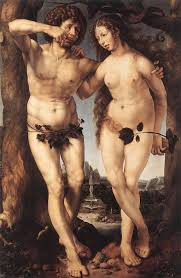
Each year as Lent approaches, I find myself flirting with the idea of giving up Lent for Lent. Lent is just too much work. For centuries, during Lent the church has emphasized so many concepts that seem alien to the 21st century mind. Each year during Lent preachers are required to undertake the unenviable task of unpacking unpopular, seemingly antiquated concepts in an effort to encourage the contemporary churchgoer to entertain the equally antiquated rituals of Lent. I mean Christmas and Easter might attract a few more people to our sanctuary, but how do you attract people with talk about repentance or fasting? Just look at our readings for this morning. Temptation is the order for toady. Eve and Adam succumbing to temptation, the Apostle Paul prattling on, heaping condemnation upon the first parents for having given in to temptation, and then Jesus himself resisting temptation from non-other than the Devil. Not exactly cheery stuff designed to bring comfort on a cold damp winter morning, where apart from the time change, there are very few signs of a longed for spring.
But Lent has arrived and so we must tuck into this dish of temptation hoping that it will reveal some hint of the promise of what lays beyond our long Lenten journey as we travel toward Easter’s resurrection joy. But these are not easy readings to unpack.
I could begin by warning against taking these texts literally. But you have heard warnings against taking the text literally and I know that you understand that the story about Eve and Adam is just a story. It never really happened. Most of you, even though you might be tempted to think that Jesus literally went out into the wilderness and was tempted by the Devil, most of you have long since realized that the Devil doesn’t actually exist. If you’re still tempted to believe that this story actually happened, well, the fact that in the story itself, Jesus goes out into the desert all by himself ought to at least make you pause to ask, who wrote this story down, if there was nobody there but Jesus and the Devil?
These stories are just that, they are stories. In the words of Marcus Borg, “The events in these stories never actually happened. But the events in these stories are always happening.” Let me say that again, lest there be any doubt: They never actually happened, but they are always happening. That’s what makes these stories such great stories. The stuff in these stories is always happening over and over again. Temptation is the stuff of our lives. Each and every one of us, each and every day struggles with temptation, each and every one of us and all of us together as humanity. This grand human experiment that we are caught up in requires that we all struggle with temptation. Continue reading →
Traditionally the season of Lent is a mournful time filled with calls to repentance and self-examination as we follow Jesus into the wilderness to be tempted and then on that long march to Jerusalem where the powers that be will have their wicked way with him. Our liturgies take a mournful tone as we lament our woeful human existence, confess our sinfulness, and hear exultations to take up our crosses so that we too can follow Jesus to the bitter end. Over and over again we are asked to remember that we are in bondage to sin and cannot free ourselves, as we gaze upon the cross remembering that Jesus our savior bled and died as a result of our wicked sinfulness.
Lent is a strange season that harkens back to a forgotten era. Unlike so many of the seasons of the church year it’s not exactly a season that attracts people to church. Not many of you got out of bed this morning and said, “Yippy it’s the first day of Lent. Oh goodie! We get to be reminded that we are sinful, that life is miserable and unless I’m willing to take up my cross and follow Jesus all the way to Golgotha, there’s precious little hope cause we’re all going to die and when the time comes we want Jesus to remember us.”
Now I know that there are some people who just love Lent and I must confess that I like the quieter, more somber tone that our liturgies take. I actually enjoy the opportunity to slow things done and be more reflective in our worship together. I savor the silences and the opportunities to be more contemplative. I love the colour purple with all its vibrant hues and the best part of all is that the beginning of Lent means that spring is just around the corner. What I don’t like about Lent are the signs, symbols, hymns and stories that make it so easy for us to fall back into the 11th century.Continue reading →
On Ash Wednesday, we dare to speak the truth. We speak the truth not in the refreshing light of the morning but in the cold darkness of a winter’s night. We are dust and to dust we shall return. We will die. We are mortal beings and so our lives will end. Our culture has taught us to deny death. Even our funerals have become celebrations of life. But life without the reality of death is lived cheaply, shallowly, in a half-sleep always pushing away and denying reality. So, on Ash Wednesday let us revel in the knowledge that we are dust and to dust we shall return. Revel in this knowledge because it liberates us!
On Ash Wednesday, the realty that we are part of something so much bigger than ourselves is born out in the knowledge that we are stardust, elements of the universe molded together over eons, molded together by a force bigger than we can even begin to imagine, a force we call God, whom we have come to know is LOVE. LOVE breathed into the timeless elements and from the dust our ancestors emerged. Each one of us lives and breathes and has our being as a result of the confluence of so many miracles we shall never be able to count. The LOVE who is God lives and breathes in with through and beyond us.
I have only words to describe the brilliant beings that each of you are. The splendor of what has emerged from the dust and what shall return to the dust is magnificent. That magnificence is made all the more spectacular with the knowledge that it is fleeting. The knowledge that we are dust and to dust we shall return liberates us from delusions of grandeur for we know that this spectacular, magnificent, life that we are currently experiencing will end and we shall die. There’s an Irish expression that I have come to love, it translates from the Gaelic into something like: “We’ll be lying down in the earth for about fifteen million years and we have only a short time here; a brief collection of moments. If that isn’t motivation for each and every one of us to live everything that is within us, then perhaps we have already died.
So, much of what passes for life in the 21st century is merely a distraction from the reality that we shall die. Preoccupied by our distractions we forget that we are part of something so much bigger than our minds can grasp. Each one of us was billions and billions and billions of years in the making and each and every molecule of who and what we are will continue to be for billions and billions and billions of years to come.
Who and what we are is beyond our ability to comprehend. We are part of something so much bigger than we can imagine. This small part of that reality this little piece that we call our life is a precious part of reality. If there is a sin that we must all confess, it is the sin of a life unlived. Our overwhelming fear of the unknown causes so many of us to settle for less. We cannot know what or how eternity shall unfold so we settle for something smaller, something more manageable and we live within the confines of what makes us feel safe. We dare not risk the temptation to wonder at the enormous reality of which we are all a part. We dare not begin to imagine how infinitesimal our time in this part of reality shall be. So, we settle for less, less wondering, less imagining, less dreaming, less reality, less life, and yes even less eternity.
On Ash Wednesday, the liberating knowledge that none of the distractions that make us feel safe can separate us from the truth that from dust we came and to dust we shall return, ought to at the very least empower us to live fully, here and now. On Ash Wednesday, we sit with the power of our own death to return us to the dust from whence we came. We spend a few moments mourning the missed opportunities, the failures and the pain and we talk a long, slow, deep, cleansing breath; a breath that reminds us of the first breath, the ruach of which our ancestors spoke, the breath, wind, spirit, that first breathed life into our dust-formed self; the breath, wind, spirit, that breathes even now, in, with, through, and beyond us, and we trust that that breath, wind, spirit, ruach comes from the Reality that lies at the very heart of all that is, the reality that we call God, the reality that we know is LOVE.
In and out we breathe, trusting that the One who is LOVE will breath in, with, through, and beyond us so that when our life here comes to its inevitable end, all that lies Beyond the Beyond, and Beyond that also will receive our dusty selves into the LOVE which is God.
Such freedom. Remember that we are dust and to dust we shall return. Such liberation. Let us live fully, here and now, savoring each and every moment of this wondrous life. Let us not settle for anything less than the magnitude of each and every moment. For we are dust, molded and shaped by LOVE, for LOVE, and to the dust we shall return. We are part of something so much greater than we can even begin to imagine. We are wonderfully and fearfully made, fit for life, here and now. We shall all die, return to the dust and there are billions and billions and billions of years to come. Our part in those years is a mystery; a mystery beyond our ability to begin to imagine.
Embrace eternity if you dare. Remember that we are dust and to dust we shall return and rejoice in the freedom that the knowledge of our death brings; the freedom to live fully here and now. Let it be so, dear friends. Let it be so!
Readings: Exodus 32:1-6, Matthew 17:1-9. Listen to the sermon here
Monday, Tuesday, Wednesday, and Thursday of this week, I found myself studying the transfiguration of Jesus. So much has been written and said about this strange little story given to us by the early followers of Jesus. I was planning to do what I’ve done here on many Transfiguration Sundays and preach to you about the power of myth to open us to new ways of understanding who and what Jesus embodies. Then two things happened on Thursday that transfigured my own images of the transfiguration of Jesus.
Where once my images were shaped by the mythological language used by the crafters of the story of Jesus’ transfiguration, the experiences I had on Thursday have transfigured Jesus in ways that reveal the glory of God beyond the pages of scripture and into the realms of the cosmos and beyond. The first thing that happened on Thursday, happened not just to me but to the whole world.
You see on Thursday, NASA, announced, and I quote: “the discovery of seven worlds orbiting a small, cool star some 40 light-years away, all of them in the ballpark of our home planet in terms of their heft (mass) and size (diameter). Three of the planets reside in the “habitable zone” around their star, TRAPPIST-1, where calculations suggest that conditions might be right for liquid water to exist on their surfaces—though follow-up observations are needed to be sure. All seven are early ambassadors of a new generation of planet-hunting targets.”
NASA’s announcement was accompanied by an artist’s rendition of what has taken place. Watch for yourselves…
As I struggled to wrap my brain around the reality of what has been discovered, our little grand-daughters came for a sleepover.Audrey is three and Evelyn is two and together they are a force to be reckoned with. I’d almost forgotten all about Trappist 1 when I found myself leaning over little Evelyn’s travel cot as she began to sing. It took a moment or two before I recognized her tentative little voice attempt to capture the tune. It didn’t take too long for me to join her: “Twinkle, Twinkle, little star how I wonder what you are. Up above the sky so high, Like a diamond in the sky. Twinkle, twinkle, little star, how I wonder what you are. In a darkened room, I stroked my granddaughter’s cheek and I was transported to a long-ago darkness that still overwhelms me. The memory of a long-ago night, far, far, far, away, in an alpine meadow at the foot of the Black Tusk mountain, near Whistler. After a long day’s hike up the Black Tusk trail, we’d camped out in Taylor Meadows, a spectacular spot located more than 7,000 feet above sea-level. Twinkle, twinkle, little star, evoked an intense memory of staring into the night sky, mesmerized by the sight of more than my mind could comprehend.
Darkness, darkness, like you never experience near the city. Darkness so deep and so vast. Darkness full of twinkling lights. Twinkle, twinkle, little star. How I wonder what you are. Vast, immensities, stretching, beyond, the beyond, and beyond that also. 40 light years from here.Continue reading →
Between the readings we were treated to a performance of Neil Bertram’s “Theory of Relativity” performed by Amelia DePiero, Rachel Miller, Linda Condy, Gary Curran, and Kyle Merrithew, accompanied by Marney Curran. This dynamic piece set the tone for the sermon’s exploration of MYSTERY.
“There is one body and one Spirit,” “The body is one,” “God is the One who gives everyone life, breath-everything.” These words attributed to the Apostle Paul in the New Testament echo an even more ancient notion of Oneness. For thousands and thousands of years, in various cultures and religions, humans have shared an intuitive sense of oneness. Indeed, it could be said that this innate notion that our individual stories are part of something bigger than ourselves lives in each one of us.
My own relationship with this idea of “Oneness” with all that is and ever shall be dates back not to the bible, but rather to some old Trixie Belden mysteries. As a little girl, I remember devouring Trixie Belden mysteries. Trixie Belden, Nancy Drew, and even the Hardy Boys gave way to Agatha Christie mysteries, followed by Sir Arthur Conan Doyle’s Sherlock Holmes mysteries, giving way to John la Carre mysteries of international intrigue. You just can’t beat a good P.D. James murder mystery. These days I don’t have a lot of time for mystery novels so I satisfy my lust for mystery with great British TV dramas. American TV mysteries tend to be too easy to solve. Nobody does murder like the Brits, so whether it’s Midsummer Murders, Broadchurch, Inspector Morse, Wallander, or the latest incarnation of Sherlock, count me in. I like nothing better than a TV mystery that you can’t figure out until the last few minutes of the show when all is revealed. Clever, ingenious, solutions, to devious mysteries that keep you guessing, lead you up various garden paths, and delight you with one wrong turn after another, only to dumbfound you with the final reveal; now that’s entertainment.Continue reading →












 pastordawn