
Join us tomorrow as we celebrate the Baptism of Jesus. Everyone is welcome!
See you at 10:45am at Holy Cross Lutheran Church
Our Hymn of the Day will be Marty Haugen’s Song Over the Waters


 There’s a definition of what it means to be a priest that has always daunted me. A priest it has been said is “a keeper of the mysteries; a keeper of the sacred mysteries of our faith. People often confuse the idea of mystery with the idea of secret. But I can assure you that as a keeper of the mysteries of the faith it is not my job, nor is it any other priest’s job, to keep the mysteries of our faith a secret. Yes, as an ordained pastor, one of my responsibilities is to be a keeper of the mysteries of our faith. As a keeper of the mysteries I am responsible for ensuring that the community I serve holds those mysteries sacred. We do so, by remembering that the reality that we call God works in, with, and through those mysteries.
Baptism is considered to be one of the mysteries of our faith. Baptism is a sacrament of the church and by definition a sacrament takes ordinary stuff – water – mixes that ordinary stuff with the Word and in the combination of water and the Word you have a tangible means of God’s grace. God’s grace is revealed in the sacrament of Baptism by the act of our gathering together and mixing the stuff of the earth with the Word. We have only two sacraments in the Lutheran church Baptism and Eucharist, and both of those things are sacraments because we gather together take ordinary stuff – bread and wine, or water and mix it with the Word of Jesus the Christ and in the water, the bread and the wine the means of God’s grace is made visible to us.
So, there you have it the technical definition of the sacraments, the mysteries of Baptism and Communion, in which the reality that we call God works in, with, through and under. But like all technical definitions of mysteries, these definitions fail to capture the essence of the mystery that lies at their very heart; the mystery of the reality that we call God. As a keeper of the mysteries, one would think that a priest, a pastor, ought to be able to reveal, by way of definition something of the nature of the reality of the Divine. The truth is I have no real definition to offer you of this reality that we call God. I read once, I wish I could remember where the wisdom of a priest far more skilled than I who declared that he’d given up trying to explain God to anyone because in the end, he said, “I cannot lead you to God, anymore than anyone can lead a fish to water.”
The most important thing I learned in seminary is that “I don’t know is an answer.” The truth is the more we learn the more we know that we don’t know. But this unknowing can be so unsatisfying, precisely because we believe that God is the one in whom we live and breath and have our being, we want to know the very nature of the One who is the ultimate Reality.
Now, if these words haven’t already become so vague that the veil of unknowing has begun to make any tangible means of God’s grace seem invisible and so beyond our grasp, let me leave the theology behind and tell you a story. One thing I do know for sure is that the shortest distance between the questions of what it means to be human and understanding our humanity is a story. Continue reading
 In this coming Sunday’s gospel text (Matthew 3:13-17) we will hear echo’s of the Bat Qol which speaks at Jesus’ baptism as the heavens are torn open. The hebrew “bat qol” (bat cole) is often translated as “the still small voice” but when translated literally it is the “daughter of a sound”. The voice of God speaks to declare love. May you hear yourself named and called by that voice, for you are the daughters and sons of God, beloved of God!
A little music to tune your ears with. Enjoy you beloved daughters and sons of God! Then be the lovers you are created to be.
 Thanks to science and all we have learned about creation, we are beginning to develop new images of the ultimate reality we call God. New images of God challenge the patriarchal misogyny of religious traditions. When it comes to re-imagining the faith, Sister Joan Chittister paints a picture of God as One Who Summons from among us – Emmanuel. The Summoning One calls and encourages us toward a world of equals. “Evolution is shedding new light on our lives.”

A sermon for the Second Sunday of Christmas:
Readings: John 1:1-9; Thomas 70; Matthew 2:1-12
Listen to the sermon:
These post-celebration days, provide us with an opportunity to find our natural rhythm. Irish mystic, theologian, philosopher John O’Donohue offers wisdom for our journey.
For those who are preparing to preach on Matthew 1:1-12 this coming Sunday, Jack Spong provides an important view of the context.
 Maybe it’s because I’ve directed too many Christmas pageants, but when I hear the story of the Magi visiting the baby Jesus, I don’t think of three kings at all. No visions of regal visitors decked out in their finest riding atop camels guided by a star for me. Just memories of little boys, decked out in colourful shiny robes that threaten to trip them up, giggling and roughhousing, with their cardboard crowns askew. Of all the little boy kings that I’ve tried to corral one of them stands out from all the rest. Perhaps I remember him so well because he was so little that we couldn’t have him knell at the manger for fear that he would disappear into the hay and our audience would only see two Wise Guys paying homage. Or maybe it was the speed with which he dashed in and out of the gang of shepherds who threatened to trip him up with their crooks. But I really think it was the ingenious way he solved the problem of his lost gold, that makes little, for the purposes of this sermon let’s call him Jay, stand out from all the other little boy kings.
Little Jay’s mother, like all the mothers of all the kings, was responsible for creating a facsimile of the gift her wise son would bestow on the baby Jesus. Unlike some of the feeble efforts that I’ve seen over the years, Jay’s gift of gold was a cut above the rest. Inside an elaborately carved box that his Dad had picked up on his travels to the Middle East, Jay’s mother had placed upon a bed of statin a carefully created block of wood wrapped in golden gift paper. It positively sparkled. It must have impressed Jay, because he was forever opening up his box to show his fellow cast-members his treasure. During the dress rehearsal, Jay’s performance was perfect. Jay positively perfected the art of gazing up at the makeshift star that hung above the altar just east of our makeshift manger. When he arrived at the place where the newborn baby Jesus, who just happened to be a little girl that year, Jay strode right up to her mother Mary and opened the box containing his treasure and proudly announced his gift of gold for the new born king. They, whoever they are, say that if the rehearsal doesn’t go well then the performance will be wonderful. So, I was more than a little worried when our dress rehearsal went off so splendidly because that could mean only one thing, and I wasn’t looking forward to a performance where things went wrong. Sure enough, unbeknownst to me, on the morning of his big performance, somewhere between his home and church, Jay lost his golden treasure. All he had was an empty box when he showed up at his father’s pew wailing because all was lost. Jay had no gold to give to the baby Jesus.
This story reminds me of a story that Joan Chittister tells that I’ve told you before but like all good stories it is worth telling over and over again. It’s the story of a Sufi master who was found scratching through the sand in the middle of the road. “What are you doing?” some pilgrims asked the Sufi as they passed. The old Sufi looked up and said, “I’m looking for my treasure. I’ve lost it.” the old man said. So the pilgrims, good people all dropped to their knees to help. They sifted sand. They dug under stones. They sweat under the waxing midday sun. Until, finally, hungry, soaking wet and exhausted, one of the travellers asked of the Sufi, “Sufi, are you sure you lost your treasure here?” And the old man said, “Oh, no. No, I didn’t loose my treasure here, I lost it over there on the other side of those mountains.” Continue reading
 An Epiphany Sermon, preached in 2008. I had just read “The First Christmas” by John Dominic Crossan and Marcus Borg. Our congregation played host to Dom Crossan a month before I wrote this sermon. So, Dom’s insights run through this effort. But the heart of this sermon beats as the result of a sermon preached by Bruce Sanguin a self-proclaimed evolutionary christian who is a United Church Minister (Canadian Memorial Church, Vancouver). I had the privilege of meeting this modern mystic while on sabbatical this summer and his compelling way of unlocking the scriptures using the wealth of the christian tradition together with the insights of modern science and psychology borders upon the poetic. This sermon was anchored by Sanguin’s words (Epiphany 2007). Sermons are a “live” event. So, this manuscript is an approximation of what was actually preached.
Just five days before Christmas (2008), The Archbishop of Canterbury, The Most Reverend Doctor Rowan Williams, the leader of the worldwide Anglican Communion started a firestorm. During a BBC interview, His Grace was quoted to say that the story of the “three wise men is a legend”. The Archbishop was also heard to say that he remained unconvinced that there was indeed a star that led the legendary trio to the birth place of the Christ Child.
If that wasn’t enough to send folks off the deep-end, it has been revealed that the Presiding Bishop of the U.S. Episcopal Church The Most Reverend Doctor Katherine Jefferts Schori, who just happens to be the first woman elected primate in Anglican history, has fanned the flames of the fire-storm by sending out what has been judged by some to be an incendiary Christmas card.
I downloaded a copy of the offensive card, so that you could see for yourself. Her Grace’s choice of card has offended the good deacons of Ft Worth Texas who claim that their Primate’s actions defy explanation. As you can see the wise folks depicted on this image look a lot like women. Can you imagine the nerve of the first woman primate! How could she be so bold as to select such an offensive image? Leave it to straight talking Texans to set things straight: for despite the audacity of the Primate, the Texans have pledged to “stand for the traditional expression of the Faith.” Continue reading
John O’Donohue was an Irish, mystic, philosopher, poet whose way with words opens hearts and minds to eternity.
 While the world hurdles toward the New Year celebrations, we linger in the Twelve Days of Christmas. I do believe that the counting begins on the first day after Christmas; which means this is only the Third Day of Christmas. That means there is still time to enjoy the music of Christmas and so, I offer up one of my favourite singers: Odetta proclaiming the Good News in her own splendid style with Go Tell it on the Mountain.
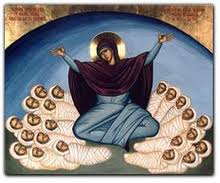 “A voice was heard in Ramah sobbing and lamenting loudly: it was Rachel weeping for her children; she refused to be consoled, for they were no more.” Matthew 2:18
Matthew 2:13-23 seems like such an offensive text to be reading so soon after Christmas. And yet, this gospel text, known as the “Slaughter of the Innocents” is indeed the prescribed lesson for the first Sunday of Christmas. Amid our celebrations, and in the midst of the gospel writer’s account of the birth of Christ, this horrendous story of the slaughter of innocents begs the question: WHY? It’s Christmas for heaven’s sake! My preaching professor, used to remind us of the first question that we should ask when we are preparing a sermon on a particular text. After reading the text over several times,we were encouraged us to ask the obvious question. “So What?”
So What? Well for this child of the sixties, only one Christmas song comes to mind when I read of the slaughter of the innocents, it’s the one Christmas song that asks the question: So What? We’ve just celebrated Christmas? So what does this mean? Please listen. “So this is Christmas?”
John Lennon was murdered on December 8, 1980. Shot by a deranged fan. And so is it any wonder, the melancholy why in which he sang this song, haunts our Christmases? So, what possible difference can Christmas make? We haven’t even had a chance to finish our celebrations and the news is far from good. Thousands continue to die in Sudan, Palestine is a mess. The people of the Philippians continue to suffer in the aftermath of disaster. Militants in Afghanistan are growing stronger despite the presence of foreign forces, violence and death are the order of the day in Syria where hundreds and thousands have been slaughtered. Millions have died in Darfur and still the world cannot find a solution so today thousands more will se-come to starvation and genocide. The war on Terror rages on as one side scores points on the other at the cost of human flesh and the word “drone” has taken on a horrific meaning. AID’s continues to ravage Africa and still we withhold the money and the medicines that could save millions. Hunger continues to claim the lives of the poor despite the fact that we have more than enough food to feed the world. Poverty continues to enslave millions the world over.
Rachel’s children—our children, yours and mine—born for love and mercy, die from neglect and ugliness and Rachel weeps bitterly. There’s a little book of prayers called: “Children’s Letters to God”. The prayers in that book have the power to make you smile and cry all at once. The very first letter to God in that book reads: “Dear God, in Sunday School they told us what you do. Who does it, God, when you are on vacation?” We may smile, but sometimes it feels as if for all intents and purposes, God is on vacation. For surely God would not stand idly by and allow so many innocents to perish?
Once we broaden our images of God; the source of our being, the One who dwells in us, we can begin to see that the place where we have traditionally located the Divine One changes from up there to in and around here and we can begin to seek God not out there but within and around us. If God is on vacation, it is because we are on vacation. For the Divine one works in, with and through us to sooth the pain caused by violence and greed.
So, let me assure you sisters and brothers, our God is not on vacation. Despite appearances to the contrary, our God is not absent, but God is surely weeping. For in Christ God showed us the way. The Christmas story insists that our God is in-fleshed and dwells among us. This changes everything. It’s not enough to pray with words expecting some far off deity to change the world. The changing of this world will happen when we begin to live into our full humanity and the sacred nature of our very being shines forth with LOVE. In, with and through us is how the LOVE we call God changes the world.. For we are God’s people on earth; Christ’s body on earth and it is through Christ’s body that God will save the innocents. There’s no time for us to waste feeling overwhelmed by the magnitude of the problems. It’s time for us to roll up our sleeves and get busy.
There’s a song that helps me to remember the hope born in Bethlehem. These Hands
And so this is Christmas… Rachel weeps. We’ve been on vacation long enough. Our God has taken on flesh and dwells among us! It’s time for the work of Christmas to begin again. We are God’s hands!
 During these twelve days of Christmas we celebrate the birth of the Messiah. Messiah, is a word the ancient Hebrews used to describe the anointed one. The one whom God would send to change the world. In Greek the word for Messiah is Christ.
On this Boxing Day, my thoughts swirl around a poem written by the unknown writer of the Gospel of John in which the birth of the Christ is describe as the WORD. It’s a mysterious cosmic poem that moves our minds away from the mundane everyday ordinary stuff of life to the extra-ordinary mysteries of creation, which when you think about it is what every birth does.
Just holding a newborn in your arms and before long you’ll find yourself pondering the mysteries of this life. Who are we and where do we come from? Why are we here? What does it all mean? These are all perfectly wonderful questions and speculating upon the many possible answers to those questions is a fascinating process. But in the end, our words will always fail us when it comes to answers. As we are speculating about the birth of this beautiful little baby, the baby is alive and among us, and needs to be fed and changed, nurtured, guided and protected.
Our speculations about the mysteries of creation are a little like our preparations for Christmas. All the preparations, the decorating, the shopping, the wrapping, the stuffing, the cooking, and the worrying, and in the end all our preparations aren’t really the point. The point is it’s Christmas day and the guests are here or we’ve arrived and the gathering is upon us, or not, and its up to us to welcome the Messiah, to celebrate Christmas.
The trouble is that sometimes, we are so preoccupied with the preparations, with the idea of getting it right that we forget the whole point of Christmas is the celebration itself; the gathering of the clan, the being with one another, the opportunity to be present to one another. It’s one of the reasons why I love the stories that the unknown writers of the gospels of Matthew and Luke put together. In those familiar tales we hear a story of a couple of parents who were not at all prepared to welcome a child into the world. It’s an earthy story that brings the pungent aroma of a animal dung right into our carefully decorated living-rooms. And the Messiah that we greet in the story found in Matthew has no halo hovering over his head. The writer of Matthew makes it very clear that the Messiah comes from a very dubious pedigree, numbering a prostitute, a product of incest, an adulteress and sexual trickster among his ancestors. The Messiah’s parents were an unwed teenage girl and an unspeaking father, who wasn’t a father, and the pair of them appear to be homeless and then on the run, seeking shelter wherever they can find it.
Our romantic notions of a pretty little stable will have to wait a thousand years for St Francis to pretty up and launch us on a quest for cattle lowing, shepherds kneeling and magi bowing. Our expectations of the Messiah have become so very highfalutin, so otherworldly that I wonder if we are really prepared to welcome the Messiah this very morning. We hardly know what to expect from the Messiah. Are you really ready to welcome the Messiah? What do you expect?
There’s an old Jewish story, I can’t remember where I first heard or read it. I suspect I might have learned it from Scott Peck? The story is now deep in my bones. It surfaces most Christmas mornings to remind me that Christ is born in us.
Once there was a monastery with a long history of commerce and a thriving spiritual community. But as time wore on, fewer and fewer villagers visited the hallowed halls. Fewer people turned to the monastery for advice. Even the sale of their famous wines began to dwindle. The abbot began to despair for his community. “What should they do?” he wondered.
They prayed daily for guidance, but the brothers only became more dispirited. The monastery itself reflected their mood, becoming shabby and untidy. At last the Abbot, hearing that a wise Jewish rabbi was visiting, swallowed his pride and went to visit the rabbi to ask his advice. The abbot and the rabbi visited for a long time.
They talked of their respective religions, and the fickleness of human nature. The abbot explained his problem to the rabbi and asked for advice, but the Jewish sage only shook his head and smiled.
As the abbot sadly departed, the rabbi suddenly rose and shouted after him, “Ah, but take heart my friend for the Messiah lives amongst you!” All the way home the abbot pondered the rabbi’s words, “The Messiah lives amongst you.” What could he mean? Did the Messiah live in the abbey? The abbot knew all the brothers very well. Could one of them really be the Messiah? Surely he, the abbot, was not the Messiah… Was it possible?”
Upon reaching the monastery the abbot confided the rabbi’s words to another brother, who told another brother, who was overheard telling another brother. Soon the whole abbey had heard the news. “The Messiah lives amongst us!” “Who do you suppose he could be?”
As each brother speculated on who the Messiah could be, his view of his brothers began to change. Brother Louis no longer appeared simple, but rather innocent. Brother Jacques was no longer uncompromising, but rather striving for spiritual perfection.
The brothers began to treat each other with greater respect and courtesy; after all, one never knew when he might be speaking to the Messiah. And, as each brother discovered that his own words were taken seriously, the thought that he might become the Messiah would cross his humble mind. He would square his shoulders and attend his work with greater care and start acting like a Messiah.
Soon the neighboring villages began to notice the change that had come over the monastery. The brothers seemed so happy. Villagers flocked to the monastery and were energized by the spirit of the Brothers. And so the spirit grew and the monastery flourished. As each new brother was welcomed, the question arose, “Could he be the Messiah?”
Apparently the monastery still prospers today and it is often whispered both within its walls and in the surrounding towns that the Messiah lives amongst them. As you celebrate Christmas this year, remember that the Messiah lives among you.
If you are waiting for perfection, Christmas is going to be a lonely and frustrating time. If you are waiting for some future time, the wonders of this moment will pass you by. If you are expecting salvation outside yourself, you might miss your own wisdom. If you hold your loved ones to impossible standards you just might miss the Messiah who sits right next to you. I know that you’ve worked hard, and made all kinds of preparations, but today is the day it’s time to greet the Messiah, now. Don’t miss a moment of it. Enjoy. The Messiah arrives in you and right next to you! Enjoy!
We know that the birth of Christ did not happen the way it is described in the gospels according to Matthew and Luke. But we know that the birth of Christ happens that way each and every day, everywhere!!! Let us always be open to the presence of Christ in all of humanity, on this day and every day!
The Boy: produced by the Reformed Church of Hungary
 Listen to the Christmas Eve sermon
Christmas Eve sermons are a challenge for any preacher who takes the gathering of folk on a dark and holy night seriously. I am indebted to Marcus Borg, John Dominic Crossan, Parker Palmer, Michael Morwood, Matthew Fox, and Michael Dowd for much of the inspiration for this sermon.
 Several years ago Lesley attended a small church in the suburbs. Every year toward the end of Advent the members of this church would create a living nativity. About a week before Christmas when most people were busy getting ready for the holiday they would conscript a few volunteers to begin the preparations for the living nativity. Out on the front lawn of the church, the volunteers would slap together a few boards in the shape of a stable. Costumes would be created out of old sheets and bathrobes so that children from the congregation could be dressed up as Mary and Joseph, shepherds, angels and wise folks. Then the children would be arranged in the make-shift stable so that people passing by in their cars would be reminded of what took place in Bethlehem on the first Christmas. The church was located at a fairly busy intersection and year after year, Lesley would marvel at the fact that the living nativity had never caused an accident, as drivers strained to see a motley band of children pushing and shoving each other inside what only remotely resembled a stable.
The living nativity was the brainchild of Deedee the dreaded church organist. Deedee was a rather severe woman, who always wanted everything to be done just so. Deedee worked hard to plan various grand events that she felt would benefit the congregation. But somehow, Deedee’s grand plans were always beyond the capabilities of the volunteers that she usually managed to conscript. Over the years, people in the congregation learned to hide whenever they saw Deedee coming toward them with her clipboard. If Deedee managed to corner you and your name got put onto her clipboard, you were sunk. Once your name was on the list, you were one of Deedee volunteers. Deedee’ s conscripts never really knew what it was they had volunteered for until they arrived for their first rehearsal. And by then it was too late, because Deedee had never been known to let a volunteer slip through her hands. Continue reading

As Christmas draws near, we turn to stories to express the inexpressible. Like the Gospel writers we are at a loss to explain the activity of our God in the world and so we too resort to story telling. Families gather and the reliable old stories are told. Each year new stories are added to our treasure troves as we seek to express the inexpressible and touch the hem of our God who is love. What better way to touch and be touched by God than to tell stories of God’s love in the world? We all have treasure troves of stories of Christ taking on flesh and dwelling among us. My story took place when I was a young woman determined that my first Christmas living out in the world would be the type of Christmas that dreams are made of.
It’s a story about the quest for the perfect Christmas. When I was growing up, I always wanted Christmas to be just so. But the reality of life with all its inherent dysfunctions coupled with financial limitations meant that we just couldn’t pull off the perfect Christmas. I used to comfort myself with the notion that when I grew up things would be different. When I grew up, I’d do things better. I’d save up my money so that no one would be disappointed and there’d be enough to ensure that the house would be filled with Christmas cheer! The decorations would be perfect and no family arguments or disappointments would be allowed to ruin my dream of the perfect Christmas. I knew that just as soon as I had my own place, I’d be able to pull off the kind of Christmas that would be so full of peace and harmony that the angels wouldn’t be able to keep from singing. Continue reading
I have been asked to post last year’s Christmas Eve sermon. You can listen to it or read a transcript. The progressive version of God Rest Ye Progressive Christians appears in the transcript. I searched without success for its source. If you know who wrote it please let me know.
Listen to the sermon
Last night, while suffering from a serious case of writers’ block, panic set in as I desperately struggled to figure out what to say to you all this evening. I’d spent most of the afternoon in my office, reading and re-reading chapters, articles and sermons, searching for a way to express the inexpressible. Christmas Eve is a challenge for a preacher. You all know the story so well that there’s nothing new that I can say. Then there’s the fact that many of you don’t make it to church all that often, so we preachers kinda want to make our Christmas Eve sermons something special, in the hope that we might just inspire you to come back some Sunday morning. Add to that the fact that we at Holy Cross fall in to a category of Christianity that has been called “progressive” which means that we’re pretty clear on the fact that the Christmas stories in the New Testament are full of metaphors and symbols that point to various truths about the nature of the MYSTERY we call God, as well as truths about ourselves and our life in the world.
As Progressive Christians living in the 21st century, we are fond of using the best scholarship available as we study the scriptures and so we know that the New Testament stories about the birth of Jesus are not actual historical accounts of the events of Jesus’ birth. So, last night as the panic began to get the better of me, I did what writers do when we are in the midst of a serious block, under the threat of a looming dead-line, I looked for a way to distract myself in the hope that if I gave my brain a rest, something might occur to me. Well by the time I made it back to my computer, I was determined that I’d throw caution to the wind and write a very informative, scholarly sermon which would give you all a progressive Christian view of the nativity. But you can all relax because, thanks to the arrival of an email, you have all been saved from Satan’s power. The email was from a colleague in Australia for whom the Christmas Eve deadline had already come and gone, so he was feeling more than a little smug about having finished his sermon. His message to me came in the lyric of a song, which I’d love to sing for you. But most of you know that with my singing voice it is better that I just read to you what he wrote:
Well after singing that over to myself, I shut down my computer and went to bed. I went to sleep longing for the good old simpler days, when my brother Alan and I could enjoy our very own Christmas Eve tradition of watching the old black and white version of A Christmas Carol; the one were Alistair Sim plays Scrooge. I told myself that if I just went to sleep, something would come to me and I’d wake up knowing just what to say to you all on this night of nights. So, I dozed off with Alistair Sim’s Scrooge dancing in my head and singing, “I don’t know anything. I never did know anything. But now I know that I don’t know. All on a Christmas morning.”
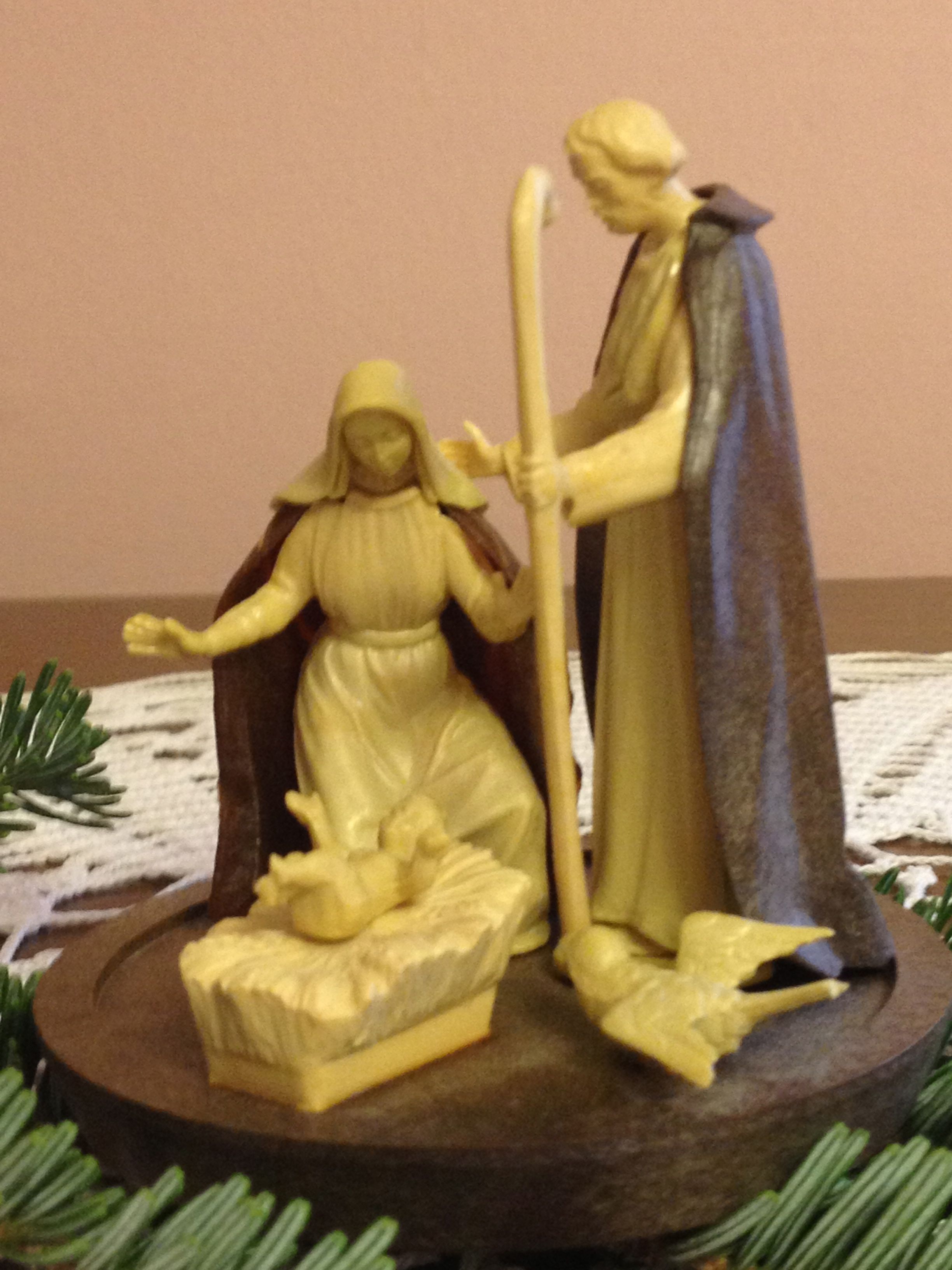 It may be small. It may just be a cheap imitation, but when I look at it I see all the hopes and dreams of all the years as they are told in the story of stories. No more ghosts visited me in the night, but just like Ebenezer Scrooge, I woke up knowing just what I had to do. You see Scrooge wasn’t the only movie that my brother and I used to watch. Alan was particularly fond of science-fiction movies. Sometimes, when he would manage to convince me to watch one of this movies with him, I would complain after just a few minutes in, that the premise was just too unbelievable; I mean really nothing like that could ever actually happen. Alan would remind me that you don’t have to believe them; you just have to watch them, go with the story, see where it takes you. When you really think about it, many of our best-loved stories never actually happened the way we tell them. Take Scrooge for example; does any one of us actually believe that Ebenezer was really visited by three ghosts? We know that it is a story that never actually happened the way it has been told to us; and yet it has the power to take us somewhere, to move us as we watch the incredible transformation of old Scrooge and we too are moved to keep Christmas well. Continue reading
 pastordawn