Giving Up the Theories of Atonement in Order to Move Toward an Evolutionary Understanding of Jesus: a Good Friday sermon

eloi eloi lamaI am indebted to Michael Morewood for the theological insights in his book “It’s Time: Challenges to the Doctrine of the Faith” for helping me to see beyond the idols in my head! This sermon was preached on Good Friday 2013 at Holy Cross Lutheran Church. Additional Good Friday sermons can be found here and here

The account of Jesus’ execution that we have just heard from the Gospel according to John lacks the rawness of the earlier accounts of Jesus death. The author of this account wrote at the turn of the first century, some seventy to eighty years after the Romans executed Jesus. That’s enough time for two, maybe three, or possibly even four generations to have pondered these events. The first account of these events, the Gospel According to Mark was written slightly earlier, sometime after the year 70. Most scholars date it between the years 70 and 85. That’s still 40 to 65 years after the execution; still time for one or two generations to have pondered these events. Perhaps it’s the closer proximity of the Gospel according to Mark that gives it much shaper raw feeling when it is read. Or maybe it’s the decision of translators down through the ages to preserve the intensity of Jesus’ cry from the cross in Aramaic. I don’t know about you, but I cannot begin to contemplate the events of this dreadful day without hearing the echoes of Jesus’ plaintive cry, in his mother tongue: “Eloi, eloi, lama sabachthani?”

“Eloi, eloi, lama sabachthani?” “My God, my God, Why have you forsaken me?” The rawness, the bitterness, the desperation of this horrendous moment, and all the horrendous moments that have transpired before or since are captured in Jesus plea, “My God, My God, Why have you forsaken me?” I have always imagined a dying Jesus gathering up what little strength he has to raise his head to the heavens and cry: “Eloi, eloi, lama sabachthani?” In most of the films depicting the crucifixion that I can remember seeing, Jesus looks up, up toward the heavens to utter this painful cry to God.Jesus’ question has haunted the followers of Jesus for centuries as Christians have struggled to understand how and why Jesus died.This question has left the followers of Jesus tied up in knots for nearly 21 centuries as our ancestors in the faith have struggled to offer up answers to the questions of the faithful. Why did Jesus have to die?

In pulpits all over the planet, preachers are struggling to help their listeners cope with the realities of the violence that murdered the One whom we seek to follow. I have spent most of my life, struggling to understand exactly why Jesus died and what Jesus’ death means for all the generations who have trusted and followed Jesus. I have studied the answers that have been offered by successive generations of Jesus’ followers. I can recite chapter and verse of the various theories that have been offered by the church to explain Jesus’ death as all part of God’s grand plan to reconcile humanity to God. I can tell you about the Apostle Paul, who looked back to the Book of Genesis to try to fathom a reason for it all and settled upon the story of Adam’s disobedience as the source of our sinfulness. I could talk for hours about the theologies that hang on that apple. I know far too much about the fall and original sin and the need for reconciliation. I could recount the various theories of how God went about settling the score; of making us one with God. The theologians called this process of reconciliation with God, atonement and then proceeded to develop all sorts of theories of atonement. Lutheran pastors are required to study them all; all the way from the moral authority and ransom theories to the favorite of the last few centuries aptly named the satisfaction theory. Continue reading

Good Friday Rituals or Crimes Against Divinity? – A Good Friday Sermon

A Good Friday Sermon preached at Holy Cross Lutheran Church in 2012

it is finished 22The memory of it still haunts me to this day. I was 18 years old. Some friends of mine from church convinced me to go to a big youth gathering. I don’t remember who sponsored the gathering, I do remember that most of the Lutheran youth groups in the greater Vancouver area were in attendance and various Lutheran pastors were involved in the leadership. At some point near the beginning of the event we were each given a small nail, divided into groups and asked to line up behind one of the three wooden crosses that were laying in the hall. We were then given our instructions. We were about to hear a dramatic reading of the Gospel According to John’s account of the crucifixion. When the reading was over we would be invited to proceed to the cross nearest us, knell down, take a hammer, and drive our nail into the cross. With each blow upon the nail we were asked to remember our own responsibility for the death of Jesus. We were asked to remember that it was we who had crucified Jesus, for we were the guilty sinners for whom Jesus died. It was a powerful, gut wrenching experience that still haunts me to this day.

I wasn’t the only young person who wept buckets that day. I immersed myself into the ritual act as I recounted inwardly the list of my own sins. Together with my friends, we left that hall believing that Jesus died because of us. We left judged, convicted, guilty, tormented, anguished, and full of hope, for we knew that Jesus had died to save us from our sinfulness. Like so many who have gone before us and like so many who will gather on this Good Friday, we left that hall believing that God sent Jesus to die for us; to pay the price for our sin.  Continue reading

Religionless Christianity: Commemoration of Dietrich Bonhoeffer

Reposted today as the Church commemorates the life and witness of Dietrich Bonhoeffer.

When I was just a teenager, I was introduced to the writings of Dietrich Bonhoeffer by a wise Lutheran Pastor. I remember devouring Bonhoeffer’s “Life Together” and “Letters and Papers from Prison”. To this day, I credit Bonhoeffer for making me a Lutheran.  While a great deal of water has flowed under a good many bridges since I was first enamoured of Lutheran theology, to this day I am grateful to that wise old Lutheran pastor who gave me my first taste of Bonhoeffer.   Of late, there has been much ado about a little phrase that has been extracted from Bonhoeffer’s work: “religionless Christianity”.

(click here for full quotations from Letter and Papers from Prison)

“It is not for us to prophecy the day when men will once more ask God that the world be changed and renewed. But when that day arrives there will be a new language, perhaps quite non-religious. But liberating and redeeming as was Jesus language. It’ll shock people. It’ll shock them by its power. It’ll be the language of a new truth proclaiming God’s peace with men.”  Bonhoeffer: Agent of Grace

Tragically, Bonhoeffer was executed before he had the opportunity to expand on his idea of Christianity beyond religion.  The phrase “religionless Christianity” has intrigued agnostics, atheists, humanists, liberal christians and progressive christians.  Eric Metaxas, author of “Bonhoeffer” dismisses the idea that Bonhoeffer was anything but a serious, orthodox Lutheran pastor right up to the end.

Despite the historical evidence of Bonhoeffer’s religious orthodoxy, the notion of religionless Christianity will not die. Bishop John Shelby Spong is among those who have tried to build on Bonhoeffer’s phrase and his book “Jesus for the Non Religious” has certainly moved the conversation along among progressive christians.  

The dream of religionless christianity has moved well beyond Bonhoeffer as twenty-first century christians wrestle with archaic images of God and move beyond the religious trappings of traditional christianity. The notion of moving beyond religion has always intrigued me. Years ago, while studying Hinduism my professor offered a definition of God from one of the Vedas: “God is beyond the beyond, and beyond that also”.  As I continue to explore the life and teachings of the man none as Jesus of Nazareth it becomes more and more evident that such a definition is compatible with his portrait of God.  Jesus of Nazareth attempted to move his co-religionists beyond their religious images of God. What might our images of God become if we move beyond the idols offered to us by the religion of Christianity?   Might we move toward images of God that more closely resemble the teachings of Jesus by moving toward a religionless christianity?

Sometimes we can better reflect upon our own tradition from the perspective of another tradition. In the video below, twentieth century philosopher and theologian Alan Watts explores the concept of the Religion of No Religion. 

“Beyond the Beyond and Beyond that also.” Letting go of our images is the gift of faith that moves us beyond religion. I can hear Jesus call us to let go!

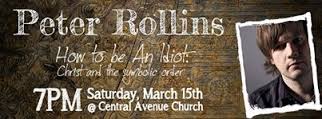
How To Be An Idiot: Christ and the Symbolic Order

rollins idiotRecorded on March 15, 2014 – Those familiar with Pete Rollins work will recognize some familiar themes and stories at the beginning of this video which then moves into some interesting new ideas about “morons, idiots and imbeciles.” Rollins provocative ideas about the relationship of Christ to the symbolic order challenges us all to move beyond our moronic ideas and practices into the roll of idiots so that we might become imbeciles. Well worth a listen for those familiar with Rollins work and for those who have never encountered him before!!!

Singularity and the Omega Point: Jason Silva

cosmic christAs our understanding of what it means to be human changes, our theologies are changing in ways that embrace reality rather than try to deny the evidence that is revealing a whole new dynamic that is drawing us toward an appreciation of creation that is even more amazing than our ancestors could possibly have imagined. Some Christians are afraid of this ever evolving view of creation, while others of us are compelled to wander beyond the confines of our comfort-zones. My hope is that we will find  ways of staying in relationship with one another.

Christ in Evolution: Ilia Delio

ilia delioDr. Ilia Delio offers an integration of cosmology and theology which opens the way to a re-articulation of the Christ narrative that is lodged within the reality of our unfolding evolution. Her considerable ability to articulate a wholistic theology which has the potential to move Christianity into the twenty-first century is exciting!!! I am currently devouring her mind-blowing book, “Christ in Evolution” in preparation to spend a day soaking up her wisdom when she visits Guelph in April (for details click here). I hope to have the opportunity to read her latest book The Unbearable Wholeness of Being: God, Evolution, and the Power of Love”, and revisit her earlier book, “The Emergent Christ: Exploring the Meaning of Catholic in an Evolutionary Universe” which introduced me to her exceptional mind. Her just published collection of essays, “From Teilhard to Omega: Co-creating an Unfinished Universe” awaits I will endeavour to post more about her work in the weeks to come. But for now, the video of her lecture “Christ in Evolution” is an excellent introduction to her work. Dr. Delio is an exciting evolutionary theologian whose brilliance is tempered by her sense of humour and her ability to challenge her listeners to stretch ourselves beyond what we think we can possibly comprehend toward a new appreciation of our roles in the ongoing process of evolution. Splendid stuff!!!!

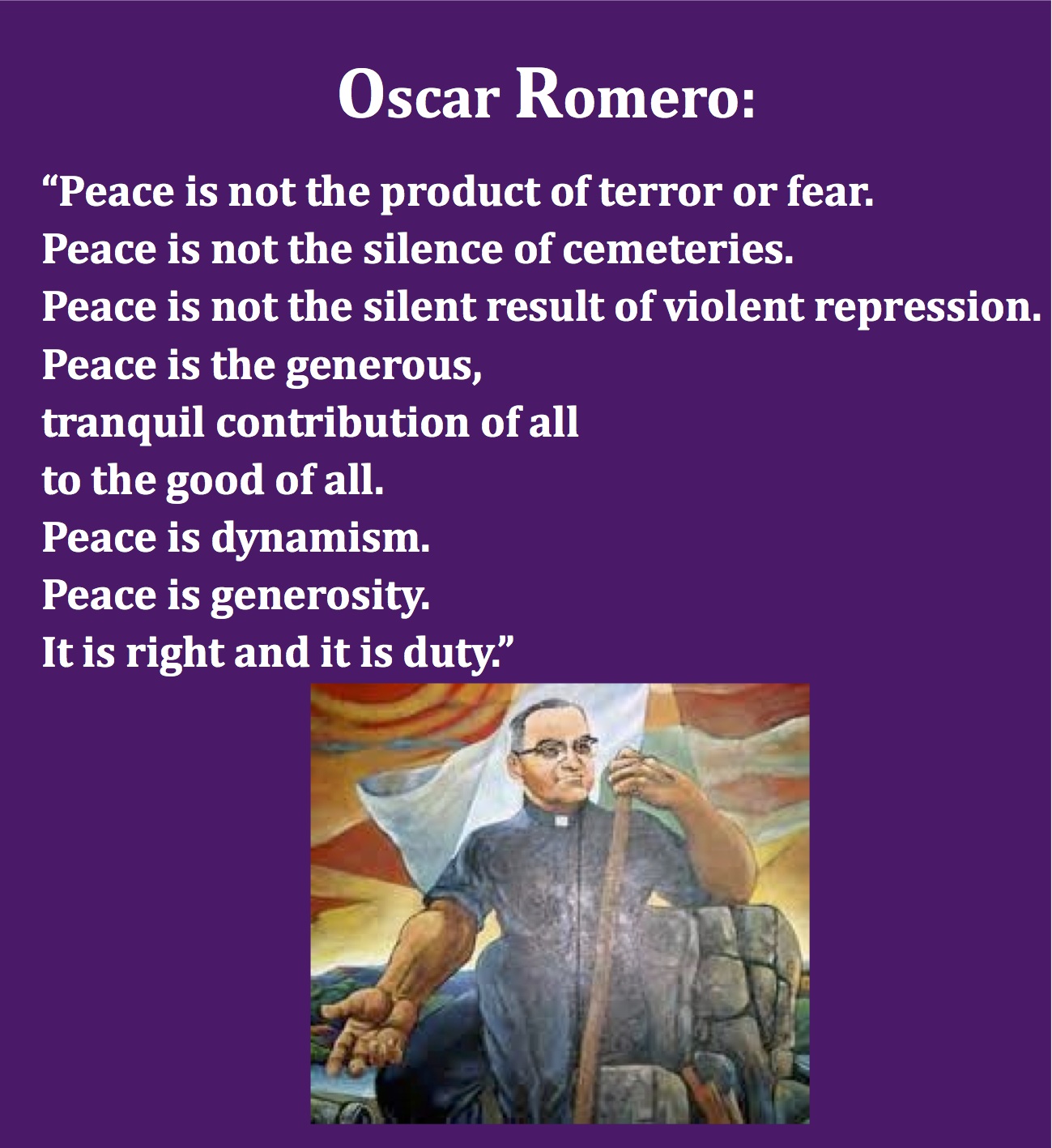
Peace: Oscar Romero

Oscar Romero Peace pastordawn

You can learn  about the life and witness of Romero from this excellent film

To Be LOVE in the World: a sermon for Lent 3A – John 4:1-42

woman

Readings:  Thomas Aquinas “EMBRACE THAT”  found here

St. Teresa of Avila “DESIRE YOU” found here

Gospel of John 4:1-42 found here

Watch the video below which was shown in worship after the reading of the Gospel: The Woman at the Well (below) and then listen to the sermon.

You can listen to the sermon audio here: 

Tickled By the Racy Svetlana; Otherwise Known as the Woman Evangelist Who Rocked Jesus’ World! – a sermon Lent 3A on John 4:1-42

Tickled

There’s a commercial currently running on the TV and each time it comes on, I can’t help myself, it makes me smile and if I let myself, it makes me laugh. It’s a collection of scenes in which lovely little babies laugh. They laugh and they laugh and they laugh and before you know it you’re hooked and you just can’t help yourself you are laughing too. Laughter is a great tonic! Laughter is good for the soul! And yet, for some unknown reason we tend to exclude laughter from our religious life. Religion is serious business and so we don’t laugh much in worship. There’s a quote from St. Teresa of Avila that served as a warning sign for me as I was preparing this sermon. “NOT YET TICKLED” writes St. Teresa, “How did those priests ever get so serious and preach all that gloom? I don’t think God tickled them yet. Beloved—hurry.” The thought of being tickled by God is delightfully refreshing. Continue reading

Faith and Begorrrah – A St. Patrick’s Day Sermon

With St. Patrick’s Day just around the corner, I was asked about the sermon I preached last year when the celebration fell upon a Sunday. The person who asked about the sermon remembered laughing a lot during its delivery and encouraged me to re-post it. So, pour yourself a glass of your favourite tipple, sit back and enjoy a laugh.

Readings:  Numbers 27: 1-11; Acts 13:44-51; John 12:1-8

guinnessbeerSt. Patrick’s Day doesn’t often fall on a Sunday, but as our congregation’s Annual Meeting would begin immediately following our worship service, I decided to be somewhat playful and irreverent with a sermon designed encourage folk to think beyond words on a page. The first reading brought the wonderful story of the Daughters of Zelophehad to church and as this reading does not appear in the Revised Common Lectionary it was fun to play withirish these feisty women. The reading from the book of Acts is actually the prescribed reading for the commemoration of St. Patrick and the Gospel text is prescribed for Lent 5C. The Guinness was just for fun! Enjoy.

Listen to the sermon

https://pastordawn.com/wp-content/uploads/2013/03/st_patricks_sermon.m4a

Read a transcript of the sermon here


Awe and Wonder: A Lenten Practice

AWE copySo many of our Lenten practices revolve around theories of atonement that cast the HOLY ONE as a participant in a grand bargain that saw Jesus of Nazareth die as a sacrifice for sin. For those of us who have left behind theories of atonement that set Jesus up as  payment for our sin, Lent can seem a very lonely place. While many churches busy themselves with rituals that encourage repentance from the perspective of confessing our unworthiness to a grand-inquistor deity,  it is tempting to give up the season of Lent all together. But with the explosion of information about the nature, beauty and complexity of the cosmos, perhaps we can achieve the humility that the ritual of confession offers in ways that do not require us to adopt the attitude that human’s are unworthy creatures in need of a god who would demand satisfaction at the expense of a blood sacrifice. 

Each time I look up into a starlit sky I am overcome with a sense of awe and wonder that is in and of itself a prayer that inspires humility in me. A sense of awe and wonder at that which is beyond ourselves is the beginning of a prayer that always leads me to a sense of ONENESS with all that IS. 

This morning, my Lenten devotion came to me in the form of this splendid video The Overview, which describes the awe and wonder of those who have had the privilege of looking at the earth from the perspective of space. They describe their awe and wonder, their prayer if you will, as the “overview effect”. The overview effect serves to connect these space travellers to the earth itself and moves them to the kind of humility that helps me to realize that awe and wonder can serve as nourishment for my own Lenten journey.

As we gaze in awe at our marvellous planet perhaps we can be moved to tread more lightly upon her. Perhaps awestruck by the beauty and wonder of creation, we can look to all the inhabitants of the earth and see that they too are fearfully and wonderfully made. I trust that a humility based not on a belief that we are wicked, unworthy creatures, but rather on a experience of awe and wonder, will lead us on a Lenten journey to a place where we will have the courage to gaze upon the cross and see beyond the violence to the hope of resurrection.

Lent: Letting Go of our Tightly Held Piety to See Our Need of Confession

JOHN OF THE CROSS as
Little Crystal was only two and a half years old when she got hopelessly stuck.
 And when she got stuck she did what all small children do, when they have gotten themselves into a situation that the can’t get out of, little Crystal cried for help. She went into her mother’s study, holding in one hand a family treasure and her other hand couldn’t be seen.  Crystal cried out, “Mommy I’m stuck”. Her unseen hand was stuck inside her great-grandmother’s vase.  The precious vase had been handed down from her great-grandmother to her grandmother, to her mother. Crystal had always been told that one day the magnificent vase would be hers.

Crystal’s mother tried to move quickly without panicking. She scooped the vase and her little girl up into her arms and carried them to the kitchen sink. She used warm soapy water to try to loosen the toddler’s hand, which was stuck all right. When soap didn’t work she reached for the butter. While greasing her child’s wrist like a cake pan, she asked the obvious “mother question.” “How in the world did you do this, child?” Crystal carefully explained that she had dropped candy down into the vase to see if she could still see it when it was at the very bottom. But she couldn’t see it, so she reached in for her candy and that’s when she got stuck and she couldn’t get her hand back out.

Well, as time passed, the situation became more and more serious. Crystal’s mother called for re-enforcements. She phoned her own mother and told her to get there as fast as she could. A neighbour suggested Vaseline. The apartment manager got out some WD40. Still no luck.  It began to seem like the only way to get Crystal’s hand out was to break the family heirloom.

When Grandma finally arrived, both Crystal and her mother were almost hysterical. They were both more than a little relieved to have Grandma’s calming presence. Grandma sat little Crystal on her knee. 

Crystal was very upset and still very stuck. Grandma took a good look at the vase that used to sit on her mother’s kitchen table all those years ago.  She looked at the miserable look on her grand-daughter’s face, and she said, “Crystal, sweetheart.  Your mommy told me that you reached into the vase for candy.  Is that right?”

Crystal was a little breathless from all the crying she had been doing and all she could manage was a whimpered, “Mmm hummm.” “Honey, tell grandma the truth now. Do you still have a hold of that candy?” “Mmm humm”.  Crystal sobbed. Then Grandma rubbed little Crystal’s back, held her close and gentle, but firmly said: “Let it go, child.  Let it go.” Sure enough, the vase slipped off as smooth as silk. (I have searched for the source of this story, without success. I first heard it at a retreat on the West Coast a lifetime ago)

In this fast paced world of ours, I often find myself in little Crystal’s predicament.  Surrounded by a treasured family heirloom, desperately clinging to a treasure.  My predicament often makes it difficult for me to appreciate the beauty of the heirloom. Letting go isn’t as simple as it sounds. But sometimes letting go is the only way to preserve the integrity of the heirloom. When I think about the church’s practice of public confession, I can see how desperately I have been holding on to candies that no longer satisfy my need for forgiveness.  Continue reading

I Refuse to Take on Any Lenten Disciplines!

JOHN OF THE CROSS wordsIn the midst of this brutally cold winter I can find no signs that spring is around the corner. To say that it is cold outside is an understatement of epic proportions. Regardless of the challenges of this wild winter, I cannot simply retreat to the warmth of the fireside. I have places to go and people to see. By the time the driveway is shovelled, the ice is scraped, the windshield juice is topped up in my car and all the extra time it takes to navigate the roads in this weather, I can barely complete the regular tasks this busy modern life of ours demands, let alone feel guilty because I’m not adopting some contemplative spiritual exercises that harken back to a simpler time! I heard someone say, “If you are currently not experiencing any stress in your life, you should immediately lie down because it appears that you may be dead.” So, please don’t ask me to take on any Lenten disciplines!

I have also heard it said,  that in Canada the most common response to the question “How are you doing?” is the word “Busy!”. Canadians and I suspect Americans, Europeans, and most inhabitants of the so-called First World, seem to feel the need to justify our existance by assuring others that we are leading busy lives. While I am absolutely convinced that lives lived in the twenty-first century are busier than the lives of our ancestors, I’m not so sure that being busy is something we ought to be proud of.

Growing up, I remember all sorts of predictions about how life in our immediate future would be filled with so much leisure time as a direct result of the technology that would be at our fingertips. But as technology advances, our ability to work wherever and whenever the need arises has severely curtailed our leisure time. Our lives are busy and we have forgotten what it means to be human beings because most of us have become human doers. We have forgotten how to simply be.

I find it reassuring, comforting even, that our ancestors understood  our Creator as YAHWEH, which translated can be understood as “I AM WHO I AM or I SHALL BE WHO I SHALL BE. That the name of God should be understood as the verb “to be” helps me to understand myself as one who is created in the image of the great I AM and not the great I DO. I am a human being not a human doer! What I need from a season like Lent is not a prescription for more things to do. But rather, the encouragement to simply be. 

Might I suggest that we can begin this encouragement to simply be by simply greeting people with a simple word of peace. If such a greeting seems awkward to you then perhaps simply asking people how they “are” rather than how they are “doing” will suffice. Such a subtle change may not be enough for some people to refrain from telling you what or how they are “doing” and you may find them insisting that they are indeed “busy”. But a little gentle persistence may enable some to respond about their very being. Reminding one another that we are beings and not just doers might lead us toward some peace. Shalom, As-salam alaykum, Peace dear beings, Peace…..

Evolution – There’s No Going Back: an Ash Wednesday Homily

purple light 2

Here’s an Ash Wednesday homily for the 21st century!

We’ve all been there. Driving down the road – distracted by thoughts of this and that, when all of a sudden it happens, a car comes at you out of no where and you slam on the breaks or you quickly swerve to avoid a disaster. You could have been killed. You could have killed someone. Your life or someone else’s life could have been radically changed in an instant. As you pull back into traffic you are ever so conscious of the weight of you foot on the accelerator and you swear that you’ve got to be more careful.  You begin to scold yourself.  What were you thinking? Why weren’t you paying attention? Wake-up you could have been killed.

Welcome to Ash Wednesday. What have you been thinking? Why weren’t you paying attention? Wake-up — you are going to die!!!  Ash Wednesday is your mid-winter wake-up call. Some of you may not need the wake-up call. Some of you know all too well that death is all around us. Some of you have lost someone dear to you. Some of you have felt that fear in the pit of your belly when the doctor suggests a particular test. Traditional Ash Wednesday worship would require us to focus on the brevity of life and remember that none of us will get out of this life alive.  Our ancestors in the faith, entered into a morose season of Lent by via the awesome reminder that they came from dust and soon they shall return to the dust. Continue reading

You Have the Power to Transfigure the Face of God

mushroom Cloud

Three years ago, the Strange History of Transfiguration Sunday inspired this sermon. I offer it here because the words of Desmond Tutu speak volumes as I work on this year’s Transfiguration sermon.

When our images of God are tied to the idol of a supernatural sky-dweller who has the power to solve all our problems, despair is sure to follow as our super-hero fails time after time to impress us.

When I was a very little girl, I was absolutely convinced that I had the power to change the mind of God! Confident that I held such power, I never missed an opportunity to exercise it. Now, I’ll grant you that like most children, I was also convinced that the universe itself actually revolved around me, so believing that I was powerful enough to change God’s mind, wasn’t exactly much of a stretch. In fact, when I was a child, it wasn’t all that difficult to change God’s mind. For instance, I could stop God from breaking my mother’s back simply by leaping over a crack in the pavement. “Don’t step on a crack and break your mothers back.” Now, in my young mind the only one powerful enough to crush my mother’s powerful spine, must be God. I also knew that God wasn’t particularly fond of ladders, and that if I refrained from walking under them, God would smile upon me. Continue reading

TRANSFIGURATION – Looking Back at the Way Forward.

transfiguration

Fifteen years ago, I travelled to Newmarket to preach for the first time at Holy Cross Lutheran Church.  It was Transfiguration Sunday and I was preaching for Call.  I knew that the following Sunday the Congregation would gather to vote on whether or not to call me as their pastor.  I’ve been serving as the Pastor of Holy Cross for almost fifteen years and over the years the people of Holy Cross have nourished and challenged me and transformed me into a pastor.  What follows is a transcript of the sermon I preached on that long ago Transfiguration Sunday.  Old sermons reveal our old selves.  While my theology has changed over the years and I would not preach this sermon in the same way now,  I treasure the memory of that hopeful candidate for call.  To the people of Holy Cross:  Thank-you for transfiguring me!  Shalom!

When I was a teenager, I was always in a hurry.  I wanted to see and do everything there was to see and do.  When I was nineteen, I knew that I just had to get out there and see what the world had to offer.  So with nothing more than a backpack, a three month Euro-rail pass, and eight-hundred dollars in travellers cheques, I boarded an airplane bound for Amsterdam. 

I was searching for adventure and I was convinced that Europe held the excitement I was looking for. Inside my backpack was the book that would make it all possible.  Europe on Ten Dollars a Day.  I was determined to make my eight-hundred dollars stretch the length and breadth of Europe.  I was going to see and do it all!  It wasn’t easy.  In fact when I look back on it now, it seems like such a lot of hard work.  Up early in the morning sightseeing all day long. Meeting new people.   Fighting my way through the crowds of tourists.  Searching for cheap places to eat and sleep. 

After two months of travelling from one European city to the next, I just couldn’t face one more castle or museum.  I figured that it was time to get away from the cities so I headed for the Alps. After a long train ride from Munich, I arrived in the Swiss town of Interlaken.  There I boarded a coggle train that would take me to the Alpine village of Grunewald.  The train was filled with tourists anxious to fill their rolls of film with pictures of the mountains, but it was overcast and there were no mountains to be seen.  Continue reading

Parables Ancient and Modern: Lenten Evening Prayer with readings from the Orthodox Heretic

Orthodox HereticA series of Lenten Evening Prayer Services which use readings from the Parables of Jesus together with readings from Peter Rollins’ “The Orthodox Heretic and Other Impossible Tales.” Prayers are drawn from the writings of the Christian Mystics. Each service includes the worship bulletin as well as an audio recording of the service at Holy Cross Lutheran Church. 

One:  NO CONVICTION

A Copy of the worship bulletin can be found here – it is designed to be printed double-sided and folded into a booklet.

Listen to the worship service here (service begins at the 48 sec. mark)

Peter Rollins reads NO CONVICTION

Two:  Translating the Word

A copy of the worship bulletin can be found here – it is designed to be printed double-sided and folded into a booklet.

Listen to the worship service here

 Three: Great Misfortune

Evening Prayer a copy of the worship bulletin can be found here – it is designed to be printed double-sided and folded into a booklet.

Listen to the worship service here

Four: The Book of Love

 Evening Prayer a copy of the worship bulletin can be found here – it is designed to be printed double-sided and folded into a booklet.

Listen to the worship service here

Five: Betrayal

Evening Prayer a copy of the worship bulletin can be found here – it is designed to be printed double-sided and folded into a booklet.

Listen to the worship service here

We Have Enemies, And So, We Pray: a sermon for Epiphany 7A on Matthew 5:38-48

NowSince I was thirteen years old, I have borne the mark of my enemy. It’s faded quite a bit over the years, but if I look carefully I can still make out the marks left behind by, let’s call her, Betty Cherie’s teeth.  Way back in the eighth grade Betty Cherie and I fell afoul of one another. I don’t really remember what it was that started the whole thing.  It was one of those grudges that only thirteen-year-old girls can hold onto with any kind of tenacity. All I can remember is that Betty Cherie and I hated each other and the whole school knew it.

One afternoon our rivalry reached the point of war. I still cringe when I remember it. After all I was thirteen and I should have known better. I’d like to say that she started it. But, I honestly don’t remember how we got ourselves to the point were we were to meet each other in the playground to fight it out. Our adolescent duel took place in full view of the student body. We met at high noon, out behind the portables, out of sight from the teachers. It began with two sworn enemies pushing each other around. There was some hair pulling, I think I even got in a punch or two before she bit me. Continue reading

D.I.V.O.R.C.E. – a sermon for Epiphany 6A

Aquinas purposeReadings included: Deuteronomy 30:15-20, Thomas Aquinas’ “Otherwise the Darkness’ (pictured above) and from the Sermon on the Mount: Matthew 5:21-37 

Listen to the sermon:  

Atheism for Lent

Atheism for LentFor more details click on this link:  ATHEISM for LENT details