 The Beatitudes: Matthew 5:1-12
Listen to the sermon:

The Beatitudes: Matthew 5:1-12
Listen to the sermon:
Advice to preachers from the best New Testament scholar I’ve ever met!!! What a preacher needs to have, at a bare minimum, is a “passionate commitment to the Christian vision!” If you don’t have that, stick to worrying about the church’s leaky roof and stay out of the pulpit! Perhaps, it’s his Irish lilt that allows him to make inflammatory statements sound like ordinary common sense. Dom’s passion for the Christian vision comes through in his articulation of the Jesus’ vision of peace through justice. Enjoy this interview recorded on Dec. 16, 2013
For those of you who may be using the Narrative Gospel reading this coming Sunday, here’s a sermon that was inspired by Teresa of Avila’s image of being tickled by God.
 There’s a commercial currently running on the TV and each time it comes on, I can’t help myself, it makes me smile and if I let myself, it makes me laugh. It’s a collection of scenes in which lovely little babies laugh. They laugh and they laugh and they laugh and before you know it you’re hooked and you just can’t help yourself you are laughing too. Laughter is a great tonic! Laughter is good for the soul! And yet, for some unknown reason we tend to exclude laughter from our religious life. Religion is serious business and so we don’t laugh much in worship. There’s a quote from St. Teresa of Avila that served as a warning sign for me as I was preparing this sermon. “NOT YET TICKLED” writes St. Teresa, “How did those priests ever get so serious and preach all that gloom? I don’t think God tickled them yet. Beloved—hurry.” The thought of being tickled by God is delightfully refreshing.
I must confess that I don’t spend much time laughing with God. Listen to this quote from the writings of St. Teresa: “Just these two words God spoke changed my life, “Enjoy Me.” “What a burden I thought I was to carry—a crucifix, as did Christ. “Love” which is Teresa’s name for God. “Love once said to me, ‘I know a song would you like to hear it?’ And laughter came from every brick in the street and from every pore in the sky. After a night of prayer, God changed my life when God sang, “Enjoy Me.” Enjoy Me. What a different place the world would be if we could only hear God beseeching us, “Enjoy Me.”
We are a serious lot we Christians. Duty, responsibility, guilt, and consternation have left us precious little time to “Enjoy!” We’ve got things to do, stuff to learn, values to instill and standards to uphold, so we’ve put enjoyment on the back-burner. After all, God is far too high and mighty to be trifling with, we daren’t laugh in the presence of our God. And yet, God continues to tickle us. Over and over again, with the most absurd wonders, and we can’t help ourselves, but smile. Creation is so full of laughs. Life is so funny! And church, I mean, whenever I think of the ridiculous things we get up to in church, well its enough to make you laugh until you cry. So to those of you who insist upon personifying our Creator, don’t you try to tell me that the Creator of all that is or ever shall be, the one who is responsible for creating humour itself, doesn’t just roar with laughter at the stuff that we get up to. So, isn’t it just possible that when it comes to laughing babies, God has plenty of scope for delighting in us? Surely, laughter is one of the most sublime forms of prayer? We ought to lighten up and enjoy our time with God. Cause lord knows, serious people are all well and good but who wants to spend time with a bunch of folks who can’t enjoy a joke.
So with that said, let’s turn to this mornings Gospel reading. This story is a real tickler! But in order to get the jokes, you’ve got to know some of the stuff the insiders knew. It’s a bit like trying to understand British humour, sometimes you don’t quite get the joke, if you don’t know something about life in Britain. The Gospel of John is full of stories that play on the local humour of Palestine in the first century. This story, about the Woman at the Well is full of double en-ton-dras. Indeed, this story is so outrageous that when the powers that be were sitting around deciding which books would make it into the New Testament, The Gospel of John almost didn’t make the cut. This story was far too racy and I mean racy in both senses of the word, this story was about race and it was far too risqué for the likeings of the religious authorities who were functioning as the thought police for the early church. So, sit back and allow yourselves to be tickled as I let you in on the jokes. Continue reading
 Most us us have heard the words from Matthew 5, known as the Beatitudes, so many times that we can recite them from memory. Indeed, the Beatitudes are at the very core of our Christian tradition. But there is a danger in our familiarity with these words because it allows us to distance ourselves from them as we relegate them to some idealized notion of some unattainable goal.
I have studied these words many times and I do not believe that Jesus intended these words to become a prescription for how to be a better Christian. So, I won’t be encouraging anyone to be poor in spirit, to mourn, or to be meek in the hope that they might gain the kindom of heaven, or be comforted, or inherit the earth. While hungering and thirsting for righteousness is in and of itself a good thing, along with being merciful, pure of heart, and peace-making, all of which I heartily encourage. However, these attributes or beatitudes are not a prescription for holiness or wholeness.
So, if Jesus wasn’t prescribing the beatitudes from atop the mountain, what was he doing? Well, there’s an old storytellers’ ploy that I’d suggest in order to better understand Jesus words. The ploy doesn’t have a name, but most of us are very familiar with the trick. It’s the one where you tell an unfamiliar story alongside of a very familiar story in the hope that the unfamiliar story will help to shed some new light on the words of the familiar story. The unfamiliar story is taken from Bryce Courtenay’s autobiographical novel “The Power of One.” * The Power of One was are into a movie about twenty years ago, so the story may be somewhat familiar. Continue reading
 Michael Morwood is an “Adult Faith Educator” whose various books help adults to “re-imagine and re-evaluate their faith in light of the contemporary ‘story’ about our universe.” In Children Praying A New Story, Morwood turns his attention to the task of education children from the perspective of a thinking twenty-first century Christian. Morwood offers insights about teaching children to pray, not to an external, listening Deity but to the Source and Ground of our being. This book has helped me as I craft the prayers of our congregation and I know that parents, grandparents and anyone who is engaged with children and their spirituality will find inspiration in Morwood’s approach. We are looking forward to hearing from Michael Morwood in person; when he visits Holy Cross the weekend of May 2-4.
 When I was in my early twenties, I grew weary of sharing space and I decided that I wanted an apartment all to myself, despite the fact that I couldn’t really afford an apartment all to myself. But I was determined and that’s how I ended up living in a very rough neighborhood in the east end of Vancouver. My parents weren’t’ very happy about the neighbourhood and worried about the unsavory characters that lived in the run-down building where I found a spacious one bedroom apartment that I could just about afford. The apartment was just a couple of blocks away from the office where I worked, so I was able to walk to work. I ignored all the warnings of my family and friends and I convinced myself that I could handle anything that came my way.
In my heart of hearts I was rather pleased to be living in such a poor rough and tumble neighbourhood. I was young and foolish and the neighbourhood was exciting. Every Sunday I would make the trip back to my home church in the suburbs. Sometimes I would make a second trip out during the week to attend a Bible study. Like so many young people, I was harsh in my criticisms of the elaborate life-styles of my elders. At bible studies, I was always bringing up the plight of the poor and the oppressed and challenging people to do something. Various members of my own family often accused me of being a bleeding heart liberal. I wore their criticism with a certain amount of pride, convinced that I was living out my beliefs.
Although I walked to work each day, I didn’t know any of my neighbours, until one morning I was surprised by a knock on my apartment door. I wondered how anyone would get past the lock on the front door. So, I peered through the peephole and was relieved when I saw a young woman at my door. I unbolted the door and in swept Brenda. Brenda was all smiles and laughter as she explained that she and her roommates were out of coffee and she wondered if I might be able to lend them some coffee. When I explained that I had just used up the last of my coffee making my own morning brew, Brenda told me not to worry, she and her roommates would be happy to join me. When Brenda returned, she introduced her roommates, Janice and Sue and we all sat down together for our morning coffee. Continue reading
In the Epistle Reading for this coming Sunday, 1 Corinthians 1:10-18, the Apostle Paul talks about the “foolishness” of the message about the cross. As I begin to prepare myself for a serious engagement of the scripture readings, I am reminded of the foolishness with which various interpreters of the life and death of Jesus have developed the various theories of atonement. This little video, sarcastically holds up a mirror to those theories. Laughter seems like a good place to begin a conversation about this foolishness. Surely, any serious engagement of the Jesus experience must set aside the follies of our attempts to turn Jesus into something he was not.

 Robin Meyers gives the 2013 Beecher Lectures at Yale Divinity School. “The three lectures, given by Meyers, are entitled “UNDONE: Faith as Resistance to Ego, Orthodoxy, and Empire.” Instead of conceiving of the church as an institution that promotes faith as a belief system, defending doctrinal claims as essential to salvation and good works, UCC pastor and author Robin Meyers will make the case that the Jesus
 Movement was in the beginning, and must be again, a Beloved Community of Resistance. Confronting our illusions with help from Kierkegaard, and drawing the poetry of Anna Kamienska, each lectures will focus on three areas that demand resistance: ministry as performance (ego), ministry as right belief and worship (orthodoxy), and ministry as sentimental surrender to the status quo (Empire).”
 Marcus Borg is often quoted as having said something to the effect that the average adult has but a grade five understanding of Christianity. Which is okay if you are in grade five but it won’t sustain you through a lifetime of questions. While I agree with Borg that a good many people have rejected Christianity on the basis of what they learned as children and we have a great deal of work to do to educate adults about the breadth and depth of the Christian faith, I wonder what it would mean for the church if we stepped up our game when it comes to the education of children.
I can still remember taking my first religious studies class as an adult and being  blown away by the revelation that so many of the biblical stories that I was struggling with actually had their origins in tales that were told long before a wandering Aramean went down to Egypt. I remember being both fascinated with the story of Gilgamesh and angry at the Church for failing to let me in on the reality that human’s have been myth-making since forever. I’m sure that I would have been far less traumatized by the realization that the biblical writers engaged in the ancient art of myth-making had I been introduced to it in my adolescence. Needless to say, since I have been teaching Confirmation classes (ages 11-15) I have taken the opportunity to introduce the Epic of Gilgamesh as a precursor to discussions on the book of Genesis.
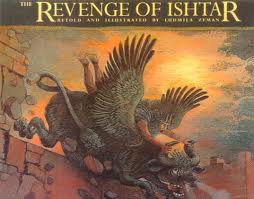 Several years ago, the task of introducing Gilgamesh to young people was illuminated by the discovery of a two of books by Ludmila Zeman designed to bring the tales first carved onto clay tables in Mesopotamia to life. Both Gilgamesh the King and The Last Quest of Gilgamesh are beautiful illustrated and even though they are recommended for children ages 8 and up, provide an engaging experience for adolescents. For those Confirmation students who are particularly keen, I have added Zeman’s The Revenge of Ishtar to the Confirmation class’s collection of resources. I have even been known to use this speeded little tomes in Adult Education Classes. Ludmila Zeman emigrated to Canada from Czechoslovakia and lives, works and creates in Vancouver.
 A sermon for the celebration of the Baptism of Jesus
 Peter Mayer, one of my favourite folk singers, captures a hint of the essence of God when he sings. This morning our worship celebrates the baptism of Jesus and with so much water everywhere around us, the image of God as a river strikes some chords that I find both refreshing and challenging.

There’s a definition of what it means to be a priest that has always daunted me. A priest it has been said is “a keeper of the mysteries; a keeper of the sacred mysteries of our faith. People often confuse the idea of mystery with the idea of secret. But I can assure you that as a keeper of the mysteries of the faith it is not my job, nor is it any other priest’s job, to keep the mysteries of our faith a secret. Yes, as an ordained pastor, one of my responsibilities is to be a keeper of the mysteries of our faith. As a keeper of the mysteries I am responsible for ensuring that the community I serve holds those mysteries sacred. We do so, by remembering that the reality that we call God works in, with, and through those mysteries.
Baptism is considered to be one of the mysteries of our faith. Baptism is a sacrament of the church and by definition a sacrament takes ordinary stuff – water – mixes that ordinary stuff with the Word and in the combination of water and the Word you have a tangible means of God’s grace. God’s grace is revealed in the sacrament of Baptism by the act of our gathering together and mixing the stuff of the earth with the Word. We have only two sacraments in the Lutheran church Baptism and Eucharist, and both of those things are sacraments because we gather together take ordinary stuff – bread and wine, or water and mix it with the Word of Jesus the Christ and in the water, the bread and the wine the means of God’s grace is made visible to us.
So, there you have it the technical definition of the sacraments, the mysteries of Baptism and Communion, in which the reality that we call God works in, with, through and under. But like all technical definitions of mysteries, these definitions fail to capture the essence of the mystery that lies at their very heart; the mystery of the reality that we call God. As a keeper of the mysteries, one would think that a priest, a pastor, ought to be able to reveal, by way of definition something of the nature of the reality of the Divine. The truth is I have no real definition to offer you of this reality that we call God. I read once, I wish I could remember where the wisdom of a priest far more skilled than I who declared that he’d given up trying to explain God to anyone because in the end, he said, “I cannot lead you to God, anymore than anyone can lead a fish to water.”
The most important thing I learned in seminary is that “I don’t know is an answer.” The truth is the more we learn the more we know that we don’t know. But this unknowing can be so unsatisfying, precisely because we believe that God is the one in whom we live and breath and have our being, we want to know the very nature of the One who is the ultimate Reality.
Now, if these words haven’t already become so vague that the veil of unknowing has begun to make any tangible means of God’s grace seem invisible and so beyond our grasp, let me leave the theology behind and tell you a story. One thing I do know for sure is that the shortest distance between the questions of what it means to be human and understanding our humanity is a story. Continue reading
 He was once the Primate of the Episcopal Church in Scotland but these days Richard Holloway describes himself as an agnostic Christian hungering after transcendency and preaching a gospel of uncertainty. His memoir “Leaving Alexandria: A Memoir of Faith and Doubt” is a favourite of mine. In this video he explores being honest to God and understanding religion as an art form. Holloway’s words both challenge and comfort me as he plumbs the depths of our longing through the poiesis of ultimate meaning.
 Heather Murray Elkins tells her story, “The Secret of Our Baptism” and opens us to a new way of hearing the Bat Col, the Daughter of a Sound, the Voice of the Divine, the Word, who speaks in this Sunday’s Gospel reading. Matthew 3:13-17
In this coming Sunday’s gospel text (Matthew 3:13-17) we will hear echo’s of the Bat Qol which speaks at Jesus’ baptism as the heavens are torn open. The hebrew “bat qol” (bat cole) is often translated as “the still small voice” but when translated literally it is the “daughter of a sound”. The voice of God speaks to declare love. May you hear yourself named and called by that voice, for you are the daughters and sons of God, beloved of God!
A little music to tune your ears with. Enjoy you beloved daughters and sons of God! Then be the lovers you are created to be.
 Thanks to science and all we have learned about creation, we are beginning to develop new images of the ultimate reality we call God. New images of God challenge the patriarchal misogyny of religious traditions. When it comes to re-imagining the faith, Sister Joan Chittister paints a picture of God as One Who Summons from among us – Emmanuel. The Summoning One calls and encourages us toward a world of equals. “Evolution is shedding new light on our lives.”
 Maybe it’s because I’ve directed too many Christmas pageants, but when I hear the story of the Magi visiting the baby Jesus, I don’t think of three kings at all. No visions of regal visitors decked out in their finest riding atop camels guided by a star for me. Just memories of little boys, decked out in colourful shiny robes that threaten to trip them up, giggling and roughhousing, with their cardboard crowns askew. Of all the little boy kings that I’ve tried to corral one of them stands out from all the rest. Perhaps I remember him so well because he was so little that we couldn’t have him knell at the manger for fear that he would disappear into the hay and our audience would only see two Wise Guys paying homage. Or maybe it was the speed with which he dashed in and out of the gang of shepherds who threatened to trip him up with their crooks. But I really think it was the ingenious way he solved the problem of his lost gold, that makes little, for the purposes of this sermon let’s call him Jay, stand out from all the other little boy kings.
Little Jay’s mother, like all the mothers of all the kings, was responsible for creating a facsimile of the gift her wise son would bestow on the baby Jesus. Unlike some of the feeble efforts that I’ve seen over the years, Jay’s gift of gold was a cut above the rest. Inside an elaborately carved box that his Dad had picked up on his travels to the Middle East, Jay’s mother had placed upon a bed of statin a carefully created block of wood wrapped in golden gift paper. It positively sparkled. It must have impressed Jay, because he was forever opening up his box to show his fellow cast-members his treasure. During the dress rehearsal, Jay’s performance was perfect. Jay positively perfected the art of gazing up at the makeshift star that hung above the altar just east of our makeshift manger. When he arrived at the place where the newborn baby Jesus, who just happened to be a little girl that year, Jay strode right up to her mother Mary and opened the box containing his treasure and proudly announced his gift of gold for the new born king. They, whoever they are, say that if the rehearsal doesn’t go well then the performance will be wonderful. So, I was more than a little worried when our dress rehearsal went off so splendidly because that could mean only one thing, and I wasn’t looking forward to a performance where things went wrong. Sure enough, unbeknownst to me, on the morning of his big performance, somewhere between his home and church, Jay lost his golden treasure. All he had was an empty box when he showed up at his father’s pew wailing because all was lost. Jay had no gold to give to the baby Jesus.
This story reminds me of a story that Joan Chittister tells that I’ve told you before but like all good stories it is worth telling over and over again. It’s the story of a Sufi master who was found scratching through the sand in the middle of the road. “What are you doing?” some pilgrims asked the Sufi as they passed. The old Sufi looked up and said, “I’m looking for my treasure. I’ve lost it.” the old man said. So the pilgrims, good people all dropped to their knees to help. They sifted sand. They dug under stones. They sweat under the waxing midday sun. Until, finally, hungry, soaking wet and exhausted, one of the travellers asked of the Sufi, “Sufi, are you sure you lost your treasure here?” And the old man said, “Oh, no. No, I didn’t loose my treasure here, I lost it over there on the other side of those mountains.” Continue reading
 pastordawn