Is the Church dead? or Can these Bones Live? – Pentecost sermon – Ezekiel 37:1-14; Romans 8:22-27; Acts 2:1-21

Listen to the audio only here

Well here we are in church on celebrating Pentecost! For generations Pentecost was one of the great high feast days of the church; right up there with Easter and Epiphany. That’s right, for generations, the three great high feast days of the church year were Easter, Epiphany and Pentecost; not Christmas.  Pentecost the day when the church celebrates the birth of the church. But in our life-times the festival of Pentecost has pretty much slipped off the radar of our culture. This year, well here in Canada at least, Pentecost is eclipsed by the first long-weekend of the summer season and most of our sisters and brothers are out there enjoying this rainy Victoria Day weekend. As for the rest of the world, this weekend’s Royal Wedding has garnered far more attention than the church’s birthday.

I remember, back in the olden days, when I first joined the church as a mere teenager, even then, Pentecost’s attraction was waning. I remember being taught all about the meaning of Pentecost. I can still hear our pastor, doing his best to get us excited about those tongues of fire resting upon the first followers of the Way. I remember the worship and music committee encouraging us to wear red to church. I remember the Sunday school coordinator releasing 7 red balloons into the congregation.

I was a bit of a dork back then. Unlike my fellow teenagers, who were mostly leaving the church, I joined the church when I was fifteen. I became enthralled with my guy Jesus. I immersed myself in the church. On Pentecost Sunday, 1972, just a few weeks before my 15thbirthday, I affirmed my baptism and joined Benediction Lutheran Church. So, even though the flames of Pentecost are continue to wain in our culture, Pentecost will always hold a special place in my heart.  Back in 1972, I began a long journey of discovery; a journey that would see me study not only the birth of the church but the long history of the church; a journey that took be into the story of Jesus in ways that I could never have understood back then.

I can still remember how earnest I was back then; how diligently I studied, how deeply I believed! I took it all in. I breathed deeply of the Spirit. I was a true believer. Yes, I always had my doubts.But my doubts only drove me deeper into the MYSTERY. 

I can still remember devouring every one of those red-letter words in the bible. You know the way those old bibles used to have the words of Jesus printed in red.  I can still remember the trauma of discovering that Jesus didn’t actually say all those red-letter words! I was so very certain in the beginning that if I just studied harder, I would discover the answers. Over the years, I have studied harder, but my studies have not given me the answers; my studies have driven me to deeper and deeper questions. So many certainties, have evolved into deeper questions.  So, today on this, the festival of Pentecost, when most of the world is out there, and there are but a few of us in here, I wonder, “Can these bones live?”

As handfuls of us, all over the world, celebrate the birthday of the Church, it is tempting to ask: Are our  bones too dry? Is our hope gone? Is the Church doomed? Or, can these bones live? I’d love to be able to answer each of these questions with more than a hint of my youthful certainty. Maybe, just maybe we are in the valley of dry bones. Over the years, I’ve often grieved the loss of my youthful certainty. Over the years, I’ve shed many a tear as tightly held beliefs have been challenged. Over the years, I’ve often missed that young woman that I once was, who was so sure of herself, so confident, so steadfast in her faith, so secure in the knowledge that God was in his heaven and all would be right with the world if we would only learn to do things properly.  Over the years, I have often been laid low by the pain of discovery and locked myself away to mourn the loss of that which I held so dear.

I suspect that the followers of Jesus tasted the pain of loss. They had loved Jesus and placed all their hopes and dreams for the future in him, only to have those hopes and dreams die a horrible death. Their grief is incalculable. Still pungent some 50 or 60 years later when the anonymous gospel writer that we call Luke wrote the in the Book of Acts and created the story of Pentecost.

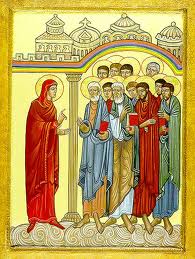
Upon entering the city of Jerusalem for during the Jewish harvest festival of Pentecost, Peter, John, James and Andrew; Philip, Thomas, Bartholomew, and Mathew: James  ben-Alpheaus: Simon, a member of the Zealot sect: and Judah ben-Jacob. Also, with them were some of the women who followed Jesus, his mother Mary and some of Jesus’ sisters and brothers.  With one mind they devoted themselves to constant prayer.”

I can see them in my mind’s eye all huddled together in an upper room united in their grief. All their hopes and dreams shattered, their lives in disarray as what they had believed so strongly so passionately was gone.  What were they to do? How could they go on?  What was the point of it all? If Jesus was gone, why bother?  Maybe he wasn’t all that they had hoped for?  

I can hear them, up there in that room arguing, weeping, searching for answers, longing for the security of the way it had been when Jesus was there with them; when they were certain about what needed to be done. I can hear them talking about Jesus, remembering the stories listening to the tales of his courage, marveling at his audacious courage, second guessing his teaching, longing for his touch, feeling the hope stir in their bellies, hope for justice, anger at the oppression they were left to deal with, confused about what to do next, not knowing what to think or believe now. Continue reading


Lonely, Yet Not Alone – John 14:23-29, Easter 6C

This morning, I want to talk to you about an epidemic that is rampant in our world. This epidemic is growing at such an alarming rate that governments all over the world are scrambling to address the pervasive suffering that this epidemic is causing in people of all ages, all races, all classes, all faiths; this epidemic does not discriminate, every one of us is susceptible to the devastating consequences of this epidemic. Any ideas about what governments are calling this quickly growing epidemic? Loneliness. Loneliness or as some experts refer to it, social isolation is growing in leaps and bounds all over the place.

All of us have known the pain of loneliness. Some of us also know that loneliness can have a detrimental impact on a person’s mental health. Loneliness causes increased rates of depression, anxiety, and irritability. Research now shows that loneliness can also be physically harmful. Loneliness is linked to potentially life-shortening health issues like, high blood pressure, heart disease and obesity. Some experts have gone as far as to argue that being lonely for a prolonged period of time is more harmful to a person’s health than smoking 15 cigarettes a day. One of the most socially isolating aspects of loneliness comes from the social stigma that surrounds loneliness. We simply don’t talk about our loneliness. This social stigma often prevents people from seeking help. “People think if they admit they are lonely it means people don’t want to be with them.” People just don’t want to admit that they are lonely.

Loneliness is a global problem. In the United Kingdom the situation has become so serious that the government has appointed a loneliness minister to address the issue. In Canada, studies have found that one in five Canadians identify as being lonely. One in five of us suffer from the shame and the fear that come from being lonely.

Watch the Lonely Bench

I can’t help but marvel at Sukhkaran’s courage. I know that I would not have had the courage to sit down on the Lonely Bench. At his age I would have been too afraid that if I sat down on that bench, nobody would have come to sit beside me. We moved around so much when I was a kid. I was always the new kid in class. Every year a new school. Sometimes more than one new school in a year. As a child, I had intimate knowledge of loneliness. All too often I felt the pain of social isolation, of not belonging. I cried so many tears because of the pain that consumed me because I had little or no connection to the strangers into whose midst I stumbled in and out of.

It wasn’t until I was a teenager that I finally found my people. I was fifteen, when I found my tribe when I happened upon a Lutheran youth group which lead me into the church. Finding my people, my tribe and finding a place to belong in church, made my life a lot better. But even a sense that I actually belonged somewhere didn’t end my loneliness. Even the church can be an incredibly lonely place. Continue reading

Don’t Piss God Off! – a sermon for Easter 6C – Acts 16:9-15

lydia of philippi“Warning!” written by Jenny Joseph

When I am an old woman I shall wear purple
With a red hat which doesn’t go, and doesn’t suit me.
And I shall spend my pension on brandy and summer gloves
And satin sandals, and say we’ve no money for butter.
I shall sit down on the pavement when I’m tired
And gobble up samples in shops and press alarm bells
And run my stick along the public railings
And make up for the sobriety of my youth.
I shall go out in my slippers in the rain
And pick the flowers in other people’s gardens
And learn to spit.

You can wear terrible shirts and grow more fat
And eat three pounds of sausages at a go
Or only bread and pickle for a week
And hoard pens and pencils and beermats and things in boxes.

But now we must have clothes that keep us dry
And pay our rent and not swear in the street
And set a good example for the children.
We must have friends to dinner and read the papers.

But maybe I ought to practice a little now?
So people who know me are not too shocked and surprised
When suddenly I am old, and start to wear purple.

Lydia is one of the many mothers of Christianity. Lydia was the first European convert to Christianity. Lydia was the founder of the church at Philippi. The Scriptures tell us that before Paul and Silias proclaimed the Gospel to Lydia, she was a “God Fearer”. God Fearers, was the name given to people who were not Jewish but who were so intrigued with the God that the Jews worshipped that they lived their lives as if they were Jews. Indeed, most God Fearers followed all the Jewish laws except for circumcision. Circumcision, for adult males, living in the first century, when sanitary conditions were primitive and no antibiotics were available could lead to death.  So, most male converts to Judaism, were not called Jews but God Fearers. Generally women were given the same designation as their husbands or fathers.

So right from the beginning of the story, Lydia is described in an unconventional way. We are told that Lydia was “a God fearer; a worshipper of God and a dealer in purple.” Now an introduction like that may not seem very unconventional to us but we have to remember that for the writer of the Book of Acts to have described a situation where, Paul and Silias, two strange men in town meet a woman, any woman was in and of itself unconventional. Continue reading

Judas Is Still Hanging Around! – John 13:21-35

I’d like you to think very carefully about a couple of questions. The questions are simple ones.  They are designed to help us form images in our minds; images that might help to shed light on a particular kind of wound. But before I ask the questions, let me give you a definition of the verb that drives both of the questions that I’m going to ask. The verb comes from the Latin verb “tradere” which means to hand over. In English we say betray. The word betray literally means to hand over to an enemy by treachery or fraud. The word betray can also mean to be unfaithful; to violate trust, or to deceive.

So, here’s my first question: Have you ever been betrayed? Think about it very carefully. Has someone ever turned you over to the enemy by treachery or fraud? Has someone ever disappointed you; or been unfaithful to you, or violated your trust, or deceived you? Have you ever been betrayed?     

The second question is this: Have you ever betrayed someone? Think about it carefully. Have you ever handed someone over to the enemy? Have you ever let someone down, or been unfaithful, or violated a trust, or deceived someone? Have you ever betrayed someone?  Now take those two questions further: Have you ever been betrayed by someone you love?  Have you ever betrayed someone you love?  

The gospel reading for the fifth Sunday after Easter takes place on the night on which Jesus was betrayed. The night of Jesus’ last supper, a supper that took place after Jesus had humbled himself to kneel at the feet of his followers and bath them. A night on which the enemies of Jesus are plotting outside the dinner party; plotting to do away with Jesus. After washing his disciples’ feet,

Jesus informs them that one of them will betray him. Peter, who is worried that Jesus might be talking about him, leans over and asks Jesus who the betrayer is? Jesus answers: “it is the one whom I give this piece of bread which I have dipped it in the dish.” Jesus dips the bread in the dish and gives it to Judas Iscariot and says, “Do quickly what you are going to do.” No one at the table knew what Jesus was talking about.  After receiving the piece of bread, Judas immediately went out. It was night, darkness. When Judas had gone out, Jesus proceeds to give his followers a new commandment. “Love one another as I have loved you.”

Why after five weeks of celebrating Christ’s glorious resurrection does the church lectionary take us right back to Maundy Thursday; to the night of Jesus’ betrayal?  Why bring up Judas at a time like this? Judas left the table a long time ago. Christ is risen. We are five weeks into the celebration of Easter. Why bring up Judas and his dastardly deed?  Now that Judas has done what he has done, surely, he no longer needs to be invited to our celebrations. Once Judas left that table and did what he did everything was different. But the church just won’t let it go.  So back to that horrible night we go to the time when Jesus was betrayed. Jesus is about to go to the cross. Jesus is about to reveal to us a LOVE that takes him all the way to the cross. So, Jesus gives his followers a new commandment:  “Love one another as I have loved you.”

“Does this LOVE extend even to Judas, and to all the Judases of this world? Upon hearing Jesus’ new commandment, did any one of the other disciples go out into the night looking for Judas in order to extend that love to him? Did anyone fear for Judas, miss him, or try — even after he brought soldiers to Gethsemane — to bring Judas back, to talk him out of his shame, his anger, his rapidly deepening hell?”[i]

We don’t have the answers those questions. My guess is no one found him, even if someone tried. To this day people are searching for the “real story” about Judas. Judas is still out there, it seems, wandering somewhere in the night, forsaken by every generation of disciples since that ancient Thursday, the night of the new commandment. Every time we gather for Communion, we commemorate Judas and his unforgivable behavior when we speak of the night when Jesus was betrayed. We speak of Judas’ betrayal, but we do not name him. We have not searched for him, and we have not found him.  Judas’ place at Christ’s table remains empty.  Continue reading

Embracing Our FULL HUMANITY – The Gospel of Mary

Readings from the Gospel of Mary here

The year was 1998. I was in my final year of seminary. I took a course from a visiting New Testament Scholar, who shall remain nameless, to protect not his innocence, but because it is bad form to speak ill of our elders. Suffice it to say that this professor had achieved some renown as a New Testament Scholar, so I was eager to learn from his wisdom. This professor lived up to his reputation. He was brilliant and he was demanding. I learned a great deal from him. During a class on the women of the New Testament, I recorded a conversation between the professor and myself. The conversation impressed me so much that I included it in my Master’s Thesis. It went like this…

He just said it for the third time!  “Harlots!”

He keeps calling them “harlots”, while I rack my brains to come up with one harlot.  Then he points to the text and his charges become clearer, he says,

“she is a “prostitute!”

My carefully reigned in anger is unleashed.   “Where?  Where?  Where? Show me where it says this woman is a prostitute!”

As he refers to the Gospel text and insists that, “It is there, right there in the text”, I want to scream, I want to cry, I want to wipe the bemused expression from his face. I want to rub his nose in the damned text. Instead, I begin the uneasy process of reigning in my anger.  I slow my speech, I try to erase the tremor from my voice, and I ask him to, “Show me, show me where it says this woman is a prostitute.”

He consults his text and says, “a woman in the city who was a sinner.”

“A sinner not a prostitute.”  I respond.

He insists, “Yes a prostitute.”

“Where?” I ask.

Again, he insists, “A woman who was a sinner.”

I demanded to know, “Where does it say she was a prostitute?”

He insists, “The author means that she was a prostitute.”

I lose control, “How do you know?  What words does the author use to say that this woman was a prostitute? Show me in the text where it says she was a prostitute?”

He still doesn’t get it,“What do you mean? It is clear that this woman was a prostitute.”

Once again, I push, “Show me.  Show me where?”

He continues to say, “She was a woman from the city who was a sinner.”

I know that the text says that, so I implore him to tell me, “The Greek… What does the Greek say?”

He replies, “amartolos”.

I push, “Does that mean prostitute?”

We both know that it does not.

 He replies, “Sinner. But the context clearly shows that she was a prostitute.”

Still pushing I ask him to “Show me. Show me how the narrative says this woman was a prostitute. Show me where it says her sins were sexual. Show me where it says so in the narrative.”

He says, “It’s clear.”

Clearly, we disagree, so I try again, “Clear to you.  Show me. Show me!”

As he fumbles through the pages, I offer him a way out, “Okay.  Even if I concede the point that her sins were sexual, show me where it says that these sexual sins were nothing more than lust or adultery, show me where it says that she was a prostitute.  For Christ’s sake! Show me!”

He couldn’t show me.  It’s simply not there.

Nowhere in the New Testament does it ever say in Greek, or in English that Mary of Magdala is a prostitute. But over and over again scholars, theologians, popes, preachers, and dramatists, have continued to cast Mary of Magdala as a prostitute. In the years that have transpired since that day in seminary, when a visiting New Testament scholar insisted that “the context clearly shows that she was a prostitute,” I have delighted in being able to participate in the phenomenon of that I like to call, the resurrection of Mary the Migdal as the first Apostle. Migdal is a Hebrew word for tower and some scholars suggest that this was actually Mary’s title. Mary the Tower – perhaps because she was tall, but more likely because her authority as an Apostle “towered” above the authority of the apostles who abandoned Jesus. Continue reading

Jesus, How Long are You Going to Keep Us in Suspense? – Easter 4C, Good Shepherd Sunday

Beyond the Beyond - Dawn Hutchings

Readings Psalm 23 and John 10:22-30

Listen to the sermon here

I was about 10 years old, when I first encountered the 23rd psalm. I never went to church when I was a kid. Church simply was not part of my family’s life. But one summer, my brother and I were left in the care of my Mother’s aunt who lived down in the Adirondacks, and as a way of filling our days, Aunt Madge sent us to a local Vacation Bible School. I don’t remember much about the five days we spent attending Vacation Bible School. But, I do remember very well the glimpse of God that I encountered that week. To this day, I can still recite word for word just what I learned that week:

The Lord is my shepherd; I shall not want.  

He maketh me to lie down in green pastures: he leadeth me beside the still waters.  

He restoreth my soul:  

He leadeth me in the paths of righteousness for his name’s sake.  

Yea, though I walk through the valley of the shadow of death, I will fear no evil: 

for thou art with me; thy rod and thy staff they comfort me.  

Thou preparest a table before me in the presence of mine enemies: thou anointest my head with oil; my cup runneth over.  

Surely goodness and mercy shall follow me all the days of my life: and I will dwell in the house of the Lord forever.

I can still hear the minister carefully translating each phrase into language that children could understand. I remember thinking that I had learned some secret knowledge that had been hidden from me all my life. For the first time in my short little life, I caught a glimpse of God and he wasn’t some angry old man who was sitting up on a cloud thinking up ways to punish me.  He wasn’t some mean Father who sent his only son to die on a cross.  

For the first time in my life I caught a glimpse of God the shepherd, who wanted nothing more than to take care of me, who provided beautiful green meadows with lovely rivers flowing through them, were I could feel the warmth of the sun and know that even if hard times were just around the corner, God would go with me, and take care of me. Best of all, this God would fill me with so many blessings that my life would be just like a chocolate mike-shake that was so full that it would never end. I had absolutely no idea what a shepherd was, or what a shepherd did. I simply knew that God is my shepherd and following God was the greatest, safest, most rewarding thing I would ever do.

The metaphor of God as my shepherd carried me to a place beyond the words of the 23rd psalm, to a paradise more sublime than my ten year old self had ever imagined before. A place of beauty, safety and security, that at the tender age of ten, I was already longing for.

Metaphors are quite literally words strung together to carry us beyond the words themselves, and for me and for millions of people, generation after generation, the words strung together in the 23rd psalm have carried our longing souls far beyond the words themselves to into the midst of our hopes and dreams.  As a ten year old, who was always the new kid in town, the nomad, wandering from new school to new school, the mere mention of a being led to a place of safety, where I would find comfort and rest from the shadows that haunted me, was all the goodness and mercy that I needed to know about in order to want to know more about this Shepherd. Those first glimpses of God, still comfort me.

My life has not been particularly difficult. I am blessed, I am loved, I am privileged, I am wealthy, my cup does indeed overflow with goodness. But, like all people, I have my dark valleys were the shadows of death frighten me. There are moments of longing in which I long to be swept up into the arms of a Good Shepherd, who will hold me close in an embrace of LOVE so that I will be able to rest, knowing that I am at home. But I’m not ten years old. The metaphor of a shepherd no matter how good or great that shepherd might be, cannot satisfy my longing to know the One who is at the very core of our existence. Continue reading

We Are All ONE – Pluralism Sunday – John 21:15-17

A long time ago, I owned a beat-up 1969 Chevy Nova that I paid less than $700 for in the hope that that old car would last long enough to get me through my undergraduate years at the University of British Columbia. I was a late bloomer. I didn’t get around to doing my undergraduate degree until I was 32 years old, when I enrolled in the Religious Studies program at UBC. I was living in a shabby basement apartment, where the rent was cheap, but the parking was non-existent. If I was lucky, I’d find a parking spot in the alley behind my apartment. Walking in that dark alley at night was more than a little scary. Often, as I was hurrying through that dark alley, I would see this old woman who was living rough in a makeshift tent. It wasn’t much of a shelter, just some cardboard held together by old clothes and torn grocery bags.

The old woman and I never spoke to one another. After several weeks of seeing one another in that back-alley, we would quietly nod in recognition of one another. I knew that she belonged in the neighbourhood and she knew that I belonged in the neighbourhood. Neither of us was comfortable in the back alley at night and it seemed almost comforting to see a familiar face, rather than running into some totally unknown stranger.

One morning as I was hurrying off to class, I heard the old woman moaning underneath her makeshift tent. I am ashamed to say that her moans frightened me, and I dashed to my car, unlocked it as quickly as I could, and drove off to the university so that I could continue my study of the religions of the world. The irony was not lost on my and I was ashamed.

I had some brilliant professors at UBC who taught me all sorts of things, but none of those wise professors ever taught me as much as one of my fellow students taught me. My classmate Sannidhi taught me more about religion than any professor. Sannidhi is a Hindu who I suspect has traveled this earth in many incarnations. Sannidhi possessed wisdom beyond his 20 years of age. To this day, some of what I learned from Sannidhi, I continue to try to teach others. It was Sannidhi who taught me the Hindu understanding that all gods are but pale imitations of the ONE God who lies at the very heart of all that IS. It was from Sannidhi that I first learned the Hindu description of the MYSTERY that we call God, that I have come to love above all other descriptions of the DIVINE ONE. I’ve shared this description with you many times:  “God is beyond the beyond and beyond that also.”

Despite the difference in our ages and backgrounds or maybe because of them, Sannidhi and I became study partners. Together, we navigated the murky waters of Religious Methodology as we tried our best to move beyond our own religious practices so that we could learn from the religious practices of others. Sannidhi often spoke about his home in India and how he couldn’t wait to show me what India was really like.

One evening I offered Sannidhi a ride home in my car. To this day, I’m not sure whether or not he was teasing me or if he actually was seriously impressed with my old Chevy. I remember him running his hand over its white vinyl roofand making a sort of tutting sound as his head bobbed from side to side and he expressed his admiration for such a fine mode of transport. Driving along, our conversation about the nature and reality of God was so engrossing that I invited Sannidhi to stop off at my place for a cup of tea so that we could continue our conversation. That’s how we ended up talking to the old woman who live lived in the back-alley behind my basement apartment. turns out her name was Joanna. In just a few moments, Sannidhi had learned that she liked milk and just a touch of sugar in her tea. I myself had never dreamed of offering the old woman a cup of tea. Sannidhi never dreamed of not offering her a cup of my tea. Continue reading

Sometimes I wonder if our liturgical utterances of resurrection are in danger of becoming the last gasps of a Church that is all but dead. – Easter 3C sermon

grave-clothes

Christ is Risen!  Christ is risen indeed! Alleluia! During the Easter season we punctuate our celebration of resurrection by declaring that, “Christ is risen!” and sometimes I wonder if our liturgical utterances of resurrection are in danger of becoming the last gasps of a Church that is all but dead. Are we who gather in churches on a Sunday morning members of a church that is the living body of the risen Christ or are we mourners at the funeral of a religion that died in the last century because it did not have the stamina for 21st century?

As congregations shrink, churches close, and the few mourners who are left insist upon preserving what’s left of the corpse, the season of Easter, designed to celebrate resurrection, is in danger of becoming the church’s final attempt at denying the corpse of Christianity. Generations to come may look back upon this critical time in the church’s life and pronounce that resurrection itself was the cause of the church’s death. While worshipers remained fixated upon the physical resuscitation of Jesus’ corpse determined to defend the doctrines of the church, the life-blood of the body of Christ slipped away, no longer able to congeal around the idea of a deity so small that “HE” could only be worshipped by those who could narrow their thinking so that it could fit into the boxes created by the need to suspend everything they have learned about the nature of reality.

Gathering around the ancient stories of resurrection, those who sought to save the church could not agree on the treatment necessary to save the church. While some insisted that a good dose of biblical literalism was the only way to save Christianity, others advocated for a more radical treatment, one that took on board all that we have learned about the cosmos and what it means to be human. Still others looked to more nuanced forms of treatment and reached into the long traditions of the church which have always worked wonders in the past; traditions that honoured the human need for reason while they still managed to encompass the unfolding mysteries of the cosmos. While the theologians, priests, laypeople, hierarchy’s, would be evangelists, charlatans, worshippers, seekers, and philosophers, tended to the perceived needs of the church, the members of the Body slipped away to seek nourishment and healing elsewhere; leaving the patient to die a slow and laborious death. Oh there are a faithful few, huddling around the corpse doing their damnedest to resuscitate the corpse of Christianity. But life has long since left the patient. All that is left are the mourners who simply cannot believe that their beloved is dead. But like all deaths, life goes on, and the world scarcely notices all that has been lost. Some of us, hang around, finding solace in one another, remembering the good old days, longing for the future we had hoped to see.

When some folk return from the empty tomb that the church became, to tell us that Christ is not there, that Christ is risen. Dare we even begin to imagine that the one place we expected to find Christ is empty? Can it be true? Can Christ have escaped the empty tomb we call the church? Or, is this just one more idle tale? Continue reading

Exposing Our Wounds: John 20:19-31

All we have are a few brief stories.

There’s the one about the empty tomb.

A stranger robed in white, a gardener perhaps?

Folded grave-cloths.

Weeping women.

Fleeing men.

Horrible wounds.

Rumors.

Confusion.

Fear.

Doubt.

And always the nagging question.

Why?

Just some disconnected stories, scant stories, light on details and yet powerful in their truth. It has been said that, “The shortest distance between a human being and truth is a story.” It has also been said that the greatest story ever told is the story of resurrection. Like all really good stories, the story of resurrection has been told over and over again as storytellers attempt to convey its truth. We have heard Easter’s story of resurrection so many times that you would think the truth of resurrection would be obvious to us all.

Yet, we struggle to find truth in Easter’s familiar stories. Some of us have been shaped by these particular stories. Some of us have built our lives around the truth that others have reported to us about these stories. Some of us have rejected these stories and filed them away with all the other idle tales in which we can find no truth. Some of us have moved on from these stories convinced that there is no longer any truth to be found. Some of us love to hear these stories because they take us back to familiar truths that inspire a nostalgic sense of well-being. Some of us, are determined to wrestle with Easter’s stories until they release all the truth that we can find in, with, and between the lines; truths that call us toward a new way of being, a way of being that we long to embrace.

I myself, I am a wrestler. Like Jacob of old, I wrestle with Easter’ familiar stories determined to get from these ancient tales not just truth, but an inkling of the DIVINE ONE who dwells in, with, through, and beyond all of our stories. Every year, after the excitement of Easter Sunday, the stories of a community locked away in fear come to us. Every year some element of these stories, touches me in ways that open old wounds and awaken familiar fears.

I remember long ago, when I was an intern trying to learn what it is to be a pastor. I’d never been to a visitation at a funeral home before. I remember putting on the uniform of a pastor. Back then, I wore the collar and the black-shirt not so much as someone wears a uniform, but rather as someone who puts on a suit of armor – hoping against hope that the uniform would give me an air of competence and perhaps even hide the fear that so often wells up in me.

I don’t really remember much about that particular funeral home visitation. I couldn’t tell you who it was who had died. I remember being relieved to see a familiar face in the long line up to greet the widow. I remember sticking close to that familiar face trusting that she would show me what was expected of me.

As we waited for our turn to greet the widow of the dead man, I wondered what on earth I could possibly say to ease her pain. Back then, I believed that this was the job of a pastor, to ease the pain. I hadn’t yet learned to be in the pain, to be with, to share in the wounding. Standing and waiting I kept asking myself, “What can be said when a lover dies?” The magnitude of such loss is immense. I don’t think I was the only one in that crowd of mourners who felt ill at ease.

Then suddenly it happened. I was confused as to why it was happening. It was like we were a sea parting as we made way for a woman who strode into our midst with such purpose. People stepped aside, got out of her way and then we all watched as this woman, this widow opened up her arms to embrace the newly widowed woman. Their wounds were not the same except perhaps in their depth. No words were spoken between these widows and yet the magnitude of their touch was a kind of miraculous healing. Continue reading

Resurrection: Believing is NOT the point! – sermons for the Second Sunday of Easter

Looking ahead to Doubting Thomas’ annual appearance, I am reminded that resurrection is not about belief. Resurrection is a way of being in the world. Over the years I have tried serval different approaches to encourage the practice of resurrection. click on the titles below to see

Believing in Resurrection is NOT the point! click here

Easter: 50 Days to Practice Resurrection! click here

Humpty Dumpty, Doubting Thomas, and Resurrection click here

Leap of Doubt – How Do We Believe Resurrection? click here

Can the ways in which we tell the stories of resurrection transform us into followers of Jesus who embody a way of being in the world that can nourish, ground, and sustain the kind of peace that the world years for? click here

Practicing Resurrection: Forgiveness click here

Apostle to the Apostles: Mary’s Story

a to aThis coming Sunday, in churches all over Christendom, worshippers will hear the gospel story of Doubting Thomas. The story of Doubting Thomas is prescribed gospel reading every year for the Sunday after Easter. I’ve never understood why Thomas should hold such a prominent place in our lectionary: I mean, as the stories have been handed down to us, when the chips were down, and Jesus could have used their support, Thomas and the guys deserted Jesus; they left him alone and spread out across the city to hide from the Romans and the religious authorities. According to the anonymous-gospel-story-tellers, it was the two Marys, together with the other women who had financially supported Jesus’ ministry, and who stuck by him to the bitter end. Also according to the anonymous-gospel-story-teller, we know as John, it was Mary, the one they call Magdala who brought back the news that Jesus was not dead, but had risen. Despite the fact that Mary Magdalene was the one chosen to be the Apostle to the Apostles, (the word apostle comes from the Greek for “the one sent”) our lectionary quickly moves on from the empty tomb to the upper room so that we can all once again explore the story of good old, doubting Thomas.

So here, let me honour Mary the Apostle to the Apostles with this my imaginary account of Mary’s story. Remember the power of our imaginations to breathe life into what appears to all the world to be dead. 

Shalom.  I greet you in the name of our risen Christ. My name is Mary.  You may know me as Mary Magdalene. I am not from around here.  I come from a good family in Magdala.  Magdala is a wealthy city on the Sea of Galilee, just south of Capernaum. My family made a lot of money in the fishing industry in Magdala.  While I was growing up I lacked nothing.  But I was not happy.  I was sick.  I would sit around the house moping and complaining and make everyone miserable.  I was so distraught.  Often I was so upset that I pulled out my own hair.

Sometimes I would be so excited that people couldn’t stop me from talking.  I ran up all sorts of bills in the market place which my parents had to pay.  I was always cooking up some mad scheme or other.  I would rant and rave at the slightest provocation.  From time to time I would become ill and stay in bed for weeks on end.  I knew something was terribly wrong and nothing seemed to ease my anxieties. I was a prisoner inside my own mind. Then I met Jesus.  He was teaching outside of the synagogue.  At first, I just stood back in the crowd and listened as he spoke about a new world which God intended to create. It would be a world where the sick are healed and prisoners are set free. I wanted to taste this freedom which Jesus spoke about. I wanted to ask him so many questions.  But the crowd pressed in upon him demanding that he tell them more and I was pushed farther away from him. In despair, I turned to leave. Continue reading

Saudade: through the absence we feel the presence. – Easter Sermon

This time last year I was in Belfast. Many of you know that I lived in Belfast when I was a child. When I visit Belfast, I always stay in the part of the city that is known as the Cathedral District. From there you easily get around to most of the attractions that Belfast has to offer. Sure, there are plenty of tourist attractions in the Cathedral District but the real attractions are the pubs in this splendid part of Belfast. Trust me I’ve walked, some would say crawled, to some of the best pubs in Belfast. Which is not surprising because you see, I do come from a long line of pub-crawlers. My Grandad was a legendary pub-crawler. Grandda loved a wee dander about, as long as that dander took him to either a pub to the dogs. Fortunately, for Grandda there was always a pub at or near the dog racing tracks. So, when I wander the streets of Belfast city, I do so haunted by images of my Grandda all done up in his best, walking with such purpose and determination at first and then with a little less of a sense of direction as he crawled the pubs. Grandda has been dead for almost 40 years but in Belfast I can still see him in all his old haunts. So, when I’m in Belfast, every pub I go into, I enter with expectation and  I wonder what it must have been like when me Grandda came in here. Sometimes I actually see my me Grandda. I know he is long dead and gone. I know that he can’t possibly be there. But I can’t help myself, the feelings are so overwhelming.

We don’t really have a word in the English language that captures the emotion that I feel when I walk the streets of Belfast. There is a word that I learned a long time ago, it is a Portuguese word: “saudade.” Saudade doesn’t actually translate into English. The best translation of saudade that I have ever come across is, the presence of an absence….the presence through absence. It doesn’t appear to make any sense. How can you experience presence through absence? Something is either present or it is absent. And yet, if you speak to anyone who has ever lost someone they love and they will tell you that that person’s absence is so intense that they can actually feel them, right here, deep inside.

When a mother loses a child, the pain of that absence is so intense that she can feel the child she carried in her belly right here, inside. When a lover loses their beloved, the pain of that loss is so intense that the lost love is felt here, right her deep inside. When someone we love is gone, they are still here. We see them here there and everywhere. We catch glimpses of them on the streets. Sometimes we shake our heads knowing that what we see can’t be real, and yet we know it’s real. A loved one’s absence can be very present. Saudade, through the absence we feel a presence. Saudade.

Now I suspect that some of you are thinking and why wouldn’t you, it is Easter after all, so some of you are thinking,  “Aha, I get it…this is this progressive preacher’s way of explaining the resurrection.” Pretty good ha??? Well know, there might have been a time when I would have tried to explain the anonymous gospel-story-tellers’ accounts of Jesus’ resurrection. I am after all a progressive Christian pastor, and you are all enlightened 21 century people, with a pretty clear understanding of reality. There may be one or two of you who believe that Jesus physically rose from the dead. But I’m guessing that most of us don’t hang our Christianity on the concept of the physical resuscitation of a corpse.

As for this preacher, I’m with the Apostle Paul when it comes to the resurrection. Questions about the nature of the resurrection were annoying to Paul. So much so that the Apostle Paul used pretty strong language in his letter to the church at Corinth, Perhaps someone will ask, “How are the dead to be raised up? What kind of body will they have?  What a stupid question!” Like the Apostle Paul, my faith in the reality of resurrection does not hinge on the physical resuscitation of a corpse. “The sun has one kind of brightness, the moon another, and the stars another. And star differs from star in brightness. So it is with the resurrection of the dead. What is sown is a perishable body, what is raised is incorruptible. What is sown is ignoble, what is raised is glorious. Weakness is sown, strength is raised up. A natural body is sown, and a spiritual body is raised up. If there is a natural body, then there is also a spiritual body.” So says the earliest explanation we have of Jesus’ resurrection.

Saudade is not my way of trying to explain the stories of Jesus resurrection. Saudade is my way of describing what it feels like to be a progressive Christian during Holy Week. After abandoning the notion that the DIVINE source of all that IS is actually some sort of far-away person in the heavens, who orchestrated the life and the execution of a person purported to be “His only begotten Son, begotten not made,” via an execution so vile that we shouldn’t even begin to contemplate it lest we tremble, tremble, tremble; well once you come out of the closet as a 21stcentury progressive Christian, Holy Week is like a saudade festival! Continue reading

If only Good Friday only rolled around once a year…Good Friday happens each and every day!

Let me begin where I believe we must begin on every Good Friday. Jesus did not die upon the cross to save us from sin. Jesus is not some sort of cosmic bargaining chip offered up in our place to a wrathful, judgmental quid pro quo god, who demands a blood-sacrifice in order to forgive us so that he and I do mean he can usher us into heaven. Jesus did not die alone on that first Good Friday and we have not gathered here simply to grieve something that happened nearly 2000 years ago. On this Good Friday, we stand in the shadow of the cross to grieve the death of LOVE; and there is one thing we all know about LOVE and that is that LOVE dies over and over again, each and every day. Each and every day people all over the world grieve the death of LOVE. Indeed, the death of LOVE is omnipresent. The death of LOVE causes us to tremble, tremble, tremble. So much so, that as LOVE dies all around us, something in us knows that we must insulate ourselves from the reality of death’s omnipresence or the sheer intensity of trembling will surely cause LOVE to die in us. Good Friday is the day that we set aside to lament the death of LOVE; an attempt, if you will, to confine the trembling to a more manageable time and place. On Good Friday, we gather together to tremble, tremble, tremble.

I was barely five years old the first time that I can remember this kind of trembling. These early memories of the trembling are lodged deep in my psyche and I confess to not knowing what actually happened. All I can tell you is how visceral these memories are and how formative they have been when it comes to shaping who and what I have become. It was 1963, I was just five, and my personal memories are but flashes that over the intervening decades have lodged themselves in and amongst the black and white footage that has become our collective remembering of this particular death of LOVE. There’s a surreal image, not exactly an image, more of a feeling prompted by my own mother’s sobbing and the impression of my Dad’s tear-filled eyes as together, with millions and millions of others, we attended the funeral of John F. Kennedy. Reflecting on my first experience of the death of LOVE, I can see now that the hopes and the dreams of my parents’ generation died again, just like LOVE had died for my Mom when the bombs fell all around her childhood home and again and again each night my Dad sought shelter from the bombs. As children of World War II, my parents’ generation witnessed LOVE’s death over and over again. They were all too familiar with the trembling that accompanies LOVE’s death.

As I was growing up, as each of you grew up, LOVE was assassinated, executed, snuffed out, bombed, napalmed, starved, murdered, and left to die over and over again. There were far too many funerals, too many opportunities to lament as LOVE fell victim to death. We all share countless collective memories of LOVE dying over and over again. We can add to that our own personal memories and it is clear that LOVE dies over and over again, each and every day. Continue reading

Each Maundy Thursday we must peer beyond Passover lambs and scapegoats if we are to catch a glimpse the LOVE that we call God

Every Sunday I stand at the altar and preside over a mystery. A mystery that has its roots in the events we remember this Holy Thursday.  On Maundy Thursday, we gather together to contemplate MYSTERY. We know what will happen tomorrow as Good Friday plunges us into darkness. So is it any wonder that we cannot fully comprehend this MYSTERY.

The various gospel writers have created a record of Jesus’ last evening that is filled with bittersweet images. Our mystery begins with the foreshadowing of what is to come as we hear the name Judas Iscariot. Judas, son of Simon, is perhaps the most trusted of Jesus’ disciples, after all Judas is the one who is trusted with the financial resources of this struggling little group. Even though we know Judas’ role in this unfolding mystery, we must remember that Judas is among those who Jesus loved to the end. But long before the silver changes hands, we already know enough to dread the betrayal.

Our mystery continues with the tender intimacy of a teacher washing the dirty feet of his beloved bumbling students, as Jesus breaks the bonds of decorum to demonstrate the fierce tenderness of loving service. The image of Jesus washing the feet of his followers still seems undignified all these centuries later. So, is it any wonder that the intimacy of Jesus’ tenderness is more than Simon Peter can bear? In order to get beyond their inhibitions, Jesus must spell it out for them.  “Do you know what I have done to you? You call me Teacher and Sovereign —and you are right, for that is what I AM. So, if I, your Sovereign and Teacher, have washed your feet, you also ought to wash one another’s feet. For I have set you and example.” Jesus has washed their feet; all their feet, even Judas and the talk of betrayal continues as Jesus returns to the meal.

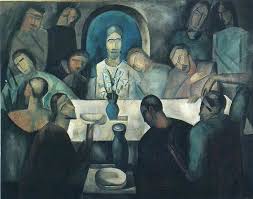
The writer of the Gospel of John does not record the details of the breaking of the bread or the passing of the cup. These details are recorded by Paul in his letter to the Corinthians and by the writers of the gospels of Mark, Matthew, and Luke: “on the night he was betrayed, our Savior Jesus took bread, gave thanks and broke it, saying, “This is my body, which is broken for you. Do this in remembrance of me.” In the same way, after supper, he took the cup and said, “This cup is the New Covenant in my blood. Whenever you drink it, do it in remembrance of me.  For every time, you eat this bread and drink this cup, you proclaim Jesus’ death until Christ comes.” Week after week, year after year, generation after generation, century after century Christian priests have presided over ritual communions using what have become known as the words of institution. In remembrance of Jesus we eat and drink. The body and blood of our Saviour Jesus Christ. And therein lies the mystery. The mystery of communion. Sometimes the meal has transforming power, nourishing power, restorative, profound power. At other times the meal is just one more religious ritual carried out by rote, experienced without feeling, or impact. Sometimes the meal seems foreign to us, almost alien, perhaps even barbaric. Continue reading

Preparing to Preach on RESURRECTION: Giving up the notion of a physical resuscitation.

resurrectionThis Sunday worship services will begin with the proclamation that: Christ is Risen! Christ is risen indeed.  Alleluia! Let me follow that proclamation up with a good Lutheran question:“What does this mean?”  What does it mean that Christ is risen? What does resurrection mean? The truth is that there are about as many different explanations of Christ’s resurrection as there are Christians.  And that’s a good thing, because the question of the resurrection is a question that lies at the very heart of Christianity. So, is it any wonder that Christians have been struggling to come to terms with resurrection since the very first rumours that Christ had risen began to circulate. Over the centuries the various responses to the question of resurrection have divided Christians as various camps work out various responses.

For many Christians and non-Christians alike Resurrection is the dividing line. But this is nothing new.  Indeed the drawing of that line can be seen in the earliest Christian writings that we have. The Apostle Paul himself, wrote to the community of followers at Corinth: “If there is no resurrection of the dead, then not even Christ has been raised. And if Christ has not been raised, then all of our preaching has been meaningless—and everything you’ve believed has been just as meaningless.” There are many believers and non-believers alike who point to these line’s in scripture and say, “Ah ha, there it is, either you believe in the resurrection or you don’t!”
Continue reading

Approaching the Resurrection – What Did Paul Actually Say?

trouble with resurrection

Far too many preachers stumble into the celebration of Easter without doing our homework. Resurrection is a central tenant of the Christian faith and Easter is the primary celebration of resurrection and yet, too many of us fail to open ourselves to current scholarship surrounding the doctrine of resurrection. Questions about the nature of the resurrection ought to send us back to the words of the Apostle Paul. Bernard Brandon Scott is a charter member of the Jesus Seminar. His book “The Trouble with Resurrection” is a must read for those who preach during the Easter Season.

If you are planning to write a sermon or listen to a sermon this Easter, this video provides essential background information about the words of the Apostle Paul on the nature of the resurrection which may surprise you. Scott’s treatment of 1 Cor. 15 provides a new understanding of resurrection which is compelling as well as liberating. For this reason, our Easter worship services ought to include reading from 1 Corinthians 15!!!


Maundy Thursday Sermons

MAUNDY THURSDAY SERMONS

Two Suppers – Maundy Thursday – A Strange Night

Scuffed Up Reddish Pumps

MAUNDY THURSDAY – When you don’t believe that Jesus was a sacrifice for sin!

We must peer beyond Passover lambs and scapegoats if we are to understand the LOVE that we call God

Jesus and the Black Hole of Our MissRemembering – Palm Sunday

Two images have vied for my attention this week. The first image resembles the shadowy figure on your bulletin cover.  It’s the image of a person sitting atop a donkey heading toward what must be Jerusalem. It’s not surprising that a preacher should be preoccupied with such an image leading up to Palm Sunday. But the second image came as a surprise to me. I suspect that most of you have seen the photograph of the black-hole that was generated by astronomers. At least, I think it was a photograph of a black-hole. The truth is, I’m not really sure. I’m not sure what a black hole is. I can tell you what has been reported. Apparently, eight telescopes across five continents joined together for a project known as the Event Horizon to collect the data that generated the image of the black hole at the center of the galaxy called Messier 87. The blurry orange doughnut shape that has flashed across our various screens and devices, is reported to be a black hole that is 55 million light-years away from Earth. That means that the photograph we’ve all been staring is of what this black-hole looked like 55 million years ago.

Now, I confess that I’ve read several definitions and descriptions of black holes and I’m still not sure exactly what they are. Black holes are created when a star collapses and nothing not even light can escape from a black hole. According to the experts, A black hole is a region of spacetime exhibiting such strong gravitational effects that nothing—not even particles and electromagnetic radiation such as light—can escape from inside it. The theory of general relativity predicts that a sufficiently compact mass can deform spacetime to form a black hole.” I have no idea what “they” mean when “they” say that, “spacetime” is deformed. I’d never heard of “spacetime” until Wednesday.  But, as this particular black hole is 55 million light years away from here, I don’t plan to worry about what it means to fuse the three dimensions of space and the one dimension of time to form a single four-dimensional continuum of “spacetime.”

I confess that when I juxtapose the image of a blackhole with the shadowy image of Jesus riding a donkey, I’m not entirely sure that the image of Jesus can escape from the blackhole into which his story has been tossed. I can’t help imagining the image of Jesus on his donkey moving perilously close to the event horizon of the black hole. The event horizon is the outer ring of that makes the black hole visible. “They” say that, in theory the event horizon is a region in spacetime beyond which events cannot affect an outside observer. In reality, the story of Jesus’ journey to Jerusalem has been warped over time into some sort of theological nightmare that casts us all in a sadomasochistic tragedy of cosmic proportions, that is rapidly losing its ability to affect the average 21stcentury observer.

Attempting to see beyond a miss-remembered Jesus is like looking through the opaque lens of a black hole. Is it any wonder that we have created such dark images of the Divine MYSTERY that we call god when those images are based on our miss-rememberings of the life and death of Jesus?

The Church’s Holy Week commemorations warp Jesus’ journey into Jerusalem with talk of a “sacrifice for sin” that has trained generations to view Jesus’ execution as some sort of cosmic bargain, dreamed up by a maniacal sky-god determined to exact payment for a multitude of sins. This quid-pro-quo view of crucifixion casts the radical, justice-seeking, revolutionary-thinking, subversive Jesus in the role that seems to forsake everything Jesus lived for. Replacing Jesus of Nazareth with a warped image of a suicidal victim of an angry, judgemental, vengeful god who leaves his only begotten son to dangle upon a cross, distorts not only our view of Jesus, but obliterates the image of Jesus’ vision of a loving Abba-God in ways that make it almost impossible to see beyond the blood dripping from the cross upon which Jesus’ was executed by the abuses of empire.

I wonder what Jesus of Nazareth would make of the god we have created from our distorted images. What kind of petty, sadistic god would engineer the birth of, foster the life of, and then engineer the death of a beloved child? Surely such a god is no more than a wicked illusion of our own making. I wonder what Jesus would make of our Holy Week commemorations.  I suspect that if Jesus is anything like the accounts of his life suggest, or his teachings imply, then Jesus would be mortified. I do mean that literally…I think that Jesus would be mortified…mortified which actually means “shamed to death”        … Jesus would be shamed to death by what has become of his life’s passion.  For if Jesus’ was passionate about anything, it was not about dying as some sort of sacrifice; Jesus was passionate about life. Continue reading

Revolutionary LOVE – Psalm 139

Following a short video clip of Bishop Michael Curry, Presiding Bishop and Primate of the Episcopal Church in the U.S., is a reflection addressing the discomfort of loving the MYSTERY. Below the video you will find my notes for the reflection.

  • Who do you see when you look into the mirror?
  • Loving others
  • Loving our enemies or opponents
  • Loving the Earth
  • And thereby LOVING the MYSTERY that we call God
  • That we should dare to LOVE is a miracle in and of itself
  • That we should dare to rise above self-interest or the will to survive in order to LOVE is a miracle
  • But that we should dare to LOVE the MYSTERY that we call God, well the word “miracle” simply cannot capture the reality of our audacity
  • The Creator, the Source of all that IS, WAS, and EVER SHALL BE, this is the ULTIMATE REALITY that we seek to LOVE and be LOVED by
  • I must confess that I am tickled by Bishop Curry’s delightful, playful, joyous approach to the audacious endeavour of LOVE
  • For if this MYSTERY that we call God, is LOVE itself, or as Augustine puts it, God is our LOVER, BELOVED and LOVE HERSELF, then as creatures created in the image of LOVE then being human, actually living into our humanity is all about learning to be LOVE
  • Surely Being LOVE is our most sacred destiny
  • Throughout LENT we have been talking about this sacred purpose this destiny of ours as Revolutionary LOVE
  • Loving Others, Loving Enemies, Loving the Earth, LOVING ourselves, and thereby LOVING the MYSTERY that we call God
  • Earlier this week, someone, I promised this someone, that I wouldn’t name them, but I can tell you that we don’t really need to name them, because I suspect that this someone’s observation has occurred to most of us who have struggled to see the MYSTERY that we call God as something other than a faraway sky-god,
  • You see this someone bemoaned the fact that it is so much more difficult to wrap our arms around the MYSTERY that is LOVE, than it is to relate to the faraway-sky-god, the all-powerful, all-knowing, wish-granting, string-pulling, Father-god who lives, safely up in the heavens.
  • I would have to agree with this someone
  • I confess that there are days when I miss the great-far-away-sky-god
  • So, with the image of the great-far-away-sky-god firmly planted in our minds,
  • I want to ask to listen to a Psalm that has been handed down to us by our ancestors

Continue reading

The DIVINE Finds Expression In, With, Through, and Beyond Us – a sermon for Lent 3C

It was nearly 20 years ago, and I still remember it as if it were yesterday. I was working as the on-call Chaplain at the Grand River Hospital in Kitchener. I had been paged to the emergency room to attend to a man who had accompanied a patient to the hospital, VSA, the code for Vital Signs Absent. Someone was waiting for me in the Quiet Room. The Quiet Room was a small ten by twelve room, into which loved ones of really serious patients were asked to wait for the worst possible news. They were kept there in the Quiet Room so that they wouldn’t be disturbed, but I suspect that the real reason is so that they wouldn’t disturb the less seriously ill patients.

Inside the Quiet Room sat one of the largest men I have ever met. He was about six-eight, with big broad shoulders. He wore blue jeans and a black leather jacket. He had long black hair and a bushy beard. He could have passed for the head of a biker gang and under normal circumstances, I probably would have been very afraid of this character. I introduced myself as the Chaplain and he just put his head in his hands. Chaplains are not popular people in hospital emergency rooms. People usually expect the worst when the medical profession calls in a chaplain. I took a seat and together we waited. 

Slowly, this big bear of a man began to tell me what had happened. He said, that everything was all his fault; he was to blame. Anne, his partner wouldn’t be in the other room fighting for her life if it wasn’t for him. After years of being on his own, driving truck from one place to another, never really having a home, he had met Anne and she had changed everything. No more long hauls for him. He switched to driving locally. For the first time in a very long time he had a home; a home he and Anne had made together. She’d made him so happy. He loved her so much. Everything was going so well for them.

Why? Why did this have to happen? He knew he shouldn’t have allowed himself to be happy. It was all his fault. If only he hadn’t of stuck around. None of this would have happened.

Quietly, I asked him just what had happened. He explained that he had come home from the store. He’d gone out for a pack of cigarettes. Anne had asked him to quit. He should have quit smoking. When he got back from the corner-store he found Anne lying on the floor. He dialed 911 and started CPR.

They wouldn’t let him stay with her. Could I go and see how she was doing? I headed back to the resuscitation room. They were tidying up. The doctor said she had a massive coronary, she was dead before she got to the hospital, they had just been going through the motions. I waited while the doctor filled in the paperwork and then together, we headed toward the Quiet Room. The doctor didn’t say a word when we arrived, he let his face do all the talking and I watched as a giant of a man fell to pieces.

When he quieted down a little, he told me that Anne was one of the best things in his life and that he should have known better. It was all his fault. If he’d just left her alone she would have been better off. Mutual friends had introduced them just a year ago. He fell for her right away. He should have known it was too good to be true. It was all his fault. It was happening all over again, only this time he should have known better. Through his tears, he asked me, how I could believe in such cruel God. God took his son away from him and now God had taken Anne.       He began to moan, over and over again, crying out for his lost son Billy.

It took about an hour for him to tell me what had happened, some 25 years earlier. His son had been playing with some friends down by the river. They’d made a makeshift raft. Somehow, little Billy had drowned. Just five years old and he was taken away. It was all his fault. If he hadn’t been such a lousy father, Billy wouldn’t have been taken away from him. After Billy died, his marriage fell apart. That was all his fault too. If only he’d been a better husband, a better man, God would have helped them to work it out. But clearly, God was punishing him for all the terrible things he had done in his life.

He should have known better than to take the chance. He just should have known better. If he had just stayed on the road. If he hadn’t tried to make some sort of life with Anne, she’d still be alive. God had really stuck it to him this time. This was his punishment for trying to be happy. He cried softly then. Over and over again crying out the names of Anne and Billy.

I quietly told this big bear of a broken man, that I didn’t believe in the kind of God that he was talking about. The God that I know wouldn’t do something like that. God is not that cruel. I told him that I believed that God wept for his son and for Anne, and that God knew the kind of pain that he was feeling. He just kept on sobbing, telling me that I didn’t understand, insisting that it was all his fault. Looking back, I realize that I was probably trying to convince myself at that moment that God was not some sort of monster. At that very moment I suppose that I felt like God was indeed some sort of monster. How could I have expected to help this man to reconcile the death of his son and his partner with the notion of a loving God? Surely that man was better off believing in a punishing God rather than an absent or capricious God who allowed the innocent to suffer?  The man himself was willing to blame himself rather than to blame God. God, in that man’s mind, was just doing what had to be done, punishing a guilty man. He knew beyond a doubt that he was to blame. His crimes had caused the deaths of his loved ones, not God. Who was I to destroy his worldview? At least his reasoning allowed him to make some sense out of his life.

Who among us has not done the same when calamity strikes, wondering what we have done wrong to deserve our plight?   Who among us at some time or another has not scrutinized our own behaviour, our relationships, our diets, our faith or lack of faith, hunting from some cause to explain our lot in the vain hope that we can find the reason behind our suffering?  We are only human after all, less interested in the truth than in the consequences. What we crave above all else is to grasp for control over the chaos of our lives. Continue reading