“In the night in which he was betrayed. Our Lord Jesus took bread, and gave thanks, broke it, and gave it to his disciples, saying: Take and eat this is my body, given for you.”
“In the night in which he was betrayed” these are the words of institution. I remember them well. I also remember the turmoil my pastor created in me when he had the audacity to change those words. It was 1979, I was 22 years old; young and full of ideas, hungry for knowledge and passionately faithful; excited about worship, in love with the church and determined to be the kind of Christian who had the courage not just to talk the talk, but walk the walk. The brand new Lutheran Book of Worship had only been in print for just over a year and as a dedicated member of our congregations Worship Committee I’d been to several workshops to learn all the new fangled changes that this ground-breaking new book introduced into the liturgy; new fangled changes based on a return to the traditions of the church’s glorious past. Three liturgical options, all based on the old Latin Mass of the 11th century. In all three settings of the liturgy these words were clear: “In the night in which he was betrayed. Our Lord Jesus took bread, and gave thanks, broke it, and gave it to his disciples, saying: Take and eat this is my body, given for you.”
So, why oh why, did our pastor get it so very wrong. Over and over again, no matter how hard we tried we could not get him to say the right words. Over and over again, he acted as if thousands of years of tradition meant nothing. Over and over again he insisted upon using different words. We tried to bring him back to the tradition. But it was as if he could not hear our well reasoned arguments. It was as if he didn’t care about the great crowd of witness who had gone before us. It was as if he thought he knew better than the Church; and not just the Lutheran Church but the ancient church; better than the writers of the gospels and St. Paul himself. Maybe even better than the Lord God himself, who after all had in my humble opinion, been responsible for inspiring the writing of these words. “In the night in which he was betrayed. Our Lord Jesus took bread, and gave thanks, broke it, and gave it to his disciples, saying: Take and eat this is my body, given for you.”
Jesus spoke these words, so why did our pastor believe that he had any business tinkering with these words. Sure he had a good reason for wanting to change the words. But if everyone felt free to change the words of the liturgy the next thing you know we’d have chaos; and where would the church be. I argued with him. I pleaded with him. Others argued with him and pleaded with him. Some, even threatened him. Say the words correctly or there’ll be trouble. We’ll report you to the bishop; we’ll leave the congregation. “In the night in which he was betrayed. Our Lord Jesus took bread, and gave thanks, broke it, and gave it to his disciples, saying: Take and eat this is my body, given for you.” And yet over and over again with his back turned to the congregation, because that’s how it was done in those days, when altars were up against the wall, and pastors held up the bread, up high as if God himself were up, there up high above our heads, looking down to ensure that everything was done just so. With the bread held high the pastor would insist upon saying, On the night before he died, Our Lord Jesus took bread, and gave thanks, broke it, and gave it to his disciples saying: Take and eat this is my body, given for you.” I loved that man dearly. He was a sweet, kind, generous, hard working, part-time pastor who scraped out a living as a small time farmer when he wasn’t working in the barn he was there for us. I loved him, but he was just plain wrong. Even if his reasons for being wrong were well intentioned, you just don’t mess with the tradition like that. The words are there, they way they are for reasons beyond our understanding. They are after all divinely inspired. And this is the Eucharist after all; the meal that lies at the very heart of who we are.Continue reading →
With readings from Julian of Norwich, Julia Ward Howe and the Gospel according to John 17:20-26, our Mothers’ Day was infused by Sophia! I am indebted to John Shelby Spong’s “The Fourth Gospel: Tales of a Jewish Mystic and John Philip Newell’s “Rebirthing of God: Christianity’s Struggle for New Beginnings” for insights beyond my own imaginings.
First Reading Revelations of Love, by Julian of Norwich
Chapter 26:
Again, our Lord showed himself to me, this time more glorious than I had seen him before. I learned that our soul will never find rest until it comes to the fullness of Christ’s joy.
So Christ said, again and again,
“I AM the one.
I AM the one.
I AM the one most honoured.
I AM the one you love.
I AM the one you enjoy.
I AM the one you serve.
I AM the one you long for.
I AM the one you desire.
I AM the one you yearn for.
I AM the one who is everything.
I AM the one whom the holy church preaches and teaches.
I AM the one who showed myself to you.”
There were so many words, I couldn’t understand them all. But the joy I had in listening to those words went far beyond anything I could think or desire. I won’t try to explain them, but, as the grace of God gives you love and understanding, you will know what God means.
Second ReadingThe Founder of Mothers’ Day
Julia Ward Howe’s
Mothers’ Day Proclamation (1870)
Arise, then, women of this day!
Arise, all women who have hearts, whether your baptism be that of water or tears!
Say firmly: “We will not have great questions decided by irrelevant agencies.
Our husbands shall not come to us, reeking with carnage, for caresses and applause.
Our sons shall not be taken from us to unlearn all that we have taught them of charity, mercy and patience.
We women of one country will be too tender of those of another to allow our sons to be trained to injure theirs.”
From the bosom of the devastated earth, a voice goes up with our own.
It says, “Disarm, Disarm!”
The sword of murder is not the balance of justice.
Blood does not wipe out dishonor, nor violence indicate possession.
As men have often forsaken the plow and the anvil at the summons of war, let women now leave all that may be left of home for a great and earnest day of counsel.
Let them meet first, as women, to bewail and commemorate the dead.
Let them solemnly take counsel with each other as to the means whereby the great human family can live in peace, each bearing after his own time the sacred impress, not of Caesars but of God.
In the name of womanhood and of humanity, I earnestly ask that a general congress of women without limit of nationality may be appointed and held at some place deemed most convenient and at the earliest period consistent with its objects, to promote the alliance of the different nationalities, the amicable settlement of international questions, the great and general interests of peace.
SERMON:
When I was just a kid, my mother would ask me a question that would be the beginning of a conversation, a routine of sorts that comes out of my Mom’s own childhood in Northern Ireland. The routine goes something like this. Mom would ask me: “How much do you love me?” and I would answer as I’d been taught to answer: “A big bag of sugar!” To which my Mom would reply, “I love you more, I love you two bags of sugar!” To which I would reply, that I loved my Mom, “Five big bags of sugar!” Over the years I’ve met lots of people from Belfast who measure love in bags of sugar. As near as I can tell this loving conversation has something to do with sugar’s ability to make all things sweet and the fact that over the generations sugar was in short supply because most people simply couldn’t afford to buy sugar. I’ve also been told that during and after the two World Wars sugar was rationed, so a big bag of sugar was more sugar than most people ever saw. Sugar was a much sought after satisfying treat, that was essential to a happy life, so measuring love in bags of sugar is something that to this day, my great-nieces and nephews still learn from their elders. But these days even children know that sugar isn’t what it used to be. We all know too well the dangers of a big bag of sugar. Sugar in large quantities is bad for us! Loving someone today, often means limiting their sugar intake. I suspect that expressing love in terms of bags of sugar will soon go the way of Ring-around-the-rosie…while children still sing it they have no idea that it is all about the black plague that saw millions of children fall to their death…. Love measured in bags of sugar, like packets full of posey, is a thing of the past…vaguely remembered by only a few. Given a few generations and our ways of expressing things, like language changes over time. Take for example our way of expressing the Divine, the Source of All that IS and all that Ever Shall be, the names we give to the ONE who is responsible for our Creation, the ONE in whom we live and move and have our being, the ONE we call God, has been known by many names over the centuries. The earliest name for the ONE credited with our Creation is quite simply “El”…”El” is if you will, the generic name for “God” El a word found in both the Ancient Sumerian and Canaanite languages translates as, god. In the ancient manuscripts of what we know call the Hebrew Scriptures, but our parents called the Old Testament, the earliest expression used for the God we were raised to worship is, El Shaddai, which is all too often incorrectly translated into English as God Almighty, but which quite literally translates into english as “breasted one” or the more accurate translation, “She Who Has Breasts”. Elohim, often incorrectly translated as LORD, is the feminine plural word for “majesty”. El Shekinah, is the Ancient Hebrew expression for the presence of God, which quite literally means, “she who dwells among us”. Chokhma is another Ancient Hebrew expression which was used to express the feminine spirit of the Divine which was later translated in to Greek as Sophia, we translate as Wisdom. Ruach is the Ancient Hebrew way of expressing the very essence of God, in the Scriptures it is used in Genesis as the Ruach Elohim, which literally translates as the feminine, majestic “breath, wind, or spirit of God, which we now express as the Holy Spirit. All these feminine ways of expressing what is meant by the word God, were supplemented with images of God as a mother eagle, a mother bear, a mother hen, a birthing mother, a suckling mother, a comforting mother, a woman in labour, and yes even as a woman looking for her lost coin; all these feminine ways of expressing the very nature of our God, were lost to us for generations. Slowly, we are rediscovering these old ways of understanding the nature of our God who is LOVE. LOVE infinitely sweeter than any old bag of sugar. So, today as we read the words put into the mouth of Jesus by the anonymous gospel-storyteller that we call John, in which Jesus insists that he and God are ONE, I can’t help wondering about the ways in which this expression has changed over time. Our Gospel text this morning comes from what is commonly called Jesus’ farewell discourse or the High Priestly Prayer. The story-teller we call John puts Jesus in the garden at Gethsemane just before the events that happen on what we call Good Friday. In this discourse Jesus prays for his followers, “I pray also for those who will believe in me through their message, that all may be one, as you, Abba, are in me and I in you; I pray that they may be one in us, so that the world may believe that you sent me. I have given them the glory you gave me that they may be one, as we are one—I in them, you in me—that they may be made perfect in unity. Then the world will know that you sent me, and that you loved them as you loved me. That we may be ONE…so often this fervent prayer has been interpreted as a plea for unity. Listen to what our friend Jack Spong has to say about the all too common ways this discourse has been used by Jesus’ followers: Jack writes: “The “high priestly prayer”..proceeds in three parts. The first is a prayer that Jesus utters for himself, the second is a prayer he prays for the disciples and the third is a prayer that is offered for those throughout history who will believe because of the witness of the disciples. The primary request in this prayer is that unity be achieved among believers. The desired outcome is not ecclesiastical unity,” (that is to say the unity of the church), which is how this prayer has been interpreted by the church. That interpretation, “that usage is always in the service of institutional power. Nor is it content or doctrinal unity, as various councils of the church have so often implied and sought to impose. It is not a unity imposed on any basis from outside the service of any agenda. No, the unity of which this prayer speaks is the oneness of the human with the divine that has been the constant theme of this gospel. It is the unity of the vine with the branches. That unity is found in understanding God, not as an external being, but as the essence of life. John even makes Jesus use the third-person name and title for himself to make his point: Unity comes in knowing “the only true God and Jesus Christ whom you have sent.” The Word of God comes from God, reveals the meaning of God and returns to God. It is a mystical experience of oneness-not a oneness in which individuality is lost, but a oneness in which individuality is affirmed, security is surrendered and new being is entered.” What our friend Jack Spong is trying to open us up to is the way in which Jesus followers understood Jesus to be opening humanity up to a new understanding of what it means to be human. A way of being in the world that understands our origins in the ONE, our existence as ONE, and our passage into the ONE. This radical expression of our humanity as being ONE with the divine, or seeing divinity in humanity changes everything. But most importantly, it changes the way in which we relate to God. God is no longer expressed as some far off distant super-natural being, but rather as an intimate, integral, being, in which we live and move and have our being. I reminded you at the beginning of our worship that today is also the feast day of Julian of Norwich, a 14th century woman who understood this ONEness in the same radical way. Julian of Norwich insisted that we are not just created from afar by a distant Creator. We are born from the very womb of the divine. John Philip Newell writes of Julian: “This is why Julian so loves to refer to God as Mother as well as Father. She sees us as coming forth from the essence of the ONE who is the Source of all things. What does it mean that we are made of God rather than simply by God? In part it means that the wisdom of God is deep within us, deeper than the ignorance of what we have done. It is to say that the creativity of God is deep within us, deeper than any barrenness in our lives or relationships, deeper than any endings in our families or our world. Within us—as a sheer gift of God—is the capacity to bring forth what has never been before, including what has never been imagined before. Above all else, as Julian says, the love-longings of God are at the heart of our being. We and all things have come forth from the ONE. Deep within us are holy, natural longings for oneness, primal sacred drives for union. We may live in tragic exile from these longings, or we may have spent a whole lifetime not knowing how to truly satisfy them, but they are there at the heart of our being, waiting to be born afresh.” We are not just made by God, we are made of God. Think about it. You and I are made of God. When we begin to see our fellow human beings as ONE with God, this has profound implications for how we relate to one another. For as much as you do unto the least of these you do unto me. Jesus is teaching a whole new way of being in the world. Jesus knew this intimacy, this ONEness with God, and sought to instil the wisdom of this Unity, this divinity that finds expression in humanity, into his followers so that all would know the truth of our ONEness in the unity that finds expression in each of us. The implications for how we live together are enormous. Bags and bags of sugar could not even begin to sweeten life in the way our ONEness with the LOVE that we call God offers to those who embrace this unity. God is not an external, distant entity; God is a life we enter, a love we share, the ground in which we are rooted. The call of Christ is not into religion, but into a new mystical oneness. Jack Spong puts it this way: “The good news of the gospel, as John understands it, is not that you—a wretched, miserable, fallen sinner—have been rescued from your fate and saved from your deserved punishment by the invasive power of a supernatural, heroic God who came to your aid. Nowhere does John give credibility to the dreadful, guilt-producing and guis-filled mantra that “Jesus died for my sins.” There is rather an incredible new insight into the meaning of life. We are not fallen; we are simply incomplete. We do not need to be rescued, but to experience the power of an all-embracing love. Our call is not to be forgiven or even to be redeemed; it is to step beyond our limits into a new understanding of what it means to be human. It is to move from a status of self-consciousness to a realization that we share in a universal consciousness. John’s rendition of Jesus’ message is that the essence of life is discovered when one is free to give life away, that love is known in the act of loving and that the call of human life is to be all that each of us can be and then to be an agent of empowering others to be all that they can be.” Jack Spong, like Julian before him, like the anonymous gospel-storyteller we call John, see in Jesus the expression of the ONEness of which we are made. How much do I love you? Well lets just say that once, I spoke like a child, I thought like a child. But when I became an adult, I put the ways of childhood behind me. Where once a bag of sugar, was enough to express my love, now I am beginning to understand that I was not just created by love, I am created of love, a love beyond my ability to imagine, a love in which I live and move and have my being. The love that we call God, El Shaddai, the breasted one, Elohim, majesty, El Shekenia, She Who Dwells Among us, Sohpia, Wisdom, Mother of us all, Yahweh, I will be who I will be. The I AM, in which I live and move and have my being. And just as, if not more importantly, the I AM in which all humanity lives and moves and has being. The implications of this way of expressing Divinity and understanding humanity are as immense as the LOVE that makes us ONE. Amen.
Mothers’ Day is not on the church’s liturgical calendar and yet the statisticians tell us that church attendance on Mothers’ Day is surpassed only by Christmas and Easter. Worship leaders who fail to mark the importance of this day do so at their peril; the same kind of peril that compels so many reluctant offspring to accompany their mothers to church. However, a simple liturgical nod in the direction of mothers or an over-the-top sentimental sermon all too often fails to capture the magnitude of the day’s significance in the history of women. Planning the liturgy is challenging enough, but writing the sermon is a challenge which promises to keep me toiling away into the dark hours of this coming Saturday. So, for my colleagues who share a similar plight: below you will find links to previous attempts to commemorate this day of days. Feel free to share your efforts with me in the comments section. Please! I need all the help you can offer!!!
El Shaddai, Eloheim, Rauach, Chokma, Rechem, YAHWEH, these are the ancient biblical Hebrew names for the reality that we call God. El Shaddai which translates as “she – breasted one, ”Eloheim which is the feminine plural for “majesty,” Rauach a feminine word for “wind” “breath” “spirit,” Chokma, a feminine word for “wisdom.” Rechem also a feminine word which translates as “ womb love” mother love, compassion. YAHWEH – I AM, WHO AM or I shall be who I shall be Ancient biblical Hebrew names for the reality that we call God.
During the time of Jesus there was another name for God that was used by the Jewish people: El Shekinah which translates as “she who dwells among us.” There were other words for the reality that we call God which the writers of the New Testament would have been so familiar with; Greek words like: Theos — a feminine noun which translates simply as “God,” Sophia – which is the Greek translation of the Hebrew word Rauach for “Wisdom,” Pnumena – the feminine noun which is the Greek translation of the Hebrew word Chokma which means: wind, breath or spirit. That these names for the reality that we call God are all feminine nouns is remarkable when you look at how these words were translated by the Roman Empire into Latin: Patris et Filii et Spiritus Sancti Father, Son, and Holy Spirit. Stripped of her breasts and her womb-love, the One we call God, the Chokma who Dwells among us, is given the aura of a powerful young Roman God as the word for breasts is translated as “Almighty” and whose Rechem – womb-love is reserved for those who fear HIM.
Yet despite the Empire’s attempt to penetrate the sacred feminine with masculinity’s youthful vigor, (yes, I did mean that pun) this reality we call God will age over the centuries to become a bearded old grandfather-like figure who lives up there somewhere, and woe to those who dare to expose His transgendered history; for God is male and that’s that. The image of the great I AM erected by the male hierarchy to be worshipped and glorified, forever and ever, as Father, Son, and yes, even the nebulous Holy Spirit becomes HE in order to penetrate His Bride the church. No room for talk of breasts or womb as SHE who dwells among us, Chokma, Sophia, Wisdom is banished to the mists of time. That is until women began to be admitted to the sacred halls of the academy; until women began in significant numbers to study the ancient texts and unravel the ancient languages and begin to question the work of their male predecessors and contemporaries. Female academics, female theologians, and female translators’ questions lead to the discover of the long hidden, often denied, and ever present breasts and womb which now that they have been exposed will never again be cast out from their dwelling place among us. Wisdom, Sophia has been emancipated she is woman hear her roar.Continue reading →
Are we who gather in churches on a Sunday morning members of a church that is the living body of the risen Christ or are we mourners at the funeral of a religion that died in the last century because it did not have the stamina for the 21st century? As we continue to ask, “Can the ways in which we tell the stories of resurrection transform us into followers of Jesus who embody a way of being in the world that can nourish, ground, and sustain the kind of peace that the world years for?” we cannot ignore the tattered grave-clothes that litter the empty tomb the church is becoming. The tattered, raggedy, remains of original sin, virgin birth, theories of atonement that cast God as judge and executioner, physical resuscitation of a corpse, individual salvation, triumphalism, violence, greed, misogyny, doctrines, and dogma are the discarded grave-clothes that litter the empty tomb.
The resurrection stories of John 21 and Acts 9 were our readings today.
Richard Holloway, the former Primate of the Scottish Episcopal Church, interprets the story of the resurrection not as an historical tale, but as our own story. Holloway has written of his longing for a humbled and broken church. His own humility and brokenness shines through this video as Holloway embodies his own longing.
Our first reading was the traditional gospel story for the Second Sunday of Easter in which we heard the story of Doubting Thomas for John 20:19-31. This was followed by a video in which Richard Holloway retells the story of Peter’s denial and the encounter between the resurrected Jesus and Peter. You can view the video here . This was followed by the gospel reading from John 21:15-20 You can listen to the sermon here
Our first reading was the traditional gospel story for the Second Sunday of Easter in which we heard the story of Doubting Thomas for John 20:19-31. This was followed by a video in which Richard Holloway retells the story of Peter’s denial and the encounter between the resurrected Jesus and Peter. You can view the video here . This was followed by the gospel reading from John 21:15-20 You can listen to the sermon here
It has been said that, “The shortest between a human being and truth is a story.” It has also been said that the greatest story ever told is the story of resurrection. Like all really good stories, the story of resurrection has been told over and over again as storytellers attempt to convey the truth. We have heard Easter’s story of resurrection so many times that you would think the truth of resurrection would be obvious to us all and yet we struggle to find truth in Easter’s familiar story. Some of us have been shaped by this particular story. Some of us have built our lives around the truth that others have reported to us about this story. Some of us have rejected this story and filed it with all the other idle tales in which we can find no truth. Some of us have moved on from this story convinced that there is no longer any truth to be found. Some of us love to hear this story because it takes us back to familiar truths that inspire a nostalgic sense of well-being. Some of us, are determined to wrestle with this story until it releases all the truth that it harbors in, with, and between the lines which call us toward a new way of being that we long to embrace.
I myself, I am a wrestler. Like Jacob of old, I wrestle with this familiar story determined to get from this ancient tale not just truth but an inkling of the Divine who dwells in, with, through, and beyond all of our stories. The gospel storyteller who we know as John tells Easter’s resurrection story in a particular way, determined to reveal the truth that dwells in him and among the people with whom he dwelled. One of the things that we 21st century truth-seekers are particular fond of is deconstructing stories. We love to take stories apart. Dissecting every line. Examining each and every detail, each and every word so as not to miss a single nuance of the author’s intent. We are also skilled in the imperfect art of attempting to place stories back into their historical context so that we can establish exactly what was going on in the first century lives of the story-teller and his listeners. We look to the historical context in the hope that we can determine the original meaning of the story. Convinced that history can tell us what the story-teller cannot we wrestle with the facts, as best as we can determine them, so that we can be sure that the truth we thought we knew is more than just the summation of our mistaken interpretations.
Together, we have wrestled with Easter’s story of resurrection and together, I must say that we are pretty good wrestlers. We have deconstructed this story, we have applied the historical-critical method, we have approached it from all sorts of angles and employed the best 21st century scholars to aid us in our struggle to wrestle the truth from the piles and piles of dogma, which have been heaped upon it. But this morning, I’d like to approach Easter’s story of resurrection from the perspective, not of wrestlers determined to find the truth, but rather as people touched by the story itself. But even though we are not going to wrestle, like Jacob of old, we run the risk of being touched and even wounded by the truth as the Divine One is revealed and we are compelled by our wounds to walk in a different way.Continue reading →
Sermon for the Second Sunday of Easter April 15 2012
A few years ago on the Second Sunday of Easter, I tried something new for me at the time: introducing a video clip into the sermon! You can view the video within the written text of the sermon below or listen to the audio version provided. I am indebted to the work of James Rowe Adams for much of the New Testament Scholarship in this sermon.
The Scripture texts were John chapter 20:19-31 and Acts 4:32-35
Christ is Risen! Christ is Risen indeed! Alleluia!
So, Christ is Risen! So What???
What can it possibly mean to you and to me, that a rag-tag bunch of Jesus’ followers gathered together in an upper-room and talked about their experiences of Jesus and decided that not even death could extinguish the life that they experienced in Jesus? What difference does it make to you or to I that Christ is risen?
The truth is that it can make absolutely no difference what so ever. Now there are a whole lot of people who will tell you that the important thing about resurrection is that you believe it. Those same folks absolutely love the story of doubting Thomas. And so every year on the second Sunday of Easter we read the story of doubting Thomas as a kind of inoculation against Thomas’ disease.
I sometimes think that the designers of the lectionary were trying to build up our resistance to doubt. Having problems believing in resurrection, well don’t do what Thomas did, don’t doubt, because you’ll be proven wrong. Jesus is alive, the wounds in his hands proved that to Doubting Thomas, so have no doubt about it the resurrection happened! Believe in the resurrection!
The trouble with believing in stuff is that it belief can make absolutely no difference what so ever. I can believe in justice for all, but unless I’m prepared to seek justice, to be fair, or to resist injustice, it makes absolutely no difference what so ever. You can shout, “Christ is risen!” all you want but unless you are willing to live it, the resurrection means very little at all.
In order to live the resurrection you have to begin practicing resurrection. In order to practice something, you have to know what it looks like, what it sounds like, or what it feels like.
I’ve been trying to figure out how to show you what resurrection looks like in the flesh. Then I remembered a video that’s been doing the rounds on the internet, so I want you to watch this modern miracle of resurrection.
WATCH THE VIDEO CLIP FROM: Alive Inside
Christ is Risen! Christ is Risen indeed! Alleluia!
2000 years ago a bunch of rag-tag Jesus followers were huddled together in fear. Their beloved leader had been brutally executed by the powers that be and they were terrified that they would be next. Paralyzed by their fear, hiding behind a locked door, something happened that gave them the strength to burst forth from their own tomb and change the world.
Ever since they began to practice resurrection, people have been trying to figure out exactly what happened; what could have changed these bumbling, terrified, betrayers, abandoners, who seemed to be always getting things wrong, into a bunch of leaders who began a movement that spread through out the Empire within their own life-times and then based on the power of their witness, spread throughout the world and continues to nourish and sustain millions of people from generation to generation?
Now there are those that insist that it was the power of Jesus having been physically resuscitated from the dead that motivated his followers to change their lives and the lives of millions who have come after them. But we live in the 21st century and we have access to all sorts of information that the generations who have gone before us did not. Most of us, myself included, are not swayed by arguments about a physical resuscitation of Jesus’ body. But I can tell you without a doubt that I do believe in resurrection and I know that Christ is risen and I also know that the same power that the early followers of Jesus used to change the world is available to you and to me. And now more than ever the world needs us to start using that power. It’s long past time for us to start practicing resurrection.
So, if they weren’t talking about a physical resuscitation when they spoke of Jesus’ resurrection, what did the early followers of Jesus actually mean when they spoke of Jesus having been raised from the dead? During the first century many Jews had adopted a vision of the future that dealt with the prevailing question of the day: “How could a just God allow his people to suffer endlessly at the hands of their enemies?” Or as Dom Crossan puts it: When was God going to clean up the world so that justice could prevail? Continue reading →
Our readings this beautiful Easter morning included: Luke 24:1-12, 1 Corinthians 15:1-11; and John 20:1-18. I am indebted to Clay Nelson for reminding me of “ordinary resurrections,” Bernard Brandon Scott for his excellent exegesis of 1 Corinthians 15:1-11, and most of all to Clara Thomas for always embodying the LOVE that we call God in ways that continue to encourage me to wake-up and stand-up. You can listen to the sermon here
The doctor who signed her death certificate and I crossed paths in the driveway. We recognized one another from the few times that our visits to the house had coincided. I hadn’t been a pastor for more than about a year and I remember thinking the first time I’d seen the doctor arrive with her medical bag, “at least she has some real pain medication in there.” All I had in my bag was a bible and my tiny, little communion kit. Just some old wine and a few stale wafers. I envied the doctor with her knowledge, her pills, her medicine and her skills. The doctor sighed, “Oh thank-God you’re here! They’re a real mess in there.” As I stood there, wondering what to say to that, I remember wishing the doctor had something in her bag of tricks that could give me the courage to enter the house, I felt like a fool. What was I suppose to do?
This wasn’t my first visit. A parishioner had called me just a few months earlier, “Could I go and visit a friend of hers who was dying; cancer it won’t be long now. She iss being cared for at home; she wants to die at home. She used to go to church and now as the end draws near she wants to reconnect.” Would I please go and see her.”
I knew I was out of my depth from the moment I hung up the phone. I thought this is it. This is the real stuff of being a pastor. This is where they discover that I don’t have what it takes to do this job. Leading worship, preaching, and teaching is one thing, this,
this is something entirely different. But the parishioner was insistent, her friend, let’s call her Anna, her friend Anna, you’ll never guess she was once a Lutheran; yes she went to Sunday School, Confirmation, had her kids baptized and even taught Sunday School. But since they moved to Newmarket they had fallen out of the habit of going to church. There wasn’t a Lutheran church in Newmarket when they first moved here some ten or was it twenty years ago. “Anyway Pastor, she really needs to get close to God right now, so I told her you would come; you will go and see her won’t you, I know she’s not a member, but she really needs to get things in order before she goes.”
Standing there in the driveway feeling like a fool, I said good-bye to the doctor and tried to get myself to go inside.The black van in the driveway signaled the presence of the funeral home; there to collect the body. Her husband welcomed me at the door, fell into my arms and said only, “It is almost finished, they’ll be gone soon.” Continue reading →
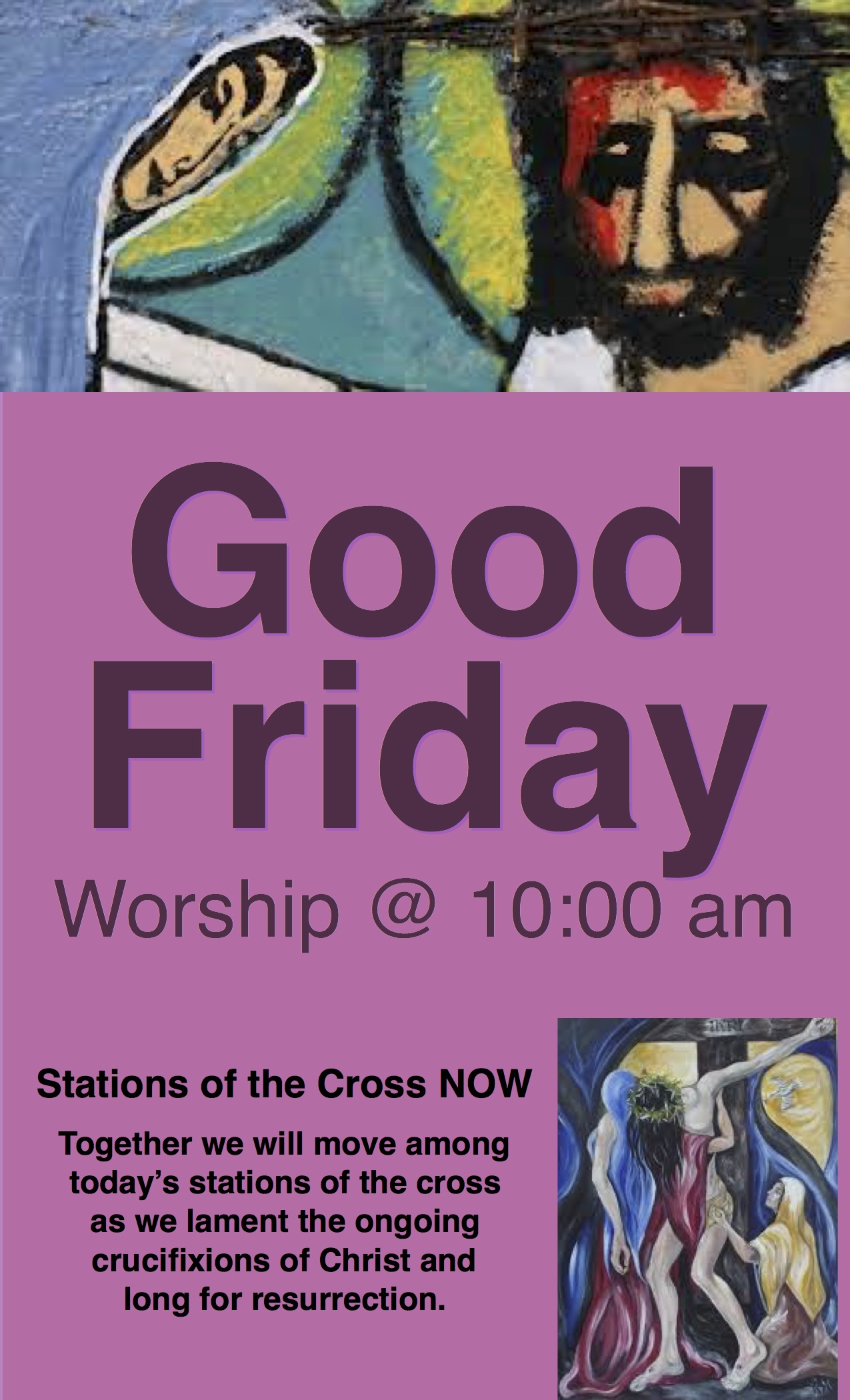
Holy Week marks a sharp uptick in visitors to this blog. From comments, messages, and emails I hear from fellow preachers who, like me, are daunted by the task of preparing the Good Friday sermon. That task is even more daunting for those of us who serve progressive communities. My fellow progressive-christian-preachers tell me of the dearth of progressive-christian Good Friday sermons to be found on the internet and encourage me to re-post my own attempts to rise to the occasion. So, here are the links to some of the Good Friday sermons I have preached over the years of my journey with the progressive community which I serve. The people Holy Cross Lutheran Church has over the years provided an invigorating space for me to pursue my questions. They have also provided the resources which make this blog possible. So, if you find the work posted here of value to you and your community, please consider supporting this ministry of Holy Cross. I rarely solicit donations. But Holy Cross is a small community that continues to give to others in so many ways and your encouragement is greatly appreciated!!! (Holy Cross Lutheran Church, 1035 Wayne Dr., Newmarket, On. L3Y 1N3)
Follow the links to Good Friday sermons and feel free to use/adapt/repost
2015 Not Salvation! Solidarity and Transformation click here
According to the American novelist, Joyce Carol Oates: “Homo sapiens is the species that invents symbols in which to invest passion and authority, then forgets that symbols are inventions.” Following last year’s Maundy Thursday worship, I received a very rude reminder of our all too human habit of investing passion and authority in invented symbols. Our efforts to remember the life and death of Jesus of Nazareth are bolstered year after year, decade after decade, century after century by the symbols we followers of the Way have invented and invested with passion and authority. So, after our regular Maundy Thursday ritual of removing invented symbols from the sanctuary, I went looking for our own sacred Good Friday symbol. Each Maundy Thursday, we followers of the Way get together to remember Jesus by focusing upon the symbols which represent to us the events of the night before Jesus died, when he gathered his followers together to eat the Passover meal. At that supper Jesus took bread, gave thanks and broke it and the rest as they say is history. Our Maundy Thursday Eucharist is packed with symbols, from the hand-basins in which we ritually wash one another to remember Jesus washing of his followers feet, bread and wine which we ritually consume as Christ given and poured out for us, to the ritual stripping of the sanctuary of all of the symbols in which we have invested passion and authority, in our efforts to re-member Jesus.
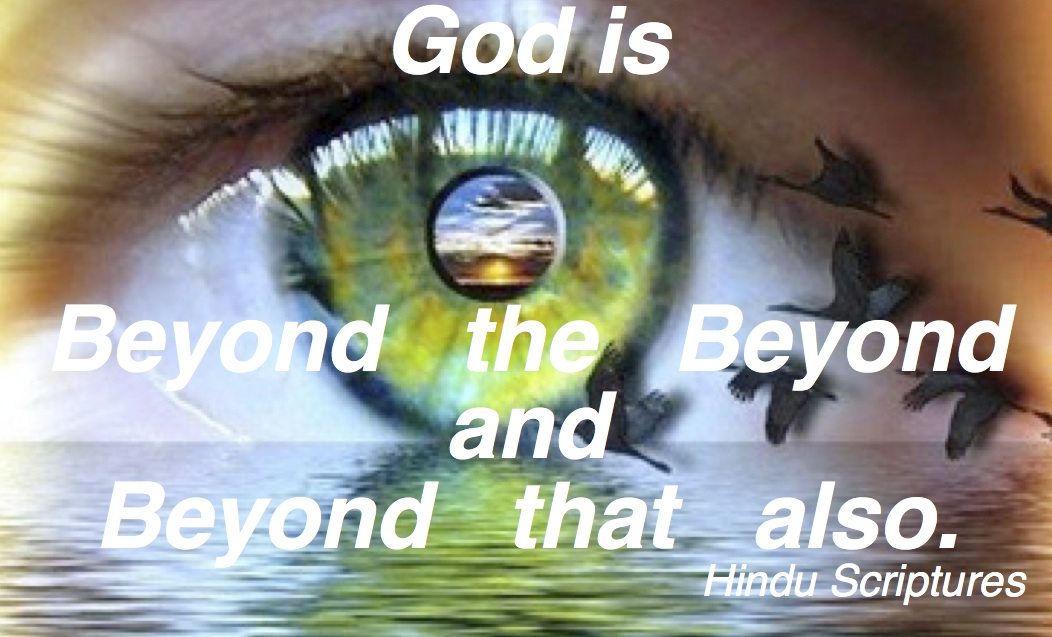
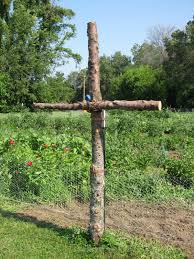
The rituals of Maundy Thursday prepare us for the rituals of Good Friday and so after our worship, I went downstairs to venture into the cupboard under the stairs to retrieve the stark symbols of this congregation’s Good Friday rituals. It is the same every year, a rough-hewn cross, fashioned out of the trunk of a Christmas tree that once adorned this sanctuary. A Christmas tree – evergreen, a symbol in which we invest our passion for everlasting life, stripped of it’s branches so that only the trunk remains and then cut so that the top section can be lashed with twin to the main section to fashion a cross of sorts. A rough-hewn cross in which we invest our passion for what we have come to call the passion of Christ. Each year, once the sanctuary is stripped of all the symbols which we have invented to facilitate our ritual remembering, I journey down beneath the stairs to retrieve our rough-hewn cross to facilitate our Good Friday remembering. This year, I had designed our remembering ritual, so that we could pay particular attention to our rough-hewn cross. This sermon was built around an exercise of re-membering which I hoped would help us to participate in the very act for which symbols are invented. Symbols are created to point beyond themselves, to direct our focus to that which lies beyond the symbol. This year, my Lenten sermons had focused on a definition of Divinity which describes God as beyond the beyond and beyond that also. So, this Good Friday sermon was written to use our rough-hewn cross to examine the work of the cross in the lives of the followers of Jesus, so that we might see beyond the symbol to the One who is beyond the beyond and beyond that also. I planned to place the rough-hewn cross here on the floor of the sanctuary, right in the middle of our circle so that as the Gospel according to John’s symbolic narrative, which has become known as the Passion Narrative, was read you could gaze upon our rough hewn cross and as my sermon began I would literally and figuratively take apart our invented symbol so that we might peer beyond it. I planned to sit here in the midst of you and unlash the vine that held our rough-hewn cross together and as I untied the vine, I would do my level best to untie the bonds that our religious tradition have placed upon the symbol of the cross and perhaps encourage you to question the passion and authority which is all too often invested in this invent symbol of the life, death, and resurrection of Jesus of Nazareth. Then with dramatic flare, I planned to put it back together again. As I used the old Christmas tree trunk to pull together our history and tradition, and the withered vine to lash our troubled attempts to remember back into the form of the cross in the hope that we might see the cross from the perspective of the 21st century followers of the way which on this day of days we struggle to be.Continue reading →
The Church’s Good Friday obsession with talk of “sacrifice for sin” has been breed into the bones of this particular preacher. I have been trained to speak the language of the Church. I know full well the many doctrines of atonement that have been proposed to explain the reasons Jesus died upon a cross. I’ve been studying the historical context and the theological consequences of Jesus’ death for more years than I care to admit. Yet every year, I find myself wanting to book a vacation or call in sick so that I can avoid the awesome task of preaching on Good Friday.
I put off tackling the Good Friday texts as long as I dare. Then I pick up my copy of “The Last Week” by John Dominic Crossan and Marcus Borg, together with my copies of John Shelby Spong’s “Resurrection: Myth or Reality” and “Jesus for the Non Religious” as well as Marcus Borg’s final book “Convictions” and Dom Crossan’s “How to Read the Bible and Still Be Christian” and James Carroll’s “Christ Actually: the Son of God for the Secular Age” spend days in pursuit of a sermon.
What follows is not the sermon I will preach on Good Friday, but rather, the notes I made a few years ago to remind myself not to fall into the trap of talking about the events surrounding Jesus’ death in the way I was trained to speak of those events. I offer up my notes hoping that those who are engaged in the struggle of grappling with how to talk about the cross in the 21st century might find some solace in a fellow struggler’s ruminations. For those of you who don’t have to come up with a sermon for Good Friday, I offer these notes as my humble attempt to see beyond the rhetoric about the cross to the Good News. As always I am indebted to the progressive scholars for their invaluable resources. However, in the end, the only way to discover the sermon is to wander into the darkness, trusting that the hours of preparation will allow you to let go, breathe, and trust the One who lives in, with, through, and beyond you.
There are many ways in which our focus upon the cross is disturbing. Not the least of which is the way in which we as Christians tend to talk about the crucifixion as Jesus’ passion. I have always thought it a tragedy that we should describe the events of Jesus’ crucifixion as Jesus’ passion. I’ve always understood talk of an individual’s passion to be concern with those things that people lived for. And so to insist that Jesus’ lived to die a horrible death might sooth those who seek to turn Jesus into some sort of preordained blood sacrifice.
But for those of us who look to Jesus in search of the face of God, such talk seems is indeed a crime against divinity. For what kind of petty, sadistic god would engineer the birth of, foster the life of, and then engineer the death of a beloved child. Surely such a god is no more than a wicked illusion of our own making. I wonder what Jesus himself would make of the god we have created. I wonder what Jesus himself would make of our Good Friday commemorations? I suspect that if Jesus is anything like the accounts of his life suggest, he would be mortified, and I mean that literally…I think that Jesus would be mortified …mortified ie shamed to death…of what has become of his life’s passion; for if Jesus’ was passionate about anything, he was passionate about life. Jesus declared, “I have come so that you may have life and live it abundantly.” Jesus’ passion was about living. Living fully, abundantly. Continue reading →
I was asked by a colleague, “So, if you do not believe that Jesus died for your sins, then why bother celebrating the events of Holy Week?” Behind this question lies the assumption that the only way to understand Jesus’ death is to frame it within the context of the theology of “penal sacrificial atonement” ie “we are judged to be sinful creatures, punishment is required, God sends Jesus to pay the price for our sin”. That Anslem’s theory of sacrificial atonement was formulated in the 11th century and continues to hold sway in the minds of so many followers of Christ is a testament to the power of our liturgies and hymns to form our theology. However, Anslem’s theory is not they only faithful way to understand Jesus’ death.
When one seriously engages the question, “What kind of god would demand a blood sacrifice?” the answers often render God impotent at best and at worst cruel and vindictive. I have often said that atonement theories leave God looking like a cosmic son of #%#%# ! Progressive Christian theologians are opening up new ways of understanding the death and resurrection of Jesus that empower the faithful to see new possibilities. To my colleague, who fears that I am leading the faithful astray, and to those who find little comfort in the theories of an 11th century monastic, I the following notes, crafted in my preparation to lead Maundy Thursday worship.
Jesus said, “I give you a new commandment: Love one another. And you’re to love one another the way I have loved you. This is how all will know that you’re my disciples: that you truly love one another.” That we should love one another is not a new commandment. There have been many before Jesus and many who came after Jesus who have commanded, advised, encouraged, implored, and even begged us to, “love one another.”
What is new about Jesus commandment is that we are to love one another the way that Jesus loved us. Which begs the question: How exactly did Jesus love? I believe that Jesus loved in ways that I am only beginning to understand. I believe that Jesus was so open to the power of the LOVE that is God; that Jesus was able to live his life fully without fear. I believe that Jesus wanted more than anything else for his followers to be so open to the power of LOVE that is God so that they too would live their lives fully without fear. I believe that that’s what Jesus meant when he said, “I have come that you might have life and live it abundantly.” I believe that Jesus lived life abundantly and that means that he loved abundantly and without fear. Jesus was so open to the power of LOVE that is God that Jesus would not let the powers of darkness stop him from loving and living fully.
The kind of LOVE that Jesus embodied and taught has no boundaries. No darkness, no power, no fear, not even death can limit the power of LOVE. For if LOVE is limited by death, then love will always be qualified and quantified. That Jesus was willing to LOVE without boundaries, came at great cost to himself. But Jesus was willing to pay that price in order to show others the way. The way to LOVE without limit, without fear, without boundaries.
LOVE without boundaries is abundant life. That Jesus’ LOVE endured the worst that the world could send his way, that Jesus’ LOVE was for all the world, dead and buried, and yet bursts free from the grave, bears witness to the power of LOVE. That Jesus LOVE could not be destroyed, not even by the thing we fear the most, death itself, saves us from the need to fear death.
Jesus has shown us the way. We can live abundantly lives that are free from the fear of death. Because Jesus has shown us the way we are free to live fully, to love extravagantly and be all that we were created to be.
LOVE shines in the darkness and darkness shall not overcome LOVE.
If Jesus, life, death, and resurrection teach us anything, surely they teach us not to be afraid.
Not to be afraid of the darkness.
Not to be afraid of living fully.
Not to be afraid of loving extravagantly.
Not to be afraid of the powers of evil.
Not to be afraid of the power of death.
LOVE will endure.
All will be well.
Jesus can’t save us from life.
There is evil to contend with.
There will be darkness and there will be death.
Jesus couldn’t save himself and he cannot save us from life. Darkness and death are part of life. Each of us must walk into the darkness that lies before us. We can beg God to take the cup from us! But the darkness will still come. And there will be days when the darkness will triumph. There are good Fridays too many to mention out there. We can shout all we want for Jesus to save us, but in the end we too will have to take up our cross and find a way to follow Jesus into the darkness and beyond, trusting that even though it feels for all the world that God has forsaken us, we will make it beyond the darkness.
The cross will not look the same for each of us. But there will be crosses to bear. Jesus has showed us the way. If we are to follow Jesus, then we must love one another they way that Jesus loved. It is the way beyond the darkness. Do not be afraid of evil, of death, or of the darkness. Follow Jesus who by love frees us from the power of darkness to hold us captive to our fears so that we can have life and live it abundantly.
Our worship began outside in the bright sunshine of the first morning of springtime, where we spoke of the reenactment of one of the two parades that took place in Jerusalem nearly 2000 years ago. Embracing Jesus’ political act of performance art we processed into the sanctuary waving our palm branches and shouting our hosannas. Rather than the familiar Palm Sunday readings our worship included the story from Genesis chapter 32 which tells of Jacob wrestling with God, Psalm 118, and John 12:12-15. you can read them here and listen to the sermon here











 pastordawn