Quest for the Cosmic Christ – a sermon

Cosmic Christ pastordawnA few years ago, we at Holy Cross began our quest for the Cosmic Christ on  the last Sunday of the Church calendar; traditionally the festival of Christ the King or Reign of Christ Sunday. Our readings: John 1:1-6; Colossians 1:15-20; and Matthew 9:16-17. The sermon was the first in a series of sermons on our Quest for the Cosmic Christ which anticipates the season of Advent’s waiting and hoping for Christ to be born in us.

“No one sews a piece of unshrunken cloth onto an old cloak, because the patch will pull away from the cloak and the tear will get worse. Nor do people put new wine into old wineskins—if they do, the skins will burst, the wine will run out, and the skins will be ruined. No, they put new wine into new wineskins, and both are preserved.” Matthew 9:16-17

My one and only experience with old wineskins was not a pleasant one. If I’m honest, I have to admit that I’m not exactly sure that the offending wineskins were old when I encountered them. They were however old-fashioned. Indeed, I do believe that if Jesus tried to tell this story in the in this century instead of the first century, he would have cautioned us against putting new wine into old-fashioned wineskins. Few people use old-fashioned wineskins. The only time I’ve ever come across old-fashioned wineskins was about 35 years ago when I myself wasn’t so very old. I was backpacking around Europe on a very tight budget. In order to extend our stay we had to stretch every penny. So, from time to time we camped out. I remember one particular night, after securing our campsite and pitching our tent, we walked back into the nearest village. I don’t remember the name of the village, I only remember that we were somewhere north of Florence, Italy. After a cheap dinner in a local taverna, we were wandering back to our campsite, when one of us, I don’t remember who, decided that we needed some more wine. When you are travelling in Italy on the cheap, some wines are less expensive than bottled water. So, I’m sure my travelling companion was just trying to save us some money, when he came out of the shop and encouraged us all to go in and take advantage of the great deal he had just bought. For not much money he had purchased two wineskins full of what promised to be a charming little vintage. I do love a bargain, so in I went to purchase my first and my last old-fashioned wineskin full of a very decent little chianti. The rest of the way back to our campsite, we speculated over the source of the wineskin, but as to whether sheep, goats, or cattle had given up the ghost for these skins, I’ll never know. I do know that we consumed a great deal of wine over our campfire. Sometime during the early hours of the next morning, most of us ended up down by the riverside, tossing the contents of our own stomach. Later in the afternoon, convinced that we were dying, some of us managed to drag our sorry-selves to a nearby clinic where we discovered that we were not hung-over at all; we were in fact suffering from a type of poisoning. Apparently, if wineskins are not cured properly, bacteria that are normally generated in the stomach of the animal, whether it’s a goat, a sheep, or cattle, morphs into some kind of poison, which can in some cases be fatal. My friends and I got away with about four days of hugging a riverbank in a kind of agony that some would say we deserved for trusting old-fashioned wineskins; something the locals are loath to do. Continue reading

Preparing to Preach or Not to Preach on Reign of Christ Sunday

cosmic christI usually have the presence of mind to book my vacation or some sort of continuing education event that takes me far away from the pulpit on Reign of Christ Sunday. Formerly known as “Christ the King Sunday” an attempt to move beyond exclusively male imagery for Christ (in whom there is no east nor west, male nor female) some church-folk have attempted to change the name of this festival to Reign of Christ Sunday. But merely changing the title fails to get  beyond the struggles I have with this festival of the church year!!!!

Born in an age that was birthing fascist regimes, this particular festival of the church clings to it’s christian imperialist past. Instituted in 1925, by Pope Pius XI,  (you can read the full proclamation here) the festival was designed to remind the world that Christ is the King of the World. The irony of proclaiming Christ as “King” when the life of Jesus of Nazareth positively denies “kingliness” seems lost on the church. The appropriateness of asserting Christ over the religions of the world lacks the kind of humility embodied by Jesus of Nazareth. So, this year I am not prepared to celebrate Christ the King or the Reign of Christ Sunday. Instead, we will take a leaf out of Matthew Fox’s book and craft our worship around the theme of the Quest for the Cosmic Christ.

Cosmic ChristYears ago, long before I ventured to seminary, Matthew Fox’s book Original Blessing opened me to the wonders of Creation Spirituality. So, I eagerly worked my way through his book The Coming of the Cosmic Christ. I confess that my first reading of Fox’s tome left me in the dust of my own lack of understanding of traditional Christology. But even back then, without the benefit of theological training, I sensed something of the MYSTERY that I had always trust Christ to BE. I have returned to Fox’s work many times over the years and over and over again I have discovered a WISDOM that moves me beyond the limitations of the historical Jesus toward a more holistic vision of Christ, which like Fox I believe, has the potential to move us to a more wholistic relationship with Creation. I trust that the WISDOM of the Cosmic Christ will lead us into the Season of Advent so that we can be about the work of birthing the Cosmic Christ.

Be the Crack that Lets the Light Shine In – a sermon lamenting the election

img_0693Our readings included Ecclesiastes 3:1-8 and Luke 21:5-19, our Contemporary Psalm was “Anthem” by Lenard Cohen

Listen to the sermon here

“There is a time for everything,

a season for every purpose under heaven:

a season to be born and a season to die;

a season to plant and a season to harvest;

a season to hurt and a season to heal;

a season to tear down and a season to build up;

a season to cry and a season to laugh;

a season to mourn and a season to dance;

a season to scatter stones and a season to gather them;

a season for holding close and a season for holding back;

a season to seek and a season to lose;

a season to keep and a season to throw away;

a season to tear and a season to mend;

a season to be silent and a season to speak;

a season to love and a season to hate;

a season for hostilities and a season for peace.” (Ecclesiastes 3:1-8)


“The birds they sang

at the break of day

Start again

I heard them say

Don’t dwell on what

has passed away

or what is yet to be.

Ring the bells that still can ring

Forget your perfect offering

There is a crack in everything

That’s how the light gets in.”  (Anthem by Lenard Cohen)


What a season we are in; a time to grieve, a time to weep, a time to harken back through the ages to seasons when our ancestors spoke of rending their garments.

Tearing their clothing, the fabric that protects them from the elements.

Tearing the fabric that adorns their body, the fashion that identifies them, shows the world who and what they are ripped and torn as they throw themselves down to the ground and wail in their grief.

In these past few days, the sound of rending garments has haunted my very being as if the fabric of civility is torn in two and our hopes and dreams as timid as we allow them to be, are ripped asunder.

Wailing and gnashing of teeth can only begin to express our grief.

What we need is the ululation, that long, wavering, high-pitched scream, the kind of howling that has long since got out of fashion in our civil society.

“We asked for signs

the signs were sent:

the birth betrayed

the marriage spent

Yeah the widowhood

of every government —

signs for all to see.”

Our hopes and dreams of a new season had barely begun to surface.

When our own demons tore the curtain asunder to reveal the reality that white supremacy and male supremacy, are not going gently into the great night.

“Ah the wars they will

be fought again

The holy dove

She will be caught again

bought and sold

and bought again

the dove is never free.”

Women grabbed as once again misogyny is worn as a badge of honour.

Walls erected.

People of colour taunted with lynching ropes.

Our fragile planet groaning under the pressure of our filth, threatened by the ignorance of powerful deniers who now wield the power of the richest purse. 

“Ah the wars they will

be fought again

The holy dove

She will be caught again

bought and sold

and bought again

the dove is never free.”

Conversion therapy is on the books again.

Tired tropes of white supremacy.

Muslim bans, deportation squads, treaties broken, pipelines built, clean coal replacing suspicious solar, as our energies are directed and distracted by promises of taking back and making great again.

“The holy dove is never free.

The wars they will be fought again,”

 water-boarding and torture back in vogue again.

Even generals cower before visions of their new commander-in-chief, promises to “bomb the shit out of them” as the generals wonder who are “them.”

Let’s build a wall. Let’s build it high.

Let’s dig a moat. Let’s fill that moat with crocodiles.

Let’s keep them out.

What a season this is.

Only the promise of winter can cheer our hearts, the drifting snow, the promised birth.

Let Jesus come.

Let Christmas mirth distract us here.

Jesus saves.

But Christians cheer.

They’ve found their saviour.

“Two Corinthians” is their guy.

Pussies be damned we hear them preach.

What a season this is.

I’ve struggled wondering what to say to you this morning; what hope can I offer?

When the message of the one we profess to follow has been used in ways that have convinced 81% of white evangelicals to vote for change such as this?

The majority of Roman Catholics joined in.

33% of the women who voted cast their lot with a misogynist.

75% percent of those who voted profess to be Christian.

Jesus weeps.

The curtain is torn.

Wars and rumors of wars.

“The holy dove

She will be caught again

bought and sold

and bought again

the dove is never free.

Ring the bells that still can ring

Forget your perfect offering

There is a crack in everything

That’s how the light gets in.”

“Here we stand.”

We Canadians.

Convinced that we are above it all.

Polite and kind are we.

Have a nice day.

Your welcome.

Excuse me.

“Here we stand.”

We who have yet to elect a female prime minister or a prime minister of colour.

Our last prime minister called for a burka ban and a barbaric practices hotline and we had already elected him 3 times.

But we’re not them.

No orange tan, just pretty locks of hair and a name that takes us back to simpler days when the just society, and multiculturalism inspired a mania whose child now feeds our arrogant notions of sunny ways.

We’re not them.

Our fingers point to the racist south while First Nations die in a slow creeping genocide.

It’s been a year since McLeans’ announced that our Indigenous peoples are incarcerated at ten times the rate as other Canadians.


But we are not them, despite the fact that our Indigenous peoples are murdered at more than six times the national average.

NO we are not them, even though our Indigenous peoples must survive on 40% less than the average wage in Canada.

We are not them.

139 active drinking water advisories in 94 First Nations communities across the country, more than 1000 missing and murdered indigenous women and girls and to which we say,

“Have a nice day

your welcome.”

We are not them.

Even if it is true that by almost every measurable indicator Canada’s indigenous population suffers a worse fate and more hardship than the African American population in the United States.

We are not them.

We are not racist.

“The birds they sang

at the break of day

Start again

I heard them say

Don’t dwell on what

has passed away

or what is yet to be.”


There is a season turn turn turn, to every purpose under heaven.

Jesus saves.

And here we stand, right smack in the middle of a season in which the Gospel and the church are associated with bigotry, racism, misogyny, sexual assault, climate change denial, and persecution of people based on ancient myths interpreted as facts.

Here we stand, an inclusive, progressive, science loving, historically critical, knowledge loving family that continues to struggle with the teachings of Jesus, refusing to take the Bible literally while trying to take it seriously.

Here we stand, convinced that we can do no other.

Opening our arms wide, extending a promise of radical welcome.


“Ring the bells that still can ring

Forget your perfect offering

There is a crack in everything

That’s how the light gets in.”

Ring the bells that still can ring:

the bells of justice

the bells of hope

the bells of peace

the bells of joy

“Forget your perfect offering.”

The cracks are there for all to see.

The light shines in.

And still we sing.

And still we stand.

Trusting that every tear will be wiped away.

That all shall be well and all manner of things shall be well.

LOVE will turn our mourning into dancing.

Here we stand for we can do no other.

Ring the bells that can still ring.

The LOVE that is God is the only hope I have to offer you in this strange season that we are in.

The LOVE that is God is the best hope that we have to give.

There is a crack in everything.

Be that crack.

Let the light come in.

Ring the bells that can still ring.

Be that crack.

Let the LOVE come in.

BE THE LOVE SHINING IN.


Lest We Forget – A Peace Remembered

The young woman can still remember one particular Remembrance Day when her words and actions did nothing more than offend someone she loved very much. It was the one and only argument she ever had with her Grandmother and it happened over Remembrance Day. At the time, she was living in London. She remembers thinking that Londoners take Remembrance Day very seriously indeed. More so, she thought, than in her native Canada. She wondered if the blitz had something to do with it.

While most of the poppies people wore were red, she began to see white poppies appear on the lapels of more than just a few people.  She read in the newspaper that those who were committed to peace and believed that for the most part, Remembrance Day only serves to glorify war were donning white poppies.  You could pretty well draw a dividing line between the generations using the colors of poppies as your guide. Young people, who had never experienced war tended to wear white poppies, while those who were older and who had memories of war, tended to wear red poppies. In many homes poppies in and of themselves managed to start wars. 

The idealistic young woman was just twenty and her commitment to peace determined her choice. She was wearing a white poppy the day she traveled up to the Midlands to visit her Grandmother. It was the day before Remembrance Day when she arrived on her Grandmother’s doorstep. She’d forgotten all about the white poppy that adorned her lapel. She couldn’t help thinking that there was something odd about the reception she received from Grandmother. It wasn’t exactly what you would call warm. Her Grandmother was upset about something. But the young woman couldn’t quite figure out what, because her Grandmother appeared to be giving her the silent treatment. She just served dinner and listened quietly as the young woman chatted on about her week in London. Continue reading

The Curtain Has Been Torn and The Temple Lies in Ruins: Luke 21:5-19 a sermon

Isaiah 65Our readings today were from Isaiah 65:17-25, Dietrich Bonheoffer’s “Letters from Prison, and Luke 21:5-19

A pdf of the worship bulletin which includes the Bonhoeffer reading can be found here  Pentecost 26C Nov 17 2013

Listen to the sermon here

You better watch out. You better not pout. You better not cry. You know who is coming to town. Yes, this is the weekend. In cities, towns, and villages all over the place you know who is coming to town. He knows if you’ve been sleeping. He knows if you’re awake. He knows if you’ve been bad or good so be good for goodness sake! I’m not too old to remember a time when I believed in the person you know in Canada as Santa Claus, but when I was a kid in Belfast we called him “Father Christmas”. I remember the excitement I felt about his pending arrival and I remember trying ever so hard to be good. I don’t remember being disappointed when I realized that Father Christmas was a conspiracy of sorts. Somewhere, somehow in my little child’s brain, I sort of transferred all the love, affection, anticipation, and fear that I harbored for Father Christmas over to THE FATHER. FATHER GOD, who I imagined as a grey-bearded old man who lived up there in heaven. We never went to church, but somehow the adults in my life managed to communicate to me that, I’d better watch out, I’d better not cry, cause HE knows if I’ve been bad our good and I’d better be good for goodness sake. I learned to say my prayers, to thank the Father for all the good stuff in my life, and to ask the Father to take care of Mummy & Daddy,  Nannie and Granda, Gran, my aunts and uncles and oh yes don’t forget my brother Alan, even if little brothers are annoying, please Father take care of him and maybe make sure that Mummy and Daddy have all the money they need to buy us Christmas presents and if there’s time help us all to live in peace.

My childish notions about HIM, up there, eventually gave way to adolescent wonderings about why HE let bad stuff happen to all the good people, and why people died in accidents, or people got hurt, or sick and died. I remember being particularly preoccupied with thoughts about why bad, evil, nasty people got away with stuff; I mean why didn’t HE just use some of HIS all powerfulness to stop bad things from happening? Eventually, when I found my way into the church, I began to add qualities to the character of the FATHER. Gradually, the FATHER became gentler, kinder, wiser, and more gracious. Continue reading

Shusssh…Peace…Shalom…Shusssh… Oh No! the apocalypse is here in this Sunday’s Gospel Reading from Luke 21:5-19

The end is nearIn October of 1977, I was twenty years old.  I was young and adventurous and with a rail pass in my hand, a back pack slung over my shoulders and several hundred dollars worth of American Express Travellers cheques in my pocket, I boarded a train in Zurich, Switzerland, bound for Athens, Greece.

I was tired.  Several months of backpacking in Northern Europe had left me weary.  In just five days my rail-pass would expire, so I decided to head for Greece, where the living is easy, where the warm sun, blue skies and equally blue waters held the promise of rest and relaxation.

As the train made its way through the Alps, I remembered a similar trip which I had made the year before and I tried to calculate whether my remaining funds would allow me to return to the village of Hannia on the island of Crete.  I knew that in Crete I could find work.  I planned to mix a lot of rest and relaxation with just a little work and try to live out the winter on the Mediterranean.

As the train rattled through Austria toward what was then Yugoslavia it began to get dark. I was disappointed that my journey through Yugoslavia would be completed in darkness.  I remembered my previous journey, by car, through Yugoslavia and how at the time, I had marvelled at the diversity of this strange little country.  I remembered men and women driving oxen as they ploughed their fields in much the same way as there ancestors had done.  I also remembered my surprise at entering the ultra modern city of Belgrade; the showcase of Tito’s communist regime. I fell asleep pondering the sharp differences between the lives of the poor people in the villages who appeared to live without any modern conveniences at all and the lives of those who inhabited the city of Belgrade with its towering skyscrapers and streets filled with automobiles.  Several centuries seemed to co-exist in Yugoslavia.

I was awakened by the sound of people shuffling to find their papers as the train conductor instructed us to get our passports and visas ready for customs inspection.  When the Yugoslavian custom officials, with their rifles over their shoulders boarded our train they were preceded by men guided by vicious looking German shepherds.  Even though I knew that I had all the right papers and that my back pack contained nothing more offensive than some dirty laundry, the sight of the dogs, guns and uniformed officials struck fear into my heart.  I nervously handed over my precious passport to an official who looked younger than my twenty years.  He carefully read over the visa which I had obtained in Zurich the day before; a visa that I could not read because it was written in an unfamiliar language and an unfamiliar alphabet. Continue reading

“Makarios” – Blessed, Happy, Fortunate, Evolved – a sermon for All Saints’ Sunday

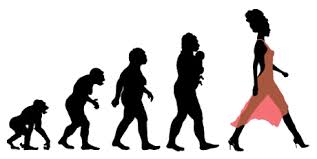
evolution

All Saints’ Sunday readings:  Contemporary reading:  “A Return to Love: Reflections on the Principles of a Course in Miracles” by Marianne Williamson, Gospel:  Luke:6:20-31 – extensive quote within the sermon from evolutionary scientist Stephen Jay Gould – the hymn sung before the gospel is “I Am the Dream” words: S. Curtis Tufts, Music: Rick Gunn

Listen to the sermon here

What if the point of Jesus life, death, and resurrection isn’t about that? – a Reformation Sermon

nightListen to the sermon here


Here We Stand, For We Can Do No Other – a sermon for Reformation Sunday

Simcoe Landing

Run-off pond at Simcoe Landing

Listen to the sermon here

Watch the video that was shown in place of the traditional readings for Reformation: Thomas Berry and the Earth Community here

Gospel Text: John 8:31-36

Despite the fact that my parents named me Dawn, I have never been much of a morning person. Those who know me well would probably agree that I should have been called Dusk instead of Dawn. But Dawn I am and so from time to time, I actually venture out to explore this phenomenon for which I am named. Earlier this week, after a long sleepless night, of tossing and turning, wondering and worrying, I decided that as sleep was eluding me, I might as well give up and get up. The sun was about to rise and so out I went into the quiet world of our little subdivision. We moved into our subdivision nine years ago. The subdivision was built about six years before we moved in, so our little community is only about fifteen years old. Before the subdivision was built, the land was used by a farmer to grow corn. On the fringes of our subdivision, they are expanding further into the cornfields. The neighbourhood is expanding, growing, and changing. The demands of modern life are encroaching on a lifestyle that is disappearing from countrysides all over the planet. Modern subdivisions are built to a pretty standard plan. Before the streets and infrastructure can be developed, some pretty basic problems need to be addressed, not the least of which is water run-off. As near as I can tell, modern developers deal with the problem of drainage by establishing ponds which function as catchment basins for rainwater runoff. At the foot of our subdivision there are four such ponds around which the developers created footpaths so that we suburbanites can at our leisure have someplace to take a walk.

When we first moved in, the ponds weren’t exactly picturesque. Just open pits into which runoff had poured, surrounded by paths and building sites. In the beginning these ponds were more like scares on the landscape and failed to inspire us to wander past very often. Indeed, if we wanted to take a walk, Carol and I would often get in the car and drive to a nicer spot to walk. But over the past nine years something miraculous has happen and in our neck of the woods Mother Nature has healed the Earth’s wounds and those ponds have become a favorite place to walk. Where once there was just muck and the open wounds of the Earth, now there are well healed pathways, beautiful bushes, fruit filled trees, and a whole host of wildfowl. Nature has repaired what we humans came close to destroying.

So, as the sun was rising in the east, I couldn’t help thinking about the natural rhythms and blessings of this life. And because I had been kept awake by worrying about the content of this Reformation sermon, my mind began to think about the similarities between the relationship of nature to the pond which humans created where once there was no pond and the relationship between God and the church humans created where once there was no church. Continue reading

Reformation Sunday Resources

semper reformanda

Preparing for Reformation Sunday? Some of these posts might be useful:

Luther, Spong, Fox, and Holy Cross

Enough with “A Mighty Fortress” Already! Sing a New Song!

95 Theses for the Twenty-first Century

Freedom from What?  All this Reforming is Wearing Me Out!

What Darwin Never Knew

A Reformation Day Nailing to the Internet – John Shelby Spong

A Prayer for Reformation – Thomas Berry


Baptism Opens Us to MORE – a sermon on Psalm 139 and Luke 18:15-17

wesleyListen to the sermon here

Copy of the Baptism Liturgy here

Four Ways of Thinking About God – Peter Rollins

Being – Hyper-Being, Ground of Being, Event

Drawing on John Caputo’s book “The Folly of God,” Peter Rollins articulates four ways of thinking about God. As our adult education class explores relationship to the Divine in a world beyond the creeds of our ancestors, these ways of thinking about God provided us with lenses to see beyond what is all too often a theological darkness. To view more of Pete’s facebook live videos click here or check out his website here

What it Means to “Pray Always” – Matthew Fox

Recorded Oct.16, 2016: Matthew Fox preaches on Luke 18:1-8 at All Saints Church in Pasadena. Fox defines prayer as, “a radical response to life; a profound or deep response to life.” As such, working for justice is the embodiment of our response. 

This Persistent Woman Is Wearing Me Out – a sermon on Genesis 32 and Luke 18:1-8

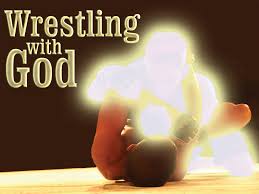
wrestlingBefore I read our Gospel text I took a few moments to reflect upon the story from the Torah that was our First Reading (Gen.32).  I showed the short film below which was created by Jewish scholars to help rabbis teach the stories of the Torah to young children. I use this video to teach the stories of the Torah to our Confirmation students. I think it is important for those of us who follow the teaching of the Rabbi Jesus, to pay attention to the way in which the stories that spoke to Jesus continue to speak to Jewish people here and now. Watch the video and then listen to the sermon here 

Our Gospel reading comes to us from a story told by an anonymous writer named Luke, who tells a parable that he attributes to the Rabbi Jesus: According to Luke: “Jesus told the disciples a parable on the necessity of praying always and not losing heart. “Once there was a judge in a certain city who feared no one—not even God. A woman in that city who had been widowed kept coming to the judge and saying, ‘Give me legal protection from my opponent.’ For a time the judge refused but finally the judge thought, ‘I care little for God or people, but this woman won’t leave me alone. I’d better give her the protection she seeks or she’ll keep coming and wear me out!’” Jesus said, “Listen to what this corrupt judge is saying. Won’t God then do justice to the chosen who call out day and night? Will God delay long over them? I tell you, God will give them swift justice. But when the Promised One comes, will faith be found anywhere on earth?”

I too have met this tiresome, troublesome, annoyingly, persistent widow who constantly cries out for justice. This woman won’t leave me alone. I must confess that I would rather not have this woman clamouring at my door! Each and every time I encounter this woman, she goes on and on, she wears me out! I cannot go anywhere without seeing this woman. She is everywhere. Pointing to her oppressor and demanding justice. She is on the radio in my car as I go about my business. She is on my computer screen as I try to keep up with the news of the day. She is in my living room as I try to relax flipping channels seeking respite from her persistent cries for justice. She appears in my facbook feed, and tweets at me from my phone, I cannot escape her cries for justice. I am sick and tired of this annoying woman. I cannot escape her shouts for justice.
I’m not sure that anything at all can be done to secure justice for this annoying woman. Too much time has passed. There are no witnesses. Boys will be boys. She needs to forgive, forget and move on. Why doesn’t she just leave me alone. There’s nothing that I can do for her. There’s nothing I want to do for her.
I have my own troubles. People to see, places to go, things to do. If only she’d leave me alone. Her persistent cries for justice have begun to haunt me and not even sleep gives me respite from her persistent cries for justice. If only she’d stop going on and on and on and on about her oppressor, about the injustice that has been perpetrated against her.
Maybe if she would just shut up about it, I wouldn’t have to wrestle with her in the night. Round and round we go, pinning one another down, she demanding justice, me pleading for peace. This wrestling over things beyond my control is wearing me down. I’m starting to wonder who this woman thinks she is. Hell, I’m beginning to wonder who I think this woman is. In the darkness of the night I sometimes wonder if this persistent, complaining woman, is just some trumped up version of myself. In her eyes, I sometimes think I see a glimmer of something far too familiar, something ugly, fearsome, unpleasant, and lurking in my own memories. In the wee hours before dawn, I think I can actually see myself in her.
But no, I’m not going there. We are not going there. Women all over the world don’t want to go there. Defenseless, innocent, naive children all over the world we dare not see them in the face of this persistent woman.
And then, just when I think that I have her pinned down and I’m about to wrestle something anything out of this insane encounter, the light begins to dawn on me, as I realize that there in the face of this persistent woman is the ONE in whom we all live and breathe and have our being; the ONE whose name eludes us.
I awaken to the realization that this place where we have all been, this place where we cannot escape is indeed Peniel, for here and now, in the face of this persistent woman, in the face of every persistent woman, indeed in the face of every persistent man, woman, and child, crying out for justice we have seen God face to face. It isn’t always pretty, it isn’t always what we want to see or where we want to see it, but it is the face of the ONE that we call God; the face of God shouting, crying, pleading, for justice.
Wrestling with the persistent, pleading, ones who continue to demand justice from me, I rise wounded from Peniel – the place where I know that I have seen God face to face, and yet my life has been spared. Limping away, forever changed, knowing that the wound that changes the way I walk in this world is the blessing given to me by those who have the courage to cry out for justice. Transformed by this wound I begin to see that I am at one and the same time both the judge who has the power to create justice and the one who cries out for justice.
In this Peniel, is  where ever and when ever we have the courage to look into the face of another and see the face of God, and our lives have been preserved. We cannot walk away from an encounter such as this without responding to the ONE in whom we see the face of God, with justice. Whether our role in this life long wrestling match is that of the judge or the seeker of justice, may we see God face to face.

Wrestling With the Almighty: Locating Our Very Selves in the Sacred Story – a sermon on Genesis 32:3-31

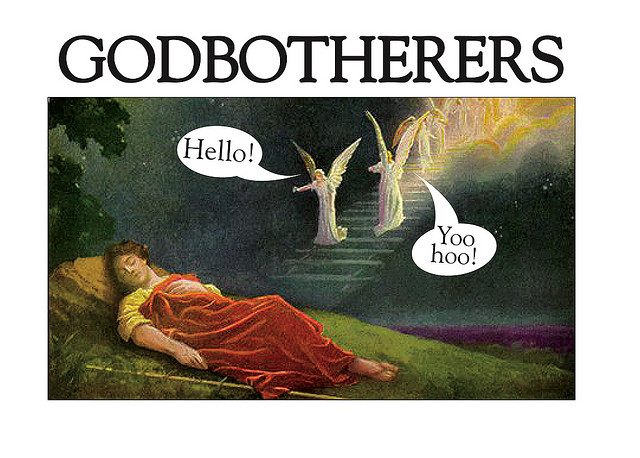
Godbotherers

For those of you preaching on the text from Genesis 32:3-31:

You may not be able to tell from looking at me. But let me assure you that you are looking at someone who used to be a champion wrestler. Believe it or not, my wrestling skills actually helped me rise to the level of a world champion wrestler. Well, perhaps I should qualify that statement. When I was an amateur wrestler, I was a world-class champion wrestler. But like so many athletes, when my status changed from amateur to professional, I lost my championship status and although I still qualify as a professional wrestler, and I like to see myself as a champion, I’m no longer what you would call world-class.

Like many professional wrestlers my career began when I was but a child. Growing up I had a very clear advantage as I developed my wrestling skills. You see having a brother who was just 18 months younger than me meant that I had ample opportunities to hone my wrestling skills. My brother and I were always at it. I’ve got to say that even though we shared the same weight class for most of our childhood, when it came to world class wrestling holds, I had him beat. I had this wicked arm-hold sleeper, and that together with my full Nelson followed by a knee-arm press, was guaranteed to have my brother screaming uncle and agreeing to be my obedient servant until in no time at all. For years I reigned as the champion of our little world! I was unbeatable. My brother didn’t stand a chance. My reign as world champion would have continued if it weren’t for the abrupt ending of my amateur status.

One morning when I was about 13 and my brother was 9 and a half, we were going at it,  and to his credit my bother had me in an ingenious hold. Somehow, he’d managed to secure me with what we professional wrestlers call an arm bar. That’s where you’re opponent wrenches your arm behind your back and applies just enough pressure to cause pain, but not enough to break anything. But just when Alan was approaching the point of no return, I managed with a feat of superhuman strength to rise up, twist around and swing for all I was worth and connect with what I though must be my brothers chest. I expected that such a thrust would have released my arm from Alan’s iron grip. But he still had me. I was about to hit him again, when for no apparent reason Alan released me from his grip. In an instant I wiggled free, spun around and connected with what I figured would be a fatal blow. Just before my blow connected with it’s victim, I realized that I was doomed.

Continue reading

God in the Guise of a Pleading Widow a Sermon on Luke 18:1-8

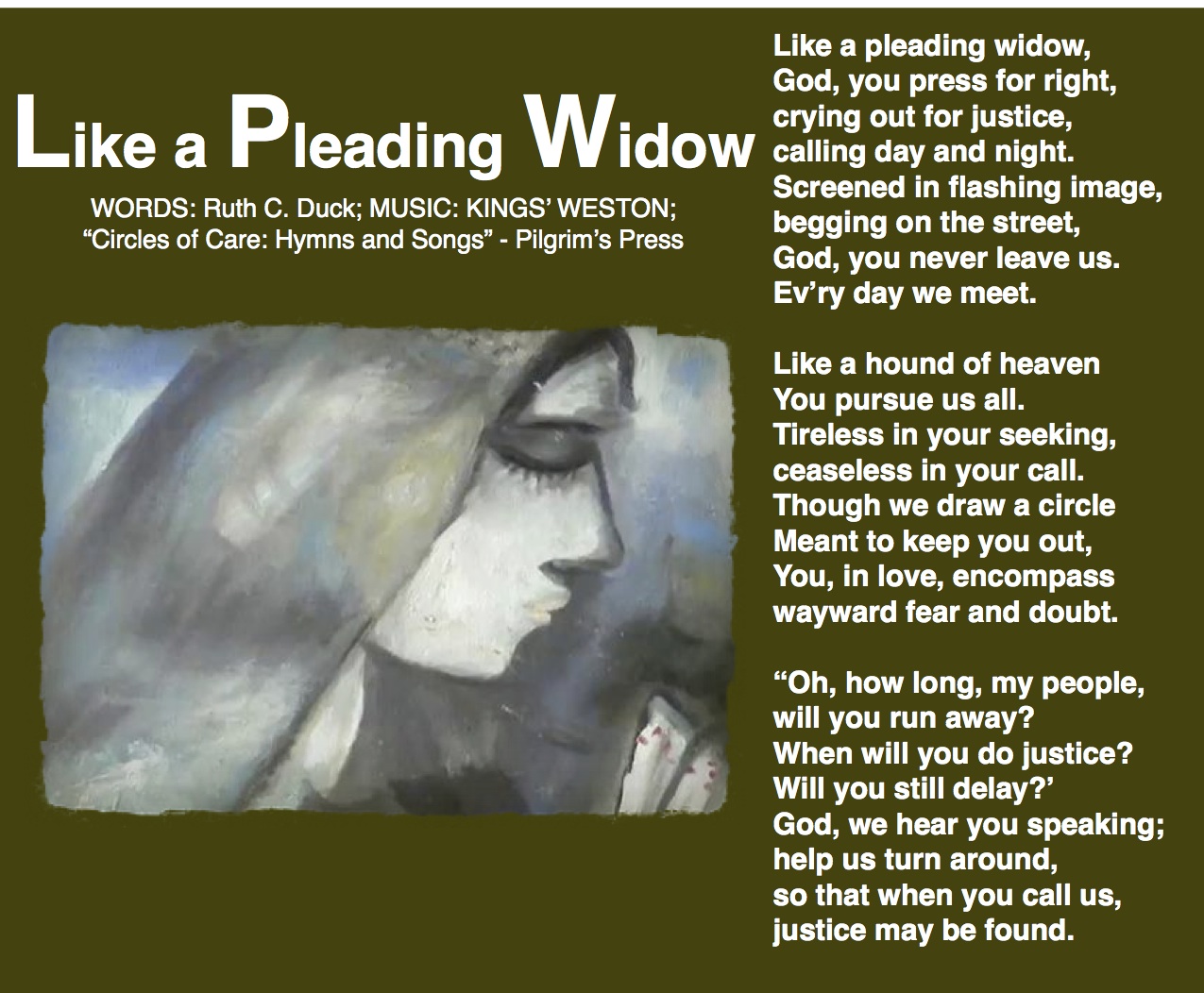
Like a Pleading WidowAi Weiwei’s exhibit “According to What? at the Art Gallery of Ontario inspired me to look beyond traditional interpretations of Jesus’ parable of the Pleading Widow to see our role as the unjust judge. The gentle breath of a newborn granddaughter enabled me to hear God persistently pleading for justice. Read the sermon manuscript below or Listen to the sermon here:  

I spent time exploring the Ai Weiwei exhibit at the Art Gallery of Ontario. It is a powerfully, disturbing, fascinating and compelling exhibit that I know will stay with me for years to come. Ai Weiwei is, according to the AGO’s description, “an artist with a very new kind of visibility. He has transcended his artwork to become a worldly figure who, for many, symbolizes the assertion of freedom of expression against great odds. Using the fame and recognition garnered by his art, Ai Weiwei has taken on issues that could not be raised publically in China.” The exhibit provides a unique window into a part of the world that continues to remain impenetrable.

Ai Weiwei and I are the same age but it is as if our worlds are light-years apart. I first became aware of his work during the Beijing Olympics in 2008. Ai is responsible for the spectacular design of the Beijing Olympic Stadium that has become known as the Bird’s Nest. With his conception of the Bird’s Nest Ai hoped to represent freedom. He saw the Olympics as a splendid opportunity to demonstrate that China was opening up after decades of seclusion with a dismantling of the barriers erected by successive totalitarian régimes. Sadly, Ai’s dreams were dashed as the stadium was constructed and the Chinese government resorted to old methods to drive the poor from their homes in order to build on Olympic sites.

On the opening day of the Olympics, Ai wrote this about his of his decision to boycott the events: “Today China and the world will meet again. People will see that the planet is now smaller than at any time in history, that mankind should bid farewell to arrogance and indifference, to ignorance and discrimination, and understand that we share the same small piece of land. It will be a time to rediscover each other, to share what is good in life, to look each other in the eye and link all 10 fingers. The colourful festival is a time not just for celebration, but also for peace and friendship. To rediscover our future, we should say goodbye to our past. We must bid farewell to autocracy. Whatever shape it takes, whatever justification it gives, authoritarian government always ends up trampling on equality, denying justice and stealing happiness and laughter from the people.

We should also leave behind discrimination, because it is narrow-minded and ignorant, denies contact and warmth; and corrodes mankind’s belief that we can better ourselves. The only way to avoid misunderstanding, war and bloodshed is to defend freedom of expression and to communicate with sincerity, concern and good intentions.

The “Bird’s Nest” National Stadium, which I helped to conceive, is designed to embody the Olympic spirit of “fair competition”. It tells people that freedom is possible but needs fairness, courage and strength. Following the same principles, I will stay away from the opening ceremony, because I believe the freedom of choice is the basis of fair competition. It is the right I cherish most. If we want it to be, today can be a moment of courage, hope and passion. This day will test our faith in the human race, and our determination to build a better future.”

The Chinese government has not reacted kindly to Ai’s public descent and he has felt the weight of their abuse. He remains under house arrest and was not allowed to travel to Toronto for the opening of his exhibit. It is only, Ai’s world renown as an artist and public dissident that protects him from the ultimate fate of so many Chinese dissidents.  Ai Weiwei’s courage in speaking out against injustice over and over again, has robbed him of his liberty and put his life in grave danger and yet he continues to publically protest the abuses of his overlords. Ai’s testimony, expressed in his art, speaks volumes to the world and even tough his protests fall on what appear to be the deaf ears of a régime that continues to oppress the people of China, one wonders how long these unjust judges will be able to resist his persistent pleas for justice. Continue reading

The Science of Happiness – An Experiment in Gratitude

thanksgiving canadaIn place of the sermon this Sunday, we watched the video “An Experiment in Gratitude” followed by brief comments about embodied gratitude. You can watch the video below and listen to our conversation here below are the notes from on which the comments are based:

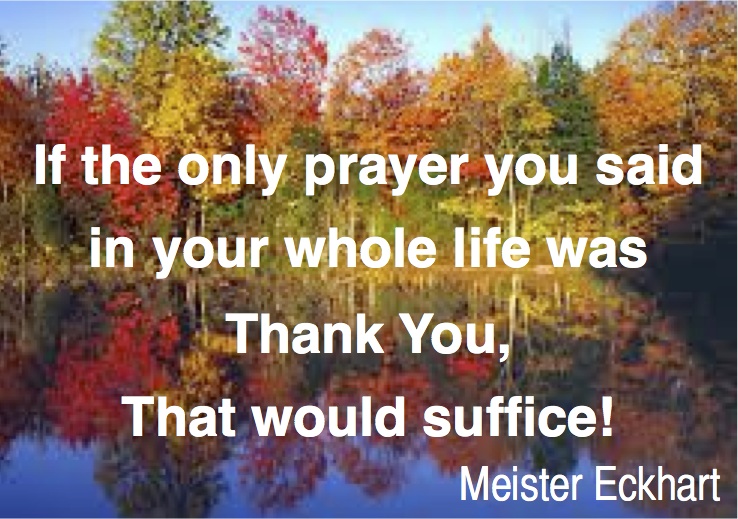
Your Mom and Dad were right when they taught you that “thank-you” is a magic word. Science now confirms what we learned at our parents’ knees all those years ago. However, many of us do not need science to confirm the power of gratitude. As far back as the 14th century Meister Eckhart insisted that “If the only prayer you said in your whole live was “Thank –you, That would suffice!”
What does gratitude look like when you no longer worship an image of God that personifies or anthropomorphizes God? When God is more than the source of our being, when God is being itself, how do we offer our thanksgiving? When God is the One in whom we live and move and have our being, how do we say thank-you? When we begin to understand that everything is in God and God is in everything, what prayer of thanksgiving will suffice? Leaves – seeing the hand of our Creator in Creation – who do we embody gratitude to creation? Humans seeing God in everyone – how do we embody gratitude to everyone? Jesus pointed to LOVE as the definition of God, God is LOVE and those who know LOVE know God. Jesus said, that he Jesus, this imperfect human being was ONE with God. Jesus taught us to see God in one another, when you give a cup of water to the least of these, you give it to me. Our gratitude is expressed in our loving.

LOVE encompasses a whole lot of things.

John Shelby Spong: “If God is the source of life, I worship God by living. If God is the source of love
I worship God by loving. If God is the ground of being, I worship God by having the courage to be more fully human;the embodiment of the divine.”
Augustine described God as: “LOVER, BELOVED, AND LOVE ITSELF” let LOVE be our embodiment of gratitude!

Happy Thanksgiving!

To Whom Shall We Go to Say Thank-you? – Thanksgiving Sunday sermons

Thankyou autumn

Follow the links for previous sermons:

Reckless Generosity a sermon with a Monty Python flair!

Who IS God? – Not One, Not Two – inspired by Garrison Keillor & Joan Chittister

Brussel Sprouts, Ebola, and Thanksgiving – seeking the ONE who IS

To Whom Shall We Go to Say Thank-you

After You Move Beyond Personifying God?

Over the course of the past nine years a group of little people have come into my life. Lovely little people who call me Gran. There are seven of them and participating in their little lives is a source of such great joy. Each stage of their development is a wonder to behold. I particularly enjoy watching their parents as they attempt to teach these little darlings the things that they need to know about being human. One of the first things that we teach little humans is the fine art of saying thank-you. It takes a fair amount of repetition to teach a child to say thank-you. Over and over again, after giving them exactly what they want, we ask, “Can you say thank-you?” and the little darlings repeat the words “Thank-you.” Sometimes all we have to do is ask the question: “What do you say?” in order to hear the words “Thank-you” uttered in such a delightful way as to inspire us to praise them as such good little girls and boys.

Expressing gratitude is a skill that all tiny little people must learn in order to develop into well-rounded human beings. Indeed, scientists insist that being grateful is a prerequisite of happiness. Happy humans it seems, are humans who embody gratitude. But there is more to gratitude than simply saying thank-you. I remember learning that gratitude includes more than simply expressing our thanks. It happened when I was about sixteen and actually noticed the beauty of a sunset and for the first time I realized that I was part of something so much bigger than myself. I know I must have seen the sunset before, but this time I actually saw the sun set. We were driving down the road, my friend Valerie and I were riding in a car driven by her mother, Lola. It was a partly over-cast day on the west coast of British Columbia.  Just a few clouds.  You could see the mountains off in the distance. We were chatting back and forth when all of a sudden, Lola pulled the car over to the far side of the road, switched off the engine and got out. Valerie followed her mother out of the car, so I figured I had better do the same. Val and her mother scampered down from the road and onto the beach. When they reached the water’s edge, they stopped and  just looked off into the distance. Apart from a tanker-ship making its way across the horizon, I couldn’t see much of anything. Lola had the most amazing expression on her face. She positively glowed with happiness. Valerie wore a similar expression. I must have looked somewhat puzzled because Val smiled at me and said “Isn’t it the most beautiful thing you have ever seen?” This only confused me more. What were they looking at that had made them stop the car, scamper down the bank and stand there at the water’s edge on a cold autumn evening. 

These happy, glowing, smiling people made me nervous. There they stood grinning from ear to ear.  What were they on? And then, I saw it. For the first time in my life, I saw it.  It had been there before. But I had never really seen it before. The sky was amazing.  The colours were overwhelming. It almost didn’t look real. It looked like someone must have painted it that way. It was magnificent. A work of art. The most beautiful thing I have ever seen. If you’ve never seen a late October, Pacific Coast Sunset before, you’ve missed one of the great wonders of the world. Neither Emily Carr’s paintings nor picture perfect post cards do a western sunset justice.          

Believe it or not, even though I had been living on the west coast for about four years, at that point I had never before really noticed just how beautiful a sunset could be. No one in my experience had ever taken the time to stop and look at one. No one had ever pointed one out to me before. I would never have dreamed of stopping a car and getting out to watch as the sun put on a show while setting. So, I stood there.  Overwhelmed by it all. Amazed at just how beautiful it was. Wondering just who or what could be responsible for such a spectacular thing as this. Before long my thoughts drifted to the Creator. Actually noticing a magnificent sunset was the beginning of a journey beyond myself as the reality that I am part of something so much bigger than myself continues to permeate my being.

Back then, I expressed my gratitude by very much the same way as my grandchildren are being taught to express their gratitude, simply by saying “Thank-you”. The object of the Thank-you being God. At the time, God was an old bloke up there in the sky somewhere. As my images of God changed over the years, my Thank-you’s continued to be expressed to my ever-changing images of God. But I must confess, that it was a whole lot easier to say thank-you to God when God was some big guy up there, out there somewhere? It was so much easier when I thought of God as “Father” or even as “Mother” to express my gratitude by simply mimicking the behaviour that I’d been taught as a child, “Can you say “Thank-you” Oh yes indeed I can say thank-you. “God is great, God is God, let us thank him for our food. By his hand we must be fed, Give us Lord Our Daily Bread.” Continue reading

World Communion Sunday after you Reject Sacrificial Atonement – a sermon on progressive Communion

world-communion-sundayThis sermon is inspired by, infused with, and indebted to the work of Kurt Struckmeyer whose essay “The Words of the Eucharist” articulates communion in terms of “liberation” and pointed me to the work of the Roman Catholic liturgist Gabe Huck; with just a little Martin Luther thrown in to insure that “this is most certainly true.” The readings included 1 Corinthians 11:23-26, Mark 14:22-25 and Luke 22:14-20 – listen to the sermon here

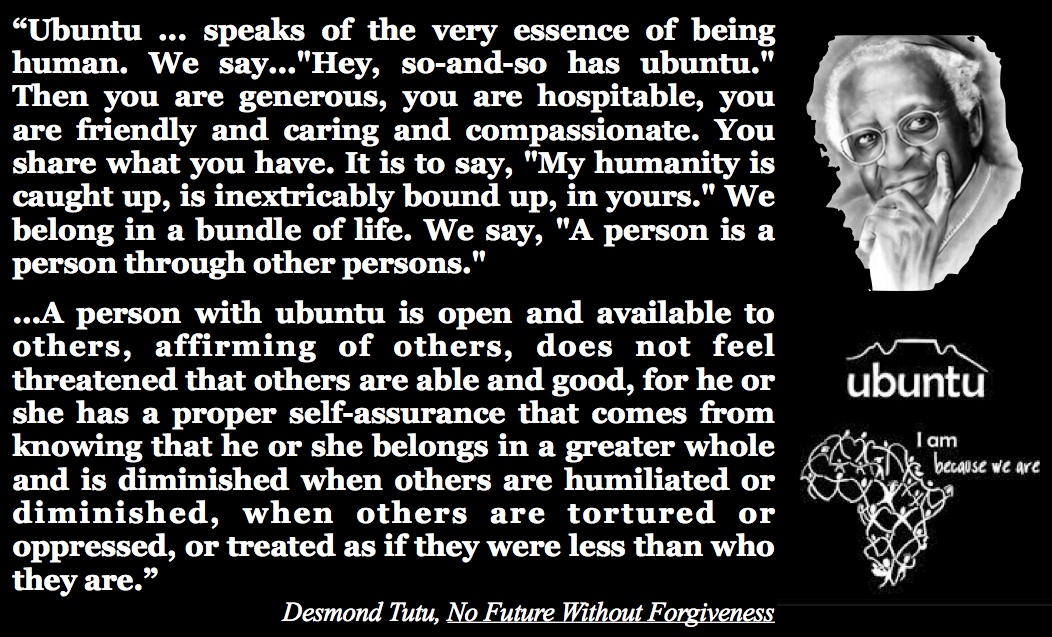
Ubuntu: A Person Is A Person Through Other Persons – Luke 17:5-10 – The Parable of the Mustard Seed

Ubuntu -- pastordawn.com

colemansListen to the sermon here: 

In his book, “The Orthodox Heretic”, Peter Rollins creates a parable which he calls “Finding Faith.”

According to Pete, “There was once a fiery preacher who possessed a powerful but unusual gift. He found that, from an early age, when he prayed for individuals, they would supernaturally lose all of their religious convictions. They would invariably lose all of their beliefs about the prophets, the sacred Scriptures, and even God. So the preacher learned not to pray for people but instead he limited himself to preaching inspiring sermons and doing good works. However, one day while travelling across the country, the preacher found himself in a conversation with a businessman who happened to be going in the same direction. The businessman was a very powerful and ruthless merchant banker, who was honored by his colleagues and respected by his adversaries. Their conversation began because the businessman, possessing a deep, abiding faith, had noticed the preacher reading from the Bible. He introduced himself to the preacher and they began to talk. As they chatted together this powerful man told the preacher all about his faith in God and his love of Christ. He spoke of how his work did not really define who he was but was simply what he had to do.

“The world of business is a cold one,” he confided to the preacher, “And in my line of work I find myself in situations that challenge my Christian convictions. But I try, as much as possible, to remain true to my faith. Indeed, I attend a local church every Sunday, participate in a prayer circle, engage in some your work and contribute to a weekly Bible study. These activities help to remind me of who I really am.’

After listening carefully to the businessman’s story, the preacher began to realize the purpose of his unseemly gift. So he turned to the businessman and said, ‘Would you allow me to pray a blessing onto your life?’

The businessman readily agreed, unaware of what would happen. Sure enough, after the preacher had muttered a simple prayer, the man opened his eyes in astonishment. ‘What a fool I have been for all these years!’ he proclaimed.  ‘It is clear to me now that there is no God above, who is looking out for me, and that there are no sacred texts to guide me, and there is no Spirit to inspire and protect me.’

As they parted company the businessman, still confused by what had taken place, returned home. But now that he no longer had any religious beliefs, he began to find it increasingly difficult to continue in his line of work. Faced with the fact that he was now just a hard-nosed businessman working in a corrupt system, rather than a man of God, he began to despise his work. Within months he had a breakdown, and soon afterward he gave up his line of work completely.

Feeling better about himself, he then went on to give to the poor all of the riches he had accumulated and he began to use his considerable managerial expertise to challenge the very system he once participated in, and to help those who had been oppressed by the system.

One day, many years later, he happened upon the preacher again while walking through town. He ran over, fell at the preacher’s feet, and began to weep with joy.

Eventually he looked up at the preacher and smiled, ‘thank you, my dear friend, for helping me to discover my faith.’”

In a parable handed down to us from our ancestors in the faith, Jesus’ disciples ask him to “increase their faith”. It is a request that I believe many of us can identify with for who among us has not at some point or other asked for the gift of more faith? If only we had more faith we would be able to believe and if we could believe we’d have the courage to  cope with whatever crisis is overwhelming us. If we could only believe, we’d be able to understand why, or how, this or that. If we could just believe strongly enough, we’d have the courage to risk, to speak out, to stand-up for, to open up to, to ask for, to go on, to do something. If only we could believe in God, believe in the life death and resurrection of Jesus, believe in the power of the Holy Spirit if only we could get it all straight in our heads we’d be able to tell all the world what it is we believe. In the meantime, we’ll just keep on struggling to believe.

For years, and years, I used to believe that what was necessary was to just believe. So, I struggled to understand what all those “I believe statements” that the church, the community of believers asks its followers to make.

“I believe in God the Father Almighty,

maker of heaven and earth and in Jesus Christ,

his only Son our Lord,

he was conceived by the power of the Holy Spirit

and born of the virgin Mary.

He suffered under Pontius Pilate,

Was crucified, died and was buried.

He descended into hell.

On the third day he rose again,

He ascended into heaven,

and is seated at the right hand of the Father.

He will come again to judge the living and the dead.

I believe in the Holy Spirit,

the holy catholic Church, the communion of saints,

the forgiveness of sins,

the resurrection of the body and the life everlasting. Amen.”

Over and over again, in liturgies, Sundays after Sunday, the church; the institution of the faith, offered me the opportunity to stand among the faithful to declare what it is that we believe. Whether it was the Apostles or the Nicene or heaven forbid the Athanasian creeds, the Church made it very clear exactly what it is that we are supposed to believe in order that we might number ourselves among the faithful. The very word “creed” itself, was handed down to us from our ancestors creed from the Latin “creedo” which translates into English as “I believe”. Continue reading