Lest we forget” is a phrase that has become synonymous with Remembrance Day. Sadly, our Remembrance Day commemorations have become disconnected from our history and the vast majority of those of us who observe Remembrance Day have forgotten its origins. Our collective amnesia about the phrase, “Lest we forget” is a case in point. I have always assumed that the phrase was coined to encourage the world not to forget those who have served, fought and in too many cases died to protect our freedoms. While the phrase’s attachment to Remembrance Day has served as a call to collective remembrance, it was coined for a far more humbling purpose than to honour the fallen heroes of foreign wars. The phrase, “Lest we forget” was coined by the great poet laureate of the British Empire Rudyard Kipling, in his daunting poem, “Recessional” written to commemorate Queen Victoria’s Diamond Jubilee in 1897. Kipling’s poem was a sobering call to humility at a time when the British people were basking in the glory of Empire. Recessional served as a reminder that the sun might never set on the British Empire, but God was still in God’s heaven and thus, the sun rises upon the evil as well as the good. Kipling warned those drunk on the excesses of Empire that God was sovereign and not the British people.
The entire poem is addressed to God as a prayer, and serves as a call to the Empire’s powerful Victorians to remember their place.
God of our fathers, known of old—
Lord of our far-flung battle line—
Beneath whose awful hand we hold
Dominion over palm and pine—
Lord God of Hosts, be with us yet,
Lest we forget—lest we forget!
The tumult and the shouting dies—
The Captains and the Kings depart—
Still stands Thine ancient sacrifice,
An humble and a contrite heart.
Lord God of Hosts, be with us yet,
Lest we forget—lest we forget!
Far-called our navies melt away—
On dune and headland sinks the fire—
Lo, all our pomp of yesterday
Is one with Nineveh and Tyre!
Judge of the Nations, spare us yet,
Lest we forget—lest we forget!
If, drunk with sight of power, we loose
Wild tongues that have not Thee in awe—
Such boastings as the Gentiles use,
Or lesser breeds without the Law—
Lord God of Hosts, be with us yet,
Lest we forget—lest we forget!
For heathen heart that puts her trust
In reeking tube and iron shard—
All valiant dust that builds on dust,
And guarding calls not Thee to guard.
For frantic boast and foolish word,
Thy Mercy on Thy People, Lord! Amen.
Amongst the pomp and circumstance of this solemn day, it is all to easy for those of us who aspire to be Christians, to forget who we are and whose we are. For we are a people who follow a man whose life was given to the cause of non-violence; a man who resisted the temptation to fight even in the face of the most brutal occupation army that the world had seen in first century. Jesus of Nazareth refused to take up arms against cruel oppression. Jesus proclaimed a radical new response to violence. Continue reading →
This Sunday at Holy Cross, we will commemorate Remembrance Day with a service of lament. As I prepare our liturgy and look toward the sermon, this story floods into my mind. I re-post it here, hoping that the memory of all that has been lost to war will inspire our efforts toward peace.
The young woman can still remember one particular Remembrance Day when her words and actions did nothing more than offend someone she loved very much. It was the one and only argument she ever had with her Grandmother and it happened over Remembrance Day. At the time, she was living in London. She remembers thinking that Londoners take Remembrance Day very seriously indeed. More so, she thought, than in her native Canada. She wondered if the blitz had something to do with it.
While most of the poppies people wore were red, she began to see white poppies appear on the lapels of more than just a few people. She read in the newspaper that those who were committed to peace and believed that for the most part, Remembrance Day only serves to glorify war were donning white poppies. You could pretty well draw a dividing line between the generations using the colors of poppies as your guide. Young people, who had never experienced war tended to wear white poppies, while those who were older and who had memories of war, tended to wear red poppies. In many homes poppies in and of themselves managed to start wars.
The idealistic young woman was just twenty and her commitment to peace determined her choice. She was wearing a white poppy the day she traveled up to the Midlands to visit her Grandmother. It was the day before Remembrance Day when she arrived on her Grandmother’s doorstep. She’d forgotten all about the white poppy that adorned her lapel. She couldn’t help thinking that there was something odd about the reception she received from Grandmother. It wasn’t exactly what you would call warm. Her Grandmother was upset about something. But the young woman couldn’t quite figure out what, because her Grandmother appeared to be giving her the silent treatment. She just served dinner and listened quietly as the young woman chatted on about her week in London.
After dinner, the young woman suggested that they pop down to the pub for a chat with her Grandmother’s neighbors. Usually, her Grandmother would have jumped at the chance to show her granddaughter off to her friends. But she seemed more than a little reluctant on this occasion. She so rarely refused her granddaughter anything, but it still took a great deal of cajoling before the young woman managed to talk her Grandmother into venturing out into the world. As they were putting on their coats to leave, the Grandmother asked her granddaughter to remove the white poppy from her coat.
The young woman looked at her Grandmother’s red poppy and refused. She began to lecture in that pompous way that only young people who don’t know any better can about the horrors of war and the need to stand up for peace. Her Grandmother insisted that she could stand up anywhere that she wanted to for peace but not in her local, not in front of her friends, not tonight. And then their battle began in earnest. They started calmly, but firmly arguing over the damn poppies. Before long, they were shouting and eventually the Grandmother, stormed out of the house and went to the pub without her granddaughter.
The young woman discretely went to bed before her Grandmother came home. Each woman slept fitfully, bemoaning the fact that they had declared their own kind of war.
Early the next morning the young woman rose quietly, hoping to dash off to London before her Grandmother awoke. She was just about to make a clean get away, when her Grandmother came into the living room. She was carrying a uniform. A uniform the young woman had never seen before; a uniform that stopped the young woman cold in her tracks.
Over breakfast the old woman explained that during the Second World War, she had joined the Women’s Auxiliary Air Force. The men were all off fighting and so the government had consented to letting women do their bit. Her job in the WAAFs was carried out on the home front. Every evening after she had fed her kids supper, she would send them off to the air-raid shelter with a neighbour, then she would put on her uniform and head off to the hills over Birmingham, where she would “man” an anti-aircraft gun.
After telling the young woman stories that she had rarely told anyone before, the old woman invited granddaughter to come her to British Legion later that morning. Awed by all she had been told, the young woman changed her plans and agreed to meet her Grandmother down at the Legion hall in about an hour.
On her way to the Legion hall, the young woman bought a red poppy and timidly pinned it to her lapel. When she finally caught up with her Grandmother, the old woman couldn’t help but smile when she saw the red poppy pinned to her beloved granddaughter’s lapel.
The young woman couldn’t manage a smile. Not threw her tears. The young woman was overcome by the sight of the white poppy that was pinned to her Grandmother’s lapel.
The two women fell into one another’s arms and for a moment, just a moment the two held one another other in the presence of a peace beyond words; a peace which surpasses all our understanding. The peace that only love can achieve. The peace that the world is dying to experience.
As the last post was trumpeted on that cold November 11th, separated by generations, perspectives, opinions, and commitments, two women stood united in love and remembered. Together they stood hoping against hope for peace.
Pastor Dawn and Pastor Tom Doherty’s All Saints’ Sunday sermon included stories from the congregation celebrating the saints in their lives. Be sure to listen to the Hymn of the Day that follows the sermon: “We Come to Tell Our Stories” with new words by Jann Aldredge-Clanton to an old familiar tune (HANKEY by William E. Fischer – I Love to Tell the Story).
click here to see an earlier post about Jann Aldredge-Clanton
All Saints’ Day is a day for remembering. The word saint simply means “holy”. In the New Testament, all those who believe and were baptized were referred to as saints. It wasn’t until round about the third century that the church began using the word saint to refer to those who had been martyred for the faith. Over time these martyred saints were held up for veneration and people used to pray to them to intercede on their behalf. I’m not going to go into all of the institutional abuses that led Martin Luther and the later reformers to abolish the veneration of the saints. Except to say, that while the Reformation put an end to the veneration of the saints in the protestant churches, it did not abolish the concept of sainthood.
Within the mainline protestant denominations, we use the term in much the same way as it was used in the New Testament to describe the faithful. We talk about the communion of saints to describe all the faithful who have gone before us who now rest in God, together with all the living who walk in faith. So today as we celebrate the saints, we give thanks for all the faithful those living and those who have gone before us.
Today, I remember and rejoice as I give thanks and praise to God for the witness of St. Joyce of Belfast. St. Joyce who in her own way taught her children to love God and to pray always. And so today, I give thanks and praise to God for the life and witness of St. Joyce of Belfast, my Mom, who was the first to teach me the Lord’s Prayer, and who puts flesh on Christ’s command that we love our neighbours as we love ourselves.
Today I remember and give thanks for the life and witness of St. John of Wales, whose life in the church as a choir-boy was followed by long years of self-exile and whose keen wit and lack of patience with hypocrisy instilled in me a desire for honesty and integrity in the articulation and living of the faith. I give thanks for St. John, my Dad, whose open heart has stretched his discerning mind and enabled many to see the humour in this God-given life we live.
Today, I remember and rejoice as I give thanks and praise to God for the witness of St. Valerie of Ladner. St. Valerie so loved and feared God that she dared to reach out and invite a wayward soul to come and worship God. St. Valerie sang God’s praise, rejoiced in the communion of saints and helped a young friend find a home in God’s holy church. And so toady, I give thanks and praise to God for the life and witness of St. Valerie, my high school friend, who was the first to invite me to come and worship God.
Today, I remember and rejoice as I give thanks and praise to God for the witness of St. Wilton of Lunenburg. St. Wilton loved God all the days of his life and served God with gladness and distinction. St. Wilton went far beyond his call as pastor, he opened up the scriptures to those who eagerly sought the truth of God’s Word with love and dedication and he went on to inspire a diligence to scholarship that nurtured the faith of so many young people. And so today, I give thanks and praise to God for the life and witness of St. Wilton, my first pastor, who taught me to be uncompromising in my study of the scriptures, and steadfast in my love for God.
Today, I remember and rejoice as I give thanks and praise to God for the witness of St. Lola of Washington. St. Lola whose appreciation for God’s grace overflowed in her love for the world. St. Lola whose desire to share God’s grace and truth, led her to give of her time and talent to the care and redemption of so many young seekers. St. Lola whose love for God’s creation inspired her to teach so many of us to give thanks to God for all that God has made. And so today, I give thanks and praise to God for the life and witness of St. Lola, my mentor in the faith, who taught me to love as I have been loved.
Today, I remember and rejoice as I give thanks and praise to God for the life and witness of St. Fritz of Chicago. St. Fritz whose dedication to the Word of God was displayed in all he did. St. Fritz who opened so many minds to the beauty of God’s ways, who taught, inspired and entertained as he sought to reveal the wonders of God’s unimaginable grace. St. Fritz who taught me that no question is unaskable for it is God who blessed us with minds and who bids us to use them in our love for God and for one another. And so today, I give thanks and praise to God for the witness of St. Fritz, my friend, who was the first to call me to the ordained ministry of Word and sacrament.
Today, I remember and rejoice as I give thanks and praise to God, for the life and witness of St.s Sharon and Irene of Pt. Roberts, St. Ellen of Lonsdale, St.s Jerry and Daniel of Minnesota, St. Nancy of Seattle, St. Anne of Vancouver, St. Donald of UBC, St.s Carol, John, Eduard, and Donna of Waterloo, and for the great cloud of witness both living and dead who have testified to God’s love in my life.
Toady, I give thanks and praise to God for the cloud of witnesses who gather to worship God and to love one another in the parish I serve. I give thanks for all the glorious saints of Holy Cross who have nourished, challenged and helped me to grow in Christ.
Today, I encourage each and every one of you, to remember and rejoice, as you give thanks to God for the great cloud of witnesses who have been a blessing to you; who have revealed God’s love to you; who have taught you God’s holy Word of truth; who have loved you, nourished you, challenged you and inspired you to love God with all your heart, with all your soul and with all your mind and to love your neighbours as you love yourself.
Who are the saints in your life? Think about the saints who revealed God’s love to you. Remember and rejoice for by their love, they taught you God’s Word, and taught you to celebrate God’s grace. Remember and rejoice in the saints of God, who are responsible for having passed the gifts of faith on to each of us. Saints who you may never read about in the church history books, but saints who by their life and witness managed to reveal a measure of God’s amazing grace to the world.
These saints of God who are so dear to us and so precious to God, are just ordinary folks who in the course of seeking to be faithful followers of Jesus Christ, in striving to love God with all their heart, soul, and mind, they ended up touching our lives in ways that changed us and had a profound effect on who we are today.
Today is a day for remembering and rejoicing in the communion of saints. Today is a day for giving thanks to God for their lives and for the witnesses that they have been and are in our lives. But today is also a day for looking around us to discover our own place in the communion of the saints. Take just a moment to think about how people will remember and give thanks for your sainthood. Whose faith have you nourished? Whose faith will you nourish? How will you nourish people in the faith? What role are you prepared to play in the Communion of Saints?
The Reverend Dr. Otis Moss III says it well listen to St. Otis preach it!
Preparing to preach on Reformation Sunday I found this sermon I preached a few years ago. Our readings that year included both John 8:31-36 and Luke 18:9-14
When my friend, (let’s call her Jane for the purposes of this sermon), when Jane was a baby she had a pale green receiving blanket. It was soft to the touch, with a two-inch band of satin around the edge. It kept Jane safe and warm and as she grew her fondness for that blanket grew. In time it became her very own security blanket and heaven help you if you were the one trying to settle her and you couldn’t find her blanket. As Jane learned to talk, for some reason that old green blanket earned the nick-name “Nuggie”. If Jane was upset or fussing, she would holler for her Nuggie and the entire household would scramble to find it. Jane dragged Nuggie everywhere she went and it often got very dirty. We learned very quickly to launder Nuggie long after Jane had settled down for the night. One of us would sneak into her room and gently ease Nuggie from her grasp and quickly toss it into the washing machine, hoping against hope that she wouldn’t wake until we retrieved it from the dryer and tucked it safely back in her crib. Jane was particularly fond rubbing the satin over her cheek and over the years the satin edge became worn and frayed. Whenever life wasn’t going her way, or she was not feeling well, or she was tired, or if she was frightened, Jane would scream, for her Nuggie. Only after her Nuggie was firmly in place and she had comforted herself with the soft satin, would order be restored.
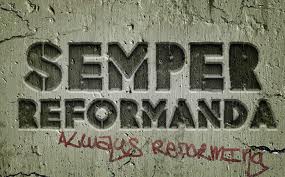
Standing here, smack dab in the middle of a Reformation of epic proportions, it feels to me like someone is trying to steal my Nuggie. Semper Reformanda — Always Reforming. Change, change, change. Sometimes I just want the security of that old time religion. I want to feel the comfort, the security that I once felt in the church. All this reforming is wearing me out. I’m tired of thinking. I’m tired of reforming my ideas. I’m tired of learning new things. I’m tired of all the questioning. I’m tired of all the questions. I want some answers. Sometimes I just want that Mighty Fortress to keep me safe. Sometimes I just want that Almighty Father to say, “There, there dear it’s all going to be all right!”
I knew were I stood in the old days. I was a wicked sinner. Heck, I was in bondage to sin and could not free myself. But I knew that Jesus was willing to die for me and save me from all my sins. I knew beyond the shadow of a doubt that even though I was a sinner, I was a forgiven sinner, simule justus et pecator. By the grace of God, I was both saint and sinner. Justified by God’s amazing grace. Thanks to the redeeming blood of the Lamb of God who washes away all my sin. Jesus died for me. Jesus saved me. And Jesus wants me for a sunbeam. Give me Jesus. Give me Jesus! I want my nuggie!
But in the words of dear old Martin Luther,“ Here I stand, for I can do no other.” Smack dab in the middle of a reformation, trying to follow Jesus. Jesus, who said that everything could be summed up in two commandments: “Love God with all your heart, with all your soul, with all your strength and with all your mind, and love your neighbour as you love yourself.” If only Jesus had left our minds out of the equation. If only we could switch off our minds and stop this constant quest for truth. But then Jesus did say, “you will know the truth, and the truth will make you free.” So, how can we keep from asking: “Free from what?” Continue reading →
In the spirit of the Reformation motto: semper reformanda – always reforming, what say we abandon the fortresses of our traditions. This Sunday, Lutheran churches all over the world will begin their Reformation Sunday worship services vigorously singing “A Mighty Fortress” and I for one wish they wouldn’t. I suspect that the hymn’s author Martin Luther might just agree with me. After all didn’t Luther write a Mighty Fortress in an attempt to bring the popular music of the day into the church? I am convinced that this particular Reformation Sunday tradition has dear old Martin spinning in his grave at the thought that the church that bears his name is still singing a tired old chestnut like A Mighty Fortress to celebrate the Reformation. The very idea of 21st century Lutheran’s celebrating the Reformation by clinging to the events of the 16th century is an affront to the memory of Martin Luther. Continue reading →
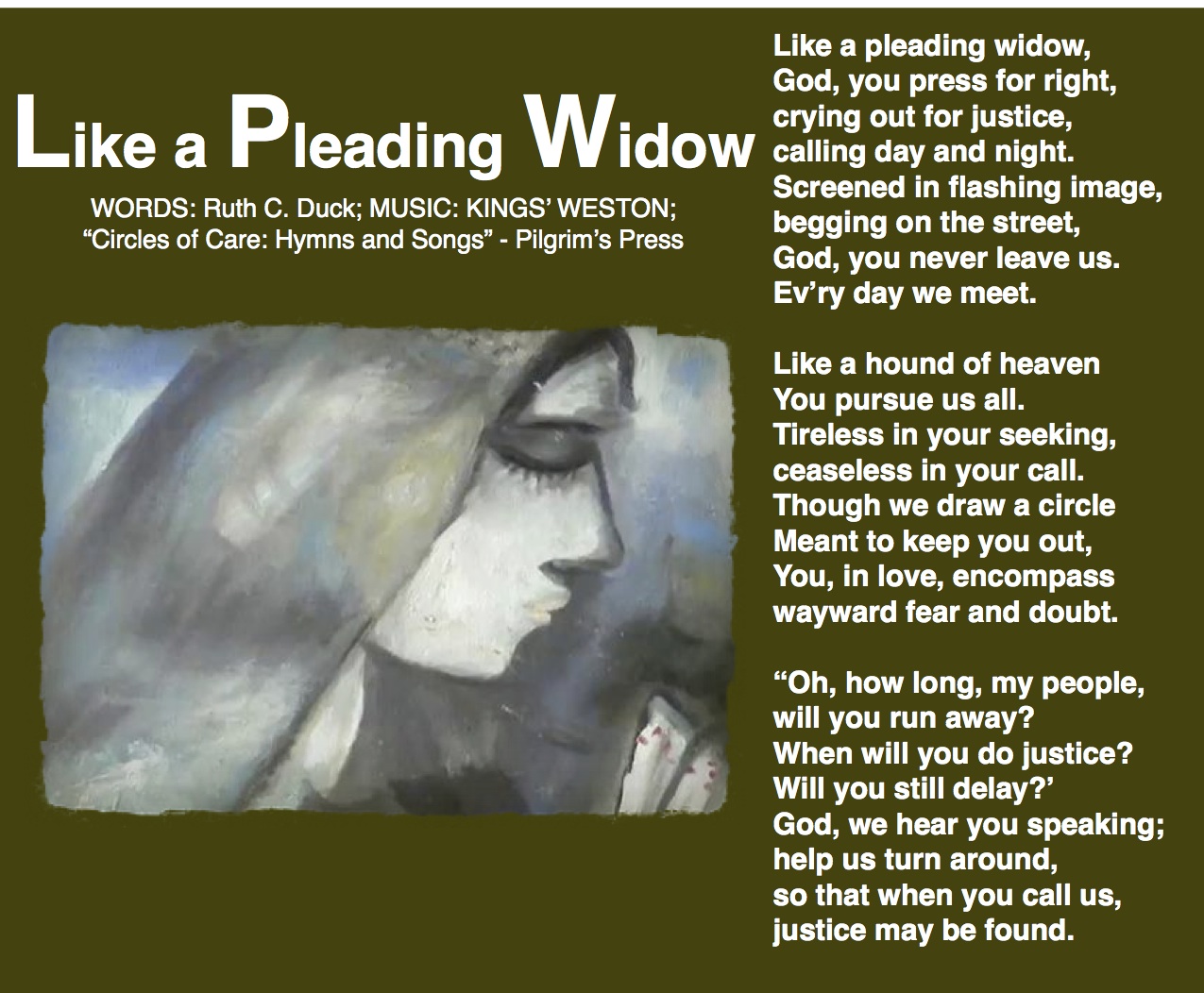
Ai Weiwei’s exhibit “According to What? at the Art Gallery of Ontario inspired me to look beyond traditional interpretations of Jesus’ parable of the Pleading Widow to see our role as the unjust judge. The gentle breath of a newborn granddaughter enabled me to hear God persistently pleading for justice.
Listen to the sermon here:
Our second reading was taken from Mechthild of Magdeburg’s “The Flowing Light of the Godhead”
Looking back on a sermon I preached six years ago on this week’s readings from Genesis 32:22-31 and Luke 18:1-8, I am struck by how much my own images of the Divine One we call God have changed and yet remain oddly similar. The intervening years have afforded me the opportunities to begin to leave behind notions of an anthropomorphic God who intervenes in our lives. As I have embraced the writings of progressive and evolutionary theologians, I have struggled to understand and articulate God’s nature from the perspective of panentheism (everything is in God). There are those who suggest that this is a departure from the Christian tradition. Yet looking back, I am beginning to see this movement as a natural progression of the tradition. Indeed, so much of what I have always loved about Lutheran theology has freed me to explore this path. So, I offer this old sermon as a snapshot of my own pathway toward new visions of the Divine. I trust that my early efforts to move beyond the notion of God as the “unjust judge” will move some to begin to see God in, with, and through all those who persistently plead for justice.
What little I know about the art of wrestling I learned from my brother Alan. He and I are just eighteen months apart in age and together we participated in many a wrestling match. All too often one or the other of us would be bothering the other and before we knew it we were rolling around on the floor wrestling. I’ll have you know that up until the age of about twelve I was quite a good wrestler. Up to that point I usually managed to hold my brother to the ground and with my knees firmly pinning his arms I would be able to get my brother to agree to my point of view. But my brother’s adolescent growth spurt put an end to my winning streak. Just as soon as my brother was big enough to pin me to the ground I decided to stop bothering him. Bothering my brother became dangerous and I had to give it up in order to save my dignity. Continue reading →
When I was a kid, the adults in my life were very fond of telling me how grateful I ought to be because things were so much harder back when they were kids. I’m sure most of us can remember being told by our elders just how tough times were when they were back in the day. My parents, grandparents, aunts and uncles and just about every adult I knew must have grown up poor. Why if I had a nickel for every time I heard someone say, “When I was a kid we were so poor that…..” well I’d have a whole lot of nickels.
Today, when I hear the words, “We were so poor that…” I brace myself for an outrageous claim like…. We were so poor that we couldn’t afford Kraft Dinner. Kraft Dinner, you were lucky, we were so poor that we couldn’t afford dinner, all we had was a cup of cold tea without milk or sugar. Cup of Tea, we were so poor that we only had filthy cracked teacups. Filthy cracked teacups, that’s nothing we were so poor that we couldn’t afford teacups, we used to have to drink our tea out of a rolled up newspaper. That’s nothing we were so poor that all we could we couldn’t afford newspapers so we had to suck our tea from a damp cloth.
Someone always chimes in with, “Well we might have been poor, but you know we were happy in those days. That’s right money can’t buy happiness. We used to live in a tiny house, with holes in the roof. “House? You were the lucky ones we were so poor that we had to live in one room, all 126 of us, with no furniture. Half the floor was missing; we were all huddled together in one corner for fear of falling! Ha! You were lucky to have a room! We used to have to live in a corridor! Ohhh we were so poor we used to dream of living in a corridor! A corridor would have been a palace to us. We used to live in an old water tank on a rubbish tip. We were woken up every morning by having a load of rotting fish dumped all over us!!! Rubbish tip, you were lucky, we were so poor that we lived in a hole in the ground covered by a piece of tarp, but it was a palace to us…especially after we were evicted from our hole in the ground and we had to go live in a lake. Lake, you were lucky to have a lake, there were a 160 of us living in a small cardboard box in the middle of the road. Cardboard, we were so poor we lived for three months in a brown paper back in a septic tank. We used to have to get up at six o’clock in the morning, clean the bag, eat a crust of stale bread, go to work down in the mines for 14 hours a day, week in week out. We had to get up out of that cardboard box at three o’clock in the morning and lick the road clean with our tongues. In case you didn’t recognize it, that was my interpretation of a classic Monty Python sketch, simply called the “We were so poor sketch”. (watch the video below) Continue reading →
I will be preaching on St. Michael and All Angels this coming Sunday. But for those of you who are working on the Parable of Lazarus and the Rich Man, here’s a copy of a sermon I preached a few years ago.
I moved out of my parent’s house when I was quite young and like most young people I didn’t have much money so I lived in some pretty weird places. I once shared a house with a bunch of people that I met working in the travel industry. I didn’t know them very well when I first moved in but as the months dragged on, I got to know some of them better than I would have liked. There were five of us living in a four-bedroom house about a block from Spanish Banks in Vancouver. The house’s proximity to the beach made up for some of my roommates’ shortcomings and the rent was cheap. So, even though I didn’t like the idea, I didn’t kick up much of a fuss when one of my roommates brought home a puppy.
Now there are those people who would argue that all puppies are cute, I just don’t happen to be one of them. Besides this thing was a Doberman and I don’t care if it was cute, I don’t like Dobermans. I was trying to convince my roommate David that he couldn’t possibly keep a Doberman in our house, when two of my other roommates showed up and quickly became besotted with the creature. One of my roommates when so far as to insist that the puppy was the cutest thing she had ever seen and that we simply had to keep it. While she was hugging and kissing the puppy, David got quite annoyed and pulled the puppy away from her and insisted that this dog was not going to be a pet. He declared that we needed this dog to grow up and be a guard dog, and if that was going to happen then we needed to start treating this dog as we meant to continue.
I had no intention of sharing a house with a Doberman, let a lone a guy who wanted to have one as a guard dog, so I started looking for another place to live. Before I moved out of that house, I had the unfortunate opportunity to watch David as he tried to train his puppy. First of all, David had to give the dog a name and it had to be a name that would instill fear into people, so that’s how the puppy ended up with a name like Vader as in Darth Vader. None of us were supposed to cuddle the dog or pat the dog or play with the dog. That was just fine with me. But one of our roommates, Ellen was forever getting into trouble for treating the puppy like a baby. So, David insisted that Vader be chained up outside. A few months after I moved out of the house, I went back to visit and discovered that even Ellen was afraid to go into the backyard because Vader was actually turning into a viscous guard dog. She told me that David had been leaving Vader chained up for longer and longer periods of time and no one in the house would dare to go out into the back yard to feed Vader. I found out from the others that even though they’d tried to get David to pay more attention to Vader, he insisted that it there was nothing wrong with the way he was treating Vader. For months David left Vader chained in the backyard for days at a time and as the dog got bigger and bigger, the three roommates that were left in the house with David became more and more afraid of the dog and eventually they had to insist that David move out. A few months later, I heard that David and Vader had parted ways. It seems that Vader had taken a chunk out of David’s arm and David had to have the poor creature put down. For some reason Jesus’ parable about Lazarus reminded me of Vader the Doberman. Continue reading →
After a long summer vacation, I returned to work this week. Getting back into the pulpit is a daunting task as I struggle to find just the right words for this Homecoming Sunday. Unable to settle upon which of the many possible readings on which to preach, I was struck by the possibilities of the Narrative Lectionary. Some musings:
You may not be able to tell from looking at me. But let me assure you that you are looking at someone who used to be a champion wrestler. Believe it or not, my wrestling skills actually helped me rise to the level of a world champion wrestler. Well, perhaps I should qualify that statement. When I was an amateur wrestler, I was a world-class champion wrestler. But like so many athletes, when my status changed from amateur to professional, I lost my championship status and although I still qualify as a professional wrestler, and I like to see myself as a champion, I’m no longer what you would call world-class.
Like many professional wrestlers my career began when I was but a child. Growing up I had a very clear advantage as I developed my wrestling skills. You see having a brother who was just 18 months younger than me meant that I had ample opportunities to hone my wrestling skills. My brother and I were always at it. I’ve got to say that even though we shared the same weight class for most of our childhood, when it came to world class wrestling holds, I had him beat. I had this wicked arm-hold sleeper, and that together with my full Nelson followed by a knee-arm press, was guaranteed to have my brother screaming uncle and agreeing to be my obedient servant until in no time at all. For years I reigned as the champion of our little world! I was unbeatable. My brother didn’t stand a chance. My reign as world champion would have continued if it weren’t for the abrupt ending of my amateur status.
One morning when I was about 13 and my brother was 9 and a half, we were going at it, and to his credit my bother had me in an ingenious hold. Somehow, he’d managed to secure me with what we professional wrestlers call an arm bar. That’s where you’re opponent wrenches your arm behind your back and applies just enough pressure to cause pain, but not enough to break anything. But just when Alan was approaching the point of no return, I managed with a feat of superhuman strength to rise up, twist around and swing for all I was worth and connect with what I though must be my brothers chest. I expected that such a thrust would have released my arm from Alan’s iron grip. But he still had me. I was about to hit him again, when for no apparent reason Alan released me from his grip. In an instant I wiggled free, spun around and connected with what I figured would be a fatal blow. Just before my blow connected with it’s victim, I realized that I was doomed.
How appropriate that preachers all over the world will be preparing sermons this week on the gospel text Luke 15. These parables of the lost will have us remembering the work of a beloved scholar whose work on the parables influenced generations of preachers. Robert Farrar Capon died on Friday and looking over the various sermons that I have prepared over the years on Luke 15, I for one am grateful to have been influenced by such a great theologian! I am also indebted to two beloved seminary professors for the formation of this sermon: Dr. Donna L. Seamone and Dr. Ed Riegert. All preachers stand on the shoulders of those who have gone before us!!!
Jesus was and is an absolute fool! An absolute fool, I tell you!
Among the teachings of Jesus, the parables of the lost and found are so well known, so familiar that we are in peril of failing to hear the foolishness they advocate.
Although only a few of us have had the opportunity to tend a flock of sheep, most of us at one time or another have been responsible for the welfare of a flock. Whether that flock be sheep or co-workers, clients, customers, students, friends, or children none but the foolish among us would leave 99 to the perils and dangers of the wilderness in order to go looking for one idiot who’d been stupid enough to get themselves lost.
We may not keep our coins at home, but I daresay that most of us have felt the sting of loosing a drachma or two or three in this recession. Only a fool would waste a moment searching for our losses when our portfolio’s are so full. I dare say that if we managed to find or recoup our loss, we’re hardly likely to invite the neighbourhood to a party that would in all likelihood eat up more than we had found. Continue reading →
Still enjoying a wonderful vacation, and I am grateful not to have to preach on the difficult text assigned for this Sunday. Here’s a facsimile of the sermon I preached a number of years ago on the gospel text.
Now large crowds were travelling with Jesus and he turned and said to them, “Whoever comes to me and does not hate father and mother, wife and children, brothers and sisters, yes, and even life itself, cannot be my disciple. Whoever does not carry the cross and follow me cannot be my disciple. For which of you, intending to build a tower, does not first sit down and estimate the cost, to see whether he has enough to complete it? Otherwise, when the foundation is laid and the tower cannot be finished, all who see it will begin to ridicule the builder, saying, “This person began to build and was not able to finish.’ Or what king, going out to wage war against another king, will not sit down first and consider whether he is able with ten thousand to oppose the one who comes against him with twenty thousand? If not, then, while the other is still far away, he sends a delegation and asks for the terms of peace. So therefore, none of you can become my disciple if you do not give up all you possession Luke: 14:25-33
Jesus you’ve got to be kidding! “Whoever comes to me and does not hate father and mother, wife and children, brothers and sisters, yes and even life itself, cannot be my disciple?…None of you can become my disciple if you do not give up all your possessions?”
Hate your father; hate your mother; hate your wife; hate your children; hate you brothers; hate your sisters; hate even life itself and oh yes while you are at it give up all you possessions and then, and only then will you be ready to take up your cross and follow Jesus. What is Jesus talking about? Has Jesus forgotten about the fourth commandment? Are we to forget about honouring our parents? Wasn’t it Jesus who said that we are to love our neighbours as we love ourselves? Didn’t Jesus try to talk people into loving their enemies? Has Jesus forgotten that God is love? Why does Jesus rant and rave about hating our father’s, mothers, children, sisters, brothers and even life itself?
It is difficult to recognize the Jesus in this text. This is not the gentle Jesus of my childhood. This is not the happy Jesus who smiled out from the pictures in my illustrated Bible.This is not the Jesus that the rightwing conservative Christians point to when they harp on about family values. This is not the gentle Jesus we have come to expect. This Jesus sounds to harsh. This Jesus wants to turn us into religious fanatics who hate everybody and give up everything, even life itself.
For a few years now, there has stood on the shelf above my desk a quotation from Deuteronomy 30. I put it there so that these word’s of God might guide me in my decision making. According to the writers of Deuteronomy, God says: “I have set before you life and death, blessings and curses. Choose life so that you and your descendants may live”. God says “Choose life!” How do I reconcile this to the Gospel lesson in which Jesus says whoever does not hate even life itself, cannot be a disciple of Jesus? Why was Jesus so harsh? What is going on here? Continue reading →
here’s a facsimile of the sermon I preached three years ago when Luke 14:1, 7-14 last appeared in the lectionary.
One Sabbath, when Jesus came to eat a meal in the house of one of the leading Pharisees, the guests watched him closely. Jesus went on to address a parable to the guests, noticing how they were trying to get a place of Honour at the table. “When you’re invited to a wedding party, don’t sit in the place of honour, in case someone more distinguished has been invited. Otherwise the hosts might come and say to you, ‘Make room for this person,’ and you would have to proceed shamefacedly to the lowest place. What you should do is go and sit in the lowest place, so that when your hosts approach you they’ll say, ‘My friend, come up higher.’ This will win you the esteem of the other guests. For all who exalt themselves will be humbled, and those who humble themselves will be exalted.” Then Jesus said to the host, “Whenever you give a lunch or dinner, don’t invite your friends or colleagues or relatives or wealth neighbours. They might invite you in return and thus repay you. No, when you have a reception, invite those who are poor or have physical infirmities or are blind. You should be pleased that they can’t repay you, for you’ll be repaid at the resurrection of the just.
I have often heard Jesus’ teaching about who sits where at a wedding feast used to encourage a kind of humility that requires those who would follow Jesus to take a back seat or better still adopt a cloak of invisibility lest we be mistaken for the proud and self-righteous. Canadians have a special affinity for this particular way of interpreting this text. It seems to me that the image of Canadian humility suggests that Canadian Christianity has had a huge impact upon our national psyche. I know that there are many who would insist that our humble national character is a direct result of living in the shadow of the Americans, whose national identity is anything but humble. I have to admit that the constant drumbeat of “We’re number one!”, “We’re number one!” coupled with a patriotism that champions the idea of American Exceptionalism which is the notion that the United States alone has the right, whether by divine sanction or moral obligation, to bring civilization, or democracy, or liberty to the rest of the world, by violence if necessary. With such pride of place, you can be sure that each and every one of our American cousins is endowed with the confidence on knowing exactly where they belong at the head table. So, is it any wonder that living next-door to a nation that instills such patriotic ardor in its citizens, that we Canadians would find a more humble approach more appealing.
Don’t get me wrong; I know that stereotypes rarely express the full character of a nation and so, it would be a mistake to paint all Americans with the same brush. But I dare say that you’d be hard pressed to find a Canadian who would disagree that even the most enlightened of our American cousins who might be found from time to time to speak softly, doesn’t underneath it all carry a big stick. Where Bravado flows through our American cousin’s national character, most Canadians prefer a quieter, softer, gentler approach, lest we be confused with the worst of American stereotypes: “the ugly American.” Continue reading →
It was hot. Already the sun had parched the earth. The air was still. The ground beneath her feet radiated the heat. She was tired. Earlier she had thought about staying at home. Her weary body could use a rest. All week long she had toiled in the heat of the sun. On this Sabbath she longed to rest her crumpled, aching body. She tried to ignore the weakness she felt. She had suffered long and hard. She couldn’t even remember when or how she had become so weak. Over the years, her weakened spirit had left her body bent and crippled. The evidence of her heavy burdens could be seen in her crooked spine. She was ashamed of her appearance.
It had been eighteen long years since she had stood straight and tall. She vaguely remembered running when she was a child. She ran everywhere back then. She ran faster than anyone else in the town. She loved to run. Running made her feel free.
Her mother used to warn her not to run. Her mother tried to stop her. But she was so full of life. She wanted to see everything. She wanted to do everything. She wanted to go everywhere.
Her mother warned her not to be so curious. Her mother tried to keep her busy. Her mother tried to keep her out of trouble. But it was no use, no matter how many tasks her mother gave her; she always managed to find time to explore. She had so many questions. She wanted to know how things worked. Life was so very exciting. She dashed from one adventure to the next. She ran everywhere, everyday. Except of course on the Sabbath. On the Sabbath she walked. She walked with her family to the synagogue. She loved to go to the synagogue. As her father and brothers took their places at the feet of the rabbis, she sat quietly with her mother and sisters and the other women and girls in the back of the synagogue. She listened carefully as the men and boys talked. Continue reading →
Mary Pregnant? St. Matthew-in-the-City (Auckland, NZ)
I’m on vacation so I don’t get to preach this coming Sunday. But if I did, I suspect that I would move the Commemoration of St. Mary to Sunday and take the opportunity to explore the life and witness of this amazing woman. Today the Church celebrates the feast of St. Mary the Mother of Jesus or as it is still called in the Roman Catholic Church The Feast of the Assumption of St. Mary into Heaven. This enigmatic woman has remained in the shadows for centuries. All too often the epithet “virgin” has been applied to the young woman who fell pregnant so long ago. So on this festival day I this re-post this sermon which I preached a couple of years ago in which I asked some questions about Mary. At the time I was reading Jane Schalberg’s “The Illegitimacy of Jesus”, John Shelby Spong’s “Born of a Woman” and “Jesus for the Non Religious” along with John Dominic Crossan and Marcus Borg’s “The First Christmas” and this sermon is laced with their scholarship. As always the written text is but a reflection of the sermon preached on the Fourth Sunday of Advent 2009.
Sadly, one doesn’t have to travel too far into the past to arrive at the time when women’s voices were not heard. Indeed, in the Lutheran church, it was only a few short decades ago. For most of us that time is within our own lifetime. For generations, men have told our sacred stories. Men have decided which stories made it into the canon of Sacred Scriptures. Men have interpreted the stories that were allowed to be told. Men have translated, taught, and commented upon those stories from pulpits, in universities, in seminaries, in commentaries and in the public square. Continue reading →

 Lest we forget” is a phrase that has become synonymous with Remembrance Day. Sadly, our Remembrance Day commemorations have become disconnected from our history and the vast majority of those of us who observe Remembrance Day have forgotten its origins. Our collective amnesia about the phrase, “Lest we forget” is a case in point. I have always assumed that the phrase was coined to encourage the world not to forget those who have served, fought and in too many cases died to protect our freedoms. While the phrase’s attachment to Remembrance Day has served as a call to collective remembrance, it was coined for a far more humbling purpose than to honour the fallen heroes of foreign wars. The phrase, “Lest we forget” was coined by the great poet laureate of the British Empire Rudyard Kipling, in his daunting poem, “Recessional” written to commemorate Queen Victoria’s Diamond Jubilee in 1897. Kipling’s poem was a sobering call to humility at a time when the British people were basking in the glory of Empire. Recessional served as a reminder that the sun might never set on the British Empire, but God was still in God’s heaven and thus, the sun rises upon the evil as well as the good. Kipling warned those drunk on the excesses of Empire that God was sovereign and not the British people.
















 pastordawn