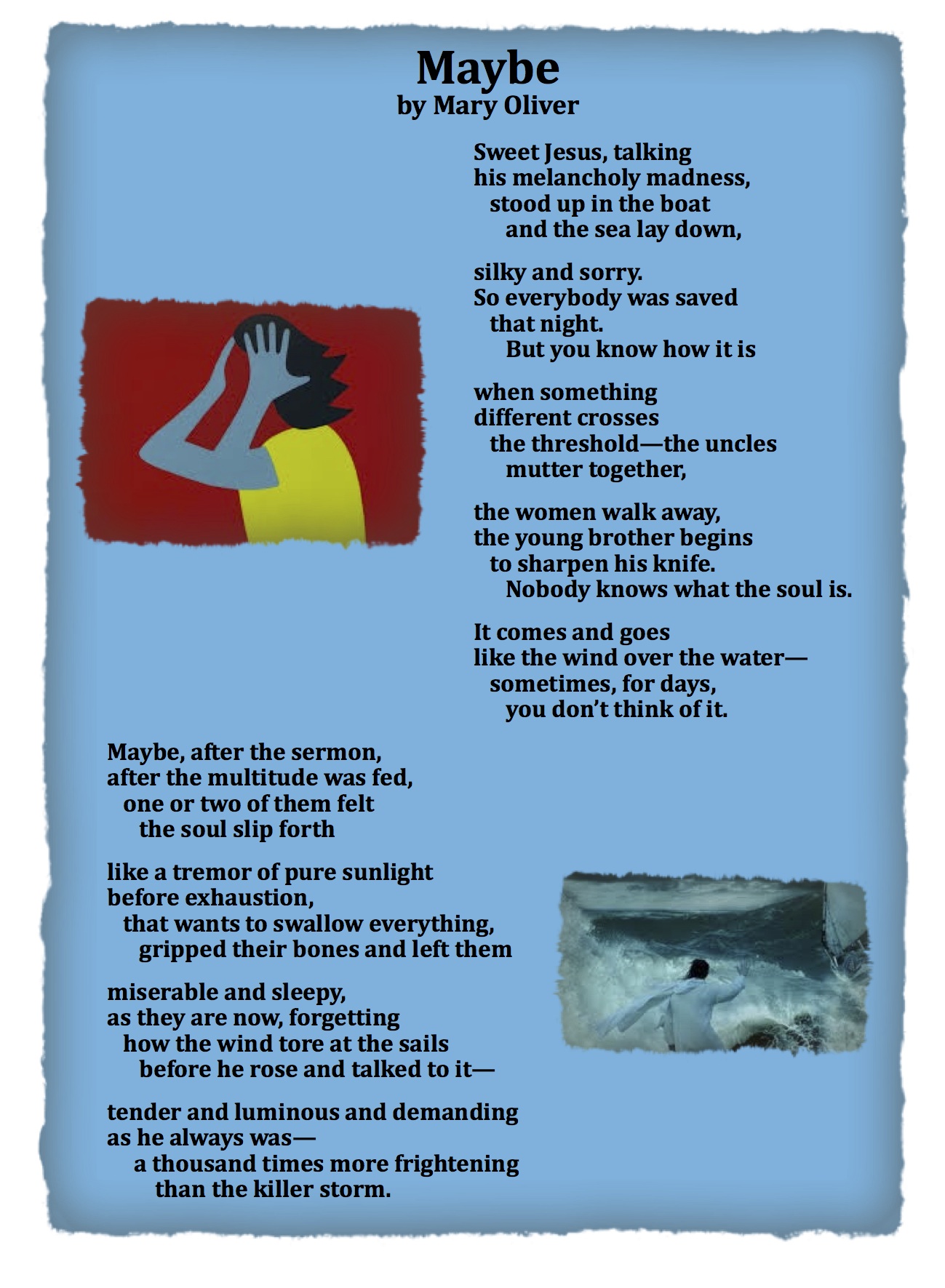
Maybe Jesus was as the Gospel says, “out of his mind.”

The gospel reading prescribed for this coming Sunday (Mark 3:20-35) paints a daunting picture of the perceptions of the people of Jesus’ hometown. The folks who knew Jesus, including his family worried that he might just be “out of his mind.” This is indeed a contrast to the ways in which Jesus is typically portrayed. This is a dangerous Jesus who ran the risk of being perceived as deranged. In his book “The Underground Church: Reclaiming the Subversive Way of Jesus” Robin Meyers captures some of this danger when he points to Mary Oliver’s poem “Maybe” in which Jesus’ “melancholy madness” is seen by his fellows as more dangerous than a storm.  Safely ensconced in our imaginations, Jesus is rarely allowed to threaten the status quo to which we cling for dear life. Are we prepared for the stormy waters that would be stirred up should we take Jesus at his word? Maybe…

Maybe Mary Oliver pastordawn

A Little Self-Involved? Try Looking Outward! – a sermon on John 3:1-17

Trinity copyWhen I was just a kid, I had what can best be described as an adolescent crush on a teacher. Looking back on it now, I’d have to say that I fell head over heels in love with my teacher. It was the kind of love that only a 13 year-old girl could have; so intense and all consuming. I came to believe that this teacher was the wisest, kindest, most interesting person in all the world. This teacher knew more than anyone else, especially my parents. This teacher was cooler, funnier, more daring and definitely more in tune with my life than anyone I had ever met. I was convinced that if I could only be just like this teacher would mean that I too would be cooler, funnier, more daring and definitely more in tune with life. So, like most adolescent girls who are suffering from a crush I became obsessed with this teacher. I was young and I was in love, and like most thirteen year-old’s the I was convinced that the world revolved around me, so I set about pursuing my passion. This teacher taught English, so naturally, I decided that when I grew up I too would teach English. This teacher loved poetry, so I too became passionate about poetry.

One day this teacher announced that we could gain extra-credit if we wanted to enter a local poetry writing contest; and even though I was pretty sure that year I’d be getting a mark that would be somewhat better than an A, I began to write poetry. I was very serious about my poetry writing.  I carried a pad of paper with me everywhere I went, and I began to ruminate about my life. I don’t remember any of those early attempts to wax poetical, but I do remember that each and every one of those poems was about me; me and my life, me and my unrequited love, me and my passion, me and the horrible way that no one paid much attention to me. Me, Me, Me, Me, it was all about me.

As the time drew near for us to submit our poetry to the competition, my teacher announced that there would be a special class after school, so that those of us who were planning to enter the competition could get some feedback on our efforts. So, by the end of the week, I would have to choose one of my great works for feedback. I spent hours pouring over one poem in particular. Tinkering with the words, trying to get things just right. I was so very proud of the final draft. I’d carefully copied it out on to a crisp piece of foolscap. Arranged the letters in the middle of the page so that they looked just so. I could hardly wait for school to be over so that I could rush to see what comments my beloved teacher had placed in the margin. There were barely a handful of us who stayed after school.

Looking back on that scene, we were a nerdy little crew. I was positively breathless as my teacher handed my offering back to me. To this day, I can’t remember a single line of my great work, but I can tell you word for ward what was scribbled in red in the margin of the ever so white foolscap. “A little self-involved, try looking outward.” I was devastated. How could anyone be so cruel? I’d poured my heart out only to have it stomped on by the indifference of truth. Continue reading

Moon-Dancing Bears, Jesus and Nicodemus: a sermon on John 3:1-17

moondancing bearsI am indebted to Jim Kast-Keat, a pioneering preacher who inspired me to open this sermon with the video below. I am also indebted to Bishop John Shelby Spong for teaching me more that I can articulate with words. His excellent book The Fourth Gospel: Tales of a Jewish Mystic opened the Gospel According to John in ways that have helped me to see aspects of the Divine to which I was once blind. Much of the sermon consists of extensive quotes from chapter 9 of Jack’s book.

Readings: John Chapter 2 and John 3:1-17

Watch the video below carefully before reading or listening to the sermon  the sermon below.

Listen to the sermon:  

So, before tackling the story of Nicodemus, I want to toss two balls into the congregation. The first ball I want to toss over here to this side of the congregation represents something all too familiar, biblical literalism. We know all too well that this particular ball has been distracting the church and most of the western world for the past few centuries. The second ball I want to toss over here to this side of the congregation represents historical biblical criticism. This particular ball is newer. It’s only been seriously tossed about for the past couple of centuries, but it is a really serious contender for our attention. But these balls have acquired a rather rhythmic bounce that tends to mesmerize us. Add to that these other balls the balls of church doctrine and theological dogma and before you know it we are so distracted that we forget what game we were trying to play in the first place as we try to keep up with the various passes made by players that have taken on a professional edge that leaves us watching from the sidelines unable to focus one of them.

None of these balls commanded the attention of the early Christians. They simply weren’t interested in taking the scriptures literally, nor were they particularly interested in the historicity of the scriptures. As for doctrine and dogma, well they were left to the professionals who only came to town on those unpleasant occasions when the league needed to ensure that it’s franchises continued to rake in enough money to keep the game on a sure footing. The scriptures, like all sacred writings, were about so much more than words scribbled on a scroll. The scriptures, like all scared writings, are about the mysteries of life. But these balls have been served up for us to play with and literalism and concerns about historical accuracy have done a magnificent job of distracting us from what really matters in these texts. Our fascination with the details of the fight-patterns of the balls that are tossed around whenever the stories in these texts play through our lives, have caused us to miss so many moon-dancing bears over the years.

Please don’t get me wrong, I love tossing these balls around and over the years I’ve learned to play ball with the best of them. But when a moon-walking bear dances onto the court, at the very least, we ought to notice the bear’s moves because the only way we’re going to learn to dance with these bears is by paying attention. Continue reading

The Spirit Alive in Our Midst: a sermon for Pentecost Sunday

Pentecost Sunday

Readings included: Ezekiel 37:1-14; Romans 8:22-27 & Acts 1:12-2:21

You can listen to the sermon here

All Shall Be Well and All Manner of Things Shall Be Well – Julian of Norwich

All shall be well

Mothers’ Day Angst

True Mother Julian of NorwichMothers’ Day is not on the church’s liturgical calendar and yet the statisticians tell us that church attendance on Mothers’ Day is surpassed only by Christmas and Easter. Worship leaders who fail to mark the importance of this day do so at their peril; the same kind of peril that compels so many reluctant offspring to accompany their mothers to church. However, a simple liturgical nod in the direction of mothers or an over-the-top sentimental sermon all too often fails to capture the magnitude of the day’s significance in the history of women.  Planning the liturgy is challenging enough, but writing the sermon is a challenge which promises to keep me toiling away into the dark hours of this coming Saturday. So, for my colleagues who share a similar plight: below you will find links to previous attempts to commemorate this day of days. Feel free to share your efforts with me in the comments section. Please! I need all the help you can offer!!!

MOTHERS’ DAY – Peace is the Way

Preaching on Mothers’ Day – Don’t Compromise

Another Option for Mothers’ Day: Bring Many Names

SHE Who Dwells Among Us – A Mothers’ Day Sermon

Arise on this Mothers’ Day: a sermon


Faith as Resistance: Adult Education Class

Spiritual DefianceCurrently the Adult Education Class at Holy Cross Lutheran Church is exploring ways in which the church can once again become communities of resistance. We began with an exploration of Cynthia Moe-Lobeda’s book “Resisting Structural Evil Love As Ecological-Economic Vocation” and we have moved on to the excellent work of Robin Meyers whose Beecher Lectures have been published in “Spiritual Defiance: Building a Beloved Community of Resistance”. Below you will find the 3rd lecture in the series, UNDONE: Faith as Resistance to Empire, which we are studying in depth. For those who would like to delve deeper all three Beecher Lectures, along with a brief bio of Robin Meyers, can be found here 

Join us for conversation at 9:15am this Sunday 

It’s about LOVE not creeds!- a sermon for Easter 5B – 1 John 4:7-21

st anne'sListen to the sermon here

Even Eunuchs and Foreigners are Welcome!

Ethiopian EunuchReposted by request: What follows is a sermon I preached on the 5th Sunday of Easter 2003. In the 13 years since I preached this sermon, the Evangelical Lutheran Church in Canada has come a long way. The debate about the full inclusion of GLBT folk in the full life of the church has been resolved and we can truly say: “All are welcome!” But rule changes don’t always change practices. Sadly, there are still places in our church were not everyone is welcome.  So, I offer this sermon to cybersapce as both a reminder of where we have been and how far we need to travel. Shalom. 

Sunday May 18th 2003   Holy Cross Lutheran

Even Eunuchs and Foreigners are Welcome!  Acts 8:26-40

Earlier this week, I was talking with a few of my colleagues. And as Lutheran Pastors are wont to do, our conversation drifted toward the lessons prescribed for this Sunday.  As we kicked around ideas, most of us agreed that it is difficult to preach on familiar passages.           

Most of you have heard a great many sermons on today’s gospel lesson, and so the challenge for preachers to bring some new insights is made all the more difficult.  So, we joked about just how many ways a preacher can twist and turn those vines until they finally snap off, dry up and rot.

Today’s epistle lesson isn’t much easier.  Preachers are always preaching about love; often we’re preaching to the choir, because most of you already know how much God loves us and how much God wants us to love one another.  Coming up with a new and interesting angle on the second lesson isn’t easy.  So, I suggested to my colleagues that this Sunday rather than preaching one more time about love, why not preach on the first lesson. Why not preach on the story of the Apostle Philip’s encounter with the Ethiopian on the road to Gaza? Well it might surprise you to know that no matter how challenging they thought it would be to come up with one more sermon about love, not one of my colleagues thought that it would be a good idea to preach about the goings on in the desert between Philip and that Ethiopian. One of my colleagues even went so far as to say that you would have to be either very brave or very foolish to even try it.

Now I have a confession to make, at the time I had no idea what it was in this particular passage that would make my colleagues so averse to preaching on it. I have to admit that I don’t really remember ever paying all that much attention to this particular story. I have certainly never before studied it in any great detail, but my colleagues’ aversion for this text, made me curious enough to hit the books just as soon as I got home. Despite the fact that this text shows up every three years in our lectionary, try as I might, I wasn’t able to find a reference to a single published sermon on this particular text. It seems that many the great preachers left this one alone.

It didn’t take me long to figure out just why this text is so daunting and why my colleagues are not alone in giving it such a wide berth. Now I don’t claim to be particularly brave, but I’ve already preached on today’s other readings. Besides it’s a long weekend and I figured that a lot of people would be away and I could sneak this one in. So this fool is about to rush in, where many have feared to tread.

Our story begins when an angel directs the apostle Philip to go south on the road from Jerusalem to Gaza. On this road in the desert Philip meets and Ethiopian eunuch. Now I don’t know about you, but this strikes me as a really odd way to introduce someone.  No name, just an Ethiopian eunuch, the author must have thought it was important because he tells us not once but five times that the Ethiopian was a eunuch. I know what an Ethiopian is.  Philip has encountered a black African man in the desert. Now that in and of it’s self is pretty remarkable. You will see later that this black man was the first missionary to Africa.

But surely this can’t be the reason why so many preachers shy away from this text. So what exactly is a eunuch? According to the most current scholarship, in the first century a eunuch is one of two things. A eunuch could have been a man who had been castrated.  Now for those of you who didn’t grow up on a farm to castrate means to remove a male’s testicles. So, this particular Ethiopian could have been a castrated male, or he could have been a male who wasn’t like most males. According to the scholars men who showed a preference for other men or displayed little or no interest in women, or who were in anyway effeminate, in the first century these men were called eunuchs. Continue reading

The Sheepskin Baggage We Bring to the Text: sermon for Easter 4B – John 10

good shepherdTraditionally the fourth Sunday in Easter is celebrated as Good Shepherd Sunday so it should not surprise us that a pesky lamb shows up. Readings:  Psalm 23, 1 John 3:16-24, John 10:11-18

Listen to the sermon here

Emmaus is Nowhere because Emmaus is Everywhere: a sermon on Luke 24

Road to EmmausThis sermon was inspired on my own journey to Emmaus where in the space of the same afternoon I heard a stranger declare: “Christianity is dead!” and Karen Armstrong’s now famous TED talk about her call for a world Charter for Compassion.

Has anybody here ever been to Emmaus? Which one? According to the latest issue of Biblical Archeology there are at least nine possible locations that are candidates for the Biblical town of Emmaus. Historians tell us that there is no record of any village called Emmaus in any other ancient source. We simply don’t know where Emmaus might have been. Tradition, tells us that it might have been a place just a few hours walk from Jerusalem. New Testament scholar, Marcus Borg suggests that Emmaus is nowhere. Emmaus is nowhere precisely because Emmaus is everywhere. Each and every one of us has at one time, or indeed for some of us, many times, traveled along the road to Emmaus.

I know that I have been on the road to Emmaus most of my life. I’ve had lots of company on the Road to Emmaus. I’ve had many conversations along the way discussing, with anyone who’d care to accompany me, the ifs, ands, and buts of Christianity, of religion, and indeed of life. If you haven’t traveled down the road to Emmaus you must be very skilled in the fine art of turning off your brain and if you check you just might discover that your heart isn’t actually beating.

It’s so easy to imagine, those two characters striding down the Road to Emmaus that we can almost hear them talking, maybe even arguing about what happened. What on earth were they to make of all this! Jesus was supposed to be the Messiah. Jesus was the One who had come to liberate Israel, to free the people from oppression. Jesus was the One who was supposed to draw the people back to God, restore the relationship between God and God’s people. Now Jesus was gone, and what had changed? Now, Jesus was gone, and the Roman Empire was still oppressing them, still inflicting such pain and hardship, still killing them. Was it all a mistake? Was it all a lie? Had they been fooled by some kind of cruel hoax—were they wrong to put their hopes in this man from Nazareth? They had trusted Jesus believed in Jesus, followed Jesus. Their lives had been changed. They had seen the lives of others changed and they had expected even greater changes to come. Jesus had confronted corrupt powers. Jesus had charmed great crowds. Jews and Gentiles alike responded to the truth of Jesus’ teaching. Rich and poor had come to Jesus, believing in Jesus’ healing power. But Jesus had been shamed, and ridiculed, and humiliated, and crucified and now Jesus was dead. Well, was Jesus dead? Some said they’d seen Jesus, alive! Not that Jesus had survived the crucifixion by some miracle of strength, but that Jesus had risen from the dead. They seemed so totally convinced by their own experience…were they confused by their own grief? Were they delirious? Had they loved this Jesus so much—invested so much hope in Jesus life and leadership—that they simply could not let him go? And what did ‘resurrection” mean? Apparently it was not the resuscitation of a corpse. Jesus wasn’t revived to resume his former life; to take up his broken body until the day he might die again. No, somehow this was some new mode of being that seemed to be spiritual to some and yet real to others. And, if Jesus were risen from the dead, what would be the point of all that? What was the point to a Messiah—to a presumed political and religious leader—if Jesus wasn’t able to lead people here on earth? How could Jesus restore Israel when he had so easily been defeated by a handful of Roman guards? How could he bring release to the captives, how could he bring justice for the poor, how could Jesus advocate for the widows and the homeless? How could Jesus call people to account for all the ways they had strayed from God’s intent, now? What good could come from some kind of spiritual ghost? We can hear these two friends wrestling with each other and with their own hearts on the road that day! Continue reading

Oh Me of Little Faith: reflecting upon Doubting Thomas

leap of doubt pastorDawnIt happens every year as Doubting Thomas makes his Easter appearance. It’s a kind of resurrection of a glimmer of the faith that I long to recall in my flesh. I harken back to the time when I could embrace those wounds as proof. Oh how that faith comforted me. Resurrecting the memory of Thomas, who for years functioned as a trusted hero in my scant faith, now sends me into the dream of belief as the answer in and of itself; a kind of innocence that once gone is never forgotten. My nostalgia for my faith in belief will pass. But for just a moment or two, I pause to embrace the wounds, waiting for my doubts to open me to the evolving reality of now.  Jump!!!

Nickel Creek – A Doubting Thomas

PRACTICING RESURRECTION – a sermon for the 2nd Sunday of Easter

resurrectionFor this sermon I used a video within the sermon to help illustrate resurrection. You can view the video within the written text of the sermon below or listen to the audio version provided. I am indebted to the work of James Rowe Adams for much of the New Testament Scholarship in this sermon.

The Scripture texts were John chapter 20:19-31 and Acts 4:32-35

Audio Version of the Sermon click here

Practicing Resurrection

Christ is Risen! Christ is Risen indeed!  Alleluia! So, Christ is Risen!  So What???What can it possibly mean to you and to me, that a rag-tag bunch of Jesus’ followers gathered together in an upper-room and talked about their experiences of Jesus and decided that not even death could extinguish the life that they experienced in Jesus? What difference does it make to you or to I that Christ is risen? The truth is that it can make absolutely no difference what so ever. Now there are a whole lot of people who will tell you that the important thing about resurrection is that you believe it. Those same folks absolutely love the story of doubting Thomas. And so every year on the second Sunday of Easter we read the story of doubting Thomas as a kind of inoculation against Thomas’ disease.

I sometimes think that the designers of the lectionary were trying to build up our resistance to doubt. Having problems believing in resurrection, well don’t do what Thomas did, don’t doubt, because you’ll be proven wrong. Jesus is alive, the wounds in his hands proved that to Doubting Thomas, so have no doubt about it the resurrection happened!  Believe in the resurrection!

The trouble with believing in stuff is that it belief can make absolutely no difference what so ever. I can believe in justice for all, but unless I’m prepared to seek justice, to be fair, or to resist injustice, it makes absolutely no difference what so ever. You can shout, “Christ is risen!” all you want but unless you are willing to live it, the resurrection means very little at all. In order to live the resurrection you have to begin practicing resurrection. In order to practice something, you have to know what it looks like, what it sounds like, or what it feels like.

I’ve been trying to figure out how to show you what resurrection looks like in the flesh. Then I remembered a video that’s been doing the rounds on the internet, so I want you to watch this modern miracle of resurrection.

WATCH THE VIDEO CLIP FROM:  Alive Inside

Christ is Risen! Christ is Risen indeed!  Alleluia!  Almost 2000 years ago, a bunch of rag-tag Jesus followers were huddled together in fear. Their beloved leader had been brutally executed by the powers that be and they were terrified that they would be next. Paralyzed by their fear, hiding behind a locked door, something happened that gave them the strength to burst forth from their own tomb and change the world. Continue reading

And Still I Rise – Maya Angelou

Not Salvation! Solidarity and Transformation: Good Friday sermon 2015

rough crossI am indebted to Marcus Borg for once again guiding me through Holy Week. Marcus’ words echo throughout this sermon. His last book (sadly his last book, what shall we do without him?) Convictions: How I Learned What Matters Most provided me with a way of seeing beyond the cross for which I am grateful. I am also grateful to James Carroll whose book Christ Actually: The Son of God for the Secular Age, remains a constant source of inspiration.

Listen to the Good Friday sermon here

I Will Remember You – Maundy Thursday sermon

Maundy Thursday

Pastor Tom Doherty’s Maundy Thursday meditation opened us to the pain and joy of memory. Listen to the sermon here

I Plead Guilty to the Charge of Denying the Resurrection – But I ain’t leaving!!!

I am reposting this particular post because it remains the most visited post of this blog.  It first appeared during  my first months of blogging and I am often asked about this post. Its contents continue to invoke the wrath of some and the appreciation of many. I offer it here, mindful that in the intervening tree years since I first posted it, I have had the opportunity to explore progressive and evolutionary theologies which have nourished me in my efforts to proclaim the Easter story in ways that move beyond the tired debate over the physical resuscitation of a corpse toward an understanding of resurrection that permeates my daily quest to know the unknowable ONE who lies at the heart of reality. 

Peter Callesen's Papercut Resurrection

Peter Callesen’s Papercut Resurrection

Blogging is sometimes a very strange medium and I must say that I am overwhelmed by the responses to my recent posts about resurrection.  While many have emailed or posted their ardent “amens” others have been scathing and some hostile to my remarks.  I am grateful to everyone who has responded.  All of your comments help me as I continue to ponder the theological and practical implications of the Easter story.  For those of you who have suggested that I have no business calling myself a Christian or a pastor and have suggested that I ought to consider leaving the church, I offer the following.

A while back, I got together with clergy colleagues to talk about the challenges of preaching during Holy Week. When the subject of the crucifixion and the resurrection came up, the conversation became very lively as the traditionalists challenged the progressives. Toward the end of our conversation, it became clear that because I was unwilling to concede to the notion that Jesus corpse was physically resuscitated; I stood accused of having denied the resurrection.

Some colleagues rose to my defense and insisted that I wasn’t saying anything different than what we all learned in seminary. But they also insisted that most lay-people simply don’t want to hear it. So, I asked them if they were going to preach about what they had learned in seminary and beyond and the general consensus was that there are too many guests on Easter Sunday to tackle theology.

Some said, they were simply too afraid of the fundamentalists in their congregations to ever even attempt to preach what they knew. A few confessed that they were working up to it; but not on Easter Sunday.

The traditionalists in the group were disgusted. One colleague went so far as to insist that I had no business being in the church because my very presence puts the beliefs of the faithful at risk. He wondered aloud, “Why do you stay in the church if you don’t believe?  If the church’s theology no longer works for you, why don’t you just leave?” Continue reading

Good Friday Sermons

Good Friday2015Holy Week marks a sharp uptick in visitors to this blog. From comments, messages, and emails I hear from fellow preachers who, like me, are daunted by the task of preparing the Good Friday sermon. That task is even more daunting for those of us who serve progressive communities. My fellow progressive-christian-preachers tell me of the dearth of progressive-christian Good Friday sermons to be found on the internet and encourage me to re-post my own attempts to rise to the occasion. So, here are the links to some of the Good Friday sermons I have preached over the years of my journey with the progressive community which I serve. The people Holy Cross Lutheran Church has over the years provided an invigorating space for me to pursue my questions. They have also provided the resources which make this blog possible. So, if you find the work posted here  of value to you and your community, please consider supporting this ministry of Holy Cross. I rarely solicit donations. But Holy Cross is a small community that continues to give to others in so many ways and your encouragement is greatly appreciated!!! (Holy Cross Lutheran Church, 1035 Wayne Dr., Newmarket, On. L3Y 1N3)

Follow the links to Good Friday sermons and feel free to use/adapt/repost

2014 God Is Dead? click here

2013 Giving Up the Theories of Atonement in Order to Move Toward an Evolutionary Understanding of Jesus. click here

2012 Good Friday Rituals or Crimes Against Divinity? click here

Preparing for Maundy Thursday: When you don’t believe that Jesus was a sacrifice for sin!

MAUNDY THURSDAY SERMONS:

Click here for Two Suppers – Maundy Thursday- A Strange Night

Click here for Scuffed Up Reddish Pumps

Click here for Is This A Big Hoax?

I was asked by a colleague: “So, if you do not believe that Jesus died for your sins, then why bother celebrating the events of Holy Week?” Behind this question lies the assumption that the only way to understand Jesus’ death is to frame it within the context of the theology of “penal sacrificial atonement” ie “we are judged to be sinful creatures, punishment is required, God sends Jesus to pay the price for our sin”. That Anslem’s theory of sacrificial atonement was formulated in the 11th century and continues to hold sway in the minds of so many followers of Christ is a testament to the power of our liturgies and hymns to form our theology.  However, Anslem’s theory is not they only faithful way to understand Jesus’ death. 

When one seriously engages the question, “What kind of god would demand a blood sacrifice?” the answers often render God impotent at best and at worst cruel and vindictive. I have often said that atonement theories leave God looking like a cosmic son of #%#%# ! Progressive Christian theologians are opening up new ways of understanding the death and resurrection of Jesus that empower the faithful to see new possibilities.

To my colleague, who fears that I am leading the faithful astray, and to those who find little comfort in the theories of an 11th century monastic, I offer the following:

Jesus said, “I give you a new commandment: Love one another. And you’re to love one another the way I have loved you. This is how all will know that you’re my disciples: that you truly love one another.”

That we should love one another is not a new commandment. There have been many before Jesus and many who came after Jesus who have commanded, advised, encouraged, implored, and even begged us to, “love one another.” What is new about Jesus commandment is that we are to love one another the way that Jesus loved. Which begs the question:  How exactly did Jesus love?

I believe that Jesus loved in ways that I am only beginning to understand. I believe that Jesus was so open to the power of the LOVE that is God; that Jesus was able to live his life fully without fear.

I believe that Jesus wanted more than anything else for his followers to be so open to the power of LOVE that is God so that they too would live their lives fully without fear.

I believe that that’s what Jesus meant when he said, “I have come that you might have life and live it abundantly.”

I believe that Jesus lived life abundantly and that means that he loved abundantly and without fear.

Jesus was so open to the power of LOVE that is God that Jesus would not let the powers of darkness stop him from loving and living fully.

The kind of LOVE that Jesus embodied and taught has no boundaries.  No darkness, no power, no fear, not even death can limit the power of LOVE.

For if LOVE is limited by death, then love will always be qualified and quantified.

That Jesus was willing to LOVE without boundaries, came at great cost to himself.

But Jesus was willing to pay that price in order to show  others the way.

The way to LOVE without limit, without fear, without boundaries.

LOVE without boundaries is abundant life.

That Jesus’ LOVE endured the worst that the world could send his way, that Jesus’ LOVE was for all the world, dead and buried, and yet bursts free from the grave, bears witness to the power of LOVE.

That Jesus LOVE could not be destroyed, not even by the thing we fear the most, death itself, saves us from the need to fear death.

Jesus has shown us the way.

We can live abundantly lives that are free from the fear of death. Because Jesus has shown us the way we are free to live fully, to love extravagantly and be all that we were created to be.

LOVE shines in the darkness and darkness shall not overcome LOVE.

If Jesus, life, death, and resurrection teach us anything, surely they teach us not to be afraid.

Not to be afraid of the darkness.

Not to be afraid of living fully.

Not to be afraid of loving extravagantly.

Not to be afraid of the powers of evil.

Not to be afraid of the power of death.

LOVE will endure.

All will be well.

Jesus can’t save us from life.

There is evil to contend with.

There will be darkness and there will be death.

Jesus couldn’t save himself and he cannot save us from life. Darkness and death are part of life.  Each of us must walk into the darkness that lies before us.  We can beg God to take the cup from us!  But the darkness will still come.  And there will be days when the darkness will triumph.  There are good Fridays too many to mention out there.  We can shout all we want for Jesus to save us, but in the end we too will have to take up our cross and find a way to follow Jesus into the darkness and beyond, trusting that even though it feels for all the world that God has forsaken us, we will make it beyond the darkness.

The cross will not look the same for each of us. But there will be crosses to bear. Jesus has showed us the way. If we are to follow Jesus, then we must love one another they way that Jesus loved.  It is the way beyond the darkness. Do not be afraid of evil, of death, or of the darkness. Follow Jesus who by love frees us from the power of darkness to hold us captive to our fears so that we can have life and live it abundantly.

How exactly did Jesus love?

Without limit.

What did Jesus save us from?

Our fears.

Journeying Toward Resurrection: John Philip Newell


snowdropsA powerful series contemplating resurrection in ever deepening ways in order to explore what a risen christianity might look like in terms of its offering of healing and blessing for the earth. Created by John Philip Newell a poet, pastor and scholar who opens our eyes o a vision beyond doctrines and dogmas that fail to proclaim the wonders of the universe in which we live.  “Christianity will rise again to the extent that we remember the sacredness of everything that has been born in the universe.”