Can the ways in which we tell the stories of resurrection transform us into followers of Jesus who embody a way of being in the world that can nourish, ground, and sustain the kind of peace that the world yearns for? In responding to this question, our understanding of the Christ all too often restricts the way in which we tell our stories of resurrection. Richard Rohr’s sermon preached at All Saint’s in Pasadena follows readings from Acts 5:27-32 and John 20:19-31 and pushes us to broaden our visions of the risen Christ.
Our first reading was the traditional gospel story for the Second Sunday of Easter in which we heard the story of Doubting Thomas for John 20:19-31. This was followed by a video in which Richard Holloway retells the story of Peter’s denial and the encounter between the resurrected Jesus and Peter. You can view the video here . This was followed by the gospel reading from John 21:15-20 You can listen to the sermon here
It has been said that, “The shortest between a human being and truth is a story.” It has also been said that the greatest story ever told is the story of resurrection. Like all really good stories, the story of resurrection has been told over and over again as storytellers attempt to convey the truth. We have heard Easter’s story of resurrection so many times that you would think the truth of resurrection would be obvious to us all and yet we struggle to find truth in Easter’s familiar story. Some of us have been shaped by this particular story. Some of us have built our lives around the truth that others have reported to us about this story. Some of us have rejected this story and filed it with all the other idle tales in which we can find no truth. Some of us have moved on from this story convinced that there is no longer any truth to be found. Some of us love to hear this story because it takes us back to familiar truths that inspire a nostalgic sense of well-being. Some of us, are determined to wrestle with this story until it releases all the truth that it harbors in, with, and between the lines which call us toward a new way of being that we long to embrace.
I myself, I am a wrestler. Like Jacob of old, I wrestle with this familiar story determined to get from this ancient tale not just truth but an inkling of the Divine who dwells in, with, through, and beyond all of our stories. The gospel storyteller who we know as John tells Easter’s resurrection story in a particular way, determined to reveal the truth that dwells in him and among the people with whom he dwelled. One of the things that we 21st century truth-seekers are particular fond of is deconstructing stories. We love to take stories apart. Dissecting every line. Examining each and every detail, each and every word so as not to miss a single nuance of the author’s intent. We are also skilled in the imperfect art of attempting to place stories back into their historical context so that we can establish exactly what was going on in the first century lives of the story-teller and his listeners. We look to the historical context in the hope that we can determine the original meaning of the story. Convinced that history can tell us what the story-teller cannot we wrestle with the facts, as best as we can determine them, so that we can be sure that the truth we thought we knew is more than just the summation of our mistaken interpretations.
Together, we have wrestled with Easter’s story of resurrection and together, I must say that we are pretty good wrestlers. We have deconstructed this story, we have applied the historical-critical method, we have approached it from all sorts of angles and employed the best 21st century scholars to aid us in our struggle to wrestle the truth from the piles and piles of dogma, which have been heaped upon it. But this morning, I’d like to approach Easter’s story of resurrection from the perspective, not of wrestlers determined to find the truth, but rather as people touched by the story itself. But even though we are not going to wrestle, like Jacob of old, we run the risk of being touched and even wounded by the truth as the Divine One is revealed and we are compelled by our wounds to walk in a different way.Continue reading →
It happens every year as Doubting Thomas makes his Easter appearance. It’s a kind of resurrection of a glimmer of the faith that I long to recall in my flesh. I harken back to the time when I could embrace those wounds as proof. Oh how that faith comforted me. Resurrecting the memory of Thomas, who for years functioned as a trusted hero in my scant faith, now sends me into the dream of belief as the answer in and of itself; a kind of innocence that once gone is never forgotten. My nostalgia for my faith in belief will pass. But for just a moment or two, I pause to embrace the wounds, waiting for my doubts to open me to the evolving reality of now. Jump!!!
The Feast of Saint Valentine and the First Sunday in Lent all on the same day. Our Readings included 1 Corinthians 13; 1 John 4:7-8; John 15:8-16. Listen to the sermon here
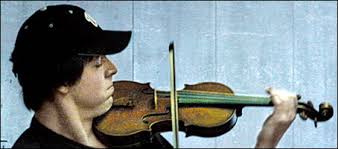
In this sermon, I attempt a method of interpretation which places one story beside another in order to reveal the sacred. The modern legend of Joshua Bell playing Bach in the subway told alongside the story of the baptism of Jesus provides epiphanies about the sacred in the other and begs questions about the way in which we tell our stories. This sermon was preached last year in the wake of tragic events in Paris. Listen to the sermon here
In April of 2007 an article appeared in the Washington Post, which earned its author, Gene Weingarten, a self-described “heathen” a Pulitzer Prize. The story went virile and over the years I have read and heard all sorts of sermons that include a version of the story loosely based on Weingarten’s article. For reasons, which I hope, will become clear, I’d like to quote Weingarten’s article without any of the usual embellishments.
“HE EMERGED FROM THE METRO AT THE L’ENFANT PLAZA STATION AND POSITIONED HIMSELF AGAINST A WALL BESIDE A TRASH BASKET. By most measures, he was nondescript: a youngish white man in jeans, a long-sleeved T-shirt and a Washington Nationals baseball cap. From a small case, he removed a violin. Placing the open case at his feet, he shrewdly threw in a few dollars and pocket change as seed money, swiveled it to face pedestrian traffic, and began to play. It was 7:51 a.m. on Friday, January 12, the middle of the morning rush hour. In the next 43 minutes, as the violinist performed six classical pieces, 1,097 people passed by. Almost all of them were on the way to work, which meant, for almost all of them, a government job. L’Enfant Plaza is at the nucleus of federal Washington, and these were mostly mid-level bureaucrats with those indeterminate, oddly fungible titles: policy analyst, project manager, budget officer, specialist, facilitator, consultant. Each passerby had a quick choice to make, one familiar to commuters in any urban area where the occasional street performer is part of the cityscape: Do you stop and listen? Do you hurry past with a blend of guilt and irritation, aware of your cupidity but annoyed by the unbidden demand on your time and your wallet? Do you throw in a buck, just to be polite? Does your decision change if he’s really bad? What if he’s really good? Do you have time for beauty? Shouldn’t you? What’s the moral mathematics of the moment?
On that Friday in January, those private questions would be answered in an unusually public way. No one knew it, but the fiddler standing against a bare wall outside the Metro in an indoor arcade at the top of the escalators was one of the finest classical musicians in the world, playing some of the most elegant music ever written on one of the most valuable violins ever made. His performance was arranged by The Washington Post as an experiment in context, perception and priorities — as well as an unblinking assessment of public taste: In a banal setting at an inconvenient time, would beauty transcend? The musician did not play popular tunes whose familiarity alone might have drawn interest. That was not the test. These were masterpieces that have endured for centuries on their brilliance alone, soaring music befitting the grandeur of cathedrals and concert halls. The acoustics proved surprisingly kind. Though the arcade is of utilitarian design, a buffer between the Metro escalator and the outdoors, it somehow caught the sound and bounced it back round and resonant.
The violin is an instrument that is said to be much like the human voice, and in this musician’s masterly hands, it sobbed and laughed and sang — ecstatic, sorrowful, importuning, adoring, flirtatious, castigating, playful, romancing, merry, triumphal, sumptuous.”
Some of you may recognize this article and those of you who do will know that the violinist was Joshua Bell. In the course of his article, Weingarten goes on to describe the complexity and the beauty of the 6 classical pieces that the virtuoso Bell played, which included masterpieces from Bach, Massenet, Schubert, Ponce, and Mendelssohn. What happened in the Washington Metro station is the stuff that legends are made of. If you read or hear this story from the 169,000 posts on the web, you will read a fairly consistent tale, which lends itself well to repetition and is the stuff great sermons are made of. However, in the retelling of this story, the details have been exaggerated in order to make a point.
There is a video of the events, which took place, so the facts can be checked. But when have we ever let facts get in the way of a good story; especially when we are trying to make a moral point. In the popular version of this story, the greatest violinist on the planet, played for 45 minutes and thousands and thousands of busy rush hour commuters passed by without paying any notice what so ever, except for one middle aged man, who slowed down and paused for just 6 seconds, later a women threw a dollar in Bell’s violin case. The one who paid the most attention was a 3 year-old boy. His mother dragged him along, but the kid stopped to look at the violinist. Finally the mother pushed hard and the child continued to walk turning his head al the time. This action was repeated by several children. All the parents, without exception, forced them to move on. In the 45 minutes that Bell played, only 6 people stopped and paid any attention, 20 tossed money as they hurried by. No One applauded and no one recognized Joshua bell.
These are the details of this popular myth. However, the Washington Post, Pulitzer Prize winning article and the videotape tell a more modest story. Exactly 1,097 people passed by, not thousands and thousands. Several people stopped and paid quite a bit of attention; one woman was heard to say that she really didn’t want to leave. As for the child, he managed to delay his mother for only 3 seconds, no other children appear on the video to take any notice and Joshua Bell was in fact recognized by a woman who couldn’t believe her good fortune and waited around until Bell’s magnificent performance was over to introduce herself to Bell before placing a twenty-dollar bill in his violin case. For his virtuoso performance Joshua Bell earned a grand total of $52.17 and a legend was born. Despite the exaggerated details in this legend, the essence of truth remains: One of the greatest violin players alive today, played some of the best music ever written, on one of the best violins in the world, and most of the people who where there that day never even noticed.
When I read the stories about the Baptism of Jesus, I get the impression that something similar has happened to this myth. The fantastic details as they are told by the gospel-story-teller known to us as Mark are pretty incredible. I don’t mean the characterization of John the Baptizer who is described as wearing camels’ hair and a leather belt around his waist, and who ate nothing but grasshoppers and wild honey. According to the gospel-story-teller we know as Mark, “Jesus came from Nazareth in Galilee and was baptized in the Jordan River by this wild-baptizer John. Immediately upon coming out of the, Jesus saw the heavens opening and the Spirit descending on him like a dove. Then a voice came from the heavens: “You are my Beloved, my Own. On you my favour rests.”Continue reading →
Wading into the waters of baptism is no simple matter for a progressive Christian. Once you leave the myth of perfection in some distant garden back there in the mists of time, reject the notion of humanity’s fall from grace as a result of original sin, and give up worshipping the sadistic image of a god who demands a blood sacrifice, it’s difficult to navigate the waters of baptism without spouting notions that the institutional church condemns as heresy. But today is the day when the church celebrates the baptism of Jesus and the stories about the baptism of Jesus that have been handed down to us by our ancestors suggest that on this day of all days, we should have the courage to follow Jesus into the river of life even if it does challenge some of our long held assumptions about what it means to be a child of God.
I venture into these troubled waters as someone who treasures the sacrament of baptism. Long before I ever entertained the idea that I might one day respond to the call to become a baptizer, I became a lover of this particular sacrament of the church. I am now, and I have always been one of those people who find it almost impossible not to shed a tear or two at baptisms. The beauty of all that hope and expectation all wrapped up in the guise of a tiny little human has a way of generating in me a watery contribution as my tears join the sprinkling to wet the babies head. When the baptized is an adult my tears flow even more bountifully. Let’s face it folks these days the reality is that infant baptisms are rare enough. Adult baptisms, especially in mainline churches are so rare that the nostalgia alone is enough to send us into spasms of uncontrollable weeping for seer joy at the thought that it is even remotely possible that someone has been able to see beyond the church’s doctrine long enough to embrace the amazing possibilities of the sacrament to provide any benefit in this the twenty-first century.
When we look back to the stories told in the synoptic gospels about the baptism of Jesus we are sometimes so distracted by the opening of the heavens, the descent of the dove and the voice of God declaring Jesus to be the beloved, that we miss an important detail of the way in which the early followers of the Way chose to tell the story of Jesus public coming out party. New Testament scholars remind us that the stories told by the writers of the gospels were written at the end of the first century; a time when it would have been clear to all those who had ears to hear, that by going down to the river Jordan to be baptized by John would have stirred up the political and religious waters. John the Baptist was a revolutionary who made no bones about the fact that the religious authorities and the political rulers were leading the people down the wrong path. John’s shouting in the wilderness was his way of warning the people to repent; to literally turn around and follow a different path. John was doing far more than ranting when he condemned the religious authorities as a brood of vipers; he was calling on the people to reject the teachings of the authorities. John’s insistence on repentance was a call to revolution, a revolution designed to overthrow the status quo. John was out there in the wilderness because it wasn’t safe for him to spout his own particular brand of incendiary fire and brimstone rhetoric within earshot of the authorities. By going down to the River Jordon and submitting to John’s baptism of repentance Jesus was choosing to identify himself with a political revolutionary.
That the writers of the gospels chose to tell there story in ways that see the God of Israel give Jesus a shout out, and the very spirit of God descending like a dove onto the shoulders of Jesus, turns John’s baptism of repentance into a kind of passing of the torch from one revolutionary to the next. Yet, despite the gospel-writers having cast Jesus into the role of revolutionary torchbearer none of the gospel writers shows Jesus following the ways of his predecessor John. There is no record of Jesus calling people to repent nor is there any record of Jesus ever having baptized anyone. All we have is Jesus “Great Commission” which if New Testament scholars are to be believed, Jesus probably never even said, “go therefore and baptize them in the name of the Father and of the Son and of the Holy Spirit.” Yes, it’s true, most preachers, dare I say modern-day baptizers, learned in seminary that rather than being an instruction given by Jesus the Great Commission was actually added to the story by the early followers of Jesus. But I digress, the point I’d like to emphasize about Jesus’ trip down to the waters of the Jordan, is that by choosing to publicly submit to John’s baptism, Jesus was making an important statement about his own public ministry. For just like John, Jesus intended to challenge the religious and political authorities.
That the gospel writers have Jesus head off into the wilderness to find his own way prepares us to follow Jesus down a completely different path than the one his predecessor John pointed toward.
So on a day, when the church looks back upon the baptism of Jesus, surely we can take courage from Jesus’ example of wandering off into the wilderness to find our own way of challenging the religious authorities of our day.Continue reading →
Each year, I begin my preparations for preaching on the Baptism of Jesus with this video in which Heather Murray Elkins tells her story, “The Secret of Our Baptism.” Elkins opens us to a new way of hearing the Bat Col, the Daughter of a Sound, the Voice of the Divine, the Word, who speaks in this Sunday’s Gospel reading. Luke 3:15-17, 21-22
The art of blessing is often neglected. The birth of a New Year calls forth the desire in us to bestow a blessing upon those we love. Several years ago, John O”Donohue, one of my favorite Irish poet’s created a New Year’s blessing for his mother entitled Beannacht-for Josie. It is a blessing of superior quality. And so, on this New Year’s Eve, may you all receive this beannacht with my added blessing for a peace-filled New Year in which the God in whom all of creation is held, might find full expression in your miraculous life!
This sermon owes much to the work of Richard Rohr whose work opens me to the LOVE who lies at the core of REALITY, the ONE we call God. The source of the story that I tell about a Christmas Eve way back when has been lost to me. I cannot remember when I first heard it. It’s power to open me to the LOVE that is God remains with me and so I treasure the story and tell it so as to open others. To open ourselves to the cosmic nature of the Christ we used different scripture readings. The readings can be foundhereDuring the sermon copious amounts of chocolate oranges were smashed open and distributed. You can listen to the sermonhere
Christmas Eve is a night when the phrase “way back when” is uttered by storytellers often. I remember way back when I was just a little girl, you know long, long, ago, way back when Christmas celebrations were so different. Way back when I was a child, we didn’t hang fancy, especially dedicated stockings on the chimney with care, in hopes that St. Nicholas soon would be there. No, way back when, people didn’t have the money to waste on special, fancy, Christmas stockings that were only used once a year. Way back when, we just went into our sock draw and pulled out the largest sock we could find and we’d hang it up, in the hope that if we’d been good we’d get some goodies instead of the dreaded lump of coal that our parents had been threatening us with for weeks. Come Christmas morning, way back when, we were happy when our sock was filled not with stocking-stuffers like we have these days, but with the same thing we got every Christmas in our stockings, an apple, an orange, a few toffee’s and a couple of coins. You see way back when, fruit was seasonal and fresh apples and oranges were a real treat. These days we can haul crates of tiny delectable oranges from the grocery store all year long. But way back when, oranges at Christmas were a real treat.
Now I never did like oranges very much, so I would always try to trade my orange with my brother so that I could have two apples instead. You see way back when children were easier to please and Christmas was different. Which leads me to another story. I don’t remember when or where I first heard this story about way back when World War II had just ended and refugees were loaded into camps until the world could figure out what to do with the millions of displaced people. Back then; refugee camps were filled to overflowing with children who’d lost their families during the war. Apparently there was this little boy in a camp in France; we’ll call him Andre. Andre couldn’t have been more than about seven years old and he could barely remember the family he lost almost three years before the war ended. He’d been living in the refugee camp, more of an orphanage really, for almost a year. A few nuns who never could scrap together enough money to feed the children properly ran the camp. But they did there best and the children were, after all was said and done, lucky to be alive. The children hardly noticed that Christmas was approaching until one of the nuns announced that a neighbour had promised to come by on Christmas Eve to drop off a sack of oranges. Andre had only a vague memory of an orange. The year before a stranger had shared an orange with him and he remembered the taste of the three tiny sections of his share of the orange that oozed precious juice down his half starved throat. Andre spent the days leading up to Christmas Eve dreaming of having a whole orange of his very own. He thought about the smell of the orange, dreamed of peeling the orange, and carefully considered whether or not to devour each and every section of the orange all at once or whether he should divided it and save a section or two for Christmas morning.Continue reading →
The quotes in this sermon are from Steven Pinker’s book “The Better Angels of Our Nature” and Joseph Holub’s “Fear Not” The Acclamation sung prior to the sermon is “The Magnificat” from Holden Evening Prayer, by Marty Haugen, featuring Gary Curran and Linda Condy: Listen to the sermon here
I usually have the presence of mind to book my vacation or some sort of continuing education event that takes me far away from the pulpit on Reign of Christ Sunday. Formerly known as “Christ the King Sunday” an attempt to move beyond exclusively male imagery for Christ (in whom there is no east nor west, male nor female) some church-folk have attempted to change the name of this festival to Reign of Christ Sunday. But merely changing the title fails to get beyond the struggles I have with this festival of the church year!!!!
Born in an age that was birthing fascist regimes, this particular festival of the church clings to it’s christian imperialist past. Instituted in 1925, by Pope Pius XI, (you can read the full proclamation here) the festival was designed to remind the world that Christ is the King of the World. The irony of proclaiming Christ as “King” when the life of Jesus of Nazareth positively denies “kingliness” seems lost on the church. The appropriateness of asserting Christ over the religions of the world lacks the kind of humility embodied by Jesus of Nazareth. So, this year I am not prepared to celebrate Christ the King or the Reign of Christ Sunday. Last year, we took a leaf out of Matthew Fox’s book and crafted our worship around the theme of the Quest for the Cosmic Christ.
Years ago, long before I ventured to seminary, Matthew Fox’s book Original Blessing opened me to the wonders of Creation Spirituality. So, I eagerly worked my way through his book The Coming of the Cosmic Christ. I confess that my first reading of Fox’s tome left me in the dust of my own lack of understanding of traditional Christology. But even back then, without the benefit of theological training, I sensed something of the MYSTERY that I had always trust Christ to BE. I have returned to Fox’s work many times over the years and over and over again I have discovered a WISDOM that moves me beyond the limitations of the historical Jesus toward a more holistic vision of Christ which like Fox I believe has the potential to move us to a more wholistic relationship with Creation. I trust that the WISDOM of the Cosmic Christ can lead us into the Season of Advent so that we can be about the work of birthing the Cosmic Christ. (you can check out last year’s sermon on the Cosmic Christ here) This year, we at Holy Cross will begin our quest for the Cosmic Christ by looking back to remember our treasured relationships with Jesus as we explore the relationship of Jesus, both our own personal Jesus and the historical Jesus, to our visions of the Cosmic Christ.
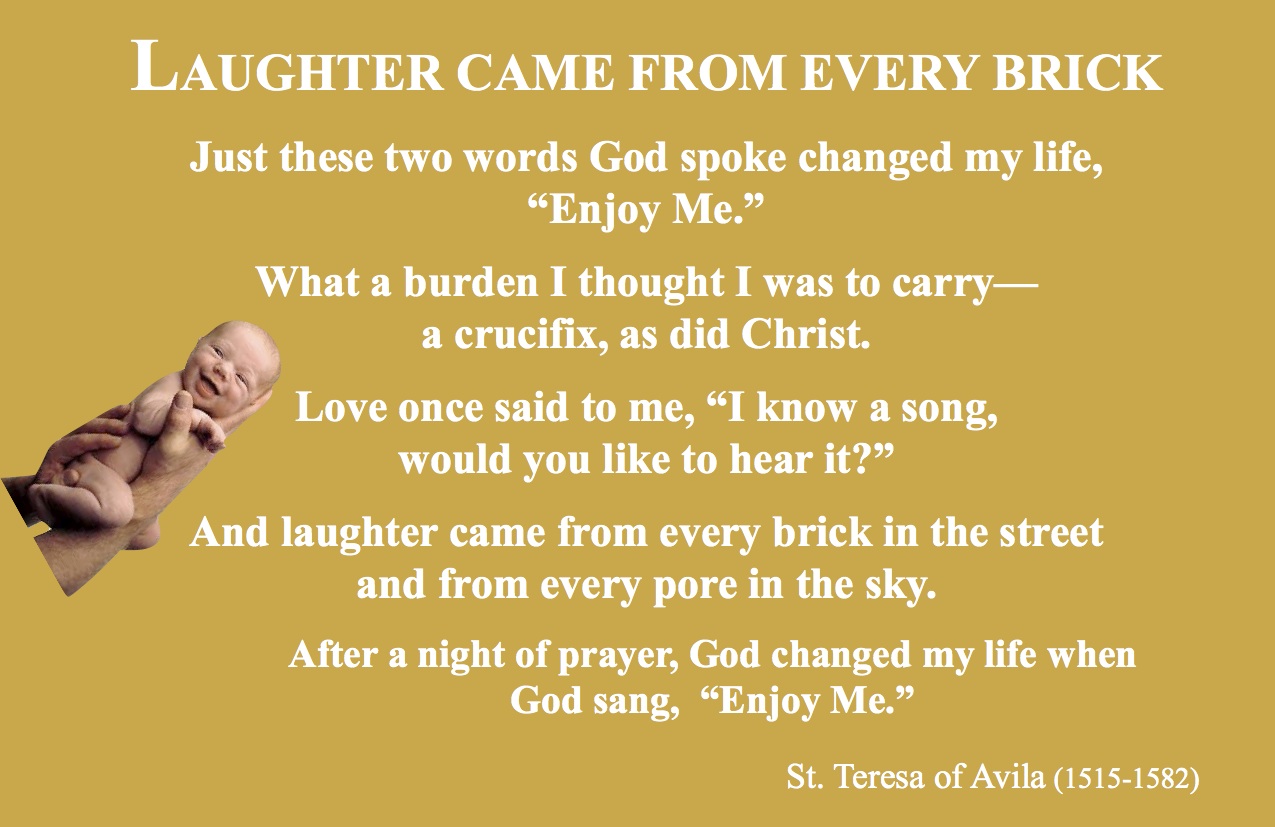
An excerpt from “Love Poems From God” by Daniel Ladinsky,
(Penguin Compass, London: 2002)
(1515-1582) “Teresa was born in Avila, a beautiful high mountain village of Spain. She was one of thirteen children, three girls and ten boys, in a wealthy family. The Spain in which Teresa grew up was permeated with 700 years of Arabian culture; the eradication of Arab power was followed by one of Spain’s darkest periods, the insanity of the Inquisitions, which, in the fourteenth century, along with other grievous deeds, forced mass conversions of Jews to Christianity.”
“Teresa was her father’s favourite child, and the most spirited. Her mother died during childbirth when Teresa was thirteen, after which she had little supervision. It is believed she had a lover at the age of fifteen, which caused her father to send her to a convent boarding school, only to see her return home two years later because of poor health. When she was twenty-one, Teresa ran away from home to join a convent. At that time many convents were more like hotels for women, allowing them a great deal more independence than they would be allowed at home, though after two years at the convent Teresa had a near-death experience that changed her life. A spiritual awakening began in which she cultivated a system of meditation that sought quieting the mind to such an extent that God could then be heard speaking. Over the next twenty years she experienced many mystical states but not until she was fifty did she begin the most far-reaching aspects of her life’s work.”Continue reading →
Then Jesus brought a little child into their midst and putting his arm around the child, said to the Twelve, “Whoever welcomes a child such as this for my sake welcomes me. And whoever welcomes me welcomes not me but the One who sent me.” Readings included Exodus 40:34-38, Mark 9:33-37














 pastordawn