Unknown's avatar

About Rev. Dawn Hutchings

Retired progressive Lutheran Pastor. Exploring the DIVINE MYSTERY that some call, "GOD," hoping to learn about the LOVE which is BEYOND the BEYOND and BEYOND that also.

Breasted ONE – reflections for Mothers’ Day – John 14:1-14

Readings: Julia Ward Howe’s Mother’s Day Proclamation; Revelations of Love, by Julian of Norwich Chapter 26; John 14:1-14

Listen to the sermon here

“I myselfam the Way—I Am Truth, and I am Life. NO one comes to Abba God but through me.” Over the course of two millennia, the ways in which these words have been interpreted by far too many people who insist that they are “Christian” is enough to make most mothers, be they Christian, Hindu, Buddhist, Muslim, Shikh, Jew, atheist, or agnostic. It seems to me, that to insist that it’s Jesus’ Way or the highway, as if Christians have the exclusive way of being in the world, violates the basic principles of the image we have of what it means to be a good mother.  Today, while we celebrate all the various stereotypes of what it means to be or to have a good mother, I don’t think any of you would hold point to the image of a mother who favoured one of her children to the exclusion of her other children. Yet somehow, the image of God as “Father” of us all, is messed up with the notion of a God who insists on a particular Way of being in the world, a way of being that believes particular things about who Jesus of Nazareth is, was, and ever more shall be; a way of being that insists that only those who believe particular things about Jesus will be welcomed into God’s household. The Good News is, that New Testament scholars have learned a great deal about this passage that contradicts the so-called “traditional interpretations” of this text. New Testament scholars begin by teaching us that these words attributed to Jesus, were in fact written some 70 plus years after Jesus’ crucifixion by an anonymous story-teller that we call John, who in all likelihood put these words into the mouth of Jesus in order to address a particular problem in the community to which this story is addressed.

But, more important than the realization that Jesus may never have actually said these words is the reality that taken out of context and proclaimed in ways that exclude some people at the expense of others, these words fail to express the very ideas of inclusion that the anonymous story-teller that we call John was trying to express to his community in the first place. For as the anonymous gospel storyteller that we call John insists:

“In God’s house there are many dwelling places; otherwise, how could I have told you that I was going to prepare a place for you? I am indeed going to prepare a place for you and then I will come back to take you with me, that where I am there you may be as well.

I suspect that part of the reason that some people are so willing to portray God as the kind of Father who would shut the door on the vast majority of human-beings, has something to do with the ways in which the reality that we call God has been imagined for far too long. So, on the day that we honour our mothers, let me remind us all, about the ways in which our tradition has failed to imagine the Source of our Being in ways expand our vision of the LOVE that is God.

In the beginning, that’s right. Genesis chapter one, verse one.
In the beginning God;
that’s God with a capital “G” in English.
But in Hebrewit’s just “el” no capital yet.
Just “el” the generic Semitic wordfor a god.
In the beginning “el” created the heavens and the earth.
Now the earth was a formless void.
Void,“tohu w’ bohu” in  Hebrew a squishy, damp cavern; reminiscent of a womb.
The earth was a formless void, there was darkness over the deep.
Tehom  dark waters.
And ‘el’s” spirit hovered over the water.
Spirit,rauach, the feminine for breath.
El’s feminine breath hovered over the tohu w bohu.
When suddenly, god speaks and there is light and the waters divide or are broken, depending on how you translate it, and all sorts of life comes teaming forth.
Five days of labour; labour get it!
Five days of labour and finally ‘el’ is ready:
“Let us make adam”
“adam” which literally means earth creature.
And so el takes some ha adama which is literally earth;    dirt.
The pun is lost in our English translations but its actually funny in Hebrew.
El takes a chunk of earth and creates the earth creature in the in the very image of the divine.
Inthe image of God, God created them.
That’s right them, that’s what it actually says in the Hebrew text of Genesis:
In the image of God, God created them, male and female God created them.
And then God blessed them.
God blessed them male and female.
Male and female made in the very image of the Creator.
Could this mean that in the eyes of our ancestors in faith, the Creator is beyond gender?
But remember, there’s another creation story in chapter two of Genesis.
This one says that the“Lord God” made the earth and the heavens.
This creation story says that the “Lord God”formed “man” out of the dust of the earth.
The “Lord God,” everyone knows that lords are men, so the Lord God is clearly male.
Maybe.
But then again Lord God is only an English translation of the Hebrewword, “elohim”.
You’ll never guess what “elohim” literally means in Hebrew.
It’s the plural form of the feminine noun for majesty.
Sound male to you.
Well it was male enough for the male translators who worked for King James.
But read just a little further to chapter 17 of Genesis.
When the Lord, that’s Elohim when Elohim first enters into a covenant with Abraham.
“When Abram was ninety-nine years old, the Lord appeared to Abram and said to him,
“I am God Almighty; walk before me and be blameless.
And I will make my covenant between me and you, and will make you exceedingly numerous.”
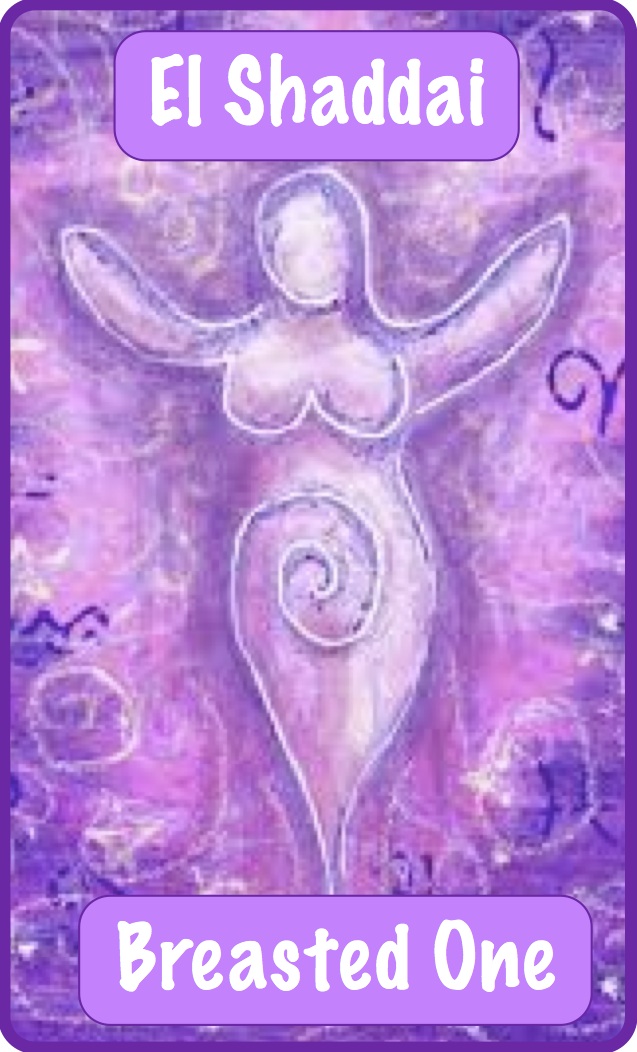
God Almighty, from the Hebrew, El Shaddai.
El Shaddai, finally we have a name for this God, this el.
Shaddai, the feminine plural for breast.
El Shaddailiterally translated means God with breasts, or Breasted God.
Good thing those translators chose to translate that one as God Almighty,
because you wouldn’t want people to think that God has breasts.
Those translators sure had their work cut out for them.
Over and over again in the Old Testament the Hebrew uses the word“rechem” to describe god’s love.
Now God’s love is a very important concept.
Remember later in the New Testament God is defined by love.
“God is love.”
Well in the Old Testament, God’s love is prefaced by the word “rechem” and those clever translators, had to fix that one cause rechem is the Hebrew word for womb.
You can’t have God Almighty having breasts and you sure can’t have God’s love describedas “womb love” so what did those guys do?
So, the next time you read the words mercy or compassion in the Old Testament remember, chances are it’s really “rechem”.
I suspect that, womb love became merciful, because the only other way to describe womb love is“motherly love” and we can’t have that, now can we?
Elohim,majesty.
El Shaddai breasted one.
Rechem “ womb love” motherly love.
And I haven’t even gotten to the really interesting parts, so I don’t really have time to tell you that God’s Spirit, well you probably already guessed or remembered that,
The Holy Spirit in Hebrew was rauach, a feminine noun for breath, breath, wind
 and even in Greek pneumani is a feminine nounfor breath, wind or spirit, but by the time the church gets around to translating the Bible into Latin, and before you know it the Holy Spirit becomes a he.
But I don’t have time to go into that, so let’s fast forward to the book of Proverbs.
And there you have the stories of God’s wisdom.
Chokma in Hebrew, a feminine name.
Sophiain Greek, also a feminine name that in our English translations becomes the noun “wisdom”.
But I digress, because everybody knows we believe in God the Father the Almighty, Jesus Christ the only Son of God and the Holy Spirit, the Lord the giver of life who proceeds from the Father and the Son.
Now don’t get excited, I’m not about to commit heresy, not yet anyway.
The expression of the Trinity as three male persons is not in and of itself wrong.
Men are indeed created in the image of God and maleness can and indeed shouldbe used as a symbol for God.
However, the tenaciously exclusive use of male symbols or images for God has reached the point of idolatry.
God is not male.
God is not female.
God is beyond gender.
All our feeble attempts to describe God with language fail to express the immense wonder of our God.
To date, I still think the Hindus have the best way of expressing the very nature of our God.
In Hindu literature we find goddescribed as:  “beyond the beyond, and beyond that also.”
We simply have no words.
So, our attempts to capture God in words fail.
Our images of God are incomplete like peering through a glass darkly.
No wonder our ancient ancestors portrayed  God as the one who forbids us to worship idols.
We cannot create an image of God and worship that image and expect to have a relationship with more than a pale reflection of our God.
In the bookof Proverbs: Chokma, Sophia, Wisdom is personified. She becomes an expression of God’s Wisdom. The writer of Proverbs urges us to:
“Acquire Sophia, acquire perception, never forget her, never deviate from my words.
Do not desert her, she will keep you safe, love her, she will watch over you.”
In the creation story from the Book of Proverbs, Sophia calls aloud in the streets, she raises her voice in the public squares; she calls out in the street corners, she delivers her message at the city gates, “You ignorant people, how much longer will you cling to your ignorance?
How much longer will mockers revel in their mocking and fools hold knowledge contemptible? Pay attention to my warning:  now I will pour out my heart to you, and tell you what I have to say.”
“From everlasting I was firmly set, from the beginning, before earth came into being.
The deep was not, when I was born, there were no springs to gush with water.
Before the mountains were settled, before the hills, I came to birth; before God made the Earth, the countryside, or the first grains of the worlds dust.
When God fixed the heavens firm, I was there, when God drew a ring on the surface of the deep, when God thickened the clouds above, when God assigned the sea its boundaries—and the waters will not invade the shore—when God laid down the foundations of the earth,
I was by God’s side, a master worker; and I was daily God’s delight, rejoicing before God always, rejoicing in God’s inhabited world and delighting in the human race.
Happy the one who listens to me,”
The ancient Hebrews had a symbol for Chokma, she was often portrayed as a dove. Sophia God’s wisdom and the rauach , the spirit of God are intimately connected in the ancient stories that try to make sense of who God is.

Throughoutthe scriptures God is portrayed as a strong mother, labouring to give birth, determined to protect her young. Suckling and nurturing the children of God at her breasts. These feminine images of God can all be found in the Bible. But still these feminine images disturbed the powers that be. So much so that scholars now believe that the evidence of the motherly attributes of God were indeed suppressed by the religious authorities. So, much so that by  the turn of the first century when the author of the Gospel of John sat down to write his account of creation,  God’s wisdom, Sophia who had a reputation for playfulness had to take on a more reasonable tone. And so wisdom became reason, the Greek word for reason is logos. Sophia becomes logos, logos has two meanings in Greek, it can mean either reason or word.

In the beginning was the reason, and the reason was with God, and the reason was God.

Reason, Wisdom, no matter how you express it, when the Word becomes flesh and lives among us it is still Jesus you’re talking about.

The links between Jesus and Sophia are many. That’s a whole other sermon. Suffice it to say that our idolatrous preoccupation with the image of that bearded old man in the sky fails to take the Bible seriously.

The church has deprived the people of God of the tender images of our God. So much so that sometimes I feel like a motherless child. We have grown up in the faith as motherless people living in a single parent universe headed by God our Father.

Psychologists warn us that in children the “loss of a mother is experienced as a loss of safety, security, nurture, comfort and joy. A child without a mother often fails to know itself as valued, or precious and often feels unworthy of love. How might our lives have been different if deep within us, we carried an image of El Shaddai, the Breasted One, Mother of Us All, and when things were bad we could nestle in her tender embrace? Men and women could both turn to El Shaddai and I suspect that the church would be a different place. The Vatican would certainly be different. Just imagine women and men created in the image of God, walking the halls of the Vatican; or what about women and men created in the image of God with an understanding of their own equality haunting the hallways of fundamentalist institutions.

Wisdom/Sophia is calling; calling us beyond the boundaries of our language and beyond the images we have created. Remember the words of the anonymous storyteller that we call John attributed to Jesus: “In God’s house there are many dwelling places; otherwise, how could I have told you that I was going to prepare a place for you?” Now, try to imagine what the welcoming of El Shaddai might look like as the Breasted One welcomes all her children into the household of God who is LOVE. Imagine, if you will, Jesus the Christ, God’s Sophia, describing herself as the Way, the Truth, and the Life, how might we emulate the Way of Christ, the truth of Christ, and the Life of Christ in any other way, than the way in which the anonymous story-teller that we call John portrayed Jesus, as the ONE in whom God was made visible, in the way that he lived and moved about the earth, tending to the needs of everyone he encountered, with compassion, ah there’s that word again, compassion, womb-like LOVE.

Let the Ruach of the Breasted ONE be who she will be, the Mother of us all, the ONE who is now and ever more shall be womb-like LOVE.

Mothers’ Day Angst – sermons for a day not included in the liturgical calendar!

True Mother Julian of NorwichMothers’ Day is not on the church’s liturgical calendar and yet the statisticians tell us that church attendance on Mothers’ Day is surpassed only by Christmas and Easter. Worship leaders who fail to mark the importance of this day do so at their peril; the same kind of peril that compels so many reluctant offspring to accompany their mothers to church. However, a simple liturgical nod in the direction of mothers or an over-the-top sentimental sermon all too often fails to capture the magnitude of the day’s significance in the history of women.  Planning the liturgy is challenging enough, but writing the sermon is a challenge which promises to keep me toiling away into the dark hours of this coming Saturday. So, for my colleagues who share a similar plight: below you will find links to previous attempts to commemorate this day of days. Feel free to share your efforts with me in the comments section. Please! I need all the help you can offer!!! click on the links below for previous Mothers’ Day sermons:

Sophia/Wisdom

MOTHERS’ DAY – Peace is the Way

Preaching on Mothers’ Day – Don’t Compromise

Another Option for Mothers’ Day: Bring Many Names

SHE Who Dwells Among Us – A Mothers’ Day Sermon

Arise on this Mothers’ Day: a sermon

ONE in GOD – a sermon


National Indigenous Anglican Bishop Mark MacDonald will speak at Holy Cross in Newmarket this Friday and Saturday

Image

LOVE Has Died. LOVE Is Risen. LOVE Will Come Again, and Again, and Again! – Pluralism Sunday

to listen to the audio only recording of the sermon here

A little girl held tightly to her grandfather’s hand as together they walked toward the centre of town.  Suddenly a tall, beautiful, woman dressed from head to toe in a long black flowing gown appeared in the street just ahead of them. The woman’s flowing gown gave the impression that she was floating rather than walking. Beneath the black flowing cloth which covered the woman’s head, was an elegant face encased by restricting starched white material. Below the smiling woman’s face, hung a slender silver cross. The little girl tugged on her grandfather’s sleeve and asked, “Who is that, Grand-dad?”  The little girl’s grandfather explained, “That my dear is a witch! Now mind you behave yourself or she will take you away and boil you in her stew pot”.  The little girl squeezed her grandfather’s hand tightly and resolved to stay far away from witches no matter how beautiful they looked.

I couldn’t have been more than about four years old when my grandfather and I encountered that Roman Catholic nun on the road in Belfast, Northern Ireland. I can’t tell you how many times as a child in Belfast, I was warned to behave myself or the nuns would come and take me away. Later I would learn that the threat of nuns was often used by protestant families to keep children in line.

For generations, Catholics and Protestants in Northern Ireland have spent most of their fighting with their neighbours about how to love God that they’ve barely had time to love God and they’ve never really learned how to love their neighbours. When I was growing up, I was taught that there are good religions and there are bad religions. It wasn’t very complicated; our religion was a good religion and everyone else’s religion was a bad religion. My parents left Northern Ireland to avoid the warring madness between Protestants and Roman Catholics euphemistically known as the “Troubles.” I know all too well the mess we humans can get into when we forget that there is more than one way to live and move and have your being in the MYSTERY that we call God.

For just over ten years now, congregations that identify themselves as “progressive” have been celebrating Pluralism Sunday. Pluralism Sunday was conceived as an opportunity for churches to celebrate religious diversity and affirm that there are so very many pathways into the MYSTERY that we call God. I must confess that nun/witch that I encountered in Belfast all those years ago has haunted my preparations for this Pluralism Sunday. Life seemed so much simpler back then. Continue reading

Stretching Metaphors Beyond their Ability to Carry Us – a sermon for Easter 5B – John 15:1-8 and 1 John 4:7-21

to listen to the audio only click here

There’s a preacher whose work I admire. His name is Salvatore Sapienza. Sal comes from New York city; Sal would say it differently – “New York.” Speaking with his New York drawl, Sal expresses the vine metaphor in a unique way. Sal says, “Jesus said, youz are the branches and I am da-vine.” Sal goes on to say that, the word divine is ‘of the vine”. Divine is another word for the MYSTERY we call God.  Of the vine, vine from the Latin for wine – wine the fruit of the vine.

Wine is something that is intimately intertwined with the stories of Jesus life. According to the anonymous-gospel-storyteller that we call John, Jesus’ very first miracle was turning water into wine. In the story Jesus takes something ordinary and transforms it into something extraordinary. Most of us are very familiar with wine’s ability to transform us. The ancient Romans had a saying, “in vinio vertais” in wine there is truth. From the other anonymous-gospel-story-tellers we also have the story of Jesus last meal, during which Jesus takes wine, gives thanks and shares the wine with his friends saying, “drink this all of you, this wine is my blood…to remember me” When we remember that meal it is as if the wine we drink together is the promise that Jesus’ life force, the life that flowed through Jesus, flows through us in the sharing of the wine. In Jesus’ we see the energy, the flow of the life force that emanates from the MYSTERY, from the LOVE, that we call God. In the sharing of the wine, we too are in the flow, we too are connected to the flow that is the Divine.

The anonymous-gospel-story-teller that we call John creates for us a metaphor drawn from the life experience of his people.We are the branches, intimately intertwined with one another, we are all connected to one another, and what flows through the Divine, flows through us. In his teachings and with his life, Jesus said, God is in me, and I am in you, we are all in each other, we are all ONE. Youz are the branches, I am Da-vine. Such a beautiful metaphor; metaphor something that carries us beyond the words to a reality that is beyond words. The storyteller uses the metaphor of the vine to carry us beyond the image of the vine to the reality that is beyond words, the reality that we call Divine and the fruit of the vine flows through us to be the DIVINE in the world or as we say here “to be LOVE in the world”.

“Those who live in me and I in them will bear abundant fruit, for apart from me you can do nothing.” Wait, what?   “Those who don’t live in me are like withered, rejected branches, to be picked up and thrown on the fire and burned.”

That’s the thing with metaphors. Metaphors can carry us beyond the words and images to a reality that is beyond words and images. Metaphors can also entrap us because we are prone to stretching metaphors beyond their ability to carry us. Metaphors often fail when they are delivered to folks who do not share the experiences of the creators of those metaphors. Vino veritas works, because we share the experience of seeing truth revealed when the wine is flowing. But when the anonymous-gospel-storyteller stretches his metaphor to say, “If you live on in me, and my words live on in you, ask whatever you want and it will be done for you.” the metaphor begins to fail, because not all of us share the experiences of asking and receiving whatever we want. And thus, the storyteller’s conclusion, “My Abba will be glorified if you bear much fruit and thus prove to be my disciples” fails  to convince us.

Today’s first reading from the first letter of John often fails to convince us for a different reason. Scholars believe that the First Letter of John and the Gospel of John were written by the same anonymous-storyteller, we don’t know his name, but the church has traditionally called this anonymous-storyteller John. Scholars tell us that both the gospel of John and the First Letter of John were written sometime between 90-110, some 60 to 80 years after Jesus of Nazareth walked the earth. Scholars do not believe that this story-teller was an eyewitness to the life and teachings of Jesus, but rather that he experienced the life and teachings of Jesus through the stories that were handed down through the community in which he lived; a community that was suffering under the persecution of the Roman Empire as well as the persecution of their neighbours because they had chosen to follow the teachings of Jesus. In the midst of a very violent, dangerous existence our story-teller writes a letter to his community in which he insists: “Beloved, let us love one another because love is of God; everyone who loves is begotten of God and has knowledge of God. Those who do not love have known nothing of God, for God is Love.”

If only he had stopped there. But he continues, “God’s love was revealed in our midst in this way: “by sending the Only Begotten into the world, that we might have faith through the Anointed One. Love, then, consists in this: not that we have loved God, but that God has loved us and has sent the Only Begotten to be an offering for our sins.”

The life and teachings of Jesus and the death of Jesus are all about love; the love that Jesus had for his neighbours and the love that Jesus had for his enemies. Jesus lived a life that embodied neighbour love and extended the definition of neighbour to include those on the margins. Jesus critiqued his own culture and the culture of his people’s oppressors based on the love of neighbour. When the religious authorities and the forces of Empire teamed up to persecute Jesus and his neighbours, Jesus refused to take up arms against his enemies choosing instead to insist that only by loving our enemies can we hope to find peace.  Jesus proclaimed that peace could only be achieved through justice; justice based on love of neighbours and love of enemies.

Violence is a violation of love and will never lead to peace. Jesus chose to embody love precisely because he understood God as love. Jesus’ embodiment of LOVE was so powerful, that in Jesus, people were able to see and experience God. The Jesus experience was so powerful, so life-changing that not even the death of Jesus could kill the experience of LOVE that his followers encountered in the life of Jesus.

Writing some 60 to 80 years after the brutal Roman execution of Jesus, the Jesus experience continued to speak powerfully to the followers of Jesus who continued to share that experience with others.  That they chose to tell the story of Jesus life and death in ways that would have resonated with the people of their time should come as no surprise to us. Sacrifice, booth animal and human were part and parcel of the religious traditions of the Hellenistic world in which the followers of Jesus lived.  That the followers of Jesus tried to make sense out of Jesus execution as a common criminal, in terms of cultic sacrifice is not surprising. That all these centuries later we continue to try to make sense out of Jesus execution as a common criminal, in terms of cultic sacrifice is astounding.  That we all too often focus on cultic sacrifice at the expense of love, is in and of itself criminal.

Every day we are learning so much about what it means to be human, about the expansive cosmos in which we live, and about the very nature of reality. We are uniquely placed to explore what lies beyond the comprehension of those who have gone before us in faith. The dimensions and the power of love deserve more than the speculations of our past or the sentimental, self-serving notions of our present age.

LOVE, the LOVE that is God, deserves our attention in the here and now. Beloved, let us love one another because love is of God. If we have any hope of learning to love our neighbours and our enemies we will need to understand more fully the magnitude of the LOVE that is God so that we might begin to truly embody that LOVE. This will require that we step up and pay attention to how we arrived at a place where love can be wrapped up in guilt and confused with human sacrifice, so that we can shake off our childish notions and grow into all that we are created to be.

LOVE Beyond measure. Beyond words, beyond race, beyond religion, beyond tribe, beyond fear, beyond time, beyond sentimentality, beyond borders, beyond reason, beyond emotion, beyond imagining. Love, beyond the beyond and beyond that also. So, let the metaphor carry us beyond the words and images, let it carry us to the reality that is the LOVE that we call the Divine.

Jesus said, youz are the branches and I am da-vine.” Let us be of the vine, for we are intertwined one with another, all wound up in da-vine, for we are ONE with the DIVINE. Let the fruit of the vine flow through us so that we can be the DIVINE in the world or as we say here and now, “to be LOVE in the world”.

LOVE Beyond measure.

Beyond words, beyond race, beyond religion,

beyond tribe, beyond fear, beyond time,

beyond sentimentality, beyond borders, beyond reason,

beyond emotion, beyond imagining.

Love, beyond the beyond and beyond that also. LOVE.

God the DIVINE who is,

LOVER, BELOVED, and LOVE itself.

May that LOVE flow through us. Amen.

It’s about LOVE not creeds!- a sermon for Easter 5B – 1 John 4:7-21

st anne's

This sermon was preached in 2015 upon my return from Belfast. I went off script for this one. So, the manuscript does not adequately reflect what was actually preached. But you can read the notes here  The audio is much better!!! I went off on a tangent using Robin Meyers’ observation that our historical creeds reduce Jesus life to a comma!

I post this on the morning of my return from another trip to Belfast, where I once again worshipped in St. Anne’s Cathedral. This time I managed to stay to the end of the service. My wife’s moderating presence may have something to do with this???

Listen to the sermon here

Even Eunuchs and Foreigners are Welcome! – Easter 5B – Acts 8:26-40

Ethiopian EunuchWhat follows is a sermon I preached on the 5th Sunday of Easter 2003. In the 18 years since I preached this sermon, the Evangelical Lutheran Church in Canada has come a long way. The debate about the full inclusion of LGBTQ folk in the full life of the church has been resolved and we can truly say: “All are welcome!” But rule changes don’t always change practices. Sadly, there are still places in our church were not everyone is welcome.  So, I offer this sermon to cybersapce as both a reminder of where we have been and how far we need to travel. Shalom. 

Sunday May 18th 2003   Holy Cross Lutheran

Even Eunuchs and Foreigners are Welcome!  Acts 8:26-40

Earlier this week, I was talking with a few of my colleagues and as Lutheran Pastors are wont to do, our conversation drifted toward the lessons prescribed for this Sunday.  As we kicked around ideas, most of us agreed that it is difficult to preach on familiar passages.           

Most of you have heard a great many sermons on today’s gospel lesson, and so the challenge for preachers to bring some new insights is made all the more difficult.  So, we joked about just how many ways a preacher can twist and turn those vines until they finally snap off, dry up and rot.

Today’s epistle lesson isn’t much easier.  Preachers are always preaching about love; often we’re preaching to the choir, because most of you already know that God is LOVE and that in loving we encounter God.  Coming up with a new and interesting angle on the second lesson isn’t easy.  So, I suggested to my colleagues that this Sunday rather than preaching one more time about love, why not preach on the first lesson. Why not preach on the story of the Apostle Philip’s encounter with the Ethiopian on the road to Gaza? Well it might surprise you to know that no matter how challenging they thought it would be to come up with one more sermon about love, not one of my colleagues thought that it would be a good idea to preach about the goings on in the desert between Philip and that Ethiopian. One of my colleagues even went so far as to say that you would have to be either very brave or very foolish to even try it.

Now I have a confession to make, at the time I had no idea what it was in this particular passage that would make my colleagues so averse to preaching on it. I have to admit that I don’t really remember ever paying all that much attention to this particular story. I have certainly never before studied it in any great detail, but my colleagues’ aversion to this text, made me curious enough to hit the books just as soon as I got home. Despite the fact that this text shows up every three years in our lectionary, try as I might, I wasn’t able to find a reference to a single published sermon on this particular text. It seems that many of the great preachers left this one alone.

It didn’t take me long to figure out just why this text is so daunting and why my colleagues are not alone in giving it such a wide berth. Now I don’t claim to be particularly brave, but I’ve already preached on today’s other readings. Besides it’s a long weekend and I figured that a lot of people would be away and I could sneak this one in. So this fool is about to rush in, where many have feared to tread.

Our story begins when an angel directs the apostle Philip to go south on the road from Jerusalem to Gaza. On this road in the desert Philip meets an Ethiopian eunuch. Now I don’t know about you, but this strikes me as a really odd way to introduce someone; no name, just an Ethiopian eunuch. The author must have thought it was important because he tells us not once but five times that the Ethiopian was a eunuch. I know what an Ethiopian is.  Philip has encountered a black African man in the desert. Now that in and of it’s self is pretty remarkable. You will see later that this black man was the first missionary to Africa. But surely this can’t be the reason why so many preachers shy away from this text. So what exactly is a eunuch? According to the most current scholarship, in the first century a eunuch is one of two things. A eunuch could have been a man who had been castrated.  Now for those of you who didn’t grow up on a farm to castrate means to remove a male’s testicles. So, this particular Ethiopian could have been a castrated male, or he could have been a male who wasn’t like most males. According to the scholars, men who showed a preference for other men or displayed little or no interest in women, or who were in anyway effeminate, in the first century these men were called eunuchs. Continue reading

The Sheepskin Baggage We Bring to the Text: sermon for Easter 4B – John 10

Traditionally the fourth Sunday in Easter is celebrated as Good Shepherd Sunday so it should not surprise us that a pesky lamb shows up. Readings:  Psalm 23, 1 John 3:16-24, John 10:11-18

Listen to the sermon here

I am currently enjoying a continuing education leave in Belfast, Northern Ireland and so, it seems only right that I should begin by telling an Irish story. This particular story comes from the Irish author Frank McCourt. Some of you will be familiar with his most famous book, Angela’s Ashes. But this story comes from his autobiographical book entitled “Tis” McCourt was a school teacher and he tells this story about a particular class in which he was challenging the assumptions of his young students.

The story begins with a familiar nursery rhyme: “Humpty Dumpty sat on the wall, Humpty Dumpty had a great fall; All the king’s horses And all the king’s men Couldn’t put Humpty together again.

McCourt asks his young students to tell him what’s going on in this nursery rhymed. The hands are up like a shot. “Well, like, this egg falls off the wall and if you study biology or physics you know you can never put an egg back together again. I mean, like, it’s common sense.

McCourt asks: “Who says it’s an egg?”

“Of course, it’s an egg. Everyone knows that.

Where does it say it’s an egg?

They’re thinking. They’re searching the text for egg, any mention, any hint of egg. They won’t give in. There are more hands and indignant assertions of egg. All their lives they knew this rhyme and there was never a doubt that Humpty Dumpty was an egg. They’re comfortable with the idea of egg and why do teachers have to come along and destroy everything with all this analysis.

“I’m not destroying,” insists McCourt, “I just want to know where you got the idea that Humpty Dumpty is an egg?”

“Because,” Mr. McCourt, “it’s in all the pictures and whoever drew the first picture musta known the guy who wrote the poem or he’d never have made it an egg.”

“All right.” Says McCourt: “If you’re content with the idea of egg we’ll let it be, but I know the future lawyers in this class with never accept egg where there is no evidence of egg.”

The story of Humpty Dumpty and the missing egg has a great deal in common with the story of Jesus and the missing sacrifice for sin. When it comes to the written word, we tend to see what we’ve been conditioned to see. Today’s gospel text is a good example of our seeing and reading into the text things that are not there. The gospel of John was written at the end of the first century; at least one possibly two generations after the life, death, and resurrection of Jesus. We know that the gospel of John is not what we 21stcentury dwellers would call history. We know the story-teller that we call John wrote his interpretations of the Jesus experience to address the needs of his community who were struggling under the oppressive rule of the Roman Empire. We know that the gospel storyteller that we call John relied heavily upon the stories, myths and history of the Hebrews to convey the magnitude of the impact Jesus life, death, and resurrection had on the small band of followers of Jesus, who were struggling to survive in very troubled times. Continue reading

What’s a Meta FOR? – a sermon for Easter 4B – John 10:11-18 and Psalm 23

John chapter 10 causes me to remember Mrs Tanner, my grade ten english teacher. I can still see her handwriting all over my carefully crafted compositions. Red ink everywhere as she constantly admonished me not to mix my metaphors. Clearly the writer of the Gospel of John never had the benefit of Mrs. Tanner’s guidance, or he would not have dared to record Jesus words the way he does in his long and rambling I AM passages.

Before we even get to chapter 10, we read that Jesus says:  “I AM the bread of life.”  and “I AM the light of the world.”  In chapter 10, we read, Jesus says, “I AM the gate,” “I AM the Good Shepherd.” Later we will read, that Jesus says, “I AM the Resurrection”, “I AM life.” “I AM the true vine.”  “I AM the way.” “I AM in God.” “I AM in you.”

But in the tenth chapter the writer of the Gospel of John goes all out and has Jesus using not just a metaphor but a mixed metaphor. For in chapter 10, we read that Jesus declared: “I AM the Gate. The gate through which the sheep must pass.” and then mixes it up by saying,  “I AM the Good Shepherd.”

Which is it? Gate or Shepherd, come on, I know your Jesus but I’m trying to understand how Jesus, who is after all, the lamb of God who takes away the sin of the world is both the Gate and the Shepherd.

I wonder if Mrs. Tanner ever took her red pen to the Gospel According to John? If she did, the letters MMX would have appeared all over this Gospel. MMX = mixed metaphor wrong! Looking back, I know that Mrs Tanner was just trying to help us to be more careful about our ideas. But today I would have to ask both Mrs Tanner and the anonymous-gospel-storyteller that we call John, “What’s a meta for?” Continue reading

Christ Appeared on the Road to Emmaus and I Almost Didn’t Recognize Her – a sermon for Easter 3B – Luke 24:36b-48

emergencyMy most memorable journey on the road to Emmaus was taken behind the wheel of a 1981 Oldsmobile, Cutlass, Brougham. I loved that car. It was a thing of beauty. It was a gift from my home congregation so that I could travel back and forth across the country to and from seminary. Despite its propensity to guzzle gas it was the perfect combination of power and elegance. It had the most amazingly plush interior with every imaginable power amenity of its day. It handled like a dream and even though I loved driving that car, neither it nor I faired well on our journey on the road to Emmaus. Five weeks into my Clinical training at the Grand River Hospital and I’d just completed one of the toughest weeks of my life when I set off for Emmaus. Clinical Pastoral Education is what the Church calls it but seminary students have other names for it, like boot camp, torture or hell. Twelve weeks of on the job training in a busy hospital combined with daily psychotherapy, group sessions, and sleep deprivation. It’s all designed to help seminarians put two years of academic study into practice before sending them off on a yearlong internship. Ask most pastors about their Clinical Pastoral Education and they’re likely to sit you down and tell you story after story about how intense an experience it was. Many of my colleagues will tell you that it almost broke them into little pieces, or that it almost destroyed their faith, or that they didn’t think they’d survive, or how they never thought that it was possible to be that scared or insecure for that many hours every day. Boot camp, torture, or hell, it all depended on whether or not you were able to get any sleep or if the demons you faced on the wards managed to destroy whatever self-confidence you might be able to muster.

The week before I set off on the road to Emmaus, wasn’t as bad as all that. I felt like I was just beginning to get the hang of things. I thought that the worst might be over. I’d managed to conquer my fear of being called Chaplain and being expected to help people who were sick, in pain, in distress, or dying. Why that week I’d even managed to help one or two of my patients. Those nagging doubts that haunted me during the first month of Clinical training were beginning to fade. It was becoming easier to believe that God was there in the midst of all the turmoil. I thought that maybe just maybe I could do the job and the terror wasn’t quite so intense when my pager went off. I remember saying to a colleague that maybe we’d be able to get through our Clinical training without coming up against the inevitable crisis of the faith that so many of our fellow students had warned us about. I wasn’t even nervous about having pulled the short straw for the long-weekend shift. 72 hours as the on-call emergency chaplain for the entire hospital. I felt like I was ready; that with God’s help, I could face anything that came my way.

I wasn’t particularly nervous when my pager went off and I calmly dialed the operator who announced that there’d been an MVA and six patients were on route; two of them were vital signs absent. MVA – Multiple vehicle accident. Vital signs absent = that usually means dead, but only a doctor can actually pronounce death so patients without vital signs are transported to the hospital before being pronounced dead. Continue reading

Emmaus is Nowhere because Emmaus is Everywhere: a sermon on Luke 24 – Easter 3B

Road to EmmausThis sermon was inspired on my own journey to Emmaus where in the space of the same afternoon I heard a stranger declare: “Christianity is dead!” and Karen Armstrong’s now famous TED talk about her call for a world Charter for Compassion.

Has anybody here ever been to Emmaus? Which one? According to the latest issue of Biblical Archeology there are at least nine possible locations that are candidates for the Biblical town of Emmaus. Historians tell us that there is no record of any village called Emmaus in any other ancient source. We simply don’t know where Emmaus might have been. Tradition, tells us that it might have been a place just a few hours walk from Jerusalem. New Testament scholars, Marcus Borg and John Dominic Crossan suggest that Emmaus is nowhere. Emmaus is nowhere precisely because Emmaus is everywhere. Each and every one of us has at one time, or indeed for some of us, many times, traveled along the road to Emmaus.

I know that I have been on the road to Emmaus most of my life. I’ve had lots of company on the Road to Emmaus. I’ve had many conversations along the way discussing, with anyone who’d care to accompany me, the ifs, ands, and buts of Christianity, of religion, and indeed of life. If you haven’t traveled down the road to Emmaus you must be very skilled in the fine art of turning off your brain and if you check you just might discover that your heart isn’t actually beating.

It’s so easy to imagine, those two characters striding down the Road to Emmaus that we can almost hear them talking, maybe even arguing about what happened. What on earth were they to make of all this! Jesus was supposed to be the Messiah. Jesus was the One who had come to liberate Israel, to free the people from oppression. Jesus was the One who was supposed to draw the people back to God, restore the relationship between God and God’s people. Now Jesus was gone, and what had changed? Now, Jesus was gone, and the Roman Empire was still oppressing them, still inflicting such pain and hardship, still killing them. Was it all a mistake? Was it all a lie? Had they been fooled by some kind of cruel hoax—were they wrong to put their hopes in this man from Nazareth? They had trusted Jesus believed in Jesus, followed Jesus. Their lives had been changed. They had seen the lives of others changed and they had expected even greater changes to come. Jesus had confronted corrupt powers. Jesus had charmed great crowds. Jews and Gentiles alike responded to the truth of Jesus’ teaching. Rich and poor had come to Jesus, believing in Jesus’ healing power. But Jesus had been shamed, and ridiculed, and humiliated, and crucified and now Jesus was dead. Well, was Jesus dead? Some said they’d seen Jesus, alive! Not that Jesus had survived the crucifixion by some miracle of strength, but that Jesus had risen from the dead. They seemed so totally convinced by their own experience…were they confused by their own grief? Were they delirious? Had they loved this Jesus so much—invested so much hope in Jesus life and leadership—that they simply could not let him go? And what did ‘resurrection” mean? Apparently it was not the resuscitation of a corpse. Jesus wasn’t revived to resume his former life; to take up his broken body until the day he might die again. No, somehow this was some new mode of being that seemed to be spiritual to some and yet real to others. And, if Jesus were risen from the dead, what would be the point of all that? What was the point to a Messiah—to a presumed political and religious leader—if Jesus wasn’t able to lead people here on earth? How could Jesus restore Israel when he had so easily been defeated by a handful of Roman guards? How could he bring release to the captives, how could he bring justice for the poor, how could Jesus advocate for the widows and the homeless? How could Jesus call people to account for all the ways they had strayed from God’s intent, now? What good could come from some kind of spiritual ghost? We can hear these two friends wrestling with each other and with their own hearts on the road that day! Continue reading

Believing in the Resurrection is not the point! – sermon – Second Sunday of Easter – John 20:19-31 – Mya Angelou – Still I Rise

Readings included 1 Corinthians 15 & John 20:19-31 – between the readings we watched Mya Angelou preform her poem: Still I Rise – you can view the video here
Christ is Risen! Christ is Risen in us!  Alleluia! So, Christ is Risen!  So, What??? What can it possibly mean to you and to me, that a rag-tag bunch of Jesus’ followers gathered together in an upper-room and talked about their experiences of Jesus and decided that not even death could extinguish the life that they experienced in Jesus?  What difference does it make to you or to I that Christ is risen? The truth is that it can make absolutely no difference what so ever. Now there are a whole lot of people who will tell you that the important thing about resurrection is that you believe it.  Those same folks absolutely love the story of doubting Thomas. So, every year on the second Sunday of Easter we read the story of doubting Thomas as a kind of inoculation against Thomas’ disease. I sometimes think that the designers of the lectionary were trying to build up our resistance to doubt. Having problems believing in resurrection? — Well don’t do what Thomas did, don’t doubt, because you’ll be proven wrong.  Jesus is alive, the wounds in his hands proved that to Doubting Thomas, so have no doubt about it the resurrection happened!  Believe in the resurrection!

The trouble with believing in stuff is that belief can make absolutely no difference what so ever.  I can believe in justice for all, but unless I’m prepared to seek justice, to be fair, or to resist injustice, it makes absolutely no difference what so ever that I believe in justice.  We can shout, “Christ is risen!” all we want but unless we are willing to live it, the resurrection means very little at all. In order to live the resurrection, we need to begin practicing resurrection.  In order to practice something, we need to know what it looks like, what it sounds like, or what it feels like. Most of us have seen resurrection with our own eyes. Many of us have experienced resurrection in our own lives. The trouble is most of us would hesitate to label what we have seen with our own eyes as “resurrection.” We hesitate to call something we have seen or experienced in our own body as resurrection. It’s long past time for us to move beyond “believing in resurrection” so that we can actually rise up.

Nearly 70 years or so after the execution of Jesus of Nazareth, the anonymous gospel-story-teller that we know as John told a story of resurrection. According to this story, a bunch of rag-tag Jesus followers were huddled together in fear. Their beloved leader had been brutally executed by the powers that be and they were terrified that they would be next.  Paralyzed by their fear, hiding behind a locked door, something happened that gave them the strength to burst forth from their own tomb and change the world. Continue reading

Apostle to the Apostles: Mary’s Story

a to aThis coming Sunday, in churches all over Christendom, worshippers will hear the gospel story of Doubting Thomas. The story of Doubting Thomas is prescribed gospel reading every year for the Sunday after Easter. I’ve never understood why Thomas should hold such a prominent place in our lectionary: I mean, as the stories have been handed down to us, when the chips were down, and Jesus could have used their support, Thomas and the guys deserted Jesus; they left him alone and spread out across the city to hide from the Romans and the religious authorities. According to the anonymous-gospel-story-tellers, it was the two Marys, together with the other women who had financially supported Jesus’ ministry, and who stuck by him to the bitter end. Also according to the anonymous-gospel-story-teller, we know as John, it was Mary, the one they call Magdala who brought back the news that Jesus was not dead, but had risen. Despite the fact that Mary Magdalene was the one chosen to be the Apostle to the Apostles, (the word apostle comes from the Greek for “the one sent”) our lectionary quickly moves on from the empty tomb to the upper room so that we can all once again explore the story of good old, doubting Thomas.

So here, let me honour Mary the Apostle to the Apostles with this my imaginary account of Mary’s story. Remember the power of our imaginations to breathe life into what appears to all the world to be dead. 

Shalom.  I greet you in the name of our risen Christ. My name is Mary.  You may know me as Mary Magdalene. I am not from around here.  I come from a good family in Magdala.  Magdala is a wealthy city on the Sea of Galilee, just south of Capernaum. My family made a lot of money in the fishing industry in Magdala.  While I was growing up I lacked nothing.  But I was not happy.  I was sick.  I would sit around the house moping and complaining and make everyone miserable.  I was so distraught.  Often I was so upset that I pulled out my own hair.

Sometimes I would be so excited that people couldn’t stop me from talking.  I ran up all sorts of bills in the market place which my parents had to pay.  I was always cooking up some mad scheme or other.  I would rant and rave at the slightest provocation.  From time to time I would become ill and stay in bed for weeks on end.  I knew something was terribly wrong and nothing seemed to ease my anxieties. I was a prisoner inside my own mind. Then I met Jesus.  He was teaching outside of the synagogue.  At first, I just stood back in the crowd and listened as he spoke about a new world which God intended to create. It would be a world where the sick are healed and prisoners are set free. I wanted to taste this freedom which Jesus spoke about. I wanted to ask him so many questions.  But the crowd pressed in upon him demanding that he tell them more and I was pushed farther away from him. In despair, I turned to leave. Continue reading

Easter: 50 Days to Celebrate the Practice of Resurrection! – sermons for the Second Sunday of Easter

Looking ahead to Doubting Thomas’ annual appearance, I am reminded that resurrection is not about belief. Resurrection is a way of being in the world. Over the years I have tried serval different approaches to encourage the practice of resurrection. click on the titles below to see

Easter: 50 Days to Practice Resurrection!

Humpty Dumpty, Doubting Thomas, and Resurrection

Leap of Doubt – How Do We Believe Resurrection?

Can the ways in which we tell the stories of resurrection transform us into followers of Jesus who embody a way of being in the world that can nourish, ground, and sustain the kind of peace that the world yearns for?

Practicing Resurrection: Forgiveness

Oh Me of Little Faith: reflecting upon Doubting Thomas

A Way to Understand the Resurrection – Richard Holloway

Practicing Resurrection: Forgiveness – a sermon for the Second Sunday of Easter

Practicing Resurrection pastordawnOur first reading was the traditional gospel story for the Second Sunday of Easter in which we heard the story of Doubting Thomas for John 20:19-31. This was followed by a video in which Richard Holloway retells the story of Peter’s denial and the encounter between the resurrected Jesus and Peter. You can view the video here . This was followed by the gospel reading from John 21:15-20

Listen to the sermon here

It has been said that, “The shortest between a human being and truth is a story.” It has also been said that the greatest story ever told is the story of resurrection. Like all really good stories, the story of resurrection has been told over and over again as storytellers attempt to convey the truth. We have heard Easter’s story of resurrection so many times that you would think the truth of resurrection would be obvious to us all. Yet, we struggle to find truth in Easter’s familiar story. Some of us have been shaped by this particular story. Some of us have built our lives around the truth that others have reported to us about this story. Some of us have rejected this story and filed it with all the other idle tales in which we can find no truth. Some of us have moved on from this story convinced that there is no longer any truth to be found. Some of us love to hear this story because it takes us back to familiar truths that inspire a nostalgic sense of well-being. Some of us, are determined to wrestle with this story until it releases all the truth that it harbours in, with, and between the lines which calls us toward a new way of being that we long to embrace. I myself, I am a wrestler. Like Jacob of old, I wrestle with this familiar story determined to get from this ancient tale not just truth but an inkling of the Divine who dwells in, with, through, and beyond all of our stories.

The gospel storyteller who we know as John tells Easter’s resurrection story in a particular way, determined to reveal the truth that dwells in him and among the people with whom he dwelled. One of the things that we 21stcentury truth-seekers are particularly fond of is deconstructing stories. We love to take stories apart, dissecting every line, examining each and every detail, each and every word so as not to miss a single nuance of the author’s intent. We are also skilled in the imperfect art of attempting to place stories back into their historical context so that we can establish exactly what was going on in the first century lives of the story-teller and his listeners. We look to the historical context in the hope that we can determine the original meaning of the story. Convinced that history can tell us what the story-teller cannot, we wrestle with the facts, as best as we can determine them, so that we can be sure that the truth we thought we knew is more than just the summation of our mistaken interpretations.

Together, we have wrestled with Easter’s story of resurrection and together, I must say that we are pretty good wrestlers. We have deconstructed this story, we have applied the historical-critical method, we have approached it from all sorts of angles and employed the best 21stcentury scholars to aid us in our struggle to wrestle the truth from the piles and piles of dogma, which have been heaped upon it. But this morning, I’d like to approach Easter’s story of resurrection from the perspective, not of wrestlers determined to find the truth, but rather as people touched by the story itself. But even though we are not going to wrestle, like Jacob of old, we run the risk of being touched and even wounded by the truth as the Divine One is revealed and we are compelled by our wounds to walk in a different way. Continue reading

LOVE Is Risen! – a sermon for Easter Sunday

A couple of kids were taken to church on Easter Sunday by their grandmother. These kids hadn’t been to church since their grandmother took them to the Christmas pageant. Angie was six years old, and her brother Joel was four. Joel giggled, sang and talked out loud. Finally, his big sister had had enough. “You’re not supposed to talk out loud in church.” “Why? Who’s going to stop me?” Joel asked. Angie pointed to the back of the church and said, “See those two men standing by the door? They’re hushers.”

Little bobby and his family travelled a long way to have Easter Sunday lunch at his grandmother’s house. Everyone was seated around the table as the food was being served.  When Bobby received his plate, he started eating right away. His Father tried to stop him:  ‘Bobby, wait until we say grace,’  ‘I don’t have to,’ the five-year-old replied.  “OH yes you do Bobby!” his Father shouted, ‘We always say a prayer before eating at our house.’ ‘That’s at our house,’ Bobby explained, ‘but this is Grandma’s house, and she knows how to cook.’

A new pastor was visiting in the homes of her parishioners. At one house it seemed obvious that someone was at home, but no answer came to his repeated knocks at the door.  Therefore, he took out a business card and wrote ‘Revelation 3:20’ on the back of it and stuck it in the door. When the offering was processed the following Sunday, he found that his card had been returned. Added to it was this cryptic message, ‘Genesis 3:10…’ Reaching for his Bible to check out the citation, he broke up in gales of laughter…Revelation 3:20 begins: ‘Behold, I stand at the door and knock.’ Genesis 3:10 reads, ‘I heard your voice in the garden and I was afraid for I was naked.’

A Baptist pastor was in the middle of the children’s sermon. The pastor, asked the children if they knew what the resurrection was. Now, I know that you have to ask questions during children’s sermons, but I also know from bitter experience that asking children questions in front of a congregation is not only tricky, it can be downright dangerous. When this pastor asked the children if they knew what the resurrection was, a little boy raised his hand……..The pastor called on him and the little boy said, “I know that if you have a resurrection that lasts more than four hours you are supposed to call the doctor.”

I have a confession to make: I seriously considered just standing up here on this glorious Easter morning and simply telling you joke after joke and trying my best to make you laugh. There’s this ancient tradition of telling jokes at Easter. Legend has it that joke telling at Easter became a popular way of imitating God’s ability to get the last laugh on the power that tried to destroy Jesus. I mean, it’s April Fools’ Day, after all, and even if my joke-telling makes a fool out of me, at least my playing the fool is in keeping with the day!

But, even though it is tempting to play the fool and just keep telling you jokes, I suspect that there might be one or two of you who expect me to talk more seriously about resurrection. By now, I hope that most of you already know that I don’t believe that resurrection is about the physical resuscitation of a corpse. I’ve preached on and on about how I take the Apostle Paul seriously when he says that talk of a physical resurrection is stupid. That’s 1stCorinthians chapter 15 – which you are all capable of reading for yourselves if you don’t believe me. Resurrection is about something so much more miraculous than the resuscitation of a corpse. So, let’s leave theology and doctrine for another day. Don’t worry, Easter lasts for 50 days. So, there will be plenty of opportunities for us to explore the theological implications of resurrection. Today, on this glorious Easter morning, let’s do what our ancestors were so good at doing when it comes to Easter, let’s not try to explain resurrection, instead let me tell you a story about resurrection. Continue reading

Preparing to Preach on RESURRECTION: Giving up the notion of a physical resuscitation.

resurrectionThis Sunday worship services will begin with the proclamation that: Christ is Risen! Christ is risen indeed.  Alleluia! Let me follow that proclamation up with a good Lutheran question:“What does this mean?”  What does it mean that Christ is risen? What does resurrection mean? The truth is that there are about as many different explanations of Christ’s resurrection as there are Christians.  And that’s a good thing, because the question of the resurrection is a question that lies at the very heart of Christianity. So, is it any wonder that Christians have been struggling to come to terms with resurrection since the very first rumours that Christ had risen began to circulate. Over the centuries the various responses to the question of resurrection have divided Christians as various camps work out various responses.

For many Christians and non-Christians alike Resurrection is the dividing line. But this is nothing new.  Indeed the drawing of that line can be seen in the earliest Christian writings that we have. The Apostle Paul himself, wrote to the community of followers at Corinth: “If there is no resurrection of the dead, then not even Christ has been raised. And if Christ has not been raised, then all of our preaching has been meaningless—and everything you’ve believed has been just as meaningless.”

There are many believers and non-believers alike who point to these line’s in scripture and say, “Ah ha, there it is, either you believe in the resurrection or you don’t!”
Continue reading

Moving on from the Tragedy of Good Friday

When tragedy strikes, we have this innate need to know the facts. What happened? It is as if the facts about what happened can save us from the horrendous impact of the tragedy. Tell us the facts. Tell us what happened: where it happened? when it happened? how it happened? Give us the facts and we will be able to figure out why it happened. If we figure out why it happened we can make sense of the tragedy, we can put the colossal impact of the tragedy into context. Once we put the tragedy into context we can get some perspective on it and begin to manage it, so that we can move on from the tragedy.

So, what are the facts? Well, what happened is, they executed Jesus. When? close to 2000 years ago. How? They nailed him to a tree, trusting that the weight of his body would in time cause his body to shut down in the most horrendous way. These are the barest of facts. In the nearly 2000 years that have passed since the tragedy of one man’s execution at the hands of a cruel Empire, we have been given many more facts about this particular tragedy. Indeed, we have been given facts, stories, legends, myths, conjectures, creeds, rituals, testimonies, and sermons about this particular tragedy. Whole libraries exist full of books written over 20 centuries trying to make sense of this tragedy, trying to put the horrendous details into context, giving us all sorts of perspectives and still we cannot make sense of this tragedy, let alone move on from it. So, we gather together, and we ask ourselves, Why? Continue reading

LOVE is Risen! LOVE is Risen Indeed! Alleluia! – with links to previous Easter Sermons

Easter sermons – click on the links

Is God Coming Back to Life here

Easter: Yes, Yes, Yes, Laugh – here 

Easter: The Greatest Story Ever Told – here

I Plead Guilty to Denying the Resurrection – But I aint’ leaving – here

Preparing to Preach on Resurrection: Giving up the notion of a physical resuscitation. here

Approaching Resurrection: What Did Paul Actually Say – here

A Resurrection Story In Memory of Nellie, My Gran – here

Words Will Always Fail Us – here

Christ is Risen! Christ is Risen Indeed! Christ is risen indeed – SO WHAT! Today, we gather to proclaim that the LOVE that we call God is more powerful than death. On Good Friday, we gathered here in this sanctuary surround by images of death. I had posted all sorts of photographic images of the kind of human failures that proclaim the power of death; images collected from the news of the day. On these walls, hung examples of human failure – graphic representations of the reality that the embodiment of LOVE, which is what we call Christ, continues to be crucified. The crucifixion did not happen once and for all when Jesus, the embodiment of the LOVE that we call God, was executed by the powers that be.

Today, over and over again, the embodiment of LOVE dies at the hands of the powers that be. The embodiment of LOVE, which is what we can the Christ, continues to be crucified each time LOVE is impoverish, starved, bombed, executed, imperiled, tortured, neglected, murdered, or forsaken, by the powers of death; powers that put selfishness, greed, indifference, and lust for power above LOVE. And so, on this Good Friday you would have seen examples of modern crucifixions in which the Earth was being ravaged and abused by our greed and indifference, animals driven out and killed by pollution and climate change, children starving in parts of the world we would prefer not to think about, First Nations people suffering without adequate housing or drinking water, homeless people neglected on our streets, war-torn ravaged villages, and a collection of modern martyrs who like Jesus, have been crucified as a result of their passion for justice. These disturbing images formed our Stations of the Cross as we lamented so many crucifixions. 

 After our Maundy Thursday service when we’d finished remembering Jesus’ new commandment that we love one another, I hung the evidence of the death of embodied LOVE upon these walls. One of the images, reduced me to tears. I suspect that the image that undid me, lies in each of your minds because this image was beamed all over the world. Continue reading

I cannot and will not worship a God who demands a blood sacrifice for sin. But the residue of atonement theories still causes me to tremble – a Good Friday reflection

“Where you there when they crucified my Lord?” Absolutely, I was there when they crucified my Lord. For so very many years, my affirmative answer to this quintessential Good Friday hymn was based on what the church had taught me about the death of Jesus. I, like many of you, was taught that Jesus died upon the cross to save humanity from sin. I was also taught that I am in bondage to sin and cannot free myself. I was taught that I was born in sin, that sinfulness is part of what it means to be human and that God so loved the world that “He” and I do mean “He” sent his only son to die, because someone had to pay the price for sin. This quid pro quo portrayal of God the Father, led me to the undeniable conclusion that I was responsible for Jesus’ crucifixion. My guilt, my shame, my sinfulness, compelled me to declare, “Yes! I was there when they crucified my Lord! I was there when they nailed him to the tree! I was there when they pierced him in his side! I was there when the sun refused to shine! I was there when they laid him in the tomb?” The sheer horror of my culpability in the Jesus’ sacrifice for my sin, caused me to “tremble, tremble, tremble. I was there when they crucified my Lord.”

The doctrine of atonement permeated my being and even though, I have long since stopped believing that Jesus died to save me from sin, the residue of atonement theories continues to cause me to tremble. Even though I have learned to look beyond the stories found in the scriptures in which various followers of the Way portray the crucifixion in ways that spoke to their particular communities, I still tremble. Continue reading