May 31st is the day the Church commemorates “The Visitation” the story of Mary’s visit to Elizabeth as it is recorded in the Gospel According to Luke 1:39-56. Since reading Jane Schalberg’s “The Illegitimacy of Jesus”, I can’t help but wonder if Mary’s visited her cousin Elizabeth or escaped to her cousin Elizabeth seeking protection for the crime of being raped in a culture that all too often blamed the victim. Historians estimate that Mary may have been all of twelve years old when she became pregnant. There is ample evidence in the New Testament accounts of Mary’s story that suggest that she may indeed have been raped. So rather than sweep the possibility under the rug, on this the Feast of the Visitation, I’m reposting a sermon I preached a few years ago during Advent. I do so because women young and old continue to be raped and to this day, are forced to flee from the accusations and persecutions of cultures that continue to blame the victim. What follows is a written approximation of the sermon which in addition to Jane Schalberg is also indebted to John Shelby Spong’s “Born of a Woman” and “Jesus for the Non Religious” along with John Dominic Crossan and Marcus Borg’s “The First Christmas”.
Sadly, one doesn’t have to travel too far into the past to arrive at the time when women’s voices were not heard. Indeed, in the Lutheran church, it was only a few short decades ago. For most of us that time is within our own lifetime. For generations, men have told our sacred stories. Men have decided which stories made it into the canon of Sacred Scriptures. Men have interpreted the stories that were allowed to be told. Men have translated, taught, and commented upon those stories from pulpits, in universities, in seminaries, in commentaries and in the public square. Continue reading →
“I”ve learned that people will forget what you said, people will forget what you did, but people will never forget how you made them feel.” Yes and no. We will not forget what you said and I will never forget how you made me feel!
Peter Rollins is a master at disrupting that which we have become unaware is there in order to open his listeners to transformation. Recorded March 15, 2014
This coming Sunday’s first reading from the book of Acts provides an excellent opportunity to explore a vision of God that has all too often been ignored by institutional Christianity. While doctrines of the Trinity abound, the rich tradition of panentheism that permeates the writings of the mystics is neglected. For those of us who are attempting to reconcile all that we are learning about the realities of the cosmos with our visions of the ONE who lies at the very heart of reality, panentheism provides a way of speaking about God that moves us beyond theistic notions of personifications of the deity toward a deeper awareness of the presence of God in all things together with the assurance that everything is in God.
Let me begin by saying, that panentheism is, in and of itself, an evolving term. The term can be found in the works of German philosopher G.W.F. Hegel, process theologian Alfred North Whithead, and more recently in the work of Juergen Moltmann, Matthew Fox, Philip Clayton and Marcus Borg (for Borg’s ideas about panentheism follow this link). The word itself is made up for three Greek words: pan = all, en = within, theism = god. Panentheism is used to describe God as ONE who is in everything. Panentheism (unlike pantheism) does not stop with the notion that God is in everything, but goes on to posit that everything is God. God is in the universe and God transcends the universe. God is greater than the sum total of the universe. But the universe cannot be separated from God. We are in God and God is in us. God breathes in, with, through, and beyond us.
The term panentheism is proving helpful to Christians in the 21st century who are working to articulate our faith in light of all that we are learning about the universe. It is also invaluable to those of us who have a deep reverence for creation and are seeking ways to live in harmony with creation by treading lightly upon the earth. Panentheism is also a concept present in many faiths and provides us with a common way of speaking together about our Creator. But like all language the term fails to fully capture the nature of the Divine. It is merely a tool to help us think beyond the idols we have created to function as objects of our worship.
The Apostle Paul insisted that God is “the One in whom we live and breath and move and have our being.” (Acts 17:28) As we look towards the heavens, we see an ever expanding new story of who we are. Just as Paul struggled to find ways to articulate the nature of the Divine to his contemporaries, Christians continue in every age to find ways to articulate the nature of the Divine to each new generation. We do not abandon the wisdom that has been offered by those who have gone before us. But we cannot ignore the wisdom that is being revealed to us here and now in our time and place within the communion of saints.
Whenever we try to articulate what God IS, language fails us. For the most part, the institutional church has defined God with words and expected that members of the institution will confess loyalty to those words. Many of the words, with which the institution has traditionally described God, craft an image of God as a supernatural being up there or out there who is responsible for creation and from time to time interferes in the workings of creation. As we continue to learn more and more about the magnitude of creation, both in time and space, our traditional words about God seem ever more puny. While some respond to our ever-expanding knowledge about creation by attempting to make our notions of God fit into the tight little containers that were crafted by our ancestors, some are seeking new ways to speak of the CREATOR OF ALL THAT IS, WAS OR EVER SHALL BE. Often our attempts are as clumsy and as limited as the attempts of our ancestors. But sometimes, sometimes the likes of Tillich breathes new life into the notions of our ancestors and Paul’s description of our God as “the one in whom we live and move and have our being” becomes for us, as Tillich imagines, “the Ground of our Being”.
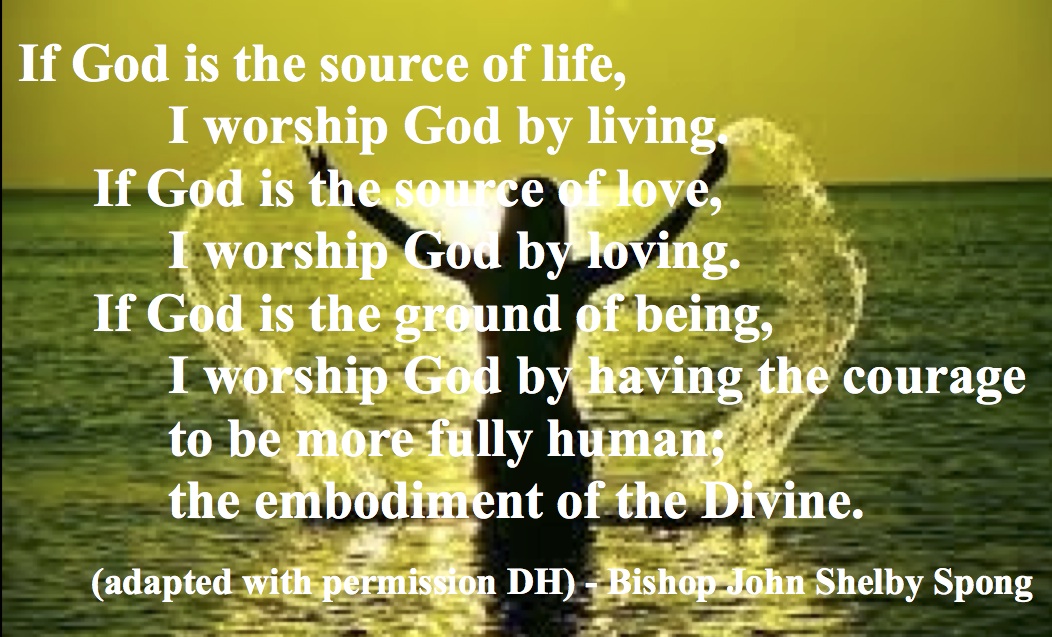
Below is a video that I have shown to Confirmation students (ages 12-15) as we begin to explore the great religious questions that have inspired wisdom seekers from the beginning of human consciousness: Who am I? What am I? Where do I come from? Why am I here? Where am I going? etc. The responses of young people inspire me! I cannot wait to see what they will reveal to us about the nature of our reality! As you watch this video, I offer you a benediction. It is a blessing that I have adapted with permission from the work of John Shelby Spong.
God is the source of life, so worship God by living,
God is the source of love, so worship God by loving.
God is the ground of being, so worship God by having the courage
to be more fully human; the embodiment of the Divine.
Evolutionary theologian Michael Dowd has developed a mantra which he refers to as “Six Agreements” which he asserts millions of people around the world, both secular and religious, can agree with:
1. Reality is our god.
2. Evidence is our scripture.
3. Big history is our creation story.
4. Ecology is our theology.
5. Integrity is our salvation.
6. Ensuring a just and healthy future is our mission.
Way back when I first began going to church, I had one of those bibles…and I dare say many of you have probably had one too…I had a red-letter bible. For those of you who’ve never had one, a red-letter bible is a bible where all the words of Jesus are printed in red and for a long time I actually believed that if it was printed in red, then Jesus actually must have said it and there are hundreds of thousands, possibly millions of Christians who still believe that if they are printed in red they are the actually words of Jesus.
When I first began reading the New Testament, many of those red-letter words were difficult to read. The 14th chapter of the Gospel according to John was just one of the many texts that I read with great trepidation. “I am the way, the truth and the life no one comes to the Father except through me.” These particular words in red led me to believe that my family and most of the people I loved, were doomed, because they didn’t believe in Jesus. So, you can imagine my delight when I went to a young adults’ retreat and one of the pastors told us that just because words are printed in red, it doesn’t mean that Jesus actually said those words. I remember going back to my home parish and asking my pastor why he never told us about the things he was taught at the seminary about the words of Jesus and I can still hear him answering, “Most laypeople aren’t ready to hear that. It would destroy their faith.”
It’s an old argument amongst the clergy. It’s as if some of, “them” whoever “they” are, believe that the world as they know it will come to an end as they know it if they were to let lay-people in on the secrets of the trade. Should we or should we not teach laypeople about the historical critical methods that we all learned in seminary. When I say we all learned, I’m talking about the vast majority of clergy from the mainline denominations, like the Lutheran church, the Anglicans, the United Church, Mennonites, even Roman Catholics, and I dare say more than a few Baptists. We all learn the historical critical methods that academic scholars have been perfecting over the years. But the sad truth is that very few of us actually teach the historical critical methods that we have learned when we get into the parish. Many of my colleagues still argue that either laypeople aren’t ready to hear it, or that they don’t want to hear it. Either way, they’re not about to start preaching it from the pulpit and run the risk of destroying people’s faith. Besides, the folks who clearly don’t want to hear any of it just might run them out of town.
I’ve never really understood this attitude. I think perhaps the fact that as a layperson I was relieved to hear that Jesus didn’t actually say all the stuff that’s printed in red. So, from the beginning, I’ve always tried to teach the historical critical methods that I have learned to apply to my own study of the bible.Continue reading →
For those of you who have asked for a print copy of Sunday’s sermon, I have posted it below. You can find the readings that preceded this sermon here and listen to the audio of the sermon here
God forgive me, but I can’t even remember her name. Staring back through the mists of time, I can barely remember the pain in her eyes. More than three decades have passed since I lived and worked in Vancouver’s east end. I was young, young and foolish, young and carefree, young and adventurous, young and callous. In my early twenties, I was still trying to figure out who I was. I was in no condition to understand who she was. How could I know? None of us knew.
I knew Jesus back then. Some might even say that I was obsessed with knowing Jesus. I went to church every Sunday and I hung out with church people. I knew the Father well back then. I was young, the world was my oyster, my future stretched out before me. I knew that my work in the travel industry was only temporary; just a means to an end, a way to make money so that I could spend it enjoying life. At the time, I was working in a pretty unglamorous part of the wholesale travel industry packaging holidays, to Mexico and Hawaii. We used to joke that it wasn’t brain surgery, just bums on seats, just filling every plane our company chartered with warm bodies so that they could get away from Vancouver’s gloomy, rain-soaked winter; bums on seats, anybody could do the job; day in day out filling airplanes, it was positively mind-numbing work.
The company I worked for occupied an entire three-story office building on the northern edge of Vancouver’s East-End. The East-End of Vancouver is still one of the poorest neighbourhoods in Canada. Back then, the gentrification of the East-End that Expo 86 and then the 2010 Olympics brought, couldn’t even be imagined. Good upstanding middle-class people avoided the poverty of the East-end, unless of course they were young like me, and then the depravity of the neighbourhood was kind of a badge of honour; as we braved the streets on our way to dance the night away in the clubs that sprang up on the edge of the East-End were rents were cheep and cops had so much more to worry about than the kind of mischief that we got into. So, I lived and worked in the East-End and saved my money for the life that stretched out in front of me.
I wish I could remember her name. I’m ashamed to confess that I cannot remember her name. But the pain in her eyes, those dark mournful eyes that I will never forget. I’d warned her more than once. It was against the rules. She was hired to clean our offices. She was to go about her work and make sure that she had the place spick-and span ready for us when we arrived in the morning and then she would be on her way. But time and time again, I’d find her lingering, long past the time when she should have left; lingering and talking on the telephone; she was the cleaner, she had no business using the phones. I was the newly minted supervisor of the reservations department; it was to me that the staff came to complain about the untidy conditions in the staff room. If she spent as much time doing her job as she did sneaking around making phone calls, we wouldn’t have to put up with the unwashed mugs in the sink. I warned her over and over again, but she just wouldn’t listen. My boss told me to fire her; but I was young and I’d never fired anyone before, besides wouldn’t Jesus want me to give her just one more chance; God forgive me I thought I could save her. Oh don’t worry, I wasn’t planning to save her for Jesus or anything as crass as that, oh no, I was going to save her from herself. I was going to redeem her from her lazy self and see to it that she kept her job. God forgive me, I did not know what I was doing.Continue reading →
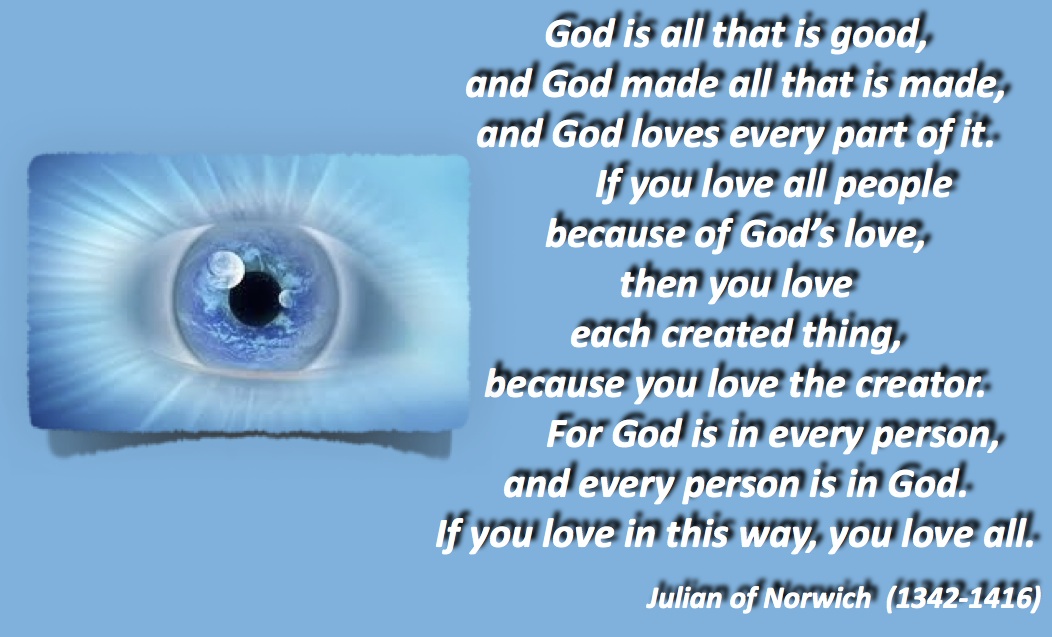
Today churches commemorate Julian of Norwich, who is perhaps one of the greatest English Mystics. Although she has never been canonized by the Roman Catholic Church she is venerated in both the Lutheran and Anglican churches. Julian is the author of the first English book ever to have been written by a woman: Sixteen Revelations of Divine Love.
Click here to listen to a meditative sung liturgy inspired by Julian’s writings
John chapter 10 causes me to remember Mrs Tanner, my grade ten english teacher. I can still see her handwriting all over my carefully crafted compositions. Red ink everywhere as she constantly admonished me not to mix my metaphors. Clearly the writer of the Gospel of John never had the benefit of Mrs. Tanner’s guidance, or he would not have dared to record Jesus words the way he does in his long and rambling I AM passages.
Before we even get to chapter 10, we read that Jesus says: “I AM the bread of life.” and “I AM the light of the world.” In chapter 10, we read, Jesus says, “I AM the gate,” “I AM the Good Shepherd.” Later we will read, that Jesus says, “I AM the Resurrection”, “I AM life.” “I AM the true vine.” “I AM the way.” “I AM in God.” “I AM in you.”
But in the tenth chapter the writer of the Gospel of John goes all out and has Jesus using not just a metaphor but a mixed metaphor. For in chapter 10, we read that Jesus declared: “I AM the Gate. The gate through which the sheep must pass.” and then mixes it up by saying, “I AM the Good Shepherd.”
Which is it? Gate or Shepherd, come on, I know your Jesus but I’m trying to understand how Jesus, who is after all, the lamb of God who takes away the sin of the world is both the Gate and the Shepherd.
I wonder if Mrs. Tanner ever took her red pen to the Gospel According to John? If she did, the letters MMX would have appeared all over this Gospel. MMX = mixed metaphor wrong! Looking back, I know that Mrs Tanner was just trying to help us to be more careful about our ideas. But today I would have to ask of her, and indeed of the writer of the Gospel of John, “What’s a meta for?”Continue reading →
This has been an amazing weekend at Holy Cross as we’ve explored a new story of what it means to be human and discovered new ways of contemplating the Divine Presence that permeates the cosmos. Michael Morwood has taught us and challenged us to peer through 21st century lenses at the one we call G-o-d. Michael concluded his time with us by delivering the sermon on Luke 24:13-35 in which he moved us beyond the Easter stories to a place were we could imagine so much more than words can capture! Enjoy!!!
Firefox users will need to click on this link to listen: Morwood sermon
Richard Holloway, the former Primate of the Scottish Episcopal Church, interprets the story of the resurrection not as an historical tale, but as our own story. Holloway has written of his longing for a humbled and broken church. His own humility and brokenness shines through this video as Holloway embodies his own longing.
Michael Morwood will speak at Dr. Dennison Secondary School (135 Bristol Road, Newmarket) at Friday at 7:30pm and at Holy Cross Lutheran Church on Saturday & Sunday – tickets will be available at the door! For more about this dynamic thinker follow this link
This sermon was inspired on my own journey to Emmaus where in the space of the same afternoon I heard a stranger declare: “Christianity is dead!” and Karen Armstrong’s now famous TED talk about her call for a world Charter for Compassion.
Has anybody here ever been to Emmaus? Which one? According to the latest issue of Biblical Archeology there are at least nine possible locations that are candidates for the Biblical town of Emmaus. Historians tell us that there is no record of any village called Emmaus in any other ancient source. We simply don’t know where Emmaus might have been. Tradition, tells us that it might have been a place just a few hours walk from Jerusalem. New Testament scholar, Marcus Borg suggests that Emmaus is nowhere. Emmaus is nowhere precisely because Emmaus is everywhere. Each and every one of us has at one time, or indeed for some of us, many times, traveled along the road to Emmaus.
I know that I have been on the road to Emmaus most of my life. I’ve had lots of company on the Road to Emmaus. I’ve had many conversations along the way discussing, with anyone who’d care to accompany me, the ifs, ands, and buts of Christianity, of religion, and indeed of life. If you haven’t traveled down the road to Emmaus you must be very skilled in the fine art of turning off your brain and if you check you just might discover that your heart isn’t actually beating.
It’s so easy to imagine, those two characters striding down the Road to Emmaus that we can almost hear them talking, maybe even arguing about what happened. What on earth were they to make of all this! Jesus was supposed to be the Messiah. Jesus was the One who had come to liberate Israel, to free the people from oppression. Jesus was the One who was supposed to draw the people back to God, restore the relationship between God and God’s people. Now Jesus was gone, and what had changed? Now, Jesus was gone, and the Roman Empire was still oppressing them, still inflicting such pain and hardship, still killing them. Was it all a mistake? Was it all a lie? Had they been fooled by some kind of cruel hoax—were they wrong to put their hopes in this man from Nazareth? They had trusted Jesus believed in Jesus, followed Jesus. Their lives had been changed. They had seen the lives of others changed and they had expected even greater changes to come. Jesus had confronted corrupt powers. Jesus had charmed great crowds. Jews and Gentiles alike responded to the truth of Jesus’ teaching. Rich and poor had come to Jesus, believing in Jesus’ healing power. But Jesus had been shamed, and ridiculed, and humiliated, and crucified and now Jesus was dead. Well, was Jesus dead? Some said they’d seen Jesus, alive! Not that Jesus had survived the crucifixion by some miracle of strength, but that Jesus had risen from the dead. They seemed so totally convinced by their own experience…were they confused by their own grief? Were they delirious? Had they loved this Jesus so much—invested so much hope in Jesus life and leadership—that they simply could not let him go? And what did ‘resurrection” mean? Apparently it was not the resuscitation of a corpse. Jesus wasn’t revived to resume his former life; to take up his broken body until the day he might die again. No, somehow this was some new mode of being that seemed to be spiritual to some and yet real to others. And, if Jesus were risen from the dead, what would be the point of all that? What was the point to a Messiah—to a presumed political and religious leader—if Jesus wasn’t able to lead people here on earth? How could Jesus restore Israel when he had so easily been defeated by a handful of Roman guards? How could he bring release to the captives, how could he bring justice for the poor, how could Jesus advocate for the widows and the homeless? How could Jesus call people to account for all the ways they had strayed from God’s intent, now? What good could come from some kind of spiritual ghost? We can hear these two friends wrestling with each other and with their own hearts on the road that day!Continue reading →
John Philip Newell is a poet, author, and peacemaker. He is the co-founder of Salva Terra: A Vision Towards Earth’s Healing. Formerly Warden of Iona Abbey in the Western Isles of Scotland, he is currently Companion Theologian for the American Spirituality Center of Casa del Sol at Ghost Ranch in the high desert of New Mexico. For more about Newell follow this link Newell’s progressive insights are permeated by his deep understanding of Celtic spirituality. It is no surprise then that Newell calls for a renewed understanding of the sacredness of matter.
In response to the current crisis of institutional Christianity, Newell sees three responses: denial of the crisis, shoring up of the old, or to ask “What is it that is trying to be born? What is it that is trying to emerge from the human soul and how can we within the Christian household be part of leading that and serving it with humility?” Newell’s gentle invitation is challenging the church to serve the deep knowing that is in the hearts of people everywhere and to empower the deep knowing of the sacredness of the knowings that come up from the deepness of our being which is of God.
This Good Friday sermon was born of the theological struggles our congregations has engaged in over the past few years. It mirrors our theological journey. This year members and friends of our congregation engaged in an “Atheism for Lent” study and so the sermon begins with a parable from an atheist critique of Christianity. I am grateful to the members and friends of Holy Cross Lutheran Church for the courage and wisdom they have shared with one another as together we seek to know the unknowable.You can listen to the audio of the sermon or read the manuscript.
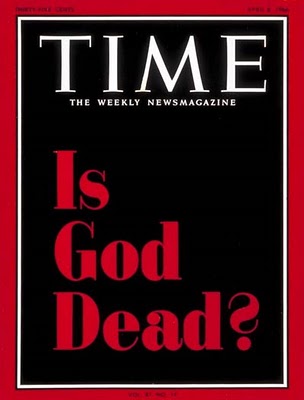
Jesus of Nazareth taught using parables. So, in the shadows of the horrors of the cross, let us turn to a parable; not one of Jesus’ parables, but a modern parable. This parable was first told in 1887. It was reprinted in 1969, in the Time Magazine that bore the iconic “Is God Dead?” cover.
“Have you not heard of that madman who lit a lantern in the bright morning hours, ran to the market-place, and cried incessantly: “I am looking for God! I am looking for God!” As many of those who did not believe in God were standing together there, he excited considerable laughter. Have you lost him, then? said one. Did he lose his way like a child? said another. Or is he hiding? Is he afraid of us? Has he gone on a voyage? or emigrated? Thus they shouted and laughed.
The madman sprang into their midst and pierced them with his glances. “Where has God gone?” he cried. “I shall tell you. We have killed him – you and I. We are his murderers. But how have we done this? How were we able to drink up the sea? Who gave us the sponge to wipe away the entire horizon? What did we do when we unchained the earth from its sun? Whither is it moving now? Whither are we moving now? Away from all suns? Are we not perpetually falling? Backward, sideward, forward, in all directions? Is there any up or down left? Are we not straying as through an infinite nothing? Do we not feel the breath of empty space? Has it not become colder? Is it not more and more night coming on all the time? Must not lanterns be lit in the morning? Do we not hear anything yet of the noise of the gravediggers who are burying God? Do we not smell anything yet of God’s decomposition? Gods too decompose. God is dead. God remains dead. And we have killed him. How shall we, murderers of all murderers, console ourselves? That which was the holiest and mightiest of all that the world has yet possessed has bled to death under our knives. Who will wipe this blood off us? With what water could we purify ourselves? What festivals of atonement, what sacred games shall we need to invent? Is not the greatness of this deed too great for us? Must we not ourselves become gods simply to be worthy of it? There has never been a greater deed; and whosoever shall be born after us – for the sake of this deed he shall be part of a higher history than all history hitherto.”
Here the madman fell silent and again regarded his listeners; and they too were silent and stared at him in astonishment. At last he threw his lantern to the ground, and it broke and went out. “I have come too early,” he said then; “my time has not come yet. The tremendous event is still on its way, still travelling – it has not yet reached the ears of men. Lightning and thunder require time, the light of the stars requires time, deeds require time even after they are done, before they can be seen and heard. This deed is still more distant from them than the distant stars – and yet they have done it themselves.”
It has been further related that on that same day the madman entered various churches and there sang a requiem. Led out and quietened, he is said to have retorted each time: “what are these churches now if they are not the tombs and sepulchres of God?”
This parable first printed in 1882, is known as The Parable of the Mad Man.” It was written by Friderich Nietzsche. One of the characteristics of a parable is that it surprises us with a truth that we already know. God is dead and we have killed him!Continue reading →
I have been asked to repost this particular post. It first appeared during my first months of blogging and I am often asked about this post. Its contents continue to invoke the wrath of some and the appreciation of many. I offer it here, mindful that in the intervening two years since I first posted it, I have had the opportunity to explore progressive and evolutionary theologies which have nourished me in my efforts to proclaim the Easter story in ways that move beyond the tired debate over the physical resuscitation of a corpse toward an understanding of resurrection that permeates my daily quest to know the unknowable ONE who lies at the heart of reality.
Peter Callesen’s Papercut Resurrection
Blogging is sometimes a very strange medium and I must say that I am overwhelmed by the responses to my recent posts about resurrection. While many have emailed or posted their ardent “amens” others have been scathing and some hostile to my remarks. I am grateful to everyone who has responded. All of your comments help me as I continue to ponder the theological and practical implications of the Easter story. For those of you who have suggested that I have no business calling myself a Christian or a pastor and have suggested that I ought to consider leaving the church, I offer the following.
A while back, I got together with clergy colleagues to talk about the challenges of preaching during Holy Week. When the subject of the crucifixion and the resurrection came up, the conversation became very lively as the traditionalists challenged the progressives. Toward the end of our conversation, it became clear that because I was unwilling to concede to the notion that Jesus corpse was physically resuscitated; I stood accused of having denied the resurrection.
Some colleagues rose to my defense and insisted that I wasn’t saying anything different than what we all learned in seminary. But they also insisted that most lay-people simply don’t want to hear it. So, I asked them if they were going to preach about what they had learned in seminary and beyond and the general consensus was that there are too many guests on Easter Sunday to tackle theology.
Some said, they were simply too afraid of the fundamentalists in their congregations to ever even attempt to preach what they knew. A few confessed that they were working up to it; but not on Easter Sunday.
The traditionalists in the group were disgusted. One colleague went so far as to insist that I had no business being in the church because my very presence puts the beliefs of the faithful at risk. He wondered aloud, “Why do you stay in the church if you don’t believe? If the church’s theology no longer works for you, why don’t you just leave?”Continue reading →
Christ is Risen! Christ is risen indeed. Alleluia! Let me follow that proclamation up with a good Lutheran question:“What does this mean?” What does it mean that Christ is risen? What does resurrection mean? The truth is that there are about as many different explanations of Christ’s resurrection as there are Christians. And that’s a good thing, because the question of the resurrection is a question that lies at the very heart of Christianity. So, is it any wonder that Christians have been struggling to come to terms with resurrection since the very first rumours that Christ had risen began to circulate. Over the centuries the various responses to the question of resurrection have divided Christians as various camps work out various responses.
For many Christians and non-Christians alike Resurrection is the dividing line. But this is nothing new. Indeed the drawing of that line can be seen in the earliest Christian writings that we have. The Apostle Paul himself, wrote to the community of followers at Corinth: “If there is no resurrection of the dead, then not even Christ has been raised. And if Christ has not been raised, then all of our preaching has been meaningless—and everything you’ve believed has been just as meaningless.”
There are many believers and non-believers alike who point to these line’s in scripture and say, “Ah ha, there it is, either you believe in the resurrection or you don’t!” Continue reading →
A powerful series contemplating resurrection in ever deepening ways in order to explore what a risen christianity might look like in terms of its offering of healing and blessing for the earth. Created by John Philip Newell a poet, pastor and scholar who opens our eyes o a vision beyond doctrines and dogmas that fail to proclaim the wonders of the universe in which we live. “Christianity will rise again to the extent that we remember the sacredness of everything that has been born in the universe.”
I was asked by a colleague: “So, if you do not believe that Jesus died for your sins, then why bother celebrating the events of Holy Week?” Behind this question lies the assumption that the only way to understand Jesus’ death is to frame it within the context of the theology of “penal sacrificial atonement” ie “we are judged to be sinful creatures, punishment is required, God sends Jesus to pay the price for our sin”. That Anslem’s theory of sacrificial atonement was formulated in the 11th century and continues to hold sway in the minds of so many followers of Christ is a testament to the power of our liturgies and hymns to form our theology. However, Anslem’s theory is not they only faithful way to understand Jesus’ death.
When one seriously engages the question, “What kind of god would demand a blood sacrifice?” the answers often render God impotent at best and at worst cruel and vindictive. I have often said that atonement theories leave God looking like a cosmic son of #%#%# ! Progressive Christian theologians are opening up new ways of understanding the death and resurrection of Jesus that empower the faithful to see new possibilities.
To my colleague, who fears that I am leading the faithful astray, and to those who find little comfort in the theories of an 11th century monastic, I offer the following:
Jesus said, “I give you a new commandment: Love one another. And you’re to love one another the way I have loved you. This is how all will know that you’re my disciples: that you truly love one another.”
That we should love one another is not a new commandment. There have been many before Jesus and many who came after Jesus who have commanded, advised, encouraged, implored, and even begged us to, “love one another.” What is new about Jesus commandment is that we are to love one another the way that Jesus loved. Which begs the question: How exactly did Jesus love?
I believe that Jesus loved in ways that I am only beginning to understand. I believe that Jesus was so open to the power of the LOVE that is God; that Jesus was able to live his life fully without fear.
I believe that Jesus wanted more than anything else for his followers to be so open to the power of LOVE that is God so that they too would live their lives fully without fear.
I believe that that’s what Jesus meant when he said, “I have come that you might have life and live it abundantly.”
I believe that Jesus lived life abundantly and that means that he loved abundantly and without fear.
Jesus was so open to the power of LOVE that is God that Jesus would not let the powers of darkness stop him from loving and living fully.
The kind of LOVE that Jesus embodied and taught has no boundaries. No darkness, no power, no fear, not even death can limit the power of LOVE.
For if LOVE is limited by death, then love will always be qualified and quantified.
That Jesus was willing to LOVE without boundaries, came at great cost to himself.
But Jesus was willing to pay that price in order to show others the way.
The way to LOVE without limit, without fear, without boundaries.
LOVE without boundaries is abundant life.
That Jesus’ LOVE endured the worst that the world could send his way, that Jesus’ LOVE was for all the world, dead and buried, and yet bursts free from the grave, bears witness to the power of LOVE.
That Jesus LOVE could not be destroyed, not even by the thing we fear the most, death itself, saves us from the need to fear death.
Jesus has shown us the way.
We can live abundantly lives that are free from the fear of death. Because Jesus has shown us the way we are free to live fully, to love extravagantly and be all that we were created to be.
LOVE shines in the darkness and darkness shall not overcome LOVE.
If Jesus, life, death, and resurrection teach us anything, surely they teach us not to be afraid.
Not to be afraid of the darkness.
Not to be afraid of living fully.
Not to be afraid of loving extravagantly.
Not to be afraid of the powers of evil.
Not to be afraid of the power of death.
LOVE will endure.
All will be well.
Jesus can’t save us from life.
There is evil to contend with.
There will be darkness and there will be death.
Jesus couldn’t save himself and he cannot save us from life. Darkness and death are part of life. Each of us must walk into the darkness that lies before us. We can beg God to take the cup from us! But the darkness will still come. And there will be days when the darkness will triumph. There are good Fridays too many to mention out there. We can shout all we want for Jesus to save us, but in the end we too will have to take up our cross and find a way to follow Jesus into the darkness and beyond, trusting that even though it feels for all the world that God has forsaken us, we will make it beyond the darkness.
The cross will not look the same for each of us. But there will be crosses to bear. Jesus has showed us the way. If we are to follow Jesus, then we must love one another they way that Jesus loved. It is the way beyond the darkness. Do not be afraid of evil, of death, or of the darkness. Follow Jesus who by love frees us from the power of darkness to hold us captive to our fears so that we can have life and live it abundantly.

 May 31st is the day the Church commemorates “The Visitation” the story of Mary’s visit to Elizabeth as it is recorded in the Gospel According to Luke 1:39-56. Since reading Jane Schalberg’s “The Illegitimacy of Jesus”, I can’t help but wonder if Mary’s visited her cousin Elizabeth or escaped to her cousin Elizabeth seeking protection for the crime of being raped in a culture that all too often blamed the victim. Historians estimate that Mary may have been all of twelve years old when she became pregnant. There is ample evidence in the New Testament accounts of Mary’s story that suggest that she may indeed have been raped. So rather than sweep the possibility under the rug, on this the Feast of the Visitation, I’m reposting a sermon I preached a few years ago during Advent. I do so because women young and old continue to be raped and to this day, are forced to flee from the accusations and persecutions of cultures that continue to blame the victim. What follows is a written approximation of the sermon which in addition to Jane Schalberg is also indebted to John Shelby Spong’s “Born of a Woman” and “Jesus for the Non Religious” along with John Dominic Crossan and Marcus Borg’s “The First Christmas”.










 pastordawn