Reality Is My God – Michael Dowd

evolutionary christianityEvolutionary theologian Michael Dowd has developed a mantra which he refers to as  “Six Agreements” which he asserts millions of people around the world, both secular and religious, can agree with:

1. Reality is our god.

2. Evidence is our scripture.

3. Big history is our creation story.

4. Ecology is our theology.

5. Integrity is our salvation.

6. Ensuring a just and healthy future is our mission.


Letting Go of the Words Attributed to Jesus So that We Can Embrace the WORD

Thomas 70 pastordawnEaster 5A sermon:

Readings:

The Gospel of Thomas 70

1 Peter 2:2-10

John 14:1-14

Reality Reconciles Science and Religion: Michael Dowd

DowdEvolutionary Christian theologian Michael Dowd speaks compellingly about Jewish and Christian expressions of God as the personification of Reality (that which when you cease believing in it doesn’t go away). Dowd sees Christ as the personification of integrety which is the way of  living in right relationship to reality. In light of this coming Sunday’s   gospel reading from John 14:1-14, Dowd provides an interesting take on Christ, the personification of integretiy as the Way, the Truth and the Life. 

Multi-coloured Meanings of those Red-letter Words in John 14:1-14

coloured pencilsWay back when I first began going to church, I had one of those bibles…and I dare say many of you have probably had one too…I had a red-letter bible. For those of you who’ve never had one, a red-letter bible is a bible where all the words of Jesus are printed in red and for a long time I actually believed that if it was printed in red, then Jesus actually must have said it and there are hundreds of thousands, possibly millions of Christians who still believe that if they are printed in red they are the actually words of Jesus.

When I first began reading the New Testament, many of those red-letter words were difficult to read. The 14th chapter of the Gospel according to John was just one of the many texts that I read with great trepidation. “I am the way, the truth and the life no one comes to the Father except through me.” These particular words in red led me to believe that my family and most of the people I loved, were doomed, because they didn’t believe in Jesus. So, you can imagine my delight when I went to a young adults’ retreat and one of the pastors told us that just because words are printed in red, it doesn’t mean that Jesus actually said those words. I remember going back to my home parish and asking my pastor why he never told us about the things he was taught at the seminary about the words of Jesus and I can still hear him answering, “Most laypeople aren’t ready to hear that. It would destroy their faith.”

It’s an old argument amongst the clergy. It’s as if some of, “them” whoever “they” are, believe that the world as they know it will come to an end as they know it if they were to let lay-people in on the secrets of the trade. Should we or should we not teach laypeople about the historical critical methods that we all learned in seminary. When I say we all learned, I’m talking about the vast majority of clergy from the mainline denominations, like the Lutheran church, the Anglicans, the United Church, Mennonites, even Roman Catholics, and I dare say more than a few Baptists. We all learn the historical critical methods that academic scholars have been perfecting over the years. But the sad truth is that very few of us actually teach the historical critical methods that we have learned when we get into the parish. Many of my colleagues still argue that either laypeople aren’t ready to hear it, or that they don’t want to hear it. Either way, they’re not about to start preaching it from the pulpit and run the risk of destroying people’s faith. Besides, the folks who clearly don’t want to hear any of it just might run them out of town.

I’ve never really understood this attitude. I think perhaps the fact that as a layperson I was relieved to hear that Jesus didn’t actually say all the stuff that’s printed in red. So, from the beginning, I’ve always tried to teach the historical critical methods that I have learned to apply to my own study of the bible. Continue reading

RISE-UP Demand Justice for Murdered and Missing First Nations Women!

canada's shameFor those of you who have asked for a print copy of Sunday’s sermon, I have posted it below. You can find the readings that preceded this sermon here and listen to the audio of the sermon here 

God forgive me, but I can’t even remember her name. Staring back through the mists of time, I can barely remember the pain in her eyes. More than three decades have passed since I lived and worked in Vancouver’s east end. I was young, young and foolish, young and carefree, young and adventurous, young and callous. In my early twenties, I was still trying to figure out who I was. I was in no condition to understand who she was. How could I know? None of us knew.

I knew Jesus back then. Some might even say that I was obsessed with knowing Jesus. I went to church every Sunday and I hung out with church people. I knew the Father well back then. I was young, the world was my oyster, my future stretched out before me. I knew that my work in the travel industry was only temporary; just a means to an end, a way to make money so that I could spend it enjoying life. At the time, I was working in a pretty unglamorous part of the wholesale travel industry packaging holidays, to Mexico and Hawaii. We used to joke that it wasn’t brain surgery, just bums on seats, just filling every plane our company chartered with warm bodies so that they could get away from Vancouver’s gloomy, rain-soaked winter; bums on seats, anybody could do the job; day in day out filling airplanes, it was positively mind-numbing work.

The company I worked for occupied an entire three-story office building on the northern edge of Vancouver’s East-End. The East-End of Vancouver is still one of the poorest neighbourhoods in Canada. Back then, the gentrification of the East-End that Expo 86 and then the 2010 Olympics brought, couldn’t even be imagined. Good upstanding middle-class people avoided the poverty of the East-end, unless of course they were young like me, and then the depravity of the neighbourhood was kind of a badge of honour; as we braved the streets on our way to dance the night away in the clubs that sprang up on the edge of the East-End were rents were cheep and cops had so much more to worry about than the kind of mischief that we got into. So, I lived and worked in the East-End and saved my money for the life that stretched out in front of me.

I wish I could remember her name. I’m ashamed to confess that I cannot remember her name. But the pain in her eyes, those dark mournful eyes that I will never forget. I’d warned her more than once. It was against the rules. She was hired to clean our offices. She was to go about her work and make sure that she had the place spick-and span ready for us when we arrived in the morning and then she would be on her way. But time and time again, I’d find her lingering, long past the time when she should have left; lingering and talking on the telephone; she was the cleaner, she had no business using the phones. I was the newly minted supervisor of the reservations department; it was to me that the staff came to complain about the untidy conditions in the staff room. If she spent as much time doing her job as she did sneaking around making phone calls, we wouldn’t have to put up with the unwashed mugs in the sink. I warned her over and over again, but she just wouldn’t listen. My boss told me to fire her; but I was young and I’d never fired anyone before, besides wouldn’t Jesus want me to give her just one more chance; God forgive me I thought I could save her. Oh don’t worry, I wasn’t planning to save her for Jesus or anything as crass as that, oh no, I was going to save her from herself. I was going to redeem her from her lazy self and see to it that she kept her job. God forgive me, I did not know what I was doing. Continue reading

Arise on this Mothers’ Day: a sermon

justice missingThe plight of particular mothers in Canada promoted a change to the readings for this Sunday. You can find Luke 23:26-34, The Mother’s Day Proclamation, and Luke 24:1-5a by clicking here. The music for the song sung after the sermon “Sweetgrass and Candle” can be found here.

You can listen to the sermon here  

To further explore the issues discussed in the sermon, I highly recommend watching the National Film Board’s film “Finding Dawn” it can be viewed by clicking here


What’s a Meta FOR? Shepherds and Gate-keepers: a sermon for Easter 4A – John 10:1-10 and Psalm 23

John chapter 10 causes me to remember Mrs Tanner, my grade ten english teacher. I can still see her handwriting all over my carefully crafted compositions. Red ink everywhere as she constantly admonished me not to mix my metaphors. Clearly the writer of the Gospel of John never had the benefit of Mrs. Tanner’s guidance, or he would not have dared to record Jesus words the way he does in his long and rambling I AM passages.

Before we even get to chapter 10, we read that Jesus says:  “I AM the bread of life.”  and “I AM the light of the world.”  In chapter 10, we read, Jesus says, “I AM the gate,” “I AM the Good Shepherd.” Later we will read, that Jesus says, “I AM the Resurrection”, “I AM life.” “I AM the true vine.”  “I AM the way.” “I AM in God.” “I AM in you.”

But in the tenth chapter the writer of the Gospel of John goes all out and has Jesus using not just a metaphor but a mixed metaphor. For in chapter 10, we read that Jesus declared: “I AM the Gate. The gate through which the sheep must pass.” and then mixes it up by saying,  “I AM the Good Shepherd.”

Which is it? Gate or Shepherd, come on, I know your Jesus but I’m trying to understand how Jesus, who is after all, the lamb of God who takes away the sin of the world is both the Gate and the Shepherd.

I wonder if Mrs. Tanner ever took her red pen to the Gospel According to John? If she did, the letters MMX would have appeared all over this Gospel. MMX = mixed metaphor wrong! Looking back, I know that Mrs Tanner was just trying to help us to be more careful about our ideas. But today I would have to ask of her, and indeed of the writer of the Gospel of John, “What’s a meta for?” Continue reading

Easter Stories: Guest Preacher: Michael Morwood

Michael MorwoodThis has been an amazing weekend at Holy Cross as we’ve explored a new story of what it means to be human and discovered new ways of contemplating the Divine Presence that permeates the cosmos. Michael Morwood has taught us and challenged us to peer through 21st century lenses at the one we call G-o-d. Michael concluded his time with us by delivering the sermon on Luke 24:13-35 in which he moved us beyond the Easter stories to a place were we could imagine so much more than words can capture! Enjoy!!!

Firefox users will need to click on this link to listen:  Morwood sermon

A Way to Understand the Resurrection – Richard Holloway

Peter Callesen's Papercut Resurrection

Peter Callesen’s Papercut Resurrection

Richard Holloway, the former Primate of the Scottish Episcopal Church, interprets the story of the resurrection not as an historical tale, but as our own story. Holloway has written of his longing for a humbled and broken church. His own humility and brokenness shines through this video as Holloway embodies his own longing.

Michael Morwood coming to Newmarket this weekend!!!

God Will Never Be the Same

Michael Morwood will speak at Dr. Dennison Secondary School (135 Bristol Road, Newmarket) at Friday at 7:30pm and at Holy Cross Lutheran Church on Saturday & Sunday – tickets will be available at the door! For more about this dynamic thinker follow this link

Morwood poster 2014

Emmaus is Nowhere because Emmaus is Everywhere: a sermon for Easter 3A – Luke 24:13-35

Road to EmmausThis sermon was inspired on my own journey to Emmaus where in the space of the same afternoon I heard a stranger declare: “Christianity is dead!” and Karen Armstrong’s now famous TED talk about her call for a world Charter for Compassion.

Has anybody here ever been to Emmaus? Which one? According to the latest issue of Biblical Archeology there are at least nine possible locations that are candidates for the Biblical town of Emmaus. Historians tell us that there is no record of any village called Emmaus in any other ancient source. We simply don’t know where Emmaus might have been. Tradition, tells us that it might have been a place just a few hours walk from Jerusalem. New Testament scholar, Marcus Borg suggests that Emmaus is nowhere. Emmaus is nowhere precisely because Emmaus is everywhere. Each and every one of us has at one time, or indeed for some of us, many times, traveled along the road to Emmaus.

I know that I have been on the road to Emmaus most of my life. I’ve had lots of company on the Road to Emmaus. I’ve had many conversations along the way discussing, with anyone who’d care to accompany me, the ifs, ands, and buts of Christianity, of religion, and indeed of life. If you haven’t traveled down the road to Emmaus you must be very skilled in the fine art of turning off your brain and if you check you just might discover that your heart isn’t actually beating.

It’s so easy to imagine, those two characters striding down the Road to Emmaus that we can almost hear them talking, maybe even arguing about what happened. What on earth were they to make of all this! Jesus was supposed to be the Messiah. Jesus was the One who had come to liberate Israel, to free the people from oppression. Jesus was the One who was supposed to draw the people back to God, restore the relationship between God and God’s people. Now Jesus was gone, and what had changed? Now, Jesus was gone, and the Roman Empire was still oppressing them, still inflicting such pain and hardship, still killing them. Was it all a mistake? Was it all a lie? Had they been fooled by some kind of cruel hoax—were they wrong to put their hopes in this man from Nazareth? They had trusted Jesus believed in Jesus, followed Jesus. Their lives had been changed. They had seen the lives of others changed and they had expected even greater changes to come. Jesus had confronted corrupt powers. Jesus had charmed great crowds. Jews and Gentiles alike responded to the truth of Jesus’ teaching. Rich and poor had come to Jesus, believing in Jesus’ healing power. But Jesus had been shamed, and ridiculed, and humiliated, and crucified and now Jesus was dead. Well, was Jesus dead? Some said they’d seen Jesus, alive! Not that Jesus had survived the crucifixion by some miracle of strength, but that Jesus had risen from the dead. They seemed so totally convinced by their own experience…were they confused by their own grief? Were they delirious? Had they loved this Jesus so much—invested so much hope in Jesus life and leadership—that they simply could not let him go? And what did ‘resurrection” mean? Apparently it was not the resuscitation of a corpse. Jesus wasn’t revived to resume his former life; to take up his broken body until the day he might die again. No, somehow this was some new mode of being that seemed to be spiritual to some and yet real to others. And, if Jesus were risen from the dead, what would be the point of all that? What was the point to a Messiah—to a presumed political and religious leader—if Jesus wasn’t able to lead people here on earth? How could Jesus restore Israel when he had so easily been defeated by a handful of Roman guards? How could he bring release to the captives, how could he bring justice for the poor, how could Jesus advocate for the widows and the homeless? How could Jesus call people to account for all the ways they had strayed from God’s intent, now? What good could come from some kind of spiritual ghost? We can hear these two friends wrestling with each other and with their own hearts on the road that day! Continue reading

The Road to Emmaus – Stephane Brozek Cordier

This Sunday the gospel text invites us to travel down our own road to Emmaus. Stephane Brozek Cordier is a poet whose words have the power to open us to our deepest wonderings as we wander down that road.

Resurrection: Leap of Doubt – Easter 2A sermon

Leap of Doubt pastorDawnThis sermon is an interactive exploration. Many thanks to the people of Holy Cross for their participation and to Peter Rollins for his beautiful words from his book Insurrection. Readings:  John 20:1-18, Philippians 3:10-14, John 20:19-31

Listen to the sermon here 

Oh Me of Little Faith: reflecting upon Doubting Thomas

leap of doubt pastorDawnIt happens every year as Doubting Thomas makes his Easter appearance. It’s a kind of resurrection of a glimmer of the faith that I long to recall in my flesh. I harken back to the time when I could embrace those wounds as proof. Oh how that faith comforted me. Resurrecting the memory of Thomas, who for years functioned as a trusted hero in my scant faith, now sends me into the dream of belief as the answer in and of itself; a kind of innocence that once gone is never forgotten. My nostalgia for my faith in belief will pass. But for just a moment or two, I pause to embrace the wounds, waiting for my doubts to open me to the evolving reality of now.  Jump!!!

Nickel Creek – A Doubting Thomas

Sacred Downtime: Barbara Brown Taylor

BB TaylorNow that Holy Week has come and gone and we are shouting our Alleluias, perhaps we can begin to turn our minds to the expectation of some sacred downtime. Barbara Brown Taylor is a preacher from whom I have learned so very much. I am currently enjoying the luxury of enjoying her latest book for the first time. Taylor’s earlier books are like old friends that I return to often. So her latest book, Learning to Walk in the Dark holds all the promise of a new treasured friendship. While searching for a video to introduce her new book, Learning to walk in the darkI came upon this video, recorded in the spring of 2009 and only recently posted online, in which Taylor offers a welcome reminder of the contours of downtime.  Looking forward to a few busy weeks, and longing for those lazy, hazy days of summer, Taylor has reminded me to stop and luxuriate in the splendour of springtime. So, rather than speed through Learning to Walk in the Dark, I shall take my time and write about it when we’ve become better friends. In the
meantime enjoy Sacred Downtime…..

PRACTICING RESURRECTION – a sermon for the 2nd Sunday of Easter

resurrectionFor this sermon I used a video within the sermon to help illustrate resurrection. You can view the video within the written text of the sermon below or listen to the audio version provided. I am indebted to the work of James Rowe Adams for much of the New Testament Scholarship in this sermon.

The Scripture texts were John chapter 20:19-31 and Acts 4:32-35

Audio Version of the Sermon click here

Practicing Resurrection

Christ is Risen! Christ is Risen indeed!  Alleluia! So, Christ is Risen!  So What???What can it possibly mean to you and to me, that a rag-tag bunch of Jesus’ followers gathered together in an upper-room and talked about their experiences of Jesus and decided that not even death could extinguish the life that they experienced in Jesus? What difference does it make to you or to I that Christ is risen? The truth is that it can make absolutely no difference what so ever. Now there are a whole lot of people who will tell you that the important thing about resurrection is that you believe it. Those same folks absolutely love the story of doubting Thomas. And so every year on the second Sunday of Easter we read the story of doubting Thomas as a kind of inoculation against Thomas’ disease.

I sometimes think that the designers of the lectionary were trying to build up our resistance to doubt. Having problems believing in resurrection, well don’t do what Thomas did, don’t doubt, because you’ll be proven wrong. Jesus is alive, the wounds in his hands proved that to Doubting Thomas, so have no doubt about it the resurrection happened!  Believe in the resurrection!

The trouble with believing in stuff is that it belief can make absolutely no difference what so ever. I can believe in justice for all, but unless I’m prepared to seek justice, to be fair, or to resist injustice, it makes absolutely no difference what so ever. You can shout, “Christ is risen!” all you want but unless you are willing to live it, the resurrection means very little at all. In order to live the resurrection you have to begin practicing resurrection. In order to practice something, you have to know what it looks like, what it sounds like, or what it feels like.

I’ve been trying to figure out how to show you what resurrection looks like in the flesh. Then I remembered a video that’s been doing the rounds on the internet, so I want you to watch this modern miracle of resurrection.

WATCH THE VIDEO CLIP FROM:  Alive Inside

Christ is Risen! Christ is Risen indeed!  Alleluia!  Almost 2000 years ago, a bunch of rag-tag Jesus followers were huddled together in fear. Their beloved leader had been brutally executed by the powers that be and they were terrified that they would be next. Paralyzed by their fear, hiding behind a locked door, something happened that gave them the strength to burst forth from their own tomb and change the world. Continue reading

Is God Coming Back to Life? – Easter Sunday sermon – April 20, 2014

time god coversThis sermon is the second of a two parter which began on Good Friday (you can find that sermon here). It is the fruit of conversations that have been going on at Holy Cross Lutheran Church for a number of months. I am indebted to the members of the congregation for their courage, wisdom and curiosity which they so graciously share. I am indebted to Dom Crossan, Jack Spong, Barbara Brown Taylor, Michael Morwood, and Dick Rauscher whose work has inspired and emboldened me in my preaching. You can listen to the sermon below and I have also provided the manuscript (which is never quite the same as what comes out from the pulpit) Shalom. 

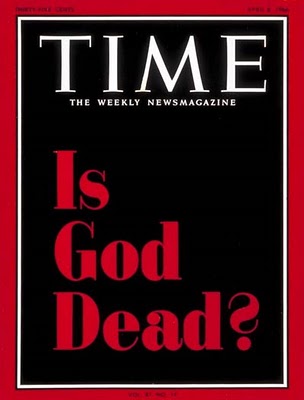
On Good Friday we gathered here to grieve the death of God. I began my Good Friday sermon with the Parable of the Mad Man that was written by Frederich Nietzsche back in 1882. The mad man in the parable goes around announcing that God is dead. The parable gained notoriety 1966 when an issue of Time Magazine asked the question: Is God Dead? The question appeared on the cover of the magazine and created quite a stir. It referenced Nietzsche’s parable as the inspiration behind the “God is dead movement” which insisted that “man” has killed God because “man” has evolved beyond our need for gods.

So, on Good Friday my sermon took a long hard look at the god who is indeed dead. In my sermon, I grieved the death of The Father-god, the Sky-god, God the grand puppeteer, who watches over us like a kindly shepherd, and listens to us, and interferes on our behalf, and judges us and longs to welcome us into heaven, but is willing to let us languish in hell if need be.

I pointed out that parables like the parable of the mad man are stories that tell us what we already know and Nietzsche’s Mad Man was right, this god that so many of us have loved and worshipped for so many years is indeed dead; sacrificed on the altars of reality.All that we have learned about the cosmos; all the scientific breakthroughs, our technologies, our philosophies, biblical scholarship and our evolving theologies have killed the personification of god that we once worshipped and adored.

I looked upon the cross and I wept because the death of the personified god is not easy to bear and I miss the Father-god because I really did love him, and he really did save me. For most of my life the personification of God was the only way I had of knowing anything of the Force that lies at the very heart of reality. God is dead; the Father God, the Sky God, the kindly Shepherd that I was counting on to make me lie down in green pastures, is dead. Our science, technology, philosophy, history, and our theologies have killed this personified deity that we both feared and adored.  God is dead and we have killed him.  Continue reading

While We Wait for Resurrection: a reminder from John Shelby Spong

Scuffed Up Reddish Pumps: a Maundy Thursday Sermon April 17, 2014

red pumpsThis year’s Maundy Thursday commemoration at Holy Cross included: hand washing, soup supper, eucharist, intimacy and this story from the Reverend Susan J. Thompson who, along with Pastor Tom Doherty presided over our worship.

It was a dark and . . . windy night. The swinging doors into the sanctuary were banging, the tree branches scraping against the stained glass windows, and casting eerie shadows.

It was then my colleague and I decided to make the place a little cosier for our Maunday Thursday service. We scrambled around the balcony storage and found all our Christmas tea lights and holders, and both of us had plenty of candles in our studies. We placed all of them around the chancel, and on the window sills where the shape-dancing trees seemed a little less intimidating in the warm candle glow.

In a kitchen to the right , Session members were preparing warm scented water and gathering the tubs in which to immerse people’s feet. The towels were at the ready. All we needed now was the chalice and plate for the elements, so I raced downstairs to the cupboard.

I was stopped in my tracks by a pounding on the door. My heart sank as I went to it, for there was (let’s call her Louise) a client of our food bank. I opened the door, exchanged pleasantries, and politely informed her that the food bank would be open next Tuesday.

“Oh, I don’t want food, she said”. Just a pair of shoes”. Continue reading

God Is Dead? – Good Friday Sermon April 18, 2014

time-is-god-deadThis Good Friday sermon was born of the theological struggles our congregations has engaged in over the past few years. It mirrors our theological journey. This year members and friends of our congregation engaged in an “Atheism for Lent” study and so the sermon begins with a parable from an atheist critique of Christianity. I am grateful to the members and friends of Holy Cross Lutheran Church for the courage and wisdom they have shared with one another as together we seek to know the unknowable. You can listen to the audio of the sermon or read the manuscript.

Jesus of Nazareth taught using parables. So, in the shadows of the horrors of the cross, let us turn to a parable; not one of Jesus’ parables, but a modern parable. This parable was first told in 1887. It was reprinted in 1969, in the Time Magazine that bore the iconic “Is God Dead?” cover.

“Have you not heard of that madman who lit a lantern in the bright morning hours, ran to the market-place, and cried incessantly: “I am looking for God! I am looking for God!” As many of those who did not believe in God were standing together there, he excited considerable laughter. Have you lost him, then? said one. Did he lose his way like a child? said another. Or is he hiding? Is he afraid of us? Has he gone on a voyage? or emigrated? Thus they shouted and laughed.

The madman sprang into their midst and pierced them with his glances. “Where has God gone?” he cried. “I shall tell you. We have killed him – you and I. We are his murderers. But how have we done this? How were we able to drink up the sea? Who gave us the sponge to wipe away the entire horizon? What did we do when we unchained the earth from its sun? Whither is it moving now? Whither are we moving now? Away from all suns? Are we not perpetually falling? Backward, sideward, forward, in all directions? Is there any up or down left? Are we not straying as through an infinite nothing? Do we not feel the breath of empty space? Has it not become colder? Is it not more and more night coming on all the time? Must not lanterns be lit in the morning? Do we not hear anything yet of the noise of the gravediggers who are burying God? Do we not smell anything yet of God’s decomposition? Gods too decompose. God is dead. God remains dead. And we have killed him. How shall we, murderers of all murderers, console ourselves?  That which was the holiest and mightiest of all that the world has yet possessed has bled to death under our knives. Who will wipe this blood off us? With what water could we purify ourselves? What festivals of atonement, what sacred games shall we need to invent? Is not the greatness of this deed too great for us? Must we not ourselves become gods simply to be worthy of it?  There has never been a greater deed; and whosoever shall be born after us – for the sake of this deed he shall be part of a higher history than all history hitherto.”

Here the madman fell silent and again regarded his listeners; and they too were silent and stared at him in astonishment. At last he threw his lantern to the ground, and it broke and went out. “I have come too early,” he said then; “my time has not come yet. The tremendous event is still on its way, still travelling – it has not yet reached the ears of men. Lightning and thunder require time, the light of the stars requires time, deeds require time even after they are done, before they can be seen and heard. This deed is still more distant from them than the distant stars – and yet they have done it themselves.”

It has been further related that on that same day the madman entered various churches and there sang a requiem. Led out and quietened, he is said to have retorted each time: “what are these churches now if they are not the tombs and sepulchres of God?”

This parable first printed in 1882, is known as The Parable of the Mad Man.” It was written by Friderich Nietzsche. One of the characteristics of a parable is that it surprises us with a truth that we already know. God is dead and we have killed him! Continue reading