SEMPER REFORMANDA: Always Reforming

95Today’s Reformation Sunday Liturgy followed the theme Semper Reformanda: Always Reforming! The sermon looked at various protests of the ongoing reformation, including Luther’s 95 Theses, (here) John Shelby Spong’s Twelve Theses, (here) Matthew Fox’s 95 Thesis for the 21st Century, (here) Holy Cross’ Mission Statement (here) and Holy Cross’ Statement of Welcome (here).

Listen to the sermon here:

Reformation For All the Children

rainbow dove flyThis morning we will gather at Holy Cross to celebrate the Reformation. Our liturgy’s theme is “Semper Reformanda: Always Reforming. As one of our Gathering Songs we will sing David Lohman’s hymn: “For All the Children”(PDF of the music here). We will sing this song of radical welcome for all those who have ever been excluded from the church in the hope that reformation will come quickly to the whole church.

For All the Children is performed in the video below which was produced by Catholics for Marriage Equality MN, “For All the Children” is a powerful and inspiring music video featuring over 300 Catholics singing their support for LGBTQ young people and spreading the good news of Christ’s love. Recorded in April of 2012, “For All the Children” was premiered August 15 in Minneapolis at a special C4ME-MN event entitled “I Do! Believe in the Freedom to Marry.” 

Semper Reformanda: Always Reforming!!!

What Darwin Never Knew

what darwin never knew“God has, in fact, written two books, not just one. Of course, we are all familiar with the first book he wrote, namely Scripture. But he has written a second book called creation,” so said Francis Bacon. As our knowledge of creation expands, how will our relationship with these two books evolve? 

As I contemplate the church’s celebration of the Reformation, I am struck by the wealth of information that can be summoned by my fingertips. Just as the invention of the printing press worked its own kind of magic on the Christian Church, the electronic media has propelled us into the Age of Information and Christianity is evolving.  The impact of our expanding knowledge is changing the way we view reality and our place in it. As the religions of the world continue to evolve, we can begin to open ourselves to the wondrous possibilities of an entirely new understanding of reality.  No history of the reformation that is happening all around us will be complete without the inclusion of our broadening understanding of our biological origins.

To the Tune of a Welcoming God: Moving God to Tears of Joy

welcomeDavid R. Weiss’ “To the Tune of a Welcoming God: Lyrical reflections on sexuality, spirituality, and the widness of God’s welcome” is a wonderful resource for worship planners who are searching for ways to engage worshippers in the difficult task of breaking down barriers to inclusion. As I wrote in the previous post, “they don’t go home humming the sermon!” Music opens our very selves toTo the Tune of a Welcoming God that which is beyond ourselves and Weiss has written some powerful texts that can be coupled with well loved, familiar hymn tunes. I was first exposed to Weiss’ way with words a number of years ago when Lutheran’s Concerned included his “O Christ Who Came” in their worship resources for the celebration of Reconciling in Christ Sunday. When set to the tune of LONDONDERRY AIR (that’s O’ Danny Boy, for the uninitiated), Weiss’ words provide an expansive welcome that we have often sung with gusto at Holy Cross. So, I was delighted to discover, on iTunes of all places, the album “To the Tune of a Welcoming God” by Sara Kay. After quickly downloading, I began to listen to all sorts of possibilities for worship in Weiss’ splendid texts set to familiar tunes. In addition to providing hymn texts that expand our vision of what it means to extend a welcome to the GLBT community, Weiss’ texts open worshippers to images of God that move us beyond words as they open us to theologies that embrace the reality of the cosmos. You can follow this link to find a copy of the hymn texts.

In addition to the hymn texts, Weiss’ book provides a collection of essays in which Weiss offers a vision of what the Church can become. Weiss is writes from his own Lutheran perspective reflecting his own struggles in work of building a more inclusive church. Weiss opens the book with his own “Credo” which I look forward to using in liturgy as an “Affirmation of Faith”. 

Credo: By David R. Weiss

I believe in God,
The Great Mystery that is the Source of all that is,
I believe that God is beyond our words
And surely beyond our genders,
But that we are still invited to name God as best we can,
With humility and wonder.
I believe in God’s love for all creation, not just humanity.
I believe in God’s yearning,
That justice hold sway in every corner of creation
And in God’s anxious longing
For Sabbath joy to fill the cosmos.

I believe that the deep beauty of Jesus’ life
Is a true revelation of God’s desire to see compassion
At the center of human community.
I believe that Jesus’ healings, parables, and table fellowship
Reveal the truth of God active in our midst.
And I believe that in Jesus’ life
We hear an invitation to echo such compassion
In our own lives.

I believe that Jesus’ death
Reminds us that oppressive power
Will stop at nothing –
Then or now – to silence compassion.
And I believe that resurrection
Names the miracle that takes place –
Then and now – whenever we rededicate
Our lives to compassion
Thereby announcing that even death
Cannot silence the love of God.

I believe that besides Jesus’ life
And besides the biblical text,
Other lives and other texts also bear the truth of God –
And that our lives are richer for listening well
To the movement of God in many places.

I believe that God continues to be present still today
And that the Holy Breath of God blows
Whenever and wherever compassion is born,
Whether in our words, deeds, or rituals.
I believe we have a special responsibility
To gather in community and share rituals,
Both ancient and fresh,
That exercise our imaginations,
Both bodily and spiritually
For the practice of compassion.

I believe that in our lives
We have the capacity to move God,
This loving mystery that dwells at the heart of all that is,
To the point of tears.

And I commit myself,
With my brothers and sisters and the whole of creation,
To living in ways that seek to move God to tears of joy.

Amen.

95 Theses for the Twenty-first Century

Delighted that so many of you after reading yesterday’s post have expressed interest in learning more of Matthew Fox’s 95 Theses for the 21st Century.  The best place to find out more is in Fox’s little book “A New Reformation: Creation Spirituality and the Transformation of Christianity” published in 2006 by Inner Traditions press.

Click Here where you will find a complete list of Fox’s  95 Theses for the Twenty-first Century

Enough with “A Mighty Fortress” Already! Sing a New Song!

In the spirit of the Reformation motto: semper reformanda – always reforming, what say we abandon the fortresses of our traditions.  This Sunday, Lutheran churches all over the world will begin their Reformation Sunday worship services vigorously singing “A Mighty Fortress” and I for one wish they wouldn’t.  I suspect that the hymn’s author Martin Luther might just agree with me. After all didn’t Luther write a Mighty Fortress in an attempt to bring the popular music of the day into the church? I am convinced that this particular Reformation Sunday tradition has dear old Martin spinning in his grave at the thought that the church that bears his name is still singing a tired old chestnut like A Mighty Fortress to celebrate the Reformation. The very idea of 21st century Lutheran’s celebrating the Reformation by clinging to the events of the 16th century is an affront to the memory of Martin Luther. Continue reading

God in the Guise of a Pleading Widow a Sermon on Luke 18:1-8

IMG_2931Ai Weiwei’s exhibit “According to What? at the Art Gallery of Ontario inspired me to look beyond traditional interpretations of Jesus’ parable of the Pleading Widow to see our role as the unjust judge. The gentle breath of a newborn granddaughter enabled me to hear God persistently pleading for justice.

Listen to the sermon here:  

Our second reading was taken from Mechthild of Magdeburg’s “The Flowing Light of the Godhead” 

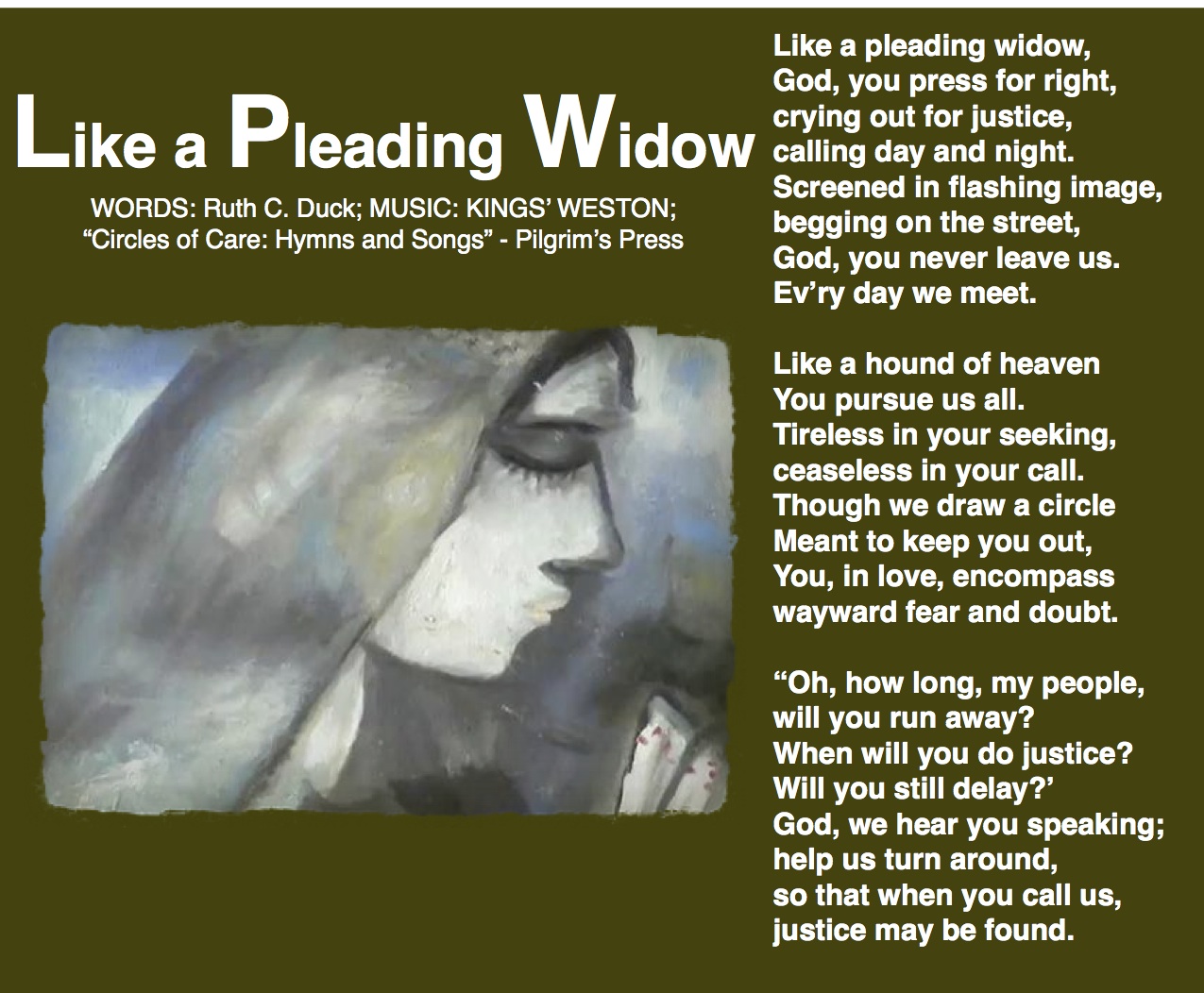
Godhead MagdeburgOur Scripture Hymn used Ruth C. Duck’s words.

Like a Pleading Widow

Evolving Images of God: Joan Chittister

the-kingdom-of-God-is-within-youEvolutionary theologian Joan Chittister articulates an image of God that does not deny the scientific evidence of reality as only she can. As our knowledge of the Cosmos increases our images of the Divine most evolve. These are exciting days to be alive: “a cross-over moment in time” as evolutionary theory casts new light on our definitions of God and understanding of truth. Chittister’s succinct articulation is a brilliant precursor to today’s scripture readings. 

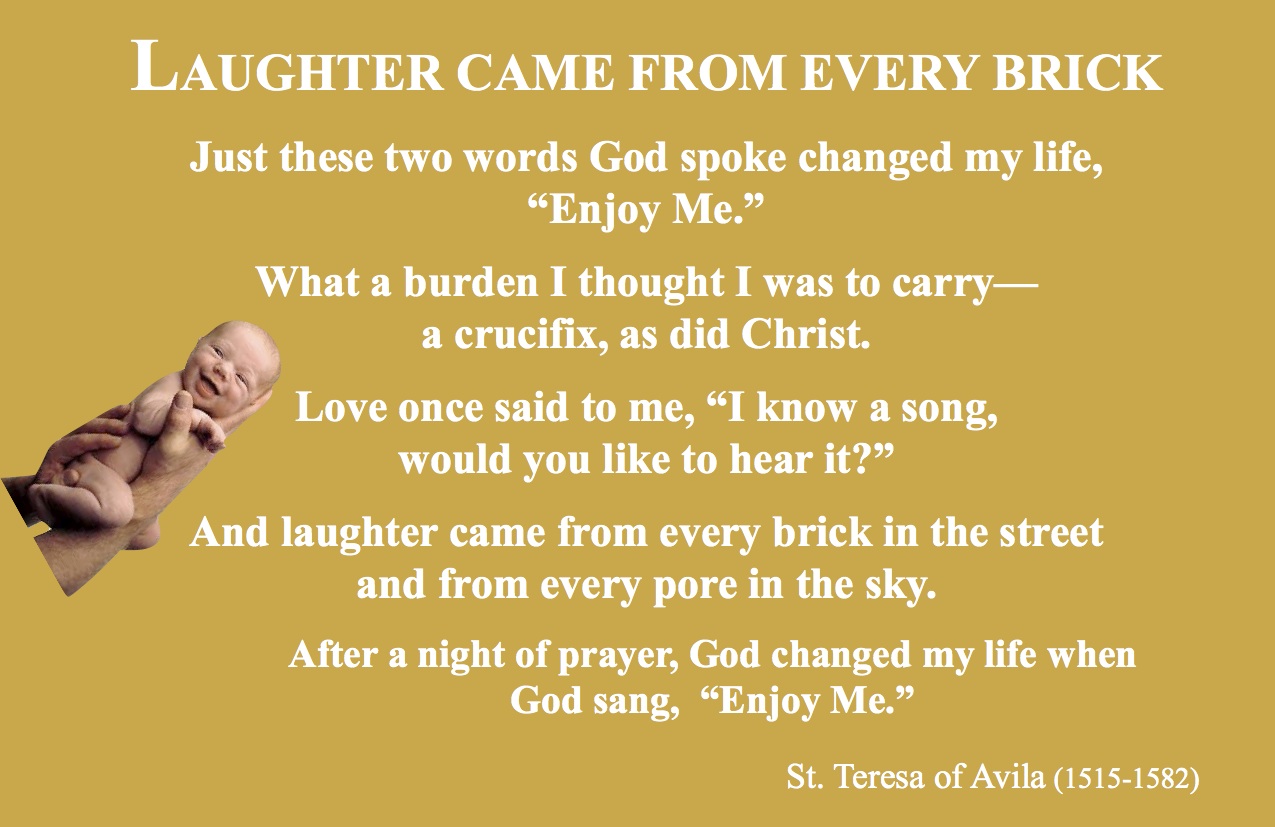
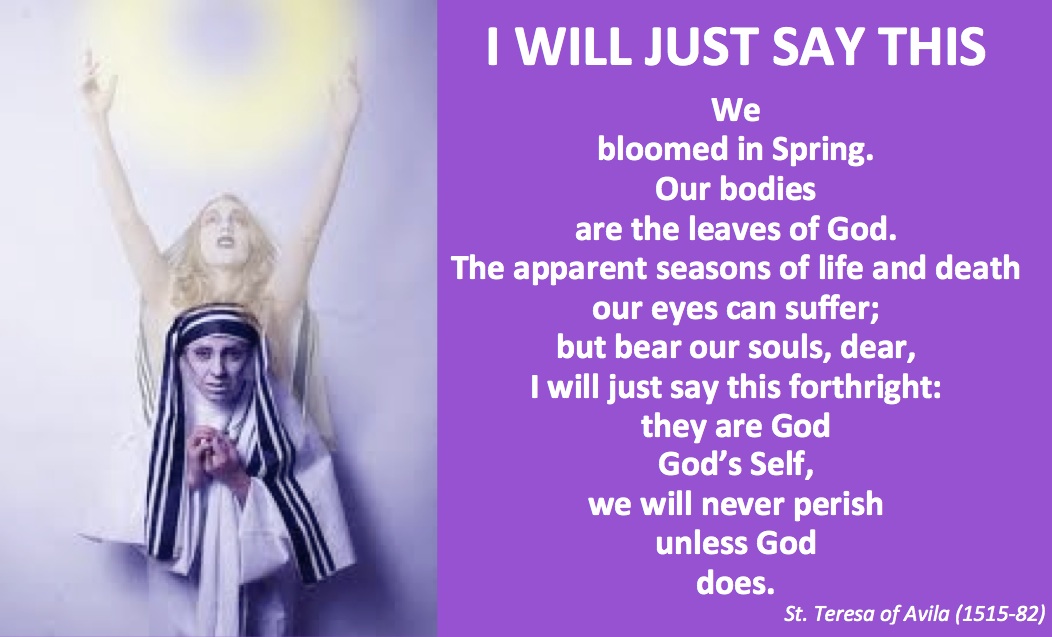
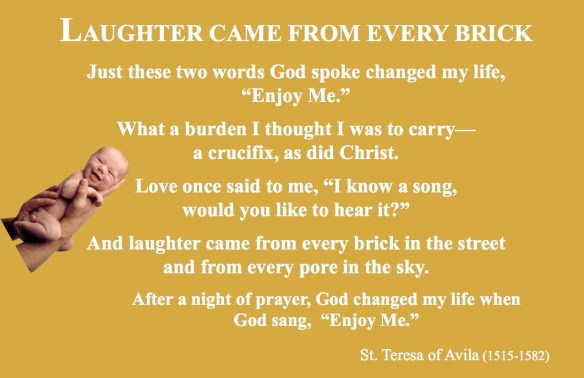
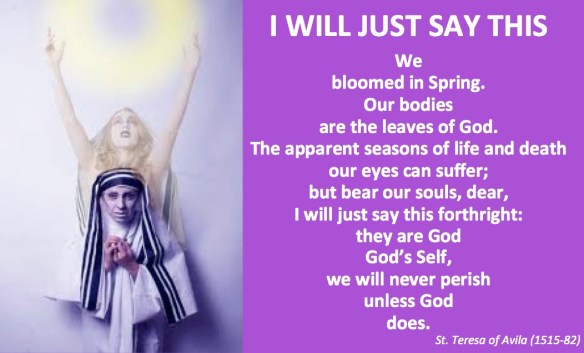
Today We Celebrate the Life and Witness of St. Teresa of Avila

An excerpt from “Love Poems From God” by Daniel Ladinsky,

(Penguin Compass, London: 2002)

(1515-1582)  “Teresa was born in Avila, a beautiful high mountain village of Spain.  She was one of thirteen children, three girls and ten boys, in a wealthy family.  The Spain in which Teresa grew up was permeated with 700 years of Arabian culture; the eradication of Arab power was followed by one of Spain’s darkest periods, the insanity of the Inquisitions, which, in the fourteenth century, along with other grievous deeds, forced mass conversions of Jews to Christianity.”

“Teresa was her father’s favourite child, and the most spirited.  Her mother died during childbirth when Teresa was thirteen, after which she had little supervision.  It is believed she had a lover at the age of fifteen, which caused her father to send her to a convent boarding school, only to see her return home two years later because of poor health.  When she was twenty-one, Teresa ran away from home to join a convent.  At that time many convents were more like hotels for women, allowing them a great deal more independence than they would be allowed at home, though after two years at the convent Teresa had a near-death experience that changed her life.  A spiritual awakening began in which she cultivated a system of meditation that sought quieting the mind to such an extent that God could then be heard speaking.  Over the next twenty years she experienced many mystical states but not until she was fifty did she begin the most far-reaching aspects of her life’s work.”

St. Teresa of Avila “had a great desire for learning and when the Inquisition, in 1559, forbade women to read, Teresa turned to God and asked God to teach her soul about divine love.  She then began to write completely out of her own experience.   Many of her poems are, in fact, intimate accounts of her communion with God. 

The Church’s persecution of Teresa had not waned when she passed away and was buried in Alba de Tormes in 1582.  A year after her death some of her disciples, feeling that she might have wished to be buried in Avila, had her body exhumed.  When her body was found to be perfectly intact and emitting a wonderful fragrance, her sainthood was formally decreed, allowing the publication and preservation of some of her works.

Most of what we see today of Teresa’s work is probably reined way back, for her writings fell into the hands and under the control of the very forces that had so opposed her throughout her life.”

“Teresa of Avila is undoubtedly the most influential saint in the Western world, and she has made great contributions to spiritual literature and poetry.  She was a woman of tremendous courage who is rightfully credited with the remarkable political and religious reform achieved against the strongest—and most insidious—chauvinistic forces.”

“A realistic picture of Teresa’s life did not even reach the English-reading general public until the 1960s.  She was known to have had a remarkable quick wit and a stunning, even provocative, sense of humour, as well as a great physical beauty.  Her complete works include seven books, four hundred and fifty letters, and assorted poetry.  Her writings are considered masterpieces of mystical prose and verse. She personally founded seventeen Carmelite convents and two monasteries, despite enormous opposition from the Church and other men in power.”

Ubuntu: Compassion brought into colourful practice.

go be love

“I must never allow my neighbour to go hungry while I’ve got a little food in my house…We as human beings must sustain each other even during times of greatest peril.”  Let our Thanksgiving become compassion and let us bring our compassion into colourful practice!

THANKSGIVING: Not One, Not Two

I AM the bread of lifeA sermon on Deuteronomy 26:1-11 and John 6:25-35 inspired by Garrison Keillor and Joan Chittister; two of the best storytellers I know.

Listen to the sermon:

The Science of Happiness – An Experiment in Gratitude

thanksgiving canada

Your Mom and Dad were right when they taught you that “thank-you” is a magic word. Science now confirms what we learned at our parents’ knees all those years ago.

Happy Thanksgiving!

Critical Thinking and Faith: Phyllis Tickle

critical thinkingPhyllis Tickle is a treasure!!! Let her no-nonsense, down-to-earth, humorous  way of articulating what should be obvious provide encouragement to the timid who sit quietly hoping that someone else will question the dogmas and doctrines that dull our senses. Let herrethinking questions inspire more questions and let set aside our carefully held notions of reality and embrace the awe and majesty of the Mystery we call God. 

The Future of the Church: Phyllis Tickle, Brian McLaren and David Lose

future churchA conversation with Phyllis Tickle, Brian McLaren, and David Lose recorded Oct. 7, 2013, and hosted by Luther Seminary, St. Paul, Minn., during the Celebration of Biblical Preaching.

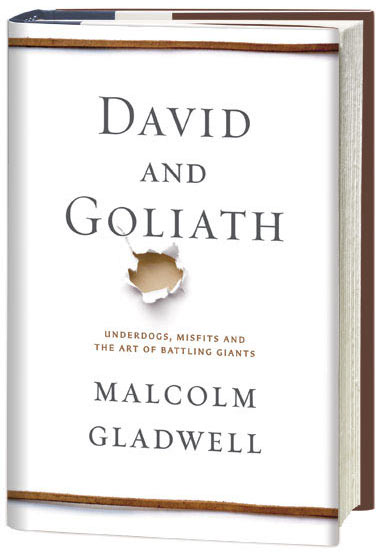
David and Goliath: Underdogs, Misfits and the Art of Battling Giants by Malcolm Gladwell

gladwellDavid and Goliath like you’ve never heard this story before! I have enjoyed Malcolm Gladwell’s writing ever since a wise seminary professor put a copy of The Tipping Point on my personal reading list. In addition to gobbling up each of his books, I savour his articles in The New Yorker. Gladwell’s mind works in ways that delight, challenge, encourage and confound. Gladwell is for this preacher/storyteller an inspiration! Gladwell is a storyteller’s storyteller.

david&goliathGladwell’s latest book David and Goliath demonstrates his considerable abilities when it comes to using stories to challenge long-held assumptions. While the book shatters assumptions about underdogs, assumptions and seemingly lost causes. Whether you agree or disagree with Gladwell’s assertions, you’ll find yourself thinking or re-thinking your own biases. It’s a positively splendid read. 

Of his own work Gladwell writes: “I write in the genre of what might be calledgladwell books “intellectual adventure stories.” Books like David and Goliath combine narratives and ideas from academic research in an attempt to get people to look at the world a little differently. I have always tried to be honest about the shortcomings of this approach. Stories necessarily involve ambiguity and contradiction. They do not always capture the full range of human experience. Their conclusions can seem simplified or idiosyncratic. But at the same time stories have extraordinary advantages. They can reach large numbers of people and move them and serve as the vehicle for powerful insights.”

Gladwell is a Canadian journalist, raised in the Mennonite tradition. In an article in the Huffington Post, Gladwell discusses his return to religion. here

To wet your appetite or just for sheer entertainment value, watch this TED talk in which Gladwell demonstrates his considerable storytelling/preaching abilities while covering the first part of his book. 

THINKING About GOD??? Philip Clayton

philip claytonOur Adult Study is currently being inspired by the new study program Painting the Stars (Living the Questions). Philip Clayton is one of the contributors to the program. Clayton is the Dean of Claremont School of Theology (Phd.  Yale – philosophy and religion) who is seeking the development of “a constructive Christian theology in dialogue with metaphysics, modern philosophy, and science.” Here are two short videos that provide an introduction to Clayton’s ideas. 

Painting the Stars

Feast Day of Saint Francis of Assisi

On this the Feast Day of Saint Francis, an evening prayer service with texts from St. Francis. The liturgy was developed for use during Lent. But on this rainy autumn afternoon St. Francis’ words provide warmth and peace. Enjoy!

Evening Prayer Service Bulletin which is to be printed double-sided

Evening Prayer Audio – the silences are intentional.  Enjoy!

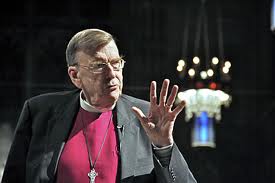
“I don’t even like religious people.” – Bishop John Shelby Spong

jack spongBishop Spong is not exactly enamoured of religion and or religiosity.  Speaking at the Seattle Rotary Club on August 28th 2013, Jack Spong tackles a number of subjects as only Jack can, including his friendship with Desmond Tutu, his belief that the Gay Marriage debate in North America is over, his latest book, number 24, The Fourth Gospel: Tales of a Jewish Mystic, and of course why “Christianity must change or die!”  As he often does, Jack reminds us that “Jesus didn’t come to make us religious, but to make us whole, so that we may live life abundantly.” Enjoy!!!

Introducing “Painting the Stars” Contributors: Bruce Sanguin

bruce sanguin

This coming Sunday, we at Holy Cross will begin the new Living the Questions interactive DVD adult education program Painting the Stars. Throughout this week I will be posting introductions to the various contributors to the program. So, if you are anywhere near Newmarket this Sunday consider joining us as we explore the dynamic relationship between science and faith!

One of the primary contributors to the program is Canadian Bruce Sanguin. Until recently, Evolutionary Christian Bruce Sanguin was the minister at the Canadian Memorial United Church in Vancouver. This summer Sanguin left parish ministry to pursue his writing and expanding his speaking career.

Bruce has  written several books that have to inspired my own worship planning. Two of his books are of particular value to any pastor who seeks to plan worship without slipping into the trap of words that re-inscribe old theological patterns:  Darwin, Divinity and the Dance of the Cosmos: An Ecological Christianity and If Darwin Prayed: Prayers for Evolutionary Mystics. Sanguin’s latest book The Advance of Love: Reading the Bible with an Evolutionary Heart explores the relationship between science and faith to shed light on biblical texts.

This video in which Bruce is interviewed by fellow evolutionary Andrew Cohen will wet your appetite for Bruce’s work while giving you an interesting look into evolutionary Christianity.   Enjoy!

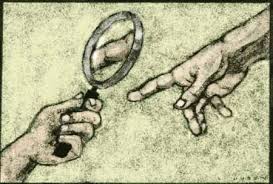
Through the Lens of Grace Held Firmly in 21st Century Frames

lens of grace

Homecoming Sermon September 22, 2013

Creation IV – Proverbs 8:22-31, Colossians 1:15-20, John 6:41-51

Companion from the Latin “com pinionem” for “with bread” or “bread fellow”