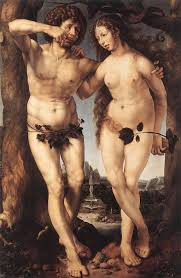
What a Joke: These Stories Never Actually Happened! – a sermon for the First Sunday in Lent – Genesis 2:15-17; 3:1-7, Matthew 4:1-11

Eve & AdamI am indebted to the exegetical work of John Holbert for the insights into Hebrew humour!

Each year as Lent approaches, I find myself flirting with the idea of giving up Lent for Lent. Lent is just too much work. For centuries, during Lent the church has emphasized so many concepts that seem alien to the 21st century mind. Each year during Lent preachers are required to undertake the unenviable task of unpacking unpopular, seemingly antiquated concepts in an effort to encourage the contemporary churchgoer to entertain the equally antiquated rituals of Lent. I mean Christmas and Easter might attract a few more people to our sanctuary, but how do you attract people with talk about repentance or fasting? Just look at our readings for this morning. Temptation is the order for toady. Eve and Adam succumbing to temptation, the Apostle Paul prattling on, heaping condemnation upon the first parents for having given in to temptation, and then Jesus himself resisting temptation from non-other than the Devil. Not exactly cheery stuff designed to bring comfort on a cold damp winter morning, where apart from the time change, there are very few signs of a longed for spring.

But Lent has arrived and so we must tuck into this dish of temptation hoping that it will reveal some hint of the promise of what lays beyond our long Lenten journey as we travel toward Easter’s resurrection joy. But these are not easy readings to unpack.

I could begin by warning against taking these texts literally. But you have heard warnings against taking the text literally and I know that you understand that the story about Eve and Adam is just a story. It never really happened. Most of you, even though you might be tempted to think that Jesus literally went out into the wilderness and was tempted by the Devil, most of you have long since realized that the Devil doesn’t actually exist. If you’re still tempted to believe that this story actually happened, well, the fact that in the story itself, Jesus goes out into the desert all by himself ought to at least make you pause to ask, who wrote this story down, if there was nobody there but Jesus and the Devil?

These stories are just that, they are stories. In the words of Marcus Borg, “The events in these stories never actually happened. But the events in these stories are always happening.” Let me say that again, lest there be any doubt: They never actually happened, but they are always happening. That’s what makes these stories such great stories. The stuff in these stories is always happening over and over again. Temptation is the stuff of our lives. Each and every one of us, each and every day struggles with temptation, each and every one of us and all of us together as humanity. This grand human experiment that we are caught up in requires that we all struggle with temptation. Continue reading

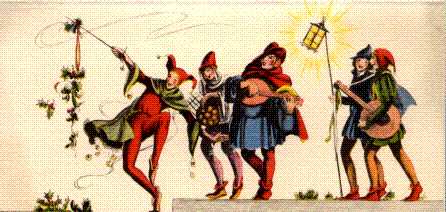
Shrove Tuesday – Such Frivolity!

ShroveTuesdaylrShrove-Tuesday, at whose entrance in the morning all the whole kingdom is inquiet, but by that time the clocke strikes eleven, which (by the help of a knavish sexton) is commonly before nine, then there is a bell rung, cal’d the Pancake-bell, the sound whereof makes thousands of people distracted, and forgetful either of manners or humanitie; then there is a thing called wheaten floure, which the cookes do mingle with water, eggs, spice, and other tragical, magical inchantments, and then they put it by little and little into a frying pan of boiling suet, where it makes a confused dismal hissing, (like the Lernean Snakes in the reeds of Acheron, Stix, or Phlegeton) until at last, by the skill of the Cooke, it is transformed into the forme of a Flip-Jack, cal’d a Pancake, which ominous incantation the ignorant people doe devoure very greedily.  John Taylor, English poet (August 24, 1580 – 1654)

Shrove comes from the old English word shrive = to shrive is to be absolvedshrove following confession.  Those who have received absolution are the shriven.  The priest who dose the shriving is the shriver. The shriven would feast using up all the foods that were avoided during Lent.

The practice of feasting is not complete without revelry and merrymaking. Many of the rules of acceptable behaviour are  set aside so as to ensure that a “wild time” is had by all:

  • Men dressed as women and women dressed as men (Prussia 15th century)
  • Football was played with wild abandon in the streets to ensure that windows were broken and gardens disturbed
  • Dancing in long meandering lines through the streets was encouraged
  • Church clipping:  clasping hands and surrounding the church
  • Jokes were told
  • Magic usually forbidden was preformed
  • Skipping (usually forbidden) was encouraged with up to ten people skipping together using the same rope (considered scandalous at other times of the year)
  • Fortune telling was allowed
  • Dancing was encouraged on church property!
  • Children were encouraged to mock their elders!
  • Tricks were played on members of the clergy.
  • Clergy decked in all their finery engaged in races.
  • Little boys and girls went from house to house knocking on doors and then running away.
  • Water was poured over the heads of officials.
  • Unspeakable things were done to chickens.
  • Eggs were tossed.

Pagan Roots:  the grand battle between Winter and Spring

  • Masks were worn to scare Winter away
  • the pancake is the symbol of the sun
  • music and revelry frightens Winter and Welcomes Spring
  • Church bells were rung at odd times to confuse Winter
  • Skipping made the earth more fertile
  • Boys and girls were encouraged to sneak away together so that matches might become inevitable.
  • Sledding down snowy slopes on Shrove Tuesday encourages the land to be fertile.

Did you know?

  • The faithful once believed that it was advantageous to hang one’s laundry out on Shrove Tuesday because chances were that the laundress having just received absolution, hanging laundry in a town full of folks who had just received absolution was sure to mean that the whites would dry whiter than white!
  • Certain works were forbidden on Shrove Tuesday: mending, sewing, hair combing, rope twisting and grindstone milling. Disobeying these bans will bring about summer storms, winds will rip off roofs, chicken will scratch in gardens, meat will have worms and fingers will swell.
  • Carnival = fare well to carni = meat

John Dear: Following Jesus in Our Culture of Death – A MUST WATCH VIDEO FOR ALL WHO ATTEMPT TO FOLLOW JESUS

john dear

John Dear is a Jesuit priest who is living into Jesus’ call to be a non-violent activist peace-makers. In this video he presents a radical retelling of the Gospel that will change the way you hear all too familiar stories about Jesus. This is perhaps the most exciting interpretation of the life of JesusLazarus come forth that I have ever heard! It will challenge everything you thought you knew about who Jesus was and is. Father John’s gentle style may deceive you into thinking he is just an idealist. But hear him out and I’m convinced you too will be challenged to re-think so many of the stories told about Jesus in the New Testament. I know I will never again hear or preach about the raising of Lazarus without referencing Father John’s insights. A word of caution: you cannot un-hear this passionate call to peacemaking and it will in all likelihood lead you into some dangerous place where you are compelled to deny our culture of death and take up the mantle of peacemaking.

Faithfulness to the Opportunities and Talents We Have Been Given: Parker Palmer

Over the years, I have learn so much from Parker Palmer. In this video Palmer warns of the perils of using effectiveness as our only measure and insists that by asking ourselves the question: “Am I being faithful to the opportunities and talents we have been given?” allows us to see beyond our obsession with numbers, results and immediate effects so that we can be about the work of love, justice, and peace.

[vimeo 35028736 w=600&h=338]

Evolution – There’s No Going Back: an Ash Wednesday Homily

purple light 2

Here’s an Ash Wednesday homily for the 21st century!

We’ve all been there. Driving down the road – distracted by thoughts of this and that, when all of a sudden it happens, a car comes at you out of no where and you slam on the breaks or you quickly swerve to avoid a disaster. You could have been killed. You could have killed someone. Your life or someone else’s life could have been radically changed in an instant. As you pull back into traffic you are ever so conscious of the weight of you foot on the accelerator and you swear that you’ve got to be more careful.  You begin to scold yourself.  What were you thinking? Why weren’t you paying attention? Wake-up you could have been killed.

Welcome to Ash Wednesday. What have you been thinking? Why weren’t you paying attention? Wake-up — you are going to die!!!  Ash Wednesday is your mid-winter wake-up call. Some of you may not need the wake-up call. Some of you know all too well that death is all around us. Some of you have lost someone dear to you. Some of you have felt that fear in the pit of your belly when the doctor suggests a particular test. Traditional Ash Wednesday worship would require us to focus on the brevity of life and remember that none of us will get out of this life alive.  Our ancestors in the faith, entered into a morose season of Lent by via the awesome reminder that they came from dust and soon they shall return to the dust. Continue reading

Ash Wednesday – Stardust

purple universe“Remember that you are dust and to dust you shall return.” are the words that are spoken during Ash Wednesday’s Imposition of Ashes. I have always thought of the dust of the earth, funerals, and death during this age-old ritual. But last year during our worship, we added a new reading to our Ash Wednesday Liturgy. This new creation story embraces a perspective on reality that is all together different than that of our ancestors in the faith. This new perspective turned my thoughts toward life and eternity.

More and more I have come to believe that unless our worship together can embrace reality as it is viewed in the 21st century, we will fail in our efforts to make worship relevant in the 21st century.   

The Star Within

a creation story by Dr. Paula Lehman & Rev. Sarah Griffith

In the beginning, the energy of silence rested over an infinite horizon of pure nothingness.

The silence lasted for billions of years, stretching across aeons that the human mind cannot even remotely comprehend.

 Out of the silence arose the first ripples of sound, vibrations of pure energy that ruptured the tranquil stillness as a single point of raw potential, bearing all matter, all dimension, all energy, and all time: exploding like a massive fireball.

It was the greatest explosion of all time!

An irruption of infinite energy danced into being. It had a wild and joyful freedom about it, and like a dance it was richly endowed with coherence, elegance, and creativity.

The universe continued to expand and cool until the first atoms came into being. The force of gravity joined the cosmic dance; atoms clustered into primordial galaxies.

Giant clouds of hydrogen and helium gases gathered into condensed masses, giving birth to stars!

Generations of stars were born and died, born and died, and then our own star system, the solar system, was formed from a huge cloud of interstellar dust, enriched by the gifts of all those ancestral stars.

Planet Earth condensed out of a cloud that was rich in a diversity of elements.

Each atom of carbon, oxygen, silicon, calcium, and sodium had been given during the explosive death of ancient stars. These elements, this stuff of stars, included all the chemical elements necessary for the evolution of carbon-based life.

With the appearance of the first bacteria, the cosmic dance reached a more complex level of integration.

Molecules clustered together to form living cells!

Later came the algae, and then fish began to inhabit the waters!

Thence the journey of life on land and in the sky.

Insects, amphibians, birds, reptiles, and mammals: all flourished and diversified and elaborated the themes of life. And now it is our time, too.

This is our story.

The story of our beginning, our cosmology.

And so we commence our Lenten Journey this night – this Ash Wednesday, with open hearts in the midst of our Creator.

As we partake in our daily things of life may we see them as sacred.

May we be empowered to perform simple acts of concern and love, and real works of reform and renewal.

Let us love deeply the earth which gives us
 air to breathe, water to drink, and food to sustain us.

May we remember that life is begotten from stardust, radiant in light and heat.

We are all one – all of creation, all that now live, 
all that have ever lived.

Remember we are stardust, and to stardust we return.

Remember we are part of the great mystery.

Remember we are stardust and to stardust we return!


Science, Inspiration, and Sustainability Intersect: Michael Dowd

Michael DowdEvolutionary theologian Michael Dowd insists that “any understanding of God that is not synonymous with the all, reality, ultimacy, or nature is a trivial and inconsequential notion of God.” He warns that how we think about God matters because our attitudes about reality lead to real-world problems. 

Preparing to Preach on Jesus’ Teaching on Non-Violence: Matthew 5:38-48

In the Gospel According to Matthew, the Sermon on the Mount provides a distillation of the teachings of Jesus; teachings Jesus lived for, teachings that eventually made Jesus so dangerous to the oppressive Roman Empire that they executed him as an enemy of the state. The very heart of the Sermon on the Mount is Jesus’ teaching on non-violence.  I can think of no better way to begin my own preparations to preach on this crucial text than to look to the work of the great Walter Wink.  I will always be indebted to this amazing teacher for all that I have learned and continue to learn from him. The videos below comprise the various parts of a lecture that Wink offered on the subject of Jesus’ teaching on Non-Violence. For anyone who aspires to follow Jesus this lecture is a must see. Wink’s books are well worn friends that I have often thumbed through to find more than a nugget or two to enable me to teach anew something that I have long since come to know as a result of Wink’s excellent work! His enlightening trilogy: Naming the Powers, Engaging the Powers, and The Powers that Be along with Jesus and Nonviolence: A Third Way should be at every preacher’s fingertips as we proclaim Jesus’ radical way of being in the world.  Follow this link to a sermon based on these resources.

Atheism for Lent

Atheism for LentFor more details click on this link:  ATHEISM for LENT details

Atonement? – John Shelby Spong

Jack speaking at Holy Cross

Jack speaking at Holy Cross

Bishop John Shelby Spong’s weekly column continues to provide so very much wisdom. Today Jack responded to a reader’s question about “atonement” and the nature of God. Jack is succinct, insightful, wise and inspirational in his response. If you don’t subscribe to Jack’s weekly column, you can find the details here

Question:

God is defined as an Almighty being. An Almighty being does not require atonement (for “sins”). Therefore if God requires atonement as the Bible says, he is imperfect and not Almighty. Does this make sense? In other words, philosophically, the need for atonement indicates a lack of something, which detracts from the perfection which God should have. I would appreciate your thoughts.    

 Answer:   Dear Raymond,

I don’t think that elementary equations in logic are the way to do theology. So let me start my answer by looking at your givens. “God is defined as an Almighty being.” By whom and on what authority? The traditional idea of God present at the heart of Christianity certainly tends to express this, but is it accurate? Can God ever be defined by human beings? Are the limits of the human brain able to be transcended sufficiently so that the fullness and mystery of God can be embraced and articulated? I do not think so.

I consider the popular definition of God as “a being,” who lives in a realm that is external to this world and who is equipped with supernatural power, to be not only inadequate but idolatrous. That is the meaning of theism. If theism as the definition of God becomes inadequate, then the only alternative is atheism. If, however, theism is an inadequate or even inaccurate attempt to define God, then atheism is simply a conviction that the theistic definition, not God, but the theistic definition of God, is not a proper way to understand the holy. In that sense I am certainly not a theist, but I am not an atheist either. The fact that I reject the theistic definition of God does not mean that I reject the reality of the God experience.

Your second given assumes that atonement is the experience of bringing God and human life into a state of oneness, and that somehow this is the goal of religion in general and Christianity in particular. I think atonement theology is bankrupt in that it is built upon a definition of human life as sinful and fallen and then it proceeds to portray God as a rescuer and the savior of the fallen, sinful life.

When I look at the origins of human life, I do not see an original perfection broken by original sin and the subsequent need for divine intervention to save the sinner. I see rather evolving life that went from single cells to complex self-conscious human beings. If there was no original perfection, there was no fall from perfection and therefore no need for a savior and the whole system collapses.

I see God as a presence and a power that leads to expanded life, expanded love and expanded being, and even the experience of an expanded consciousness. Atonement is not the word to characterize this understanding of either God or life. So, rather than worrying about whether God can be understood in terms of atonement, I would prefer to remove atonement from the Christian vocabulary altogether. I hope these brief comments will serve to open up new possibilities in your theological thinking.

My best, John Shelby Spong

Atonement? – John Shelby Spong

Jack speaking at Holy Cross

Jack speaking at Holy Cross

Bishop John Shelby Spong’s weekly column continues to provide so very much wisdom. Today Jack responded to a reader’s question about “atonement” and the nature of God. Jack is succinct, insightful, wise and inspirational in his response. If you don’t subscribe to Jack’s weekly column, you can find the details here

Question:

God is defined as an Almighty being. An Almighty being does not require atonement (for “sins”). Therefore if God requires atonement as the Bible says, he is imperfect and not Almighty. Does this make sense? In other words, philosophically, the need for atonement indicates a lack of something, which detracts from the perfection which God should have. I would appreciate your thoughts.    

 Answer:   Dear Raymond,

I don’t think that elementary equations in logic are the way to do theology. So let me start my answer by looking at your givens. “God is defined as an Almighty being.” By whom and on what authority? The traditional idea of God present at the heart of Christianity certainly tends to express this, but is it accurate? Can God ever be defined by human beings? Are the limits of the human brain able to be transcended sufficiently so that the fullness and mystery of God can be embraced and articulated? I do not think so.

I consider the popular definition of God as “a being,” who lives in a realm that is external to this world and who is equipped with supernatural power, to be not only inadequate but idolatrous. That is the meaning of theism. If theism as the definition of God becomes inadequate, then the only alternative is atheism. If, however, theism is an inadequate or even inaccurate attempt to define God, then atheism is simply a conviction that the theistic definition, not God, but the theistic definition of God, is not a proper way to understand the holy. In that sense I am certainly not a theist, but I am not an atheist either. The fact that I reject the theistic definition of God does not mean that I reject the reality of the God experience.

Your second given assumes that atonement is the experience of bringing God and human life into a state of oneness, and that somehow this is the goal of religion in general and Christianity in particular. I think atonement theology is bankrupt in that it is built upon a definition of human life as sinful and fallen and then it proceeds to portray God as a rescuer and the savior of the fallen, sinful life.

When I look at the origins of human life, I do not see an original perfection broken by original sin and the subsequent need for divine intervention to save the sinner. I see rather evolving life that went from single cells to complex self-conscious human beings. If there was no original perfection, there was no fall from perfection and therefore no need for a savior and the whole system collapses.

I see God as a presence and a power that leads to expanded life, expanded love and expanded being, and even the experience of an expanded consciousness. Atonement is not the word to characterize this understanding of either God or life. So, rather than worrying about whether God can be understood in terms of atonement, I would prefer to remove atonement from the Christian vocabulary altogether. I hope these brief comments will serve to open up new possibilities in your theological thinking.

My best, John Shelby Spong

Valentine??? Who Knew???

rainbow heartsLegends abound! There are three individuals who over the centuries have been credited as being the St. Valentine for whom the upcoming saint’s day is named. My favourite Valentine legend concerns the radical Valentine who ran afoul of the powers that be when he insisted on preforming marriages between pagans, literally someone who lives in or loves the the country or nature, and a Christians. These kinds of marriages were illegal at the time. Other versions of this legend suggest that during the reign of Claudius II it was illegal for soldiers of the Roman Empire to marry. Valentius, a bishop, is said to have conducted secret weddings for Roman soldiers. However the story is told, the idea of a priest preforming marriages which the state and the church refuse to endorse speaks volumes. Cheers and blessings be upon all valentinian priests and officials who continue to engage in courageous acts of love.

Jesus, Gandhi, and MLK – A Very Salty Trio: a sermon for Epiphany 5A

Gandhi on Sermon on the Mt copy

This morning’s readings included Matthew 5:1-12, “What Jesus Means to Me by Mahatma Gandhi (found here) and Matthew 5:13-16. The full text of the Sermon by Dr. Martin Luther King Jr. can be found here. 

Listen to the sermon here:

The Role of the Church in Our New Multicultural World: Walter Brueggemann

The Gospel After Christendom: Phyllis Tickle

A Passionate Commitment to the Christian Vision: John Dominic Crossan

Advice to preachers from the best New Testament scholar I’ve ever met!!! What a preacher needs to have, at a bare minimum, is a “passionate commitment to the Christian vision!” If you don’t have that, stick to worrying about the church’s leaky roof and stay out of the pulpit! Perhaps, it’s his Irish lilt that allows him to make inflammatory statements sound like ordinary common sense.  Dom’s passion for the Christian vision comes through in his articulation of the Jesus’  vision of peace through justice.  Enjoy this interview recorded on Dec. 16, 2013

Peace and Happiness: Karen Armstrong

Contemplating the Beatitudes: preparing to preach on Matthew 5:1-12; Epiphany 4A

The gospel reading for this coming Sunday is Matthew 5:1-12, known as the Beatitudes. The reading is so familiar that we all too often read the beatitudes as if they were a  prescription. However, when read as a description they take on a whole new meaning. Jesus climbed up above the crowd, looked around and saw the poor, the grieving, the gentle, those who were hungry and thirsty for justice, the merciful, the righteous, the peacemakers and the persecuted; and Jesus comforted, uplifted and inspired them with the truth that they are blessed. Jesus was not telling the crowd how to live he was recognizing and affirming who they are. Can we hear this affirmation of our lives? As I prepare to preach on this text, I see the faces my congregation and I know that they are blessed for they too are the poor, the grieving, the gentle, those who are hungry and thirsty for justice, the merciful, the righteous, the peacemakers and the persecuted. The Good News is that the Kindom of Heaven is theirs. 

Walk With Me: Mary Youngblood

Blanket Exercise at Holy Cross in Newmarket

IMG_0190Yesterday, the Holy Cross’ Global Justice Team hosted a Kairos Blanket Exercise. The experience of participating in the Blanket Exercise was  powerful, humbling, enlightening and inspiring. The Global Justice Team did a splendid job of guiding us through Indigenous Canadian history.  We were blessed by the presence of indigenous leaders: Suzanne Smoke (The Georgina Arts Centre and Gallery) and Cathy Elliott (DAREarts). Suzanne brought along her sacred bundle and graciously led a smudge ceremony and talking circle. Cathy gifted us by singing and drumming. Reflecting on the range of emotions that the experience generated, it is clear that in addition to providing a powerful educational experience the gathering opened our hearts and minds to a history which many of us have remained ignorant of for far too long. We have been challenged and inspired to continue to advocate for our First Nations sisters and brothers. 

I am not by any stretch of the imagination a filmmaker, but I did manage to collect a few clips to give you a taste of the experience.

The Global Justice Team has organized a followup to the Blanket Exercise in the form of a Book Club. Check out the titles:

Blanket Exercise Book Club

To view a video of a Kairos Blanket Exercise recorded at New Hope in Calgary click here

Birdsong, Human Creativity, Richard Holloway and Richard Maybey

hollowayIf you are familiar with postings on this blog, you will know just how brilliant I think Richard Holloway is. If you don’t know about this amazing, iconoclastic, barmy former Anglican primate and self-described “agnostic Christian”,  you can begin reading about him here and here