Everything is Everywhere: Carrie Newcomer
Reply

 “In this talk, Father Thomas Keating discusses the dynamic nature of God and the paradox implicit in experiencing divine oneness. With humor and wisdom, he explores the practice of contemplative prayer, and how we might begin to approach God through being present to our senses.”
 A while back, I had the privilege of attending a lecture series given by Phyllis Tickle. During the Question and Answer session, Tickle was asked what advice she would give to someone who was preparing themselves to serve in parish ministry. “Study physics” was Tickle’s reply before going on to speak about the many ways in which theology is changing and will continue to change as a result of our expanding knowledge about the nature of reality. I have been struggling for years to make up for all the things I failed to study before entering the parish and Tickle’s advice rings true. However, physics textbooks are beyond my abilities. That’s why I love this video, which provides a brief glimpse into some of the most dynamic developments in the recent history of physics. For those of us who are practicing theology with our hands tied behind our backs as a result of our lack of scientific knowledge, this video is a fun place to begin to lay a scientific foundation. Using brief biographical dramatizations the filmmakers create a narrative that is both engaging and informative. Enjoy!

This Sunday at Holy Cross, we will commemorate Remembrance Day with a service of lament. As I prepare our liturgy and look toward the sermon, this story floods into my mind. I re-post it here, hoping that the memory of all that has been lost to war will inspire our efforts toward peace.
The young woman can still remember one particular Remembrance Day when her words and actions did nothing more than offend someone she loved very much. It was the one and only argument she ever had with her Grandmother and it happened over Remembrance Day. At the time, she was living in London. She remembers thinking that Londoners take Remembrance Day very seriously indeed. More so, she thought, than in her native Canada. She wondered if the blitz had something to do with it.
While most of the poppies people wore were red, she began to see white poppies appear on the lapels of more than just a few people. She read in the newspaper that those who were committed to peace and believed that for the most part, Remembrance Day only serves to glorify war were donning white poppies. You could pretty well draw a dividing line between the generations using the colors of poppies as your guide. Young people, who had never experienced war tended to wear white poppies, while those who were older and who had memories of war, tended to wear red poppies. In many homes poppies in and of themselves managed to start wars.
The idealistic young woman was just twenty and her commitment to peace determined her choice. She was wearing a white poppy the day she traveled up to the Midlands to visit her Grandmother. It was the day before Remembrance Day when she arrived on her Grandmother’s doorstep. She’d forgotten all about the white poppy that adorned her lapel. She couldn’t help thinking that there was something odd about the reception she received from Grandmother. It wasn’t exactly what you would call warm. Her Grandmother was upset about something. But the young woman couldn’t quite figure out what, because her Grandmother appeared to be giving her the silent treatment. She just served dinner and listened quietly as the young woman chatted on about her week in London.
After dinner, the young woman suggested that they pop down to the pub for a chat with her Grandmother’s neighbors. Usually, her Grandmother would have jumped at the chance to show her granddaughter off to her friends. But she seemed more than a little reluctant on this occasion. She so rarely refused her granddaughter anything, but it still took a great deal of cajoling before the young woman managed to talk her Grandmother into venturing out into the world. As they were putting on their coats to leave, the Grandmother asked her granddaughter to remove the white poppy from her coat.
The young woman looked at her Grandmother’s red poppy and refused. She began to lecture in that pompous way that only young people who don’t know any better can about the horrors of war and the need to stand up for peace. Her Grandmother insisted that she could stand up anywhere that she wanted to for peace but not in her local, not in front of her friends, not tonight. And then their battle began in earnest. They started calmly, but firmly arguing over the damn poppies. Before long, they were shouting and eventually the Grandmother, stormed out of the house and went to the pub without her granddaughter.
The young woman discretely went to bed before her Grandmother came home. Each woman slept fitfully, bemoaning the fact that they had declared their own kind of war.
Early the next morning the young woman rose quietly, hoping to dash off to London before her Grandmother awoke. She was just about to make a clean get away, when her Grandmother came into the living room. She was carrying a uniform. A uniform the young woman had never seen before; a uniform that stopped the young woman cold in her tracks.
Over breakfast the old woman explained that during the Second World War, she had joined the Women’s Auxiliary Air Force. The men were all off fighting and so the government had consented to letting women do their bit. Her job in the WAAFs was carried out on the home front. Every evening after she had fed her kids supper, she would send them off to the air-raid shelter with a neighbour, then she would put on her uniform and head off to the hills over Birmingham, where she would “man” an anti-aircraft gun.
After telling the young woman stories that she had rarely told anyone before, the old woman invited granddaughter to come her to British Legion later that morning. Awed by all she had been told, the young woman changed her plans and agreed to meet her Grandmother down at the Legion hall in about an hour.
On her way to the Legion hall, the young woman bought a red poppy and timidly pinned it to her lapel. When she finally caught up with her Grandmother, the old woman couldn’t help but smile when she saw the red poppy pinned to her beloved granddaughter’s lapel.
The young woman couldn’t manage a smile. Not threw her tears. The young woman was overcome by the sight of the white poppy that was pinned to her Grandmother’s lapel.
The two women fell into one another’s arms and for a moment, just a moment the two held one another other in the presence of a peace beyond words; a peace which surpasses all our understanding. The peace that only love can achieve. The peace that the world is dying to experience. 
As the last post was trumpeted on that cold November 11th, separated by generations, perspectives, opinions, and commitments, two women stood united in love and remembered. Together they stood hoping against hope for peace.
 While Rob Bell’s theology only begins to pierce the dogmas that continue to plague Christianity, he does have the common touch necessary to provoke and encourage Christians to begin to question what they have long been taught about the nature of reality. If you’ve been questioning dogma for some time, you will find a kindred spirit in Bell even as you wish he’d move a little farther and deeper into his vision of what Christianity might have to offer in this new century. But his latest book “What We Talk About When We Talk About God” is worth considering as a gift to someone you might know who is just beginning to open themselves to the possibilities of a new way of exploring and articulating Christianity. In the videos below, Bell’s common touch is demonstrated as Oprah gives him ample opportunities to demonstrate his deftness at expressing Christianity in ways that encourage viewers to re-think what they thought they knew about Christianity.
You can watch the full episode here
 Pastor Dawn and Pastor Tom Doherty’s All Saints’ Sunday sermon included stories from the congregation celebrating the saints in their lives. Be sure to listen to the Hymn of the Day that follows the sermon: “We Come to Tell Our Stories” with new words by Jann Aldredge-Clanton to an old familiar tune (HANKEY by William E. Fischer – I Love to Tell the Story).
click here to see an earlier post about Jann Aldredge-Clanton
L’Chaim – To Life!!! To all those blessed saints who have touched and continue to touch my life!!! All too often we forget the sacredness of the people in our lives! So here’s too all those saints who parade around us each and every day. May we have the wisdom to see the sacred in, with, and through them.
 All Saints’ Day is a day for remembering. The word saint simply means “holy”. In the New Testament, all those who believe and were baptized were referred to as saints. It wasn’t until round about the third century that the church began using the word saint to refer to those who had been martyred for the faith. Over time these martyred saints were held up for veneration and people used to pray to them to intercede on their behalf. I’m not going to go into all of the institutional abuses that led Martin Luther and the later reformers to abolish the veneration of the saints. Except to say, that while the Reformation put an end to the veneration of the saints in the protestant churches, it did not abolish the concept of sainthood.
Within the mainline protestant denominations, we use the term in much the same way as it was used in the New Testament to describe the faithful. We talk about the communion of saints to describe all the faithful who have gone before us who now rest in God, together with all the living who walk in faith. So today as we celebrate the saints, we give thanks for all the faithful those living and those who have gone before us.
Today, I remember and rejoice as I give thanks and praise to God for the witness of St. Joyce of Belfast. St. Joyce who in her own way taught her children to love God and to pray always. And so today, I give thanks and praise to God for the life and witness of St. Joyce of Belfast, my Mom, who was the first to teach me the Lord’s Prayer, and who puts flesh on Christ’s command that we love our neighbours as we love ourselves.
Today I remember and give thanks for the life and witness of St. John of Wales, whose life in the church as a choir-boy was followed by long years of self-exile and whose keen wit and lack of patience with hypocrisy instilled in me a desire for honesty and integrity in the articulation and living of the faith. I give thanks for St. John, my Dad, whose open heart has stretched his discerning mind and enabled many to see the humour in this God-given life we live.
Today, I remember and rejoice as I give thanks and praise to God for the witness of St. Valerie of Ladner. St. Valerie so loved and feared God that she dared to reach out and invite a wayward soul to come and worship God. St. Valerie sang God’s praise, rejoiced in the communion of saints and helped a young friend find a home in God’s holy church. And so toady, I give thanks and praise to God for the life and witness of St. Valerie, my high school friend, who was the first to invite me to come and worship God.
Today, I remember and rejoice as I give thanks and praise to God for the witness of St. Wilton of Lunenburg. St. Wilton loved God all the days of his life and served God with gladness and distinction. St. Wilton went far beyond his call as pastor, he opened up the scriptures to those who eagerly sought the truth of God’s Word with love and dedication and he went on to inspire a diligence to scholarship that nurtured the faith of so many young people. And so today, I give thanks and praise to God for the life and witness of St. Wilton, my first pastor, who taught me to be uncompromising in my study of the scriptures, and steadfast in my love for God.
Today, I remember and rejoice as I give thanks and praise to God for the witness of St. Lola of Washington. St. Lola whose appreciation for God’s grace overflowed in her love for the world. St. Lola whose desire to share God’s grace and truth, led her to give of her time and talent to the care and redemption of so many young seekers. St. Lola whose love for God’s creation inspired her to teach so many of us to give thanks to God for all that God has made. And so today, I give thanks and praise to God for the life and witness of St. Lola, my mentor in the faith, who taught me to love as I have been loved.
Today, I remember and rejoice as I give thanks and praise to God for the life and witness of St. Fritz of Chicago. St. Fritz whose dedication to the Word of God was displayed in all he did. St. Fritz who opened so many minds to the beauty of God’s ways, who taught, inspired and entertained as he sought to reveal the wonders of God’s unimaginable grace. St. Fritz who taught me that no question is unaskable for it is God who blessed us with minds and who bids us to use them in our love for God and for one another. And so today, I give thanks and praise to God for the witness of St. Fritz, my friend, who was the first to call me to the ordained ministry of Word and sacrament.
Today, I remember and rejoice as I give thanks and praise to God, for the life and witness of St.s Sharon and Irene of Pt. Roberts, St. Ellen of Lonsdale, St.s Jerry and Daniel of Minnesota, St. Nancy of Seattle, St. Anne of Vancouver, St. Donald of UBC, St.s Carol, John, Eduard, and Donna of Waterloo, and for the great cloud of witness both living and dead who have testified to God’s love in my life.
Toady, I give thanks and praise to God for the cloud of witnesses who gather to worship God and to love one another in the parish I serve. I give thanks for all the glorious saints of Holy Cross who have nourished, challenged and helped me to grow in Christ.
Today, I encourage each and every one of you, to remember and rejoice, as you give thanks to God for the great cloud of witnesses who have been a blessing to you; who have revealed God’s love to you; who have taught you God’s holy Word of truth; who have loved you, nourished you, challenged you and inspired you to love God with all your heart, with all your soul and with all your mind and to love your neighbours as you love yourself.
Who are the saints in your life? Think about the saints who revealed God’s love to you. Remember and rejoice for by their love, they taught you God’s Word, and taught you to celebrate God’s grace. Remember and rejoice in the saints of God, who are responsible for having passed the gifts of faith on to each of us. Saints who you may never read about in the church history books, but saints who by their life and witness managed to reveal a measure of God’s amazing grace to the world.
These saints of God who are so dear to us and so precious to God, are just ordinary folks who in the course of seeking to be faithful followers of Jesus Christ, in striving to love God with all their heart, soul, and mind, they ended up touching our lives in ways that changed us and had a profound effect on who we are today.
Today is a day for remembering and rejoicing in the communion of saints. Today is a day for giving thanks to God for their lives and for the witnesses that they have been and are in our lives. But today is also a day for looking around us to discover our own place in the communion of the saints. Take just a moment to think about how people will remember and give thanks for your sainthood. Whose faith have you nourished? Whose faith will you nourish? How will you nourish people in the faith? What role are you prepared to play in the Communion of Saints?
The Reverend Dr. Otis Moss III says it well listen to St. Otis preach it!
 The Spirit of Reformation has broken free from the institutional church and just as Ruah lives and breathes in, with, and through all of creation, She longs to find expression in us. In Thomas Berry the Spirit found wonderful expression. Through Berry’s words the Spirit calls us to a whole new Reformation.
 In 1998 the Bishop John Shelby Spong looked around at the state of the church and decided that it was time for a new reformation. Just as the invention of the printing press helped to distribute Martin Luther’s protests, the development of the internet spread Jack’s vision around the world. To those who were hungry for change, they were a breath of fresh air. Fifteen Reformation Day celebrations have elapsed since their publication and while there are pockets of progress within the church, what Jack has coined as the “church alumni” continue to bemoan the recalcitrance of the institution as yet another generation has been lost. While so many have pronounced a judgment of irrelevance upon the institution, a remnant has begun to embrace Jack’s questions. I repost them here in the hope that the Spirit of Reformation lives and more and more communities will enthusiastically embrace the challenges of being Church for the 21st century. I hope you will add your own theses in the Spirit of Semper Reformanda!
Jack posted his Twelve Theses with these words: “Martin Luther ignited the Reformation of the 16th century by nailing to the door of the church in Wittenberg in 1517 the 95 Theses that he wished to debate. I will publish this challenge to Christianity in The Voice. I will post my theses on the Internet and send copies with invitations to debate them to the recognised Christian leaders of the world. My theses are far smaller in number than were those of Martin Luther, but they are far more threatening theologically.”

 Today’s Reformation Sunday Liturgy followed the theme Semper Reformanda: Always Reforming! The sermon looked at various protests of the ongoing reformation, including Luther’s 95 Theses, (here) John Shelby Spong’s Twelve Theses, (here) Matthew Fox’s 95 Thesis for the 21st Century, (here) Holy Cross’ Mission Statement (here) and Holy Cross’ Statement of Welcome (here).
 This morning we will gather at Holy Cross to celebrate the Reformation. Our liturgy’s theme is “Semper Reformanda: Always Reforming. As one of our Gathering Songs we will sing David Lohman’s hymn: “For All the Children”(PDF of the music here). We will sing this song of radical welcome for all those who have ever been excluded from the church in the hope that reformation will come quickly to the whole church.
For All the Children is performed in the video below which was produced by Catholics for Marriage Equality MN, “For All the Children” is a powerful and inspiring music video featuring over 300 Catholics singing their support for LGBTQ young people and spreading the good news of Christ’s love. Recorded in April of 2012, “For All the Children” was premiered August 15 in Minneapolis at a special C4ME-MN event entitled “I Do! Believe in the Freedom to Marry.”
Semper Reformanda: Always Reforming!!!
 “God has, in fact, written two books, not just one. Of course, we are all familiar with the first book he wrote, namely Scripture. But he has written a second book called creation,” so said Francis Bacon. As our knowledge of creation expands, how will our relationship with these two books evolve?
As I contemplate the church’s celebration of the Reformation, I am struck by the wealth of information that can be summoned by my fingertips. Just as the invention of the printing press worked its own kind of magic on the Christian Church, the electronic media has propelled us into the Age of Information and Christianity is evolving. The impact of our expanding knowledge is changing the way we view reality and our place in it. As the religions of the world continue to evolve, we can begin to open ourselves to the wondrous possibilities of an entirely new understanding of reality. No history of the reformation that is happening all around us will be complete without the inclusion of our broadening understanding of our biological origins.
 David R. Weiss’ “To the Tune of a Welcoming God: Lyrical reflections on sexuality, spirituality, and the widness of God’s welcome” is a wonderful resource for worship planners who are searching for ways to engage worshippers in the difficult task of breaking down barriers to inclusion. As I wrote in the previous post, “they don’t go home humming the sermon!” Music opens our very selves to
 that which is beyond ourselves and Weiss has written some powerful texts that can be coupled with well loved, familiar hymn tunes. I was first exposed to Weiss’ way with words a number of years ago when Lutheran’s Concerned included his “O Christ Who Came” in their worship resources for the celebration of Reconciling in Christ Sunday. When set to the tune of LONDONDERRY AIR (that’s O’ Danny Boy, for the uninitiated), Weiss’ words provide an expansive welcome that we have often sung with gusto at Holy Cross. So, I was delighted to discover, on iTunes of all places, the album “To the Tune of a Welcoming God” by Sara Kay. After quickly downloading, I began to listen to all sorts of possibilities for worship in Weiss’ splendid texts set to familiar tunes. In addition to providing hymn texts that expand our vision of what it means to extend a welcome to the GLBT community, Weiss’ texts open worshippers to images of God that move us beyond words as they open us to theologies that embrace the reality of the cosmos. You can follow this link to find a copy of the hymn texts.
In addition to the hymn texts, Weiss’ book provides a collection of essays in which Weiss offers a vision of what the Church can become. Weiss is writes from his own Lutheran perspective reflecting his own struggles in work of building a more inclusive church. Weiss opens the book with his own “Credo” which I look forward to using in liturgy as an “Affirmation of Faith”.
Credo: By David R. Weiss
I believe in God,
The Great Mystery that is the Source of all that is,
I believe that God is beyond our words
And surely beyond our genders,
But that we are still invited to name God as best we can,
With humility and wonder.
I believe in God’s love for all creation, not just humanity.
I believe in God’s yearning,
That justice hold sway in every corner of creation
And in God’s anxious longing
For Sabbath joy to fill the cosmos.
I believe that the deep beauty of Jesus’ life
Is a true revelation of God’s desire to see compassion
At the center of human community.
I believe that Jesus’ healings, parables, and table fellowship
Reveal the truth of God active in our midst.
And I believe that in Jesus’ life
We hear an invitation to echo such compassion
In our own lives.
I believe that Jesus’ death
Reminds us that oppressive power
Will stop at nothing –
Then or now – to silence compassion.
And I believe that resurrection
Names the miracle that takes place –
Then and now – whenever we rededicate
Our lives to compassion
Thereby announcing that even death
Cannot silence the love of God.
I believe that besides Jesus’ life
And besides the biblical text,
Other lives and other texts also bear the truth of God –
And that our lives are richer for listening well
To the movement of God in many places.
I believe that God continues to be present still today
And that the Holy Breath of God blows
Whenever and wherever compassion is born,
Whether in our words, deeds, or rituals.
I believe we have a special responsibility
To gather in community and share rituals,
Both ancient and fresh,
That exercise our imaginations,
Both bodily and spiritually
For the practice of compassion.
I believe that in our lives
We have the capacity to move God,
This loving mystery that dwells at the heart of all that is,
To the point of tears.
And I commit myself,
With my brothers and sisters and the whole of creation,
To living in ways that seek to move God to tears of joy.
Amen.
 Liturgy has the power to from us in ways that preachers can only dream of. The truth is worshippers don’t go home humming the sermon. What we sing in worship matters precisely because music has the power to both open us up and shut us down to change. As our theology evolves, so too what we sing in worship must evolve. But familiar chestnuts are familiar for a reason. Our favourite hymns are singable! Sadly, so many of the best loved hymns inscribe theologies that posit a god that few of us are willing to worship. But rather than throw the babies out with the bath water, we can give the best loved hymn tunes a new lease on life with texts that do not re-inscribe theories of atonement that we are trying to leave behind. I have been asked to share some of the resources that we have found helpful at Holy Cross and over the next few weeks I hope to post several resources.
 It hasn’t been easy to find new words with which to resurrect old hymns. But there are two resources that warm the heart of this particular worship planner. Both “Inclusive Hymns For Liberating Christians” and “Inclusive Hymns for Liberation, Peace, and Justice” are the work of Jann Aldredge-Clanton who is responsible for the hymn texts and Larry E. Schultz who provides a few new tunes for Aldredge-Clanton’s texts. I highly recommend both volumes for those progressive Christian worship planners who seek to use music to open people to the possibilities of more expansive theologies. Aldredge-Clanton’s texts go far beyond “inclusive language” for God and for people.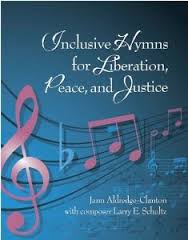
Jann Aldredge-Clanton currently serves as adjunct professor at Perkins School of Theology and Richland Community College, Dallas, Texas. Her vivid imagery opens the mind while familiar tunes comfort the spirit.
The good news is that although these resources are not easy to get in Canada, I ordered mine from Amazon.com in the U.S. and the shipping charges were minimal. Better yet, with the purchase of 10 or more you get permission to reproduce hymns for worship.
Here are two videos that provide of just two of the pieces sung in very different worship styles.
 Preparing to preach on Reformation Sunday I found this sermon I preached a few years ago. Our readings that year included both John 8:31-36 and Luke 18:9-14
When my friend, (let’s call her Jane for the purposes of this sermon), when Jane was a baby she had a pale green receiving blanket. It was soft to the touch, with a two-inch band of satin around the edge. It kept Jane safe and warm and as she grew her fondness for that blanket grew. In time it became her very own security blanket and heaven help you if you were the one trying to settle her and you couldn’t find her blanket. As Jane learned to talk, for some reason that old green blanket earned the nick-name “Nuggie”. If Jane was upset or fussing, she would holler for her Nuggie and the entire household would scramble to find it. Jane dragged Nuggie everywhere she went and it often got very dirty. We learned very quickly to launder Nuggie long after Jane had settled down for the night. One of us would sneak into her room and gently ease Nuggie from her grasp and quickly toss it into the washing machine, hoping against hope that she wouldn’t wake until we retrieved it from the dryer and tucked it safely back in her crib. Jane was particularly fond rubbing the satin over her cheek and over the years the satin edge became worn and frayed. Whenever life wasn’t going her way, or she was not feeling well, or she was tired, or if she was frightened, Jane would scream, for her Nuggie. Only after her Nuggie was firmly in place and she had comforted herself with the soft satin, would order be restored.
Standing here, smack dab in the middle of a Reformation of epic proportions, it feels to me like someone is trying to steal my Nuggie. Semper Reformanda — Always Reforming. Change, change, change. Sometimes I just want the security of that old time religion. I want to feel the comfort, the security that I once felt in the church. All this reforming is wearing me out. I’m tired of thinking. I’m tired of reforming my ideas. I’m tired of learning new things. I’m tired of all the questioning. I’m tired of all the questions. I want some answers. Sometimes I just want that Mighty Fortress to keep me safe. Sometimes I just want that Almighty Father to say, “There, there dear it’s all going to be all right!”
I knew were I stood in the old days. I was a wicked sinner. Heck, I was in bondage to sin and could not free myself. But I knew that Jesus was willing to die for me and save me from all my sins. I knew beyond the shadow of a doubt that even though I was a sinner, I was a forgiven sinner, simule justus et pecator. By the grace of God, I was both saint and sinner. Justified by God’s amazing grace. Thanks to the redeeming blood of the Lamb of God who washes away all my sin. Jesus died for me. Jesus saved me. And Jesus wants me for a sunbeam. Give me Jesus. Give me Jesus! I want my nuggie!
But in the words of dear old Martin Luther,“ Here I stand, for I can do no other.” Smack dab in the middle of a reformation, trying to follow Jesus. Jesus, who said that everything could be summed up in two commandments: “Love God with all your heart, with all your soul, with all your strength and with all your mind, and love your neighbour as you love yourself.” If only Jesus had left our minds out of the equation. If only we could switch off our minds and stop this constant quest for truth. But then Jesus did say, “you will know the truth, and the truth will make you free.” So, how can we keep from asking: “Free from what?” Continue reading
 Delighted that so many of you after reading yesterday’s post have expressed interest in learning more of Matthew Fox’s 95 Theses for the 21st Century. The best place to find out more is in Fox’s little book “A New Reformation: Creation Spirituality and the Transformation of Christianity” published in 2006 by Inner Traditions press.
Click Here where you will find a complete list of Fox’s 95 Theses for the Twenty-first Century
 In the spirit of the Reformation motto: semper reformanda – always reforming, what say we abandon the fortresses of our traditions. This Sunday, Lutheran churches all over the world will begin their Reformation Sunday worship services vigorously singing “A Mighty Fortress” and I for one wish they wouldn’t. I suspect that the hymn’s author Martin Luther might just agree with me. After all didn’t Luther write a Mighty Fortress in an attempt to bring the popular music of the day into the church? I am convinced that this particular Reformation Sunday tradition has dear old Martin spinning in his grave at the thought that the church that bears his name is still singing a tired old chestnut like A Mighty Fortress to celebrate the Reformation. The very idea of 21st century Lutheran’s celebrating the Reformation by clinging to the events of the 16th century is an affront to the memory of Martin Luther. Continue reading
 Ai Weiwei’s exhibit “According to What? at the Art Gallery of Ontario inspired me to look beyond traditional interpretations of Jesus’ parable of the Pleading Widow to see our role as the unjust judge. The gentle breath of a newborn granddaughter enabled me to hear God persistently pleading for justice.
Listen to the sermon here:
Our second reading was taken from Mechthild of Magdeburg’s “The Flowing Light of the Godhead”
 Our Scripture Hymn used Ruth C. Duck’s words.
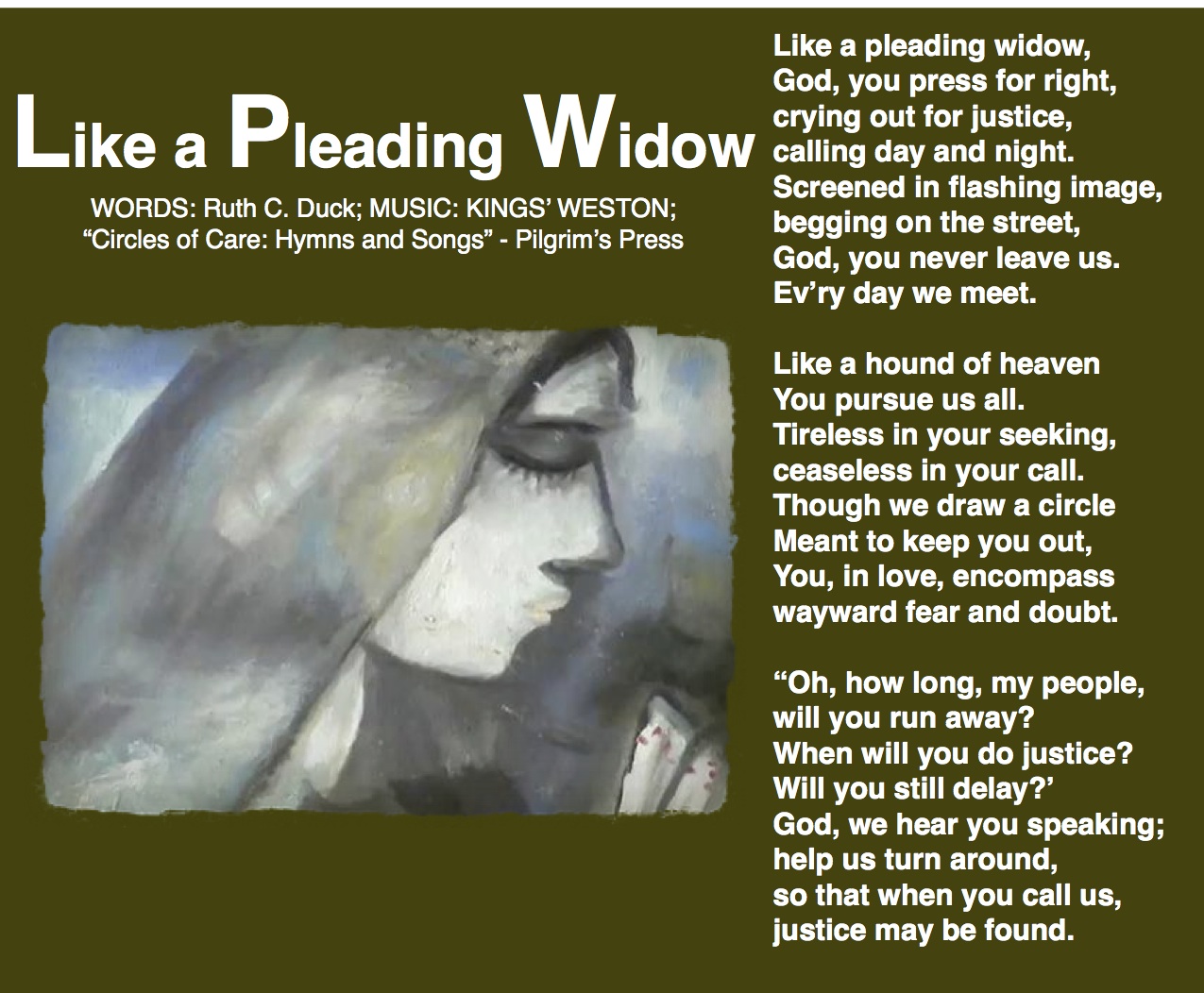
 Looking back on a sermon I preached six years ago on this week’s readings from Genesis 32:22-31 and Luke 18:1-8, I am struck by how much my own images of the Divine One we call God have changed and yet remain oddly similar. The intervening years have afforded me the opportunities to begin to leave behind notions of an anthropomorphic God who intervenes in our lives. As I have embraced the writings of progressive and evolutionary theologians, I have struggled to understand and articulate God’s nature from the perspective of panentheism (everything is in God). There are those who suggest that this is a departure from the Christian tradition. Yet looking back, I am beginning to see this movement as a natural progression of the tradition. Indeed, so much of what I have always loved about Lutheran theology has freed me to explore this path. So, I offer this old sermon as a snapshot of my own pathway toward new visions of the Divine. I trust that my early efforts to move beyond the notion of God as the “unjust judge” will move some to begin to see God in, with, and through all those who persistently plead for justice.
What little I know about the art of wrestling I learned from my brother Alan. He and I are just eighteen months apart in age and together we participated in many a wrestling match. All too often one or the other of us would be bothering the other and before we knew it we were rolling around on the floor wrestling. I’ll have you know that up until the age of about twelve I was quite a good wrestler. Up to that point I usually managed to hold my brother to the ground and with my knees firmly pinning his arms I would be able to get my brother to agree to my point of view. But my brother’s adolescent growth spurt put an end to my winning streak. Just as soon as my brother was big enough to pin me to the ground I decided to stop bothering him. Bothering my brother became dangerous and I had to give it up in order to save my dignity. Continue reading
 pastordawn