Pentecost Sunday is a day for stories about the nearness of God. So we begin with the story of the Tower of Babel from Genesis 11:1-9, then make our way to the anonymous gospel-storyteller we call Luke’s story of the early followers of Jesus’ encounter with the Holy Spirit at Pentecost in Acts 2:1-21, and then the anonymous gospel-storyteller we call John’s story of Jesus’ insistence that he and God are one, before rounding off with Sandy Eisenberg Sasso’s excellent children’s book God In Between.
There’s a children’s Book that I love. I won’t tell you the name of the book because the book’s title is also the book’s ultimate meaning. I will tell you that the book is written by Sandy Eisenberg Sasso, who just happens to be the second woman to be ordained as a rabbi back in 1974. She is also the first rabbi to become a mother. Sandy Eisenberg Sasso brings the wisdom she has learned as a rabbi to her children’s books. As the Christian celebration of Pentecost is intimately tied to the Jewish festival of Shavout, when the Jewish people read the Book of Ruth, it seems fitting to read to you from the book of a Jewish Rabbi. Shandy Eisenberg Sasso’s story begins:
“Once there was a town at the foot of a hill with no roads and almost no windows.
Without roads the people of the town had nowhere to go, and they wondered what was on the other side of the hill.
Whenever they tried to leave their homes, they would sneeze through tall tangled weeds, tumble into deep holes and trip over rocks as large as watermelons.
Without windows they would sleep late into the day, and they often wondered when the sun turned night into morning.
Their houses were closed up like boxes sealed with tape.
They could never look out and their neighbours could never look in.
This coming Sunday’s first reading from the book of Acts provides an excellent opportunity to explore a vision of God that has all too often been ignored by institutional Christianity. While doctrines of the Trinity abound, the rich tradition of panentheism that permeates the writings of the mystics is neglected. For those of us who are attempting to reconcile all that we are learning about the realities of the cosmos with our visions of the ONE who lies at the very heart of reality, panentheism provides a way of speaking about God that moves us beyond theistic notions of personifications of the deity toward a deeper awareness of the presence of God in all things together with the assurance that everything is in God.
Let me begin by saying, that panentheism is, in and of itself, an evolving term. The term can be found in the works of German philosopher G.W.F. Hegel, process theologian Alfred North Whithead, and more recently in the work of Juergen Moltmann, Matthew Fox, Philip Clayton and Marcus Borg (for Borg’s ideas about panentheism follow this link). The word itself is made up for three Greek words: pan = all, en = within, theism = god. Panentheism is used to describe God as ONE who is in everything. Panentheism (unlike pantheism) does not stop with the notion that God is in everything, but goes on to posit that everything is God. God is in the universe and God transcends the universe. God is greater than the sum total of the universe. But the universe cannot be separated from God. We are in God and God is in us. God breathes in, with, through, and beyond us.
The term panentheism is proving helpful to Christians in the 21st century who are working to articulate our faith in light of all that we are learning about the universe. It is also invaluable to those of us who have a deep reverence for creation and are seeking ways to live in harmony with creation by treading lightly upon the earth. Panentheism is also a concept present in many faiths and provides us with a common way of speaking together about our Creator. But like all language the term fails to fully capture the nature of the Divine. It is merely a tool to help us think beyond the idols we have created to function as objects of our worship.
The Apostle Paul insisted that God is “the One in whom we live and breath and move and have our being.” (Acts 17:28) As we look towards the heavens, we see an ever expanding new story of who we are. Just as Paul struggled to find ways to articulate the nature of the Divine to his contemporaries, Christians continue in every age to find ways to articulate the nature of the Divine to each new generation. We do not abandon the wisdom that has been offered by those who have gone before us. But we cannot ignore the wisdom that is being revealed to us here and now in our time and place within the communion of saints.
Whenever we try to articulate what God IS, language fails us. For the most part, the institutional church has defined God with words and expected that members of the institution will confess loyalty to those words. Many of the words, with which the institution has traditionally described God, craft an image of God as a supernatural being up there or out there who is responsible for creation and from time to time interferes in the workings of creation. As we continue to learn more and more about the magnitude of creation, both in time and space, our traditional words about God seem ever more puny. While some respond to our ever-expanding knowledge about creation by attempting to make our notions of God fit into the tight little containers that were crafted by our ancestors, some are seeking new ways to speak of the CREATOR OF ALL THAT IS, WAS OR EVER SHALL BE. Often our attempts are as clumsy and as limited as the attempts of our ancestors. But sometimes, sometimes the likes of Tillich breathes new life into the notions of our ancestors and Paul’s description of our God as “the one in whom we live and move and have our being” becomes for us, as Tillich imagines, “the Ground of our Being”.
Below is a video that I have shown to Confirmation students (ages 12-15) as we begin to explore the great religious questions that have inspired wisdom seekers from the beginning of human consciousness: Who am I? What am I? Where do I come from? Why am I here? Where am I going? etc. The responses of young people inspire me! I cannot wait to see what they will reveal to us about the nature of our reality! As you watch this video, I offer you a benediction. It is a blessing that I have adapted with permission from the work of John Shelby Spong.
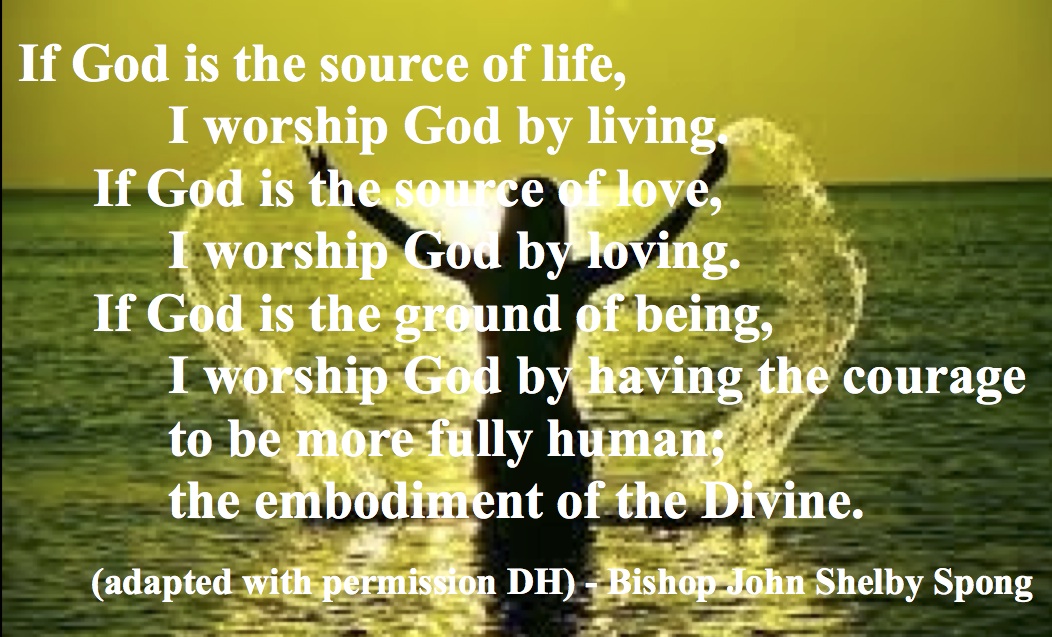
God is the source of life, so worship God by living,
God is the source of love, so worship God by loving.
God is the ground of being, so worship God by having the courage
to be more fully human; the embodiment of the Divine.
Mothers’ Day is not on the church’s liturgical calendar and yet the statisticians tell us that church attendance on Mothers’ Day is surpassed only by Christmas and Easter. Worship leaders who fail to mark the importance of this day do so at their peril; the same kind of peril that compels so many reluctant offspring to accompany their mothers to church. However, a simple liturgical nod in the direction of mothers or an over-the-top sentimental sermon all too often fails to capture the magnitude of the day’s significance in the history of women. Planning the liturgy is challenging enough, but writing the sermon is a challenge which promises to keep me toiling away into the dark hours of this coming Saturday. So, for my colleagues who share a similar plight: below you will find links to previous attempts to commemorate this day of days. Feel free to share your efforts with me in the comments section. Please! I need all the help you can offer!!! click on the links below for previous Mothers’ Day sermons:
Three years ago, when the Road to Emmaus lay before us in the lectionary, Michael Morwood was our guest preacher. It was an amazing weekend at Holy Cross as we explored a new story of what it means to be human and discovered new ways of contemplating the Divine Presence that permeates the cosmos. Michael Morwood taught us and challenged us to peer through 21st century lenses at the one we call G-o-d. Michael concluded his time with us by delivering the sermon on Luke 24:13-35 in which he moved us beyond the Easter stories to a place were we could imagine so much more than words can capture! Enjoy!!!
Firefox users will need to click on this link to listen: Morwood sermon
This Sunday the gospel text invites us to travel down our own road to Emmaus. Stephane Brozek Cordier is a poet whose words have the power to open us to our deepest wonderings as we wander down that road.
This sermon was inspired on my own journey to Emmaus where in the space of the same afternoon I heard a stranger declare: “Christianity is dead!” and Karen Armstrong’s now famous TED talk about her call for a world Charter for Compassion.
Has anybody here ever been to Emmaus? Which one? According to the latest issue of Biblical Archeology there are at least nine possible locations that are candidates for the Biblical town of Emmaus. Historians tell us that there is no record of any village called Emmaus in any other ancient source. We simply don’t know where Emmaus might have been. Tradition, tells us that it might have been a place just a few hours walk from Jerusalem. New Testament scholars, Marcus Borg and John Dominic Crossan suggest that Emmaus is nowhere. Emmaus is nowhere precisely because Emmaus is everywhere. Each and every one of us has at one time, or indeed for some of us, many times, traveled along the road to Emmaus.
I know that I have been on the road to Emmaus most of my life. I’ve had lots of company on the Road to Emmaus. I’ve had many conversations along the way discussing, with anyone who’d care to accompany me, the ifs, ands, and buts of Christianity, of religion, and indeed of life. If you haven’t traveled down the road to Emmaus you must be very skilled in the fine art of turning off your brain and if you check you just might discover that your heart isn’t actually beating.
It’s so easy to imagine, those two characters striding down the Road to Emmaus that we can almost hear them talking, maybe even arguing about what happened. What on earth were they to make of all this! Jesus was supposed to be the Messiah. Jesus was the One who had come to liberate Israel, to free the people from oppression. Jesus was the One who was supposed to draw the people back to God, restore the relationship between God and God’s people. Now Jesus was gone, and what had changed? Now, Jesus was gone, and the Roman Empire was still oppressing them, still inflicting such pain and hardship, still killing them. Was it all a mistake? Was it all a lie? Had they been fooled by some kind of cruel hoax—were they wrong to put their hopes in this man from Nazareth? They had trusted Jesus believed in Jesus, followed Jesus. Their lives had been changed. They had seen the lives of others changed and they had expected even greater changes to come. Jesus had confronted corrupt powers. Jesus had charmed great crowds. Jews and Gentiles alike responded to the truth of Jesus’ teaching. Rich and poor had come to Jesus, believing in Jesus’ healing power. But Jesus had been shamed, and ridiculed, and humiliated, and crucified and now Jesus was dead. Well, was Jesus dead? Some said they’d seen Jesus, alive! Not that Jesus had survived the crucifixion by some miracle of strength, but that Jesus had risen from the dead. They seemed so totally convinced by their own experience…were they confused by their own grief? Were they delirious? Had they loved this Jesus so much—invested so much hope in Jesus life and leadership—that they simply could not let him go? And what did ‘resurrection” mean? Apparently it was not the resuscitation of a corpse. Jesus wasn’t revived to resume his former life; to take up his broken body until the day he might die again. No, somehow this was some new mode of being that seemed to be spiritual to some and yet real to others. And, if Jesus were risen from the dead, what would be the point of all that? What was the point to a Messiah—to a presumed political and religious leader—if Jesus wasn’t able to lead people here on earth? How could Jesus restore Israel when he had so easily been defeated by a handful of Roman guards? How could he bring release to the captives, how could he bring justice for the poor, how could Jesus advocate for the widows and the homeless? How could Jesus call people to account for all the ways they had strayed from God’s intent, now? What good could come from some kind of spiritual ghost? We can hear these two friends wrestling with each other and with their own hearts on the road that day!Continue reading →
Four years ago, on the heels of Peter Rollins visit to our congregation, I preached this Earth Sunday sermon which flows out of Peter’s work. You can listen to Peter’s sermon which is the jumping off point for this Earth Day sermon here
The video of the excerpt from Chief Seattle’s Response is below
Today, this planet celebrates Earth Day; a time to pause and celebrate the wonders of this planet and to consider the fate of this planet. The church has no day on its calendar to either celebrate the Earth or to pray for the survival of the Earth. Indeed, there are churches in Christendom that actively pray for the demise of the planet, so as to hasten the arrival of Christ. We here at Holy Cross have been celebrating Earth Sunday since 2007. This week I went back over my sermons for the past six Earth Sundays and discovered that I usually point out some ecological disaster and encourage us all to take better care of the planet. While there are plenty of ecological disasters that I could point to that’s not what I want to talk to you about today because let’s face it, I’d only be preaching to the choir. All of you know that the planet is in grave danger and that we all have a role to play in saving the planet. Today, I want to talk to you about something that lies at the very heart of our abuse not only of the planet but of one another. You see all week; I’ve been haunted by a line from Pete Rollins sermon last week.
Peter was talking about the gift that Christianity has to offer the world a gift that has the potential to move us beyond religion toward a more connected holistic way of being in the world. The line that has been haunting me all week came near the end of Peter’s sermon. It was almost a throwaway line and with Belfast Peter’s accent and the speed with which he speaks, I almost missed it. Peter said that all too often what we see in religion is our desire to have some sort of holy experience; a burning bush experience like Moses. We want to find this place where the Holy is and there always seems to be things getting in the way of our having this holy experience.
There are people getting in the way and structures getting in the way of this burning bush experience. Pete insisted that in the what he described as the Apostle Paul’s conversion of bedazzlement, in this incomprehensible blinding revelation that seems so incomprehensible, so transformative has the power to transform us so that we can see inside of ourselves and we can begin to see that every bush is burning. We can begin to see that the sacred are everywhere; that the persecuted ones are the place of our transformation and our conversion.Continue reading →
A few years ago on the Second Sunday of Easter, I tried something new for me at the time: introducing a video clip into the sermon! You can view the video within the written text of the sermon below or listen to the audio version provided. I am indebted to the work of James Rowe Adams for much of the New Testament Scholarship in this sermon.
The Scripture texts were John chapter 20:19-31 and Acts 4:32-35
Christ is Risen! Christ is Risen indeed! Alleluia!
So, Christ is Risen! So What???
What can it possibly mean to you and to me, that a rag-tag bunch of Jesus’ followers gathered together in an upper-room and talked about their experiences of Jesus and decided that not even death could extinguish the life that they experienced in Jesus? What difference does it make to you or to I that Christ is risen?
The truth is that it can make absolutely no difference what so ever. Now there are a whole lot of people who will tell you that the important thing about resurrection is that you believe it. Those same folks absolutely love the story of doubting Thomas. And so every year on the second Sunday of Easter we read the story of doubting Thomas as a kind of inoculation against Thomas’ disease.
I sometimes think that the designers of the lectionary were trying to build up our resistance to doubt. Having problems believing in resurrection, well don’t do what Thomas did, don’t doubt, because you’ll be proven wrong. Jesus is alive, the wounds in his hands proved that to Doubting Thomas, so have no doubt about it the resurrection happened! Believe in the resurrection!
The trouble with believing in stuff is that it belief can make absolutely no difference what so ever. I can believe in justice for all, but unless I’m prepared to seek justice, to be fair, or to resist injustice, it makes absolutely no difference what so ever. You can shout, “Christ is risen!” all you want but unless you are willing to live it, the resurrection means very little at all.
In order to live the resurrection you have to begin practicing resurrection. In order to practice something, you have to know what it looks like, what it sounds like, or what it feels like.
I’ve been trying to figure out how to show you what resurrection looks like in the flesh. Then I remembered a video that’s been doing the rounds on the internet, so I want you to watch this modern miracle of resurrection.
WATCH THE VIDEO CLIP FROM: Alive Inside
Christ is Risen! Christ is Risen indeed! Alleluia!
2000 years ago a bunch of rag-tag Jesus followers were huddled together in fear. Their beloved leader had been brutally executed by the powers that be and they were terrified that they would be next. Paralyzed by their fear, hiding behind a locked door, something happened that gave them the strength to burst forth from their own tomb and change the world.
Ever since they began to practice resurrection, people have been trying to figure out exactly what happened; what could have changed these bumbling, terrified, betrayers, abandoners, who seemed to be always getting things wrong, into a bunch of leaders who began a movement that spread through out the Empire within their own life-times and then based on the power of their witness, spread throughout the world and continues to nourish and sustain millions of people from generation to generation?
Now there are those that insist that it was the power of Jesus having been physically resuscitated from the dead that motivated his followers to change their lives and the lives of millions who have come after them. But we live in the 21st century and we have access to all sorts of information that the generations who have gone before us did not. Most of us, myself included, are not swayed by arguments about a physical resuscitation of Jesus’ body. But I can tell you without a doubt that I do believe in resurrection and I know that Christ is risen and I also know that the same power that the early followers of Jesus used to change the world is available to you and to me. And now more than ever the world needs us to start using that power. It’s long past time for us to start practicing resurrection.
So, if they weren’t talking about a physical resuscitation when they spoke of Jesus’ resurrection, what did the early followers of Jesus actually mean when they spoke of Jesus having been raised from the dead? During the first century many Jews had adopted a vision of the future that dealt with the prevailing question of the day: “How could a just God allow his people to suffer endlessly at the hands of their enemies?” Or as Dom Crossan puts it: When was God going to clean up the world so that justice could prevail? Continue reading →
It happens every year as Doubting Thomas makes his Easter appearance. It’s a kind of resurrection of a glimmer of the faith that I long to recall in my flesh. I harken back to the time when I could embrace those wounds as proof. Oh how that faith comforted me. Resurrecting the memory of Thomas, who for years functioned as a trusted hero in my scant faith, now sends me into the dream of belief as the answer in and of itself; a kind of innocence that once gone is never forgotten. My nostalgia for my faith in belief will pass. But for just a moment or two, I pause to embrace the wounds, waiting for my doubts to open me to the evolving reality of now. Jump!!!
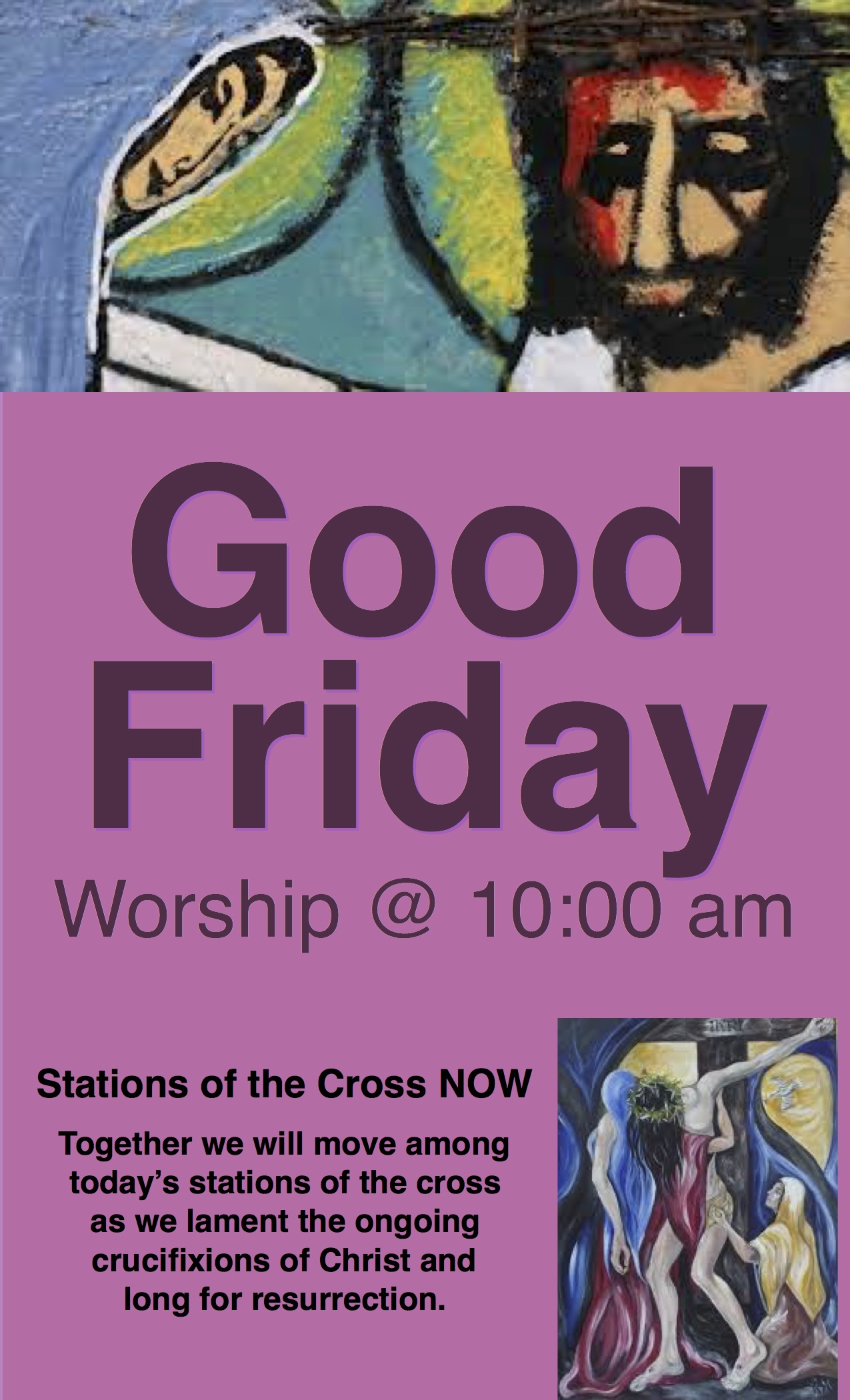
Christ is Risen! Christ is Risen Indeed! Christ is risen indeed – SO WHAT! Today, we gather to proclaim that the LOVE that we call God is more powerful than death. On Good Friday, we gathered here in this sanctuary surround by images of death. I had posted all sorts of photographic images of the kind of human failures that proclaim the power of death; images collected from the news of the day. On these walls, hung examples of human failure – graphic representations of the reality that the embodiment of LOVE, which is what we call Christ, continues to be crucified. The crucifixion did not happen once and for all when Jesus, the embodiment of the LOVE that we call God, was executed by the powers that be.
Today, over and over again, the embodiment of LOVE dies at the hands of the powers that be. The embodiment of LOVE, which is what we can the Christ, continues to be crucified each time LOVE is impoverish, starved, bombed, executed, imperiled, tortured, neglected, murdered, or forsaken, by the powers of death; powers that put selfishness, greed, indifference, and lust for power above LOVE. And so, on this Good Friday you would have seen examples of modern crucifixions in which the Earth was being ravaged and abused by our greed and indifference, animals driven out and killed by pollution and climate change, children starving in parts of the world we would prefer not to think about, First Nations people suffering without adequate housing or drinking water, homeless people neglected on our streets, war-torn ravaged villages, and a collection of modern martyrs who like Jesus, have been crucified as a result of their passion for justice. These disturbing images formed our Stations of the Cross as we lamented so many crucifixions.
After our Maundy Thursday service when we’d finished remembering Jesus’ new commandment that we love one another, I hung the evidence of the death of embodied LOVE upon these walls. One of the images, reduced me to tears. I suspect that the image that undid me, lies in each of your minds because this image was beamed all over the world.Continue reading →
Holy Week marks a sharp uptick in visitors to this blog. In comments, messages, and emails I hear from fellow preachers who, like me, are daunted by the task of preparing the Good Friday sermon. That task is even more daunting for those of us who serve progressive communities. My fellow progressive-christian-preachers tell me of the dearth of progressive-christian Good Friday sermons to be found on the internet and encourage me to re-post my own attempts to rise to the occasion. So, here are the links to some of the Good Friday sermons I have preached over the years of my journey with the progressive community that I serve. The people Holy Cross Lutheran Church have over the years provided an invigorating space for me to pursue my questions. They have also provided the resources which make this blog possible. So, if you find the work posted here of value to you and your community, please consider supporting this ministry of Holy Cross. I rarely solicit donations. But Holy Cross is a small community that continues to give to others in so many ways and your encouragement is greatly appreciated!!! (Holy Cross Lutheran Church, 1035 Wayne Dr., Newmarket, On. L3Y 1N3)
Follow the links to Good Friday sermons and feel free to use/adapt/repost
2016 I’m still working on getting my body out of the tomb in which it was laid all those years ago. – reflecting on everyday crucifixions click here
2015 Not Salvation! Solidarity and Transformation click here
I was asked by a colleague, “So, if you do not believe that Jesus died for your sins, then why bother celebrating the events of Holy Week?” Behind this question lies the assumption that the only way to understand Jesus’ death is to frame it within the context of the theology of “penal sacrificial atonement” ie “we are judged to be sinful creatures, punishment is required, God sends Jesus to pay the price for our sin”. That Anslem’s theory of sacrificial atonement was formulated in the 11th century and continues to hold sway in the minds of so many followers of Christ is a testament to the power of our liturgies and hymns to form our theology. However, Anslem’s theory is not they only faithful way to understand Jesus’ death.
When one seriously engages the question, “What kind of god would demand a blood sacrifice?” the answers often render God impotent at best and at worst cruel and vindictive. I have often said that atonement theories leave God looking like a cosmic son of #%#%# ! Progressive Christian theologians are opening up new ways of understanding the death and resurrection of Jesus that empower the faithful to see new possibilities. To my colleague, who fears that I am leading the faithful astray, and to those who find little comfort in the theories of an 11th century monastic, I the following notes, crafted in my preparation to lead Maundy Thursday worship.
Jesus said, “I give you a new commandment: Love one another. And you’re to love one another the way I have loved you. This is how all will know that you’re my disciples: that you truly love one another.” That we should love one another is not a new commandment. There have been many before Jesus and many who came after Jesus who have commanded, advised, encouraged, implored, and even begged us to, “love one another.”
What is new about Jesus commandment is that we are to love one another the way that Jesus loved us. Which begs the question: How exactly did Jesus love? I believe that Jesus loved in ways that I am only beginning to understand. I believe that Jesus was so open to the power of the LOVE that is God; that Jesus was able to live his life fully without fear. I believe that Jesus wanted more than anything else for his followers to be so open to the power of LOVE that is God so that they too would live their lives fully without fear. I believe that that’s what Jesus meant when he said, “I have come that you might have life and live it abundantly.” I believe that Jesus lived life abundantly and that means that he loved abundantly and without fear. Jesus was so open to the power of LOVE that is God that Jesus would not let the powers of darkness stop him from loving and living fully.
The kind of LOVE that Jesus embodied and taught has no boundaries. No darkness, no power, no fear, not even death can limit the power of LOVE. For if LOVE is limited by death, then love will always be qualified and quantified. That Jesus was willing to LOVE without boundaries, came at great cost to himself. But Jesus was willing to pay that price in order to show others the way. The way to LOVE without limit, without fear, without boundaries.
LOVE without boundaries is abundant life. That Jesus’ LOVE endured the worst that the world could send his way, that Jesus’ LOVE was for all the world, dead and buried, and yet bursts free from the grave, bears witness to the power of LOVE. That Jesus LOVE could not be destroyed, not even by the thing we fear the most, death itself, saves us from the need to fear death.
Jesus has shown us the way. We can live abundantly lives that are free from the fear of death. Because Jesus has shown us the way we are free to live fully, to love extravagantly and be all that we were created to be.
LOVE shines in the darkness and darkness shall not overcome LOVE.
If Jesus, life, death, and resurrection teach us anything, surely they teach us not to be afraid.
Not to be afraid of the darkness.
Not to be afraid of living fully.
Not to be afraid of loving extravagantly.
Not to be afraid of the powers of evil.
Not to be afraid of the power of death.
LOVE will endure.
All will be well.
Jesus can’t save us from life.
There is evil to contend with.
There will be darkness and there will be death.
Jesus couldn’t save himself and he cannot save us from life. Darkness and death are part of life. Each of us must walk into the darkness that lies before us. We can beg God to take the cup from us! But the darkness will still come. And there will be days when the darkness will triumph. There are good Fridays too many to mention out there. We can shout all we want for Jesus to save us, but in the end we too will have to take up our cross and find a way to follow Jesus into the darkness and beyond, trusting that even though it feels for all the world that God has forsaken us, we will make it beyond the darkness.
The cross will not look the same for each of us. But there will be crosses to bear. Jesus has showed us the way. If we are to follow Jesus, then we must love one another they way that Jesus loved. It is the way beyond the darkness. Do not be afraid of evil, of death, or of the darkness. Follow Jesus who by love frees us from the power of darkness to hold us captive to our fears so that we can have life and live it abundantly.
In the wake of a week that saw sarin gas released once again on the people of Sryria, followed by the firing of U.S. tomahawk missiles, parading around waving Palm Branches seems as foolish as it did when Jesus lead a parade into Jerusalem to face the Roman Empire on an ass. Today’s gospel picks up where the Gospel According to Matthew’s story of Jesus’ parade into Jerusalem ends, when Jesus overturns the tables of the moneychangers in the Temple – Matthew 21:12-16. Listen to the sermonhere:
Hosanna! Hosanna! Hosanna! Save us! Save us! Save us! This morning, as we shout our Hosannas to the world, the world remains entangled in a vain attempt to achieve peace through violence. The two most powerful nations on earth are leading the charge: as I speak the United States has dispatched an aircraft carrier-led strike group to the waters off the coast of North Korea, while the Russian Navy has dispatched a frigate to the Mediterranean Sea so that its cruise missiles will be in striking distance of Syria. We’ve been here so many times before; seeking peace through violence.
On Friday, according to CNN, “Raytheon, the company that makes the Tomahawk missiles used in the air strikes on Syria by the United States, saw its stocks rise. Investors seem to be betting that President Trump’s decision to retaliate against Syria after the chemical attack on Syrian citizens earlier this week may mean the Pentagon will need more Tomahawks. The US Department of Defense asked for $2 billion dollars over five years to buy 4,000 Tomahawks for the US Navy in its fiscal 2017 budget last February.
Nearly five dozen Tomahawk cruise missiles were launched at military bases in Syria from U.S. warships in the Mediterranean Sea late on Thursday. Raytheon wasn’t the only defense stock that rose sharply on Friday. Lockheed Martin which partners with Raytheon on the Javelin missile launcher system and also makes Hellfire missiles, gained nearly 1%. Defense stocks General Dynamics and Northrop Grumman also rallied Friday, a day when the broader market was flat due to a mixed US jobs report. It’s unclear whether President Trump and his Defense Secretary James Mattis will ask for a lot more money for Tomahawks once they officially submit a fiscal 2018 budget request. But Trump said in his preliminary budget blueprint last month that a brad increase in defense spending was needed. A sizable chunk of that was earmarked for upgrading warships, fighter planes and missiles. So it should come as no surprise that defense stocks are among the top performers on Wall Street not just on Friday, but for all of this year.”
What this CNN report doesn’t say, is that according to his own disclosure forms filed during the election, Trump hold a substantial amount of stock in Raytheon. Now, the cynic in me can’t help but marvel at the Commander-in-chief’s selection of Tomahawk missiles as the pathway to peace. If I only I could figure out which tables to over-turn I would lead the parade.Continue reading →
Last year our Palm Sunday worship began outside in the bright sunshine of the first morning of springtime, where we spoke of the reenactment of one of the two parades that took place in Jerusalem nearly 2000 years ago. Embracing Jesus’ political act of performance art we processed into the sanctuary waving our palm branches and shouting our hosannas. Rather than the familiar Palm Sunday readings our worship included the story from Genesis chapter 32 which tells of Jacob wrestling with God, Psalm 118, and John 12:12-15. you can read them here and listen to the sermon here
Hosanna! Hosanna! Hosanna! Save us! Save us! Save us! Once again, we travel back to Jerusalem to welcome Jesus into the city where we all know that the powers of empire will execute him. Hosanna, Hosanna, Hosanna: save us from this story that has the power to turn us into cheerleaders for an abysmal, obscene, cruel, madness that portrays the creator of everything that is, was, and ever shall be as a maniacal child killer who cannot bring himself to forgive the very ones he has created unless the most beloved of his children sacrifices himself upon a cross on a hill far away.
It happens every Palm Sunday. Over and over again, we hear atrocious interpretations of the meaning of Jesus execution that continue to distract us from the power that embodied love might have to resurrect the world in ways that will see the violence end as justice climbs out of the empty tombs into which we have tossed our dying dreams of peace. In our darkness, we have wrestled with the One who gave us light. Like Jacob of old, we too have fought, demanding a blessing from the divinity of our creation. We have wrestled in the night to find the God who will save us from ourselves. Praying for peace, longing for justice, shouting to the heavens for a blessing that will save us, save us from our hunger and greed, restore justice, and lead us forth to peace. Like Jacob, we long to know the name of our Creator, so that we will recognize our saviour when the saviour comes. Like Jacob we too have been wounded by the very sight of the face of God. For in the darkness of the night, we have wrestled our God to the ground only to discover that the blessing this God delivers, leaves us limping into the future wounded, stumbling forth with as many more questions than simply to know the name of the One whose blessing we seek. As the first light of sunrise shines on a new day, we too can but limp along injured, still seeking the One whose reluctant blessing we carry forth into an uncertain future. Hosanna, save us! Save us from our woundedness. Save us from the desires that haunt us, over power us and fracture our humanity.Continue reading →
Their baby was stillborn. Their pain was unbearable and so they asked, “Why?”
Her husband went out for his regular run; something he did every morning as part of his effort to stay healthy so that he would live long and prosper. Her husband was run over by a car and was dead by the time she arrived at the hospital. To this day she asks, “Why?”
She was raped. The pain of violation refuses to leave her even after nine long years, during which her marriage fell apart. She could not and she cannot stop asking, “Why?”
On Friday, I watched a news briefing about the massive famine that encompasses much of Africa. Yemen, South Sudan, Somalia, Nigeria, and Ethiopia are suffering from the ravages of starvation. More than 20 million people, many of them children are about to starve to death; 20 million people. It is the largest humanitarian crisis in the history of the United Nations. As I watched the horrific footage from the comfort of my living-room, all my being asked the question, “Why?”
This “Why?” was and is so much more than all the other Whys. This aching “Why?” is not the same as the other Whys. The Why that groans in me, that cries out for an answer is not: Why are babies still-born? Why do accidents happen? Why is there so much violence? Why are millions of people, so many of them children, starving to death? These whys we can seek and find answers to. The Why that groans in me, is the Why that has haunted our ancestors for generations. I’m talking about THE great big existential WHY?
Why does God allow some people to suffer while others escape suffering? There must be a reason that you and I were born. There’s got to be a reason that we were born here and not in Africa. There simply must be a reason that some of us escape suffering while others of us can’t seem to catch a break. Why? Why God? Why? Nearly two-thousand years have passed and still this great big Why screams out from the deepest darkest places of our being. Why?
When I was a child, I spoke like a child, I thought like a child, I even prayed like a child. I prayed to God to save me and mine from all sorts of suffering. I believed that God heard my prayers and that God saved me and mine. But when I grew up, I put away my childish notions as I began to see some of my dear ones suffer. I saw the suffering but I refused to see what the suffering did to my carefully held beliefs about the god I chose to worship. My faith blinded me to the idol that I had created. Out of the stories handed down to us from our ancestors I, like so many of the members of my tribe, I had carefully constructed an idol which I believed was worthy of my worship; an all-powerful, all knowing god, whose wisdom was more powerful than my reasoning; who loved me beyond measure and just as surely loved all those dying babies and suffering victims. Mine was not to reason why. Mine was but to trust and obey. The “big guy in the sky” would work it all out in the end. In the sweet by and by all would be revealed; no more blindness, no more doubt. In the meantime, all we could wonder, “Why?” as long as we didn’t let our questions draw our attention from the idol we chose to worship. Blind faith was the only answer that could keep our attention firmly at the feet of the god of our creation.
Then one day a child died; a child I knew and loved, a child who had suffered most of her short little life and I was overwhelmed by the “Why?” that screamed out from the depths of my being. I, we had put all our faith in the omni god, this omnipotent, omnipresent, omniscient god, the all-powerful, everywhere, and all knowing god that we willed into being, confident that by worshiping our idol, our precious little one would not be subjected to such suffering. When she died, the idol of my worship died with her. I was blind but now I see the folly of worshipping a god of my own making. My omni idol, had all the answers. No mystery, just reassurances. Nothing beyond my ability to imagine or conceive. Like the Pharisees before me, I could not see beyond the parameters of the Law and the traditions handed down to me. But once my eyes had been opened, my vision changed and I could no longer see the way I once saw. My WHY? Shattered my idol and my eyes were opened to a new reality. Where once I could only see death as an enemy to be conquered, the death of one so sweet, so dearly loved, revealed to me the precious beauty of life. My eyes were opened to the reality of death as a part of life, the part that makes life so very precious. It took a long time, and more questions than I can begin to recall, but slowly, I began to see the contours of a MYSTERY beyond my wildest imaginings.
There is no sin in blindness. Blindness can be a safe haven from the tremendous MYSTERY that lies at the very heart of all that IS. But there is beauty beyond the darkness. Beyond the shattered pieces of our idolatry Beyond the horizon of our limited views, there is an EMBRACE the likes of which the mystics longed for; an EMBRACE that comes from the Source of all that IS, the great I AM of which our ancestors insisted permeated all that IS. An EMBRACE that is so much more that we can ever begin to express, and yet an EMBRACE whose contours stretch beyond the heavens to permeate all of life.
This MYSTERY that some of us call God, is the LOVE that is the ground and source of all being; the RELATIONSHIP that touches every life and lures us into being more than we dreamed possible. This MYSTERY may shatter our idols, but it also compels us toward a faith that opens the eyes of the blind to possibilities that deepen life by deepening relationship in ways that broaden our vision so that we too can become all that we are created to be. This MYSTERY invites all our WHYs. This MYSTERY is powerful enough to walk with us and all our questions into the dark clouds of unknowing that make life so very precious. This MYSTERY does not demand blind faith. This MYSTERY opens our eyes to the beauty of becoming, over and over again, ONE with the MYSTERIES of LIFE.
These days, the great big WHY continues to overwhelm me and I confess that I am so very grateful to be overwhelmed because every time I am blinded by the idols of my own creation, Jesus comes along, heals my blindness, and disturbs me with visions that lead me Beyond my wildest imaginings. WHY? I do not know the answer. But I can see a way Beyond the WHYs a way that does not deny the pain or the beauty of the quest, a way that deepens and expands the beauty of the journey, a way that compels me toward the MYSTERY that is the LOVE some of us call God.
That LOVE empowers us to reach out in love to those whose whys overwhelm them; those who are grieving, those who desperately trying to recover from violence, and to do what is necessary to feed those who are starving. May your WHYs open your eyes so that you too can see BEYOND the BEYOND, and BEYOND that also, to the MYSTERY that is LOVE. Amen.
Today’s sermon includes a video clip from the short film Overview.
You can listen to the audio and watch the video clip from the “Overview” below.
I was just a little girl the first time I flew in an airplane. I can still remember just how excited I was to get on that airplane. I couldn’t wait to fly high up in the sky. I was convinced that once we got up into the clouds I would be able to see things; amazing things. I couldn’t wait to see God and Jesus, and angels, and people who had died all walking up there on the clouds. Heaven, we were going to see heaven. Jesus would be up there. I can’t remember what I was expecting them all to look like. I vaguely remember peering out of the airplane’s window desperately trying to see them all. But I could not see them.
I was too young to understand what happened to me that day. But something did. I saw things differently after that. I had seen the clouds and they were lovely, but nobody was living up there. I could see that what I thought was true was not and there was no going back. My eyes had been opened and nobody could ever convince me that heaven was up there in the sky, or that Jesus was waiting for me up there, or that God was watching me from up there, or that anybody was looking down on me from up there. I once was blind to this reality; it only took one ride on an airplane to cure my blindness. I once was blind, but up there in the sky I could see. Having seen the reality of what was actually up there, I knew enough to look elsewhere for Heaven, for lost loved ones, for Jesus, and for God. Once your eyes have been opened, the gift of vision opens you to an entirely new realty and once you’ve seen the new reality you can never go back to your old ways of thinking.
Watch the video.
It may have been simpler when we could not see; when we were blind to the reality that surrounds us. The blind man was a beggar. He knew the contours of his reality. He probably got up each morning and travelled by a familiar route to his spot on the street. He’d adapted to his reality. He learned to live in a world that was defined by his lack of vision. Having his eyes opened exposed him to a world he’d only known by touch. Suddenly a whole new sense was opened up for him. New vision can be exciting and terrifying all at the same time. But once his eyes had been opened, he could not go back, he could not un-see what he was seeing, he could only shut his eyes, or look really look and see.Continue reading →
On this St. Patrick’s Day it is fitting to receive a blessing from a grand Irishman whose writing reaches into my soul. Followers of this blog know that John O’Donohue is one of my favourite sages. I am indebted to a follower of the blog for sending me this podcast of Krista Tripett’s interview of John O’Donohue recorded shortly before his death in 2008. O’Donohue’s words continue to open my soul.
Dave Van Ronk, aka The Mayor of MacDougal Street, haunted my teen-age years with folk songs that still inhabit my soul. Some say The Mayor is the inspiration behind the movie Inside Llweyn Davis. But to me the growly voiced Mayor remains a poet who inspired me to put pen to paper. As I prepare to tickle my keyboard to create a sermon about John 4:1-42, his voice echo’s in my soul. van Ronk died in 2002 and imagining his journey “on down to Galilee, on that promenade in green” soothes the ache of his absence even as it inspires me to speculate on the rocky road the Samaritan woman travelled to that ancient well. “uka duke soda cracker!”











 pastordawn